August 5, 2026
The Chokepoint That Holds the World's Energy Ransom
Energy markets are built on assumptions of continuity. Tankers depart on schedule, cargo arrives as contracted, and the invisible infrastructure of global trade operates without interruption. When those assumptions fracture, the consequences spread far beyond the immediate incident. The Strait of Hormuz has long been the single point in the global energy system where those assumptions are most fragile, and the events of May 2026 have exposed precisely how catastrophic a fracture there can become.
The UAE accuses Iran of attacking an ADNOC oil tanker in the Strait of Hormuz, and that accusation carries weight that extends well beyond a bilateral maritime dispute. It represents a formal declaration by a sovereign state that another sovereign state has crossed a threshold, one that reshapes the diplomatic, legal, and commercial landscape of Gulf energy trade.
When big ASX news breaks, our subscribers know first
Why the Strait of Hormuz Remains Irreplaceable in Global Energy Trade
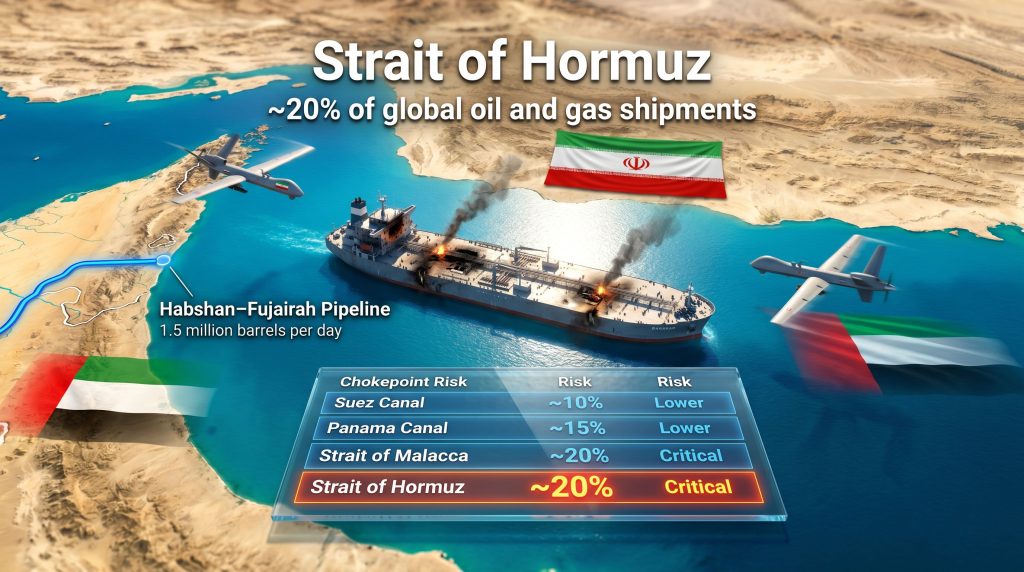
The narrow corridor separating Oman and Iran at the mouth of the Persian Gulf is, in physical terms, unremarkable. At its narrowest navigable point, vessels must pass through a channel roughly 21 miles wide, with inbound and outbound shipping lanes each extending only two miles in width, separated by a two-mile buffer zone. Yet approximately one-fifth of all global oil and gas shipments transit this single passage every year, according to Reuters reporting corroborated by the U.S. Energy Information Administration's longstanding assessments of critical maritime chokepoints.
No fully functional alternative exists. The East-West Pipeline across Saudi Arabia and the Habshan-Fujairah pipeline in the UAE provide partial relief for crude volumes, but neither has the throughput capacity to absorb total Hormuz traffic. Furthermore, circumnavigation via the Cape of Good Hope adds weeks and significant cost to journeys from the Gulf to Asian and European markets. The economic logic of Hormuz dependency is therefore structural, not incidental, and that structural dependency is precisely what makes the waterway such a potent instrument of coercion.
A Pattern Rooted in History
The current crisis is not unprecedented. During the 1980–1988 Iran-Iraq War, both nations attacked neutral commercial shipping in the Gulf in what became known as the Tanker Wars, a period in which hundreds of vessels were struck, global freight insurance markets were disrupted, and the United States ultimately deployed naval convoys to protect Kuwaiti tankers under a policy known as Operation Earnest Will. The 2019 seizure of the British-flagged Stena Impero by Iranian Revolutionary Guard forces provided a more recent preview of how Iran uses maritime access as a lever in broader geopolitical negotiations.
The 2026 escalation, however, represents a qualitative shift from both precedents. Where earlier incidents were largely opportunistic or retaliatory in character, Iran's actions since February 2026 reflect a systematic, publicly declared policy of selective maritime interdiction. Understanding these oil and geopolitics dynamics is essential for grasping why this incident carries such far-reaching consequences.
Iran's Blockade Policy: What Changed on February 18, 2026?
Following U.S. and Israeli military operations against Iranian territory, Iran moved to restrict entry and exit from the Gulf to most non-Iranian vessels from February 18, 2026 onward, as reported by Reuters. The policy operates on a de facto two-tier access framework: vessels from nations Iran designates as adversarial face interdiction or attack, while those from states Iran considers aligned or neutral are permitted passage.
This doctrine creates an immediate and fundamental conflict with international maritime law. Under Article 38 of the United Nations Convention on the Law of the Sea (UNCLOS), the right of transit passage through international straits used for international navigation cannot be suspended by any single coastal state, even during periods of heightened tension. Iran's selective blockade sits in direct contradiction to this obligation, a point explicitly invoked by the UAE in its formal diplomatic response.
The legal distinction matters practically as well as theoretically. A formal "blockade" under international law constitutes an act of war, triggering specific obligations and rights under the laws of armed conflict. Iran's preferred framing as an "access restriction" attempts to occupy a legally ambiguous space, but the operational effect on commercial shipping is identical.
The Attack on the ADNOC Tanker Barakah: Incident Profile
The vessel targeted on May 4, 2026, was the Barakah, a crude oil tanker operated by ADNOC's maritime energy logistics division. The Abu Dhabi National Oil Company is wholly owned by the Abu Dhabi government, making this an attack on a state-owned sovereign asset rather than a privately operated commercial vessel. According to Reuters, the tanker was carrying no cargo at the time of the strike, and the attack involved two confirmed drone impacts. No injuries were reported among the crew.
The United Kingdom Maritime Trade Operations (UKMTO) agency, which monitors and reports maritime security incidents across the region, confirmed the initial incident, noting that a tanker had reported being struck by unknown projectiles while positioned approximately 78 nautical miles north of UAE's Fujairah.
Why an Empty Tanker Still Constitutes a Strategic Target
The absence of cargo does not diminish the geopolitical significance of this attack. Consider the following dimensions:
-
Sovereign asset targeting: Attacking a vessel owned by a national oil company constitutes a direct challenge to the state itself, triggering formal diplomatic and potentially legal response frameworks distinct from those applicable to private shipping incidents.
-
Signalling function: Striking an empty tanker in transit demonstrates capability and intent without producing a humanitarian catastrophe that might accelerate international military intervention. It is calibrated escalation.
-
Drone warfare dynamics: Unmanned aerial systems offer Iran a low-cost, high-deniability interdiction tool. Unlike traditional naval vessels, drones are difficult to attribute definitively, relatively inexpensive to produce and deploy at scale, and capable of targeting vessels across a wide geographic zone.
-
Precedent creation: If state-owned tankers in ballast are legitimate targets, the operational risk calculus for every commercial operator routing vessels through Hormuz shifts fundamentally, affecting freight rates, insurance premiums, and shipping schedules regardless of whether their own vessels are attacked.
The UAE's Diplomatic Response and What It Signals
The UAE Foreign Ministry's formal attribution of the attack to Iranian forces represents a meaningful diplomatic escalation. Rather than routing the incident through insurance claims or maritime authority reports, the UAE chose to issue a state-level accusation. The UAE condemned the targeting of the ADNOC-affiliated tanker, characterising the strike as part of a series of unprovoked attacks and demanding Iran commit immediately to a cessation of all hostilities and the complete, unconditional reopening of the Strait of Hormuz to all vessels.
The plural framing of the UAE's statement is significant. Referencing these attacks rather than this attack positions the Barakah incident as one episode within a documented pattern, strengthening the legal and diplomatic case for collective international response. It also signals that the UAE intends to pursue accountability through multilateral frameworks rather than bilateral negotiation alone.
Diplomatic Response Mechanisms Available to the UAE
| Response Mechanism | Description | Status |
|---|---|---|
| Bilateral diplomatic protest | Formal foreign ministry statement attributing responsibility | Issued |
| UKMTO incident reporting | Maritime authority notification and advisory | Confirmed |
| GCC collective condemnation | Coordinated Gulf Cooperation Council response | Likely alignment |
| UN Security Council referral | Escalation to international body for formal consideration | Under consideration |
| UNCLOS legal invocation | Formal citation of transit passage rights violation | Formally cited |
| U.S. military coordination | Engagement with existing Gulf defence partnerships | Active |
The Zawya reporting environment confirms that the U.S. government has moved to expedite $8.6 billion in military sales to Middle East allies, bypassing standard congressional review procedures, underscoring that American strategic engagement in the region is intensifying in parallel with these maritime incidents.
Market Consequences: How Hormuz Disruption Travels Through the Global Economy
Energy markets do not require an actual supply interruption to reprice risk. The credible threat of sustained interdiction is sufficient to trigger insurance premium escalation, freight rate increases, and delivery uncertainty that compress margins across the supply chain. Crude oil price volatility is already an established concern in 2025 and 2026, and with approximately 20% of global oil and gas shipments dependent on uninterrupted Hormuz transit, the systemic exposure is enormous.
The cascading effects extend well beyond crude oil pricing. Consider the sectoral exposure:
-
Aviation: Middle East airlines recorded a 60% contraction in passenger demand during March 2026, according to Zawya reporting, functioning as a leading indicator of the broader economic disruption already underway before the Barakah incident.
-
Real estate and construction: UAE property developers have flagged potential liquidity concerns if the Iran conflict persists, according to Zawya reporting, reflecting how geopolitical risk translates into financing and sales velocity deterioration.
-
Shipping and logistics: War risk insurance premiums for Gulf transit have escalated, compressing operator margins and creating incentives for rerouting that add cost and time to global supply chains.
-
Currency markets: Zawya's latest news feed confirms that reported Iranian escalation has been directly associated with dollar strengthening, a reliable market stress indicator that reflects safe-haven capital flows triggered by energy security uncertainty.
Furthermore, the broader commodity market volatility stemming from this conflict is reverberating across multiple asset classes simultaneously, compounding the challenge for investors and businesses seeking to hedge exposure.
Comparative Maritime Chokepoint Risk
| Maritime Chokepoint | Approximate Share of Global Oil Trade | Bypass Route | Current Risk Level |
|---|---|---|---|
| Strait of Hormuz | ~20% | Limited (pipelines, Suez) | Critical |
| Strait of Malacca | ~15% | Lombok/Sunda Straits | Moderate |
| Suez Canal | ~12% | Cape of Good Hope | Elevated |
| Bab-el-Mandeb | ~9% | Cape of Good Hope | High |
| Turkish Straits | ~3% | None available | Low-Moderate |
The next major ASX story will hit our subscribers first
ADNOC's Infrastructure Position and the Limits of Hormuz Bypass
Abu Dhabi possesses one significant infrastructure asset that provides partial insulation from Hormuz dependency: the Habshan-Fujairah crude oil pipeline, which routes petroleum from onshore and offshore fields directly to the Port of Fujairah on the Gulf of Oman, entirely bypassing the Strait of Hormuz. The pipeline carries a throughput capacity of approximately 1.5 million barrels per day.
The critical limitation is that Abu Dhabi's total crude export volumes exceed this bypass capacity. A meaningful portion of ADNOC's export throughput remains Hormuz-dependent, meaning that even full utilisation of the Fujairah pipeline cannot eliminate the emirate's strategic exposure to strait closure. Full independence from Hormuz transit would require substantial additional pipeline infrastructure and terminal investment.
The fact that ADNOC continued operating vessel transits through the strait following the Barakah attack signals a deliberate policy of non-capitulation to maritime coercion. Withdrawing vessels in response to the attack would validate the interdiction strategy and effectively concede Iran's ability to regulate commercial traffic through an internationally recognised transit corridor.
Diplomatic Pathways and Conflict Trajectories
Three broad scenarios frame the medium-term outlook for the Hormuz crisis. The oil price impacts of each scenario diverge significantly, making scenario analysis essential for market participants.
Scenario A: Negotiated De-escalation
Iran accepts mediated terms, potentially facilitated through Pakistani intermediaries. Zawya reporting confirms that Iran has transmitted proposals to Washington via Pakistani mediators, indicating this channel remains active. Under this scenario, the strait reopens unconditionally, oil markets normalise within 30 to 60 days, and insurance premiums retreat. The probability driver is progress in parallel U.S.-Iran nuclear negotiations.
Scenario B: Protracted Low-Intensity Conflict
Drone attacks continue at reduced frequency, selective passage restrictions persist, and GCC economies absorb sustained uncertainty. Freight costs remain elevated, shipping operators adapt through rerouting and insurance structures, and the conflict settles into a grinding standoff without decisive resolution. This trajectory is most likely if diplomacy stalls but neither party escalates to full military confrontation.
Scenario C: Full Closure and Military Confrontation
Iran formally closes the strait to all non-Iranian vessels following renewed large-scale U.S. or Israeli strikes. This scenario would trigger an emergency International Energy Agency strategic reserve release, a significant global oil price shock, and potentially direct military engagement to reopen the waterway. Zawya reporting notes that a pivotal U.S.-Iran war deadline is approaching with no resolution in sight, making this scenario less improbable than it would have appeared six months ago.
Frequently Asked Questions
What is the Strait of Hormuz and why does it matter so much?
It is the narrow waterway connecting the Persian Gulf to the Gulf of Oman, forming the sole maritime exit for oil and gas exports from Saudi Arabia, Iraq, Kuwait, the UAE, Qatar, and Iran itself. Approximately one-fifth of all global oil and gas shipments pass through this corridor annually, making disruption there a systemic global event rather than a regional one.
Which vessel was targeted and who owns it?
The vessel was the Barakah, operated by the maritime energy logistics division of ADNOC, the Abu Dhabi National Oil Company, which is wholly state-owned by the Abu Dhabi government.
Were there casualties?
No injuries were reported. The tanker was empty of cargo at the time of the attack.
Has Iran confirmed responsibility?
As of the reporting date, Iran had not publicly acknowledged involvement. The UAE Foreign Ministry formally attributed the attack to Iranian forces in an official diplomatic statement.
Can Iran legally restrict Strait of Hormuz transit?
No. Under UNCLOS Article 38, the right of transit passage through international straits cannot be suspended by any coastal state. Iran's selective access restrictions are incompatible with this obligation under customary international law.
What is Pakistan's role in the situation?
According to Zawya reporting citing Iran's state news agency IRNA, Iran has been using Pakistani diplomatic channels to transmit proposals to Washington, positioning Pakistan as a potential mediating intermediary between the two adversarial parties.
Key Takeaways
-
The Strait of Hormuz handles roughly 20% of global oil and gas shipments, meaning any sustained disruption creates systemic exposure across energy, freight, insurance, and currency markets simultaneously.
-
Iran's selective blockade policy, in force since February 18, 2026, directly contravenes UNCLOS transit passage obligations and represents a deliberate escalation strategy rather than an incidental consequence of conflict.
-
The UAE's formal state-level accusation transforms the Barakah incident from a maritime security matter into a test of international law enforcement, multilateral accountability, and collective Gulf security architecture.
-
ADNOC's Habshan-Fujairah pipeline, with capacity of approximately 1.5 million barrels per day, provides partial but incomplete bypass capability, leaving a meaningful portion of Abu Dhabi's exports structurally exposed to continued Hormuz disruption.
-
Parallel diplomatic signals, including Pakistani mediation channels and U.S. arms transfers to regional allies totalling $8.6 billion, indicate that both escalatory and de-escalatory pathways remain simultaneously active.
-
Middle East aviation demand contracted by 60% in March 2026, and UAE real estate developers have flagged liquidity concerns, confirming that the economic damage from this conflict is already compounding across sectors. The broader geopolitical risk landscape in 2026 further compounds these pressures well beyond the energy industry itself.
This article is based on verified reporting from Reuters and Zawya as of May 4, 2026. Forward-looking scenario analysis reflects structural assessment of documented conditions and should not be construed as financial or investment advice. Geopolitical situations of this nature are inherently dynamic and outcomes may diverge materially from scenarios described.
Want to Stay Ahead of Market-Moving Resource Discoveries While Geopolitical Risk Reshapes Energy Markets?
When Hormuz disruptions send shockwaves through commodity markets, the investors best positioned are those already holding stakes in transformative mineral discoveries — and Discovery Alert's proprietary Discovery IQ model delivers real-time ASX alerts the moment those discoveries are announced, turning complex data across 30-plus commodities into a single, actionable insight. Explore how historic discoveries have generated substantial returns on Discovery Alert's dedicated discoveries page, and begin your 14-day free trial today to ensure you're never the last to know when a major opportunity emerges.