August 14, 2026
The Architecture of a Fragile Truce: Understanding the Hormuz Crisis
Few geographic features in the modern world concentrate as much systemic risk as a narrow strip of water measuring roughly 33 kilometres at its tightest navigable point. The Strait of Hormuz sits between Iran and Oman, and its vulnerability to deliberate disruption has been a known fault line in global energy security planning for decades. What is now unfolding around the U.S.-Iran ceasefire in the Strait of Hormuz is not simply a regional military standoff. It is the activation of a risk that the world's energy architecture has long acknowledged but never fully engineered around.
When big ASX news breaks, our subscribers know first
The Strait of Hormuz: A Single Point of Failure for Global Energy
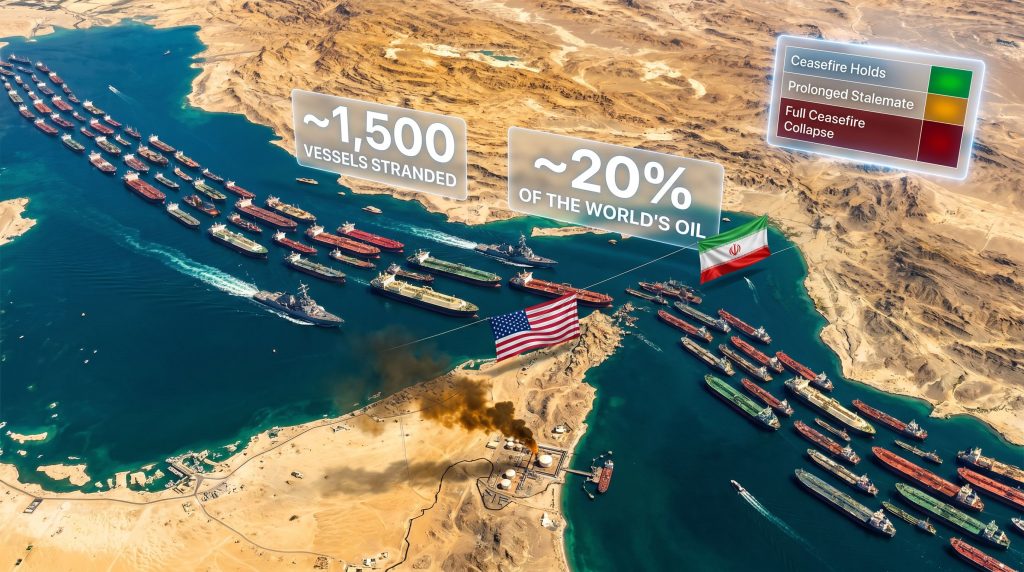
The numbers themselves explain why no policymaker can afford to treat this waterway as a peripheral concern. Approximately 20% of the world's total oil supply transits the Strait of Hormuz daily, along with a substantial share of global LNG exports, particularly those originating from Qatar and the UAE. Under normal operating conditions, roughly 100 commercial vessels pass through the strait every day, carrying crude oil, condensates, refined petroleum products, and liquefied natural gas bound primarily for Asian markets.
The strait's geography makes substitution almost impossible at scale. The only meaningful land-based bypass is Saudi Arabia's East-West pipeline, which terminates at Yanbu on the Red Sea, but its throughput capacity is a fraction of what the strait handles daily. For LNG specifically, there is no viable overland alternative at all. The LNG supply outlook for Qatar and Abu Dhabi depends entirely on Hormuz access, as their export terminals feed directly into the Persian Gulf to reach global markets.
The downstream consequences of disruption fall heaviest on Asia's import-dependent economies. Japan sources roughly 90% of its crude oil from the Middle East. South Korea and India maintain similarly high levels of Gulf dependency. China, despite diversifying its supply base in recent years, still relies heavily on Middle Eastern crude flowing through Hormuz. When transit is obstructed, these economies face feedstock shortages that ripple through refinery scheduling, industrial production, and ultimately consumer energy prices.
Historical precedent confirms how quickly Hormuz disruptions transmit into global price benchmarks. The tanker wars of the 1980s drove significant volatility in crude markets despite the world being far less tightly interconnected than it is today. More recent closure threats from Iranian leadership during U.S. sanctions pressure cycles between 2011 and 2019 consistently produced measurable spikes in Brent crude forward prices, even when no physical disruption occurred. The market's sensitivity to perceived closure risk is as significant as its response to actual disruption.
Ceasefire Architecture: What the April 7 Agreement Actually Contains
The U.S.-Iran ceasefire established on April 7, 2026, followed approximately six weeks of active military conflict that had effectively shut down commercial shipping through the strait. The agreement's core provisions reflect the irreconcilable starting positions of both parties, which is precisely what makes it structurally unstable.
From the U.S. perspective, the fundamental non-negotiable was the restoration of free and unobstructed commercial passage through the Strait of Hormuz. American negotiating objectives also included a prohibition on further uranium enrichment activity, a condition embedded within the truce framework rather than agreed to as a standalone nuclear deal. Pakistan served as the facilitating intermediary, providing a diplomatic channel that neither party was willing to construct bilaterally.
From Iran's perspective, the ceasefire delivered a halt to U.S. and allied strikes on Iranian territory while preserving what Tehran describes as its right to conduct defensive operations within the strait. Iranian military command has since insisted that commercial vessels cannot transit without coordination with Iranian forces, effectively claiming a supervisory role over passage that the ceasefire text does not appear to formally grant.
A ceasefire without a shared operational definition of compliance does not resolve a conflict. It pauses the highest-intensity phase while both parties contest the meaning of every subsequent event in the space between full war and full peace.
This definitional ambiguity is not incidental. It reflects the negotiating outcome when neither side achieves its core objectives fully. The U.S. wanted unconditional passage; Iran wanted sovereign acknowledgment of its role in controlling strait access. The resulting language satisfies neither demand and leaves every subsequent incident subject to competing interpretations. Furthermore, the oil market impacts of this ambiguity continue to compound as the standoff persists.
Project Freedom: The Operational Reality Behind the Naval Escort Mission
The U.S. Navy's commercial vessel escort operation, operating under the designation Project Freedom, represents Washington's attempt to demonstrate that passage is achievable without Iranian consent. The architecture of the operation involves two destroyers providing active escort, supported by a layered defensive posture that includes drone interception systems, missile defence capabilities, and countermeasures against the small-boat swarm tactics that Iranian forces have previously employed in the Gulf.
Defense Secretary Pete Hegseth has described the operation as maintaining continuous air defence coverage over escorted convoys. Joint Chiefs Chairman Dan Caine confirmed at the Pentagon that the ceasefire remains technically intact despite the ongoing attacks, framing recent Iranian actions as not constituting a formal breach of the truce. According to Reuters, the truce remains in doubt as both sides contest control of the strait.
By May 4, 2026, two merchant vessels had successfully transited the strait under U.S. naval protection. The operational significance of those transits is real. The scale problem, however, is severe.
| Metric | Figure |
|---|---|
| Vessels stranded in Persian Gulf | ~1,500 |
| Seafarers affected | ~22,000 |
| Normal daily transit volume | ~100 vessels/day |
| Vessels escorted under Project Freedom (as of May 4) | 2 |
| Iranian attacks on U.S. forces post-ceasefire | 10+ |
The arithmetic is unambiguous. With approximately 1,500 vessels backed up in the Persian Gulf and normal throughput running at around 100 transits per day, restoring normal shipping flow requires sustained, high-volume operations over an extended period. The current escort capacity addresses the proof-of-concept requirement but does not come close to resolving the backlog.
There is also a structural constraint that no escort mission can fully resolve. Iran has stated publicly that transit requires coordination with Iranian forces. Even if U.S. naval escorts successfully protect individual convoys, the broader commercial shipping market operates on insurance assessments, flag state advisories, and risk calculations that extend well beyond the protection window of any single naval operation.
The May 4 Escalation: What the Fujairah Strike Changes
The attack sequence on May 4, 2026 represented a qualitative shift in the conflict's parameters. Iranian forces deployed a coordinated combination of missiles, drones, and small-boat swarms against U.S.-escorted convoys. A South Korean bulk carrier was struck, as was a tanker with operational ties to Abu Dhabi National Oil Company. UAE air defence systems intercepted more than a dozen Iranian missiles during the engagement.
Most significantly, an Iranian drone struck the Fujairah Oil Industry Zone, causing a fire and injuring oil infrastructure personnel. No fatalities were confirmed in that strike. The strategic implications, however, extend far beyond the physical damage. Consequently, the geopolitical oil price drivers at play here are more complex than in any recent precedent.
Fujairah occupies a unique position in regional energy infrastructure. Located on the UAE's eastern coast, outside the Persian Gulf and technically beyond the strait itself, it serves as a critical bunkering hub, oil storage facility, and product re-export point. Its location was historically considered an advantage precisely because it offered a degree of geographic insulation from Gulf-based disruptions. Iranian targeting of Fujairah signals a deliberate decision to expand the conflict's geographic footprint beyond the strait corridor.
The targeting of Fujairah is not incidental. It represents a calculated signal that Iran's operational reach extends to infrastructure that energy markets had previously treated as insulated from the strait's risk premium.
This matters for energy market pricing in ways that go beyond crude oil flows. Fujairah is a significant node in the global ship-bunkering supply chain. Disruption to its operations affects not just Middle Eastern oil exports but the operational economics of global shipping more broadly.
Strategic Interest Asymmetry: Why Neither Side Wants Full Resolution
Understanding why the U.S.-Iran ceasefire in the Strait of Hormuz remains so fragile requires examining what each party actually gains from the current state of managed tension, as distinct from either full resolution or full conflict resumption.
U.S. strategic objectives in the current posture include:
- Maintaining credible deterrence against Iranian nuclear programme advancement without requiring active military operations
- Demonstrating to regional allies that U.S. naval power can provide meaningful protection for commercial shipping
- Managing the War Powers Act clock, with the Trump administration maintaining that U.S. military objectives have been substantially met
- Avoiding the domestic and diplomatic costs of resuming full-scale military operations
Iranian strategic objectives reflect a different calculus:
- Using strait access as a negotiating instrument to extract sanctions relief and nuclear programme concessions
- Signalling to domestic and regional audiences that Iran can impose costs on the United States and its allies
- Avoiding the destruction of Iranian military and economic infrastructure through full conflict resumption
- Preserving the ambiguity of the ceasefire terms as a space in which to conduct low-level operations without triggering a formal U.S. response
The structural asymmetry is important. Iran can impose meaningful costs on global energy markets through actions that fall below the threshold the U.S. has defined as a formal ceasefire breach. This creates a zone of operational freedom for Iranian forces that the ceasefire, as currently interpreted by Washington, effectively tolerates.
The next major ASX story will hit our subscribers first
How Oil Markets Are Pricing the Uncertainty
The oil market's response to the evolving Hormuz situation reflects a tension between the known severity of the disruption and the uncertain duration of its resolution timeline. The initial price surge on renewed May 4 escalation, followed by a partial retreat, is consistent with how futures markets handle geopolitical risk when the outcome distribution is genuinely wide. In addition, WTI and Brent futures are exhibiting elevated volatility premiums not seen since the most acute phase of the 2022 energy crisis.
| Scenario | Trigger Condition | Estimated Market Impact |
|---|---|---|
| Ceasefire Holds, Strait Gradually Reopens | Successful mass transit under Project Freedom; Iranian compliance | Moderate price retreat; normalisation of war risk premiums |
| Prolonged Stalemate | Continued low-level attacks; backlog persists; no mass transit achieved | Sustained elevated prices; progressive insurance market tightening |
| Full Ceasefire Collapse | Iranian resumption of comprehensive blockade; U.S. military re-engagement | Severe price spike; acute supply shock to Asian importers |
Beyond crude oil benchmarks, the insurance market is transmitting its own signal. War risk premiums for Persian Gulf routing have escalated substantially, and vessel operators are weighing the economics of Cape of Good Hope diversions despite the significant additional voyage time and fuel costs involved. For very large crude carriers, a diversion around Africa adds approximately two weeks to transit time and meaningfully increases per-barrel delivered cost for Asian buyers.
Asian spot LNG prices carry an additional exposure layer. Qatar is the world's largest LNG exporter by volume, and virtually all of its output transits the Strait of Hormuz. Any sustained disruption to Qatari LNG flows creates acute spot market tightness for Japanese, South Korean, and Chinese buyers who depend on flexible LNG supply to manage seasonal demand variability. This ongoing oil price shock is already reshaping how energy executives approach procurement strategy and supply chain resilience.
Key Risk Indicators: What to Watch in the Coming Days
The durability of the current ceasefire will likely be determined by a small number of observable variables over the next several days and weeks:
- Volume of commercial transits under Project Freedom — Whether escort operations scale from two vessels to dozens will determine whether the backlog begins to clear or continues to compound
- Iran's return to Pakistan-facilitated negotiations — Iranian absence from recent negotiating rounds represents a concerning signal about Tehran's near-term diplomatic intentions
- UAE formal attribution of the Fujairah strike — If Abu Dhabi formally attributes the attack and demands a response, the conflict gains a new active party with its own military capabilities and alliance commitments
- U.S. congressional pressure on War Powers posture — The Trump administration's claim that military objectives have been achieved may face legal and political challenge if attacks on U.S. forces continue
- Escalation signals from Iranian military command — Statements from Iranian military leadership have moved significantly further toward confrontational framing than the diplomatic channel suggests
The tension between Trump administration rhetoric and the simultaneous characterisation of the ceasefire as intact creates a credibility problem that constrains both escalation and de-escalation options.
The Deeper Structural Lesson: Energy Security Architecture and Its Blind Spots
The current crisis exposes a fundamental weakness in how energy security has been conceptualised and planned for over the past several decades. Strategic petroleum reserves were designed to buffer short-duration supply shocks measured in days or weeks. A sustained Hormuz disruption operating over months creates a categorically different challenge that reserve drawdowns cannot adequately address.
The inadequacy is compounded by the concentration problem. Decades of energy trade infrastructure investment flowed toward maximising efficiency through the strait rather than building redundancy around it. The East-West pipeline bypass, ADNOC's Habshan-Fujairah pipeline, and the limited existing infrastructure for large-scale overland oil transit all reflect an architecture built around the assumption that the strait would remain open most of the time.
For Asian importers, the strategic implication is significant. The crisis may accelerate the timeline for infrastructure investments in alternative routing, emergency storage expansion, and supply diversification away from exclusive Gulf dependency. These are long-cycle investments measured in years, not responses to the immediate crisis. However, the political and commercial calculus for making them has shifted materially as a result of what is currently unfolding.
The Gulf Cooperation Council states face their own navigation challenge. The Fujairah strike places UAE in an acutely uncomfortable position between its U.S. alliance commitments and its physical proximity to Iranian military reach. As NBC News reports, shipping firms are already being warned of sanctions over paying Iranian tolls, adding yet another layer of commercial and diplomatic complexity to an already fraught situation.
Disclaimer: This article contains forward-looking analysis, scenario projections, and market commentary based on available information as of the date of publication. Oil price scenarios and geopolitical outcomes involve significant uncertainty. Nothing in this article constitutes financial, investment, or trading advice. Readers should consult qualified financial and geopolitical advisors before making investment decisions related to energy markets or related securities.
Frequently Asked Questions: U.S.-Iran Ceasefire and the Strait of Hormuz
What percentage of global oil passes through the Strait of Hormuz?
Approximately 20% of global oil supply transits the Strait of Hormuz daily, making it the single most consequential maritime chokepoint in the world energy system. No alternative route exists at comparable scale or cost.
When was the U.S.-Iran ceasefire established?
The ceasefire was established on April 7, 2026, following roughly six weeks of active military conflict that had effectively shut down commercial shipping through the strait.
What is Project Freedom?
Project Freedom is a U.S. naval escort operation deploying destroyers and layered air defence capabilities to shepherd stranded commercial vessels through the Strait of Hormuz. As of May 4, 2026, two vessels had successfully transited under its protection.
How many vessels are stranded in the Persian Gulf?
As of early May 2026, approximately 1,500 commercial vessels carrying around 22,000 seafarers remain unable to transit the strait due to the ongoing conflict and associated shipping disruption.
Has Iran violated the ceasefire?
The U.S. Department of Defense, including Joint Chiefs Chairman Dan Caine and Defence Secretary Pete Hegseth, has maintained that the U.S.-Iran ceasefire in the Strait of Hormuz remains intact despite more than 10 documented Iranian attacks on U.S. naval assets and escorted vessels since April 7. The threshold for what constitutes a formal breach remains contested between the parties.
What happened at Fujairah during the May 4 escalation?
An Iranian drone strike ignited a fire at the Fujairah Oil Industry Zone in the UAE, marking Iran's first confirmed direct strike on UAE territory since the ceasefire was established. UAE air defences intercepted more than a dozen Iranian missiles during the same engagement sequence. Injuries were reported among oil infrastructure personnel, with no confirmed fatalities.
Want To Track The Next Major Discovery Before The Market Moves?
With geopolitical risk reshaping global energy flows and commodity markets facing sustained volatility, Discovery Alert's proprietary Discovery IQ model delivers real-time ASX mineral discovery alerts — instantly identifying actionable opportunities across the resources sector before the broader market reacts. Explore how historic discoveries have generated exceptional returns and begin your 14-day free trial at Discovery Alert to position yourself ahead of the market.