August 7, 2026
The Waterway That Holds the World's Energy System Hostage
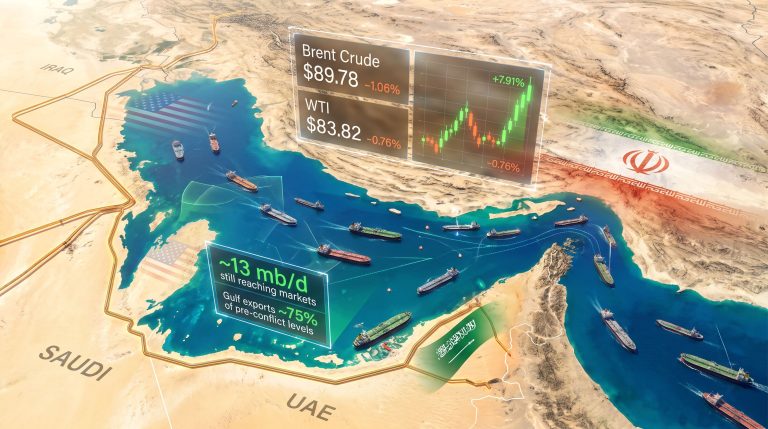
Every major disruption to global energy supply in the modern era traces back, in some way, to a handful of geographic bottlenecks. The Strait of Malacca, the Suez Canal, the Bab el-Mandeb — each has been a flashpoint at various moments in history. But none carries the concentrated economic weight of the Strait of Hormuz, the narrow passage connecting the Persian Gulf to the Indian Ocean. Iran's control of Strait of Hormuz shipping has now moved from theoretical concern to operational reality, with roughly 20% of the world's entire oil supply flowing through this corridor under normal conditions.
What makes this waterway categorically different from other strategic chokepoints is the absence of meaningful alternatives for the nations that depend on it most. Iraq, Kuwait, the United Arab Emirates, Qatar, and Iran itself have no other viable maritime export route. When the strait closes, their oil and gas stays landlocked. Consequently, when their oil and gas stays landlocked, global markets feel the consequences within days — not weeks.
That scenario, long theorised and periodically threatened over decades of geopolitical tension, is no longer hypothetical. As of early May 2026, the Strait of Hormuz is effectively closed to standard commercial transit for the first time in its modern history, and the mechanism Iran has used to formalise that closure represents something genuinely unprecedented in international maritime affairs.
When big ASX news breaks, our subscribers know first
Understanding the Geography and Military Architecture of the Strait
The strait itself is deceptively narrow. At its tightest navigable point, the channel spans approximately 33 kilometres, with inbound and outbound shipping lanes each running just a few kilometres wide through Omani territorial waters. Oman's Musandam Peninsula forms the southern boundary, while Iran's coastline defines the northern edge.
This geographic configuration gives Iran a structural advantage that has shaped the strait's geopolitical character for generations. Iran controls a cluster of strategically positioned islands in the waterway — including Abu Musa and the Greater and Lesser Tunbs — which provide elevated surveillance and interdiction capability over vessel movements throughout the channel. These positions are not merely symbolic territorial claims. They host radar installations, fast-attack boat staging areas, and shore-based missile systems operated by the Islamic Revolutionary Guard Corps Navy (IRGCN).
The IRGCN's operational toolkit is worth understanding in detail, because it explains why the strait is genuinely difficult to force open through conventional military means:
- Fast-attack craft (FACs): Small, highly manoeuvrable vessels capable of swarming larger ships and commercial tankers
- Submarine assets: Midget and conventional submarines capable of mining operations and covert interdiction
- Anti-ship missile systems: Shore-based platforms with ranges covering the entire width of the strait
- Drone capabilities: Aerial surveillance and potential strike platforms
Under normal conditions, approximately 17 to 21 million barrels of crude oil transit the strait daily, alongside significant volumes of liquefied natural gas (LNG), petrochemicals, fertilisers, and bulk industrial cargo. The disruption of this flow does not simply affect energy markets in isolation — it cascades into agricultural input costs, manufacturing supply chains, and transport economics across dozens of import-dependent nations.
Iran's Persian Gulf Strait Authority: What It Is and How It Functions
On or around May 4 to 7, 2026, Iran formally established the Persian Gulf Strait Authority (PGSA), a newly created government agency tasked with evaluating, approving, and taxing commercial vessel passage through the Strait of Hormuz. Shipping data firm Lloyd's List Intelligence confirmed the agency's existence after receiving direct communication from the PGSA, including an application form distributed to international shipping companies seeking transit authorisation.
The PGSA is not, strictly speaking, an entirely new operational concept. It formalises and institutionalises what had previously been an informal vetting arrangement conducted through IRGC-controlled shipping lanes along the strait's northern waters near the Iranian coastline. The difference is significant: whereas the previous arrangement operated with deliberate opacity, the PGSA gives Iran's transit control a bureaucratic structure, a named institution, and an explicit claim to legal authority.
According to Lloyd's List Intelligence, the agency has positioned itself as the sole legitimate authority over transit through the waterway — a claim that maritime law experts describe as a direct violation of binding international convention. Furthermore, the 2026 Strait of Hormuz crisis has drawn widespread condemnation from Western governments and shipping industry bodies alike.
What Vessels Must Submit to the PGSA
Ships seeking passage are required to submit a comprehensive Vessel Information Declaration covering the following categories:
| Requirement Category | Details Required |
|---|---|
| Vessel Identity | Name, flag state, IMO number, ownership structure |
| Cargo Declaration | Type, volume, origin, destination, end-user |
| Crew Information | Nationalities, certifications, crew manifest |
| Insurance Documentation | P&I club details, hull and cargo coverage |
| Operational Purpose | Commercial, humanitarian, or government-linked |
The depth of information demanded across these categories is notable. Cargo end-user disclosure, for instance, allows Iran to screen shipments destined for sanctioned entities or politically unfriendly nations. Ownership structure disclosure enables identification of vessels connected to US, Israeli, or other adversarial commercial interests. In practice, the declaration form functions as both a revenue mechanism and an intelligence-gathering instrument.
Vessels that comply with PGSA requirements are offered maritime, technical, and medical support through Iran's Ports and Maritime Organisation. Those that do not comply face the prospect of interception by IRGC naval units. Iranian state broadcaster IRIB characterised the situation as commercial shipping waiting for Iran's authorisation, with traffic restricted to IRGC-designated corridors near Iranian island territories.
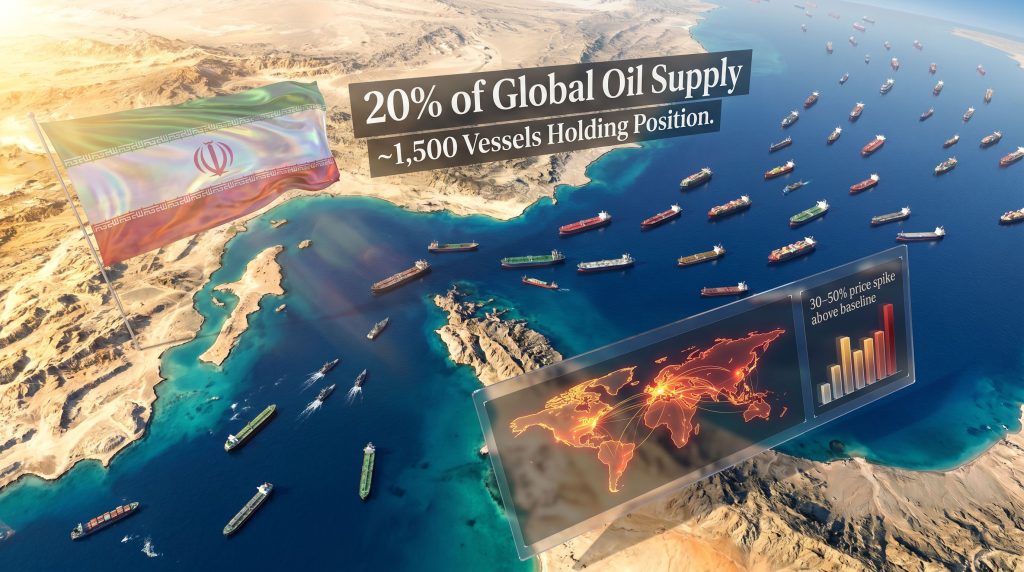
As of May 7, 2026, Lloyd's List Intelligence confirmed that zero transits had been recorded through the strait. Approximately 1,500 commercial vessels were reported to be anchored or holding position within the Persian Gulf, unable to reach open waters.
The Conflict That Produced This Crisis: A Chronological Framework
The current closure did not emerge from a single policy decision. It is the product of a rapidly escalating military and diplomatic confrontation that began with coordinated US and Israeli strikes on Iranian targets on February 28, 2026 — a date that now marks the opening of the most severe disruption to Persian Gulf shipping in the modern era.
The sequence of events that followed illustrates how quickly geopolitical escalation translates into maritime crisis:
| Date | Event |
|---|---|
| February 28, 2026 | US and Israeli forces launch coordinated strikes against Iran, initiating open conflict |
| Early March 2026 | Iran retaliates with mining operations and vessel interceptions in the strait |
| April 8, 2026 | A fragile ceasefire between the US and Iran takes effect |
| Late April 2026 | Pakistan-hosted in-person peace talks collapse without agreement |
| Early May 2026 | US launches "Project Freedom" — a military-escorted transit corridor |
| May 6–7, 2026 | Project Freedom suspended after two days; two US-flagged merchant ships complete the route; six Iranian fast-attack boats reported sunk |
| May 4–7, 2026 | PGSA formally established; effective closure of strait to commercial transit |
| May 8, 2026 | Iran confirms it is reviewing US peace proposals mediated by Pakistan |
The Project Freedom Episode and What It Revealed
The Trump administration's attempt to force a military-escorted commercial shipping corridor through the strait lasted fewer than 48 hours before being suspended. The stated rationale was creating diplomatic space for a negotiated resolution, but the operational outcome exposed several hard constraints on US strategy.
Only two American-flagged merchant ships are confirmed to have transited the US-guarded route during the entire operation. The US military reported sinking six Iranian fast-attack boats during the corridor's brief operational window. The operation was then halted. In addition, Project Freedom's ambitious scope — originally intended to escort thousands of commercial vessels — was severely curtailed by the realities on the ground.
Critically, Saudi Arabia publicly distanced itself from the initiative. A senior Saudi official confirmed that the kingdom informed Washington it would not support the effort and that US forces could not use Saudi territory or bases for operations related to reopening the strait. Saudi Arabia also communicated directly with Iran that it would not participate in any US military action connected to the corridor operation. Notably, Saudi Arabia had not been consulted before the initiative was launched.
The Project Freedom episode revealed three structural limitations simultaneously: insufficient commercial shipping willingness to transit even under military protection, Iranian military capability sufficient to threaten and deter operations, and allied non-cooperation that narrowed Washington's strategic options considerably.
Iran's Control of the Strait of Hormuz: The Legal Dimension
The question of whether Iran has the legal authority to impose the PGSA's permit and toll regime on commercial shipping has a relatively clear answer under international law — though enforcement of that answer is a separate and more complicated matter.
The governing legal framework is the United Nations Convention on the Law of the Sea (UNCLOS), which establishes the doctrine of "transit passage" for international straits. Under this doctrine, all vessels enjoy the right of continuous and expeditious transit through straits used for international navigation — a right that coastal states are explicitly prohibited from suspending, conditioning, or taxing, even within their own territorial waters.
The Strait of Hormuz qualifies as an international strait used for international navigation under UNCLOS, which triggers transit passage rights for all vessels regardless of flag state or cargo type. Transit passage rights are structurally stronger than "innocent passage" rights that apply in normal territorial waters — they cannot be suspended under any circumstances by the bordering coastal state.
Iran's PGSA framework — which requires permit applications, cargo declarations, crew manifests, and toll payments — directly contradicts this framework. Maritime law experts have characterised the PGSA's operational structure as a violation of binding international law. However, Iran's control of Strait of Hormuz shipping has been further complicated by the broader geopolitical mining landscape, which has seen Iran assert dominance across multiple fronts simultaneously.
The UN Security Council Deadlock
The United States and Gulf allies have sought a UN Security Council resolution condemning Iran's chokehold on the strait and authorising sanctions. That effort has been blocked by Russia and China, both of which vetoed a prior resolution calling for the strait's reopening.
This veto dynamic is not incidental. Russia and China's diplomatic cover for Tehran effectively shields Iran from multilateral enforcement mechanisms and extends the timeline for any resolution that depends on international institutional pressure. It also reveals a broader pattern: the Strait of Hormuz crisis is simultaneously a regional conflict and a front in a wider contest over the rules-based international order.
The Economic Consequences of a Closed Strait of Hormuz
Quantifying the economic impact of a sustained Strait of Hormuz closure requires understanding not just the energy market dynamics but the full cascade of dependencies that run downstream from petroleum supply disruption.
Historical analysis of prior supply disruptions suggests that sustained closures of the Strait of Hormuz lasting 30 to 60 days correlate with crude price spikes of 30 to 50% above baseline, depending on the scale of strategic reserve deployment and the availability of alternative routing capacity.
The current situation involves compounding factors that make simple historical comparisons inadequate. Both the strait closure and a US blockade on Iranian ports are operating simultaneously, creating a mutual siege dynamic with no direct historical parallel. Furthermore, the broader oil market volatility generated by this standoff has reverberated through futures markets and corporate hedging strategies globally.
Beyond Oil: The Supply Chain Cascade
The consequences extend well beyond crude oil prices. The following sectors face compounding disruption:
- LNG supply: Europe's transition away from Russian gas has increased dependency on Middle Eastern LNG. Disruptions to global LNG supply have placed South and Southeast Asian economies with limited alternative supply sources under acute shortages
- Fertiliser markets: Gulf-origin fertiliser shipments face indefinite delays, raising food security concerns in import-dependent nations across Africa and Asia
- Petrochemical feedstocks: Industrial gases and chemical raw materials routed through the Gulf are accumulating in a queue of approximately 1,500 stranded vessels
- Insurance markets: Persian Gulf routing premiums have escalated dramatically, with some underwriters suspending coverage for the region entirely
- Crew welfare: The humanitarian dimension of 1,500 vessels with crews unable to transit has attracted attention from international maritime organisations
Comparative Routing Scenarios
| Route Option | Additional Transit Time | Cost Premium | Viability at Scale |
|---|---|---|---|
| Strait of Hormuz (normal) | Baseline | Baseline | Full capacity |
| Cape of Good Hope diversion | +15 to 20 days | +25 to 40% per voyage | Partial, limited by fleet availability |
| Suez Canal (from Gulf) | Not applicable without Hormuz exit | N/A | Blocked by same closure |
| Overland pipeline alternatives | Varies by origin | High capital cost | Limited to specific producers |
The Cape of Good Hope diversion adds substantial time and cost but remains the primary practical alternative for vessels not willing to wait for strait reopening. The key constraint is fleet availability: diverting significant volumes to the longer route requires more vessels to maintain equivalent delivery frequency, creating bottlenecks in global shipping capacity.
The next major ASX story will hit our subscribers first
The Key Actors and Their Strategic Calculations
Iran's Institutional Strategy
The PGSA serves multiple Iranian objectives simultaneously. Revenue generation through transit tolls provides a financial return from the closure itself. Formal assertion of sovereign authority over the waterway advances a long-standing Iranian position that its role in managing the strait should be recognised institutionally.
Most significantly, control over commercial transit creates leverage in peace negotiations — the authority to reopen the strait is directly tied to the terms Iran can extract from a settlement. Iran's control of Strait of Hormuz shipping is, in this sense, as much a diplomatic instrument as a military one. The oil price shock reverberating through global markets has only amplified Tehran's negotiating position.
Supreme Leader Mojtaba Khamenei, who assumed the role after his father Ayatollah Ali Khamenei was killed during the conflict's opening strikes, has reportedly been playing a central role in overseeing negotiation strategy whilst remaining in an undisclosed location following injuries sustained early in the war. Iranian President Masoud Pezeshkian described a meeting of more than two hours with Khamenei as demonstrating sincere engagement, signalling internal leadership cohesion on the negotiating position.
Pakistan: The Indispensable Intermediary
Pakistan has emerged as the primary diplomatic channel between Washington and Tehran. Pakistani Foreign Minister Ishaq Dar held direct phone consultations with Iranian Foreign Minister Abbas Araghchi on May 8, 2026. Pakistani Prime Minister Shehbaz Sharif described Islamabad as maintaining continuous contact with both Iran and the United States around the clock to extend the ceasefire and advance a settlement.
Pakistani Foreign Ministry spokesperson Tahir Andrabi stated that an agreement was expected sooner rather than later, though no specific timeline was offered. Pakistan's mediation role reflects its unique positioning as a nuclear-armed state with deep ties to both the Islamic world and Western security frameworks — a combination that makes it credible to both sides.
Saudi Arabia's Calculated Distance
Riyadh's refusal to support Project Freedom or permit US military use of Saudi territory represents one of the most consequential constraints on American strategic options. Saudi Arabia's direct communication to Iran — assuring Tehran of non-participation in US military action — is a striking departure from conventional alliance behaviour.
The incentive structure explaining Saudi positioning is complex. Saudi Arabia's own export infrastructure depends on the strait's eventual reopening, creating pressure to seek negotiated resolution rather than military escalation. At the same time, being seen as actively supporting US military operations against a neighbouring Islamic nation carries domestic and regional political costs that Riyadh has calculated are not worth absorbing.
Russia and China: Strategic Patience as a Tool
Both nations have leveraged their Security Council veto power to shield Iran from multilateral pressure. Their continued diplomatic cover extends the negotiating timeline and constrains Western enforcement options. China, as the world's largest oil importer and a significant recipient of Iranian crude, faces its own economic pressures from the strait closure — but also benefits from the competitive disadvantage the crisis imposes on Western economies dependent on Gulf energy.
Resolution Scenarios: What a Settlement Would Actually Require
Core Demands on Each Side
The gap between US and Iranian negotiating positions explains why Pakistan-mediated talks in late April 2026 failed to produce agreement:
US position:
- Resumption of oil and natural gas shipments
- Dismantling of Iranian mining operations in the waterway
- Removal of PGSA toll and permit requirements
- Verifiable ceasefire compliance
Iranian position:
- Recognition of Iranian rights over the strait
- Removal of the US blockade on Iranian ports
- Security guarantees against further strikes
- Sanctions relief
Three Plausible Scenarios
Scenario A — Negotiated Framework (Most Likely Near-Term)
A phased reopening agreement tied to ceasefire verification and partial sanctions relief. PGSA operations suspended or converted into a nominal administrative body with no enforcement authority. An international monitoring mechanism established under a neutral third party such as Pakistan or an Omani-brokered arrangement.
Scenario B — Prolonged Stalemate (Base Case If Talks Fail)
Sustained closure with gradual diversion of global shipping to alternative routes. Continued energy price elevation and accelerating investment in non-Gulf supply alternatives. Incremental erosion of Iran's economic position through compounding sanctions pressure.
Scenario C — Renewed Military Escalation (Tail Risk)
Breakdown of the ceasefire following an incident — drone attack, tanker seizure, or miscalculation. US resumption of strikes on Iranian military and nuclear infrastructure. Potential for regional escalation involving proxy forces across multiple theatres.
How the 2026 Crisis Differs from Every Prior Hormuz Threat
| Year | Trigger | Iran's Action | Outcome |
|---|---|---|---|
| 1984–1988 | Iran-Iraq War (Tanker War) | Attacks on neutral shipping | International naval escorts; partial disruption |
| 2012 | Western sanctions over nuclear programme | Threatened closure; naval exercises | No closure; oil prices spiked approximately 15% |
| 2019 | US maximum pressure campaign | Tanker seizures; drone attacks | Heightened tensions; no formal closure |
| 2026 | US-Israeli military strikes | Formal closure via PGSA; mining | Ongoing; most severe disruption in modern history |
The 2026 crisis is structurally distinct from all prior episodes across multiple dimensions. Previous Hormuz confrontations involved threats, demonstrations of capability, or limited tactical actions. The current situation involves an active armed conflict, a formally institutionalised transit control mechanism with bureaucratic infrastructure, physical mining of the waterway, and a mutual blockade dynamic in which the US is simultaneously restricting Iranian port access.
No historical precedent provides a direct template for resolution, which explains both the diplomatic complexity and the oil market disruptions that the crisis continues to generate across global energy markets.
Frequently Asked Questions
Can Iran Legally Close the Strait of Hormuz?
Under UNCLOS, Iran cannot legally suspend, tax, or condition transit passage through the Strait of Hormuz. The waterway qualifies as an international strait used for international navigation, granting all vessels transit passage rights that coastal states are prohibited from restricting under any circumstances. The PGSA's permit and toll framework is widely regarded by maritime law experts as a violation of binding international law.
How Many Ships Are Currently Stranded in the Persian Gulf?
As of May 7 to 8, 2026, approximately 1,500 commercial vessels are reported to be holding position within the Persian Gulf, unable to transit to open waters due to the effective closure of the strait.
What Is the Persian Gulf Strait Authority?
The Persian Gulf Strait Authority (PGSA) is a newly established Iranian government agency that requires commercial vessels to submit detailed permit applications covering cargo type, crew composition, ownership structure, and insurance details before being granted transit authorisation through the Strait of Hormuz. It also imposes tolls on approved passages and operates through IRGC-designated shipping lanes.
What Was Project Freedom?
Project Freedom was a short-lived US military initiative to escort commercial vessels through the Strait of Hormuz under armed protection. It was suspended after approximately two days of operation, during which only two American-flagged merchant ships completed the passage and the US military reported sinking six Iranian fast-attack vessels.
What Role Is Pakistan Playing?
Pakistan is serving as the primary diplomatic intermediary between the United States and Iran, facilitating message exchanges and hosting direct talks. Pakistani officials have expressed optimism about reaching an agreement but have declined to specify a timeline for any resolution.
What Happens to Global Oil Prices If the Strait Remains Closed?
A sustained closure carries significant upward pressure on crude prices given the waterway's role in carrying approximately 20% of global oil supply. Historical disruption episodes suggest price spikes of 30 to 50% above baseline during extended closures, though strategic reserve releases and demand destruction can moderate the impact over time. The simultaneous US port blockade on Iran adds further complexity to any market forecast.
Disclaimer: This article contains forward-looking assessments, scenario projections, and market analysis based on information available as of May 8, 2026. Geopolitical situations of this nature are subject to rapid and unpredictable change. Nothing in this article constitutes financial, investment, or legal advice. Readers should consult qualified professionals before making decisions based on any information contained herein.
Want to Stay Ahead of the Market Opportunities Created by Global Energy Disruptions?
The ongoing Strait of Hormuz crisis is reshaping commodity markets in real time, creating significant volatility across energy, mining, and resource sectors — and Discovery Alert's proprietary Discovery IQ model instantly identifies significant ASX mineral discoveries and actionable opportunities as they emerge, ensuring subscribers are positioned ahead of the broader market. Explore how historic mineral discoveries have generated substantial returns and begin your 14-day free trial at Discovery Alert today to secure a market-leading edge.