June 21, 2026
When Rhetoric Becomes Reality: Decoding the Hormuz Standoff
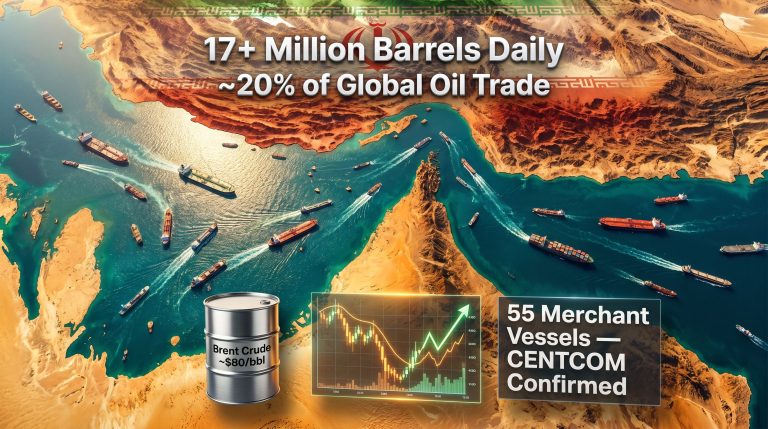
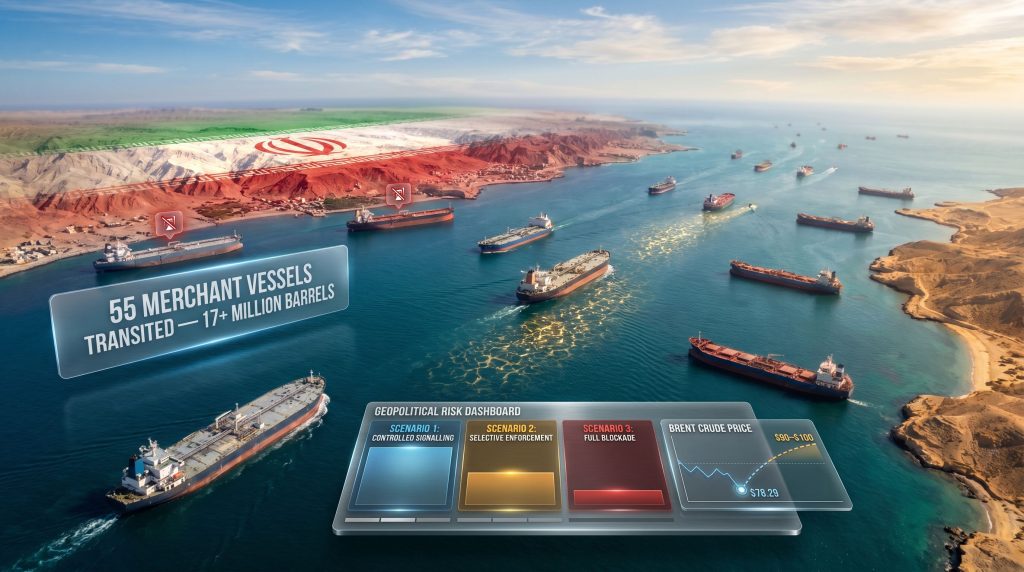
Every major chokepoint crisis in modern energy history has followed a recognisable pattern: a declaration, a counter-declaration, a frantic period of data collection, and then a slow market recalibration based on what is actually happening at sea rather than what governments are claiming. The current Strait of Hormuz dispute fits this template with unsettling precision. Iran says Hormuz closed, US says flows intact — and when Tehran's military apparatus announced a closure on 20 June 2026 while U.S. Central Command simultaneously confirmed 55 commercial vessel transits carrying more than 17 million barrels of oil, two entirely different versions of the same waterway were presented to global markets within hours of each other.
Understanding which version is operationally true, and why both can exist simultaneously, is the central challenge for energy traders, commodity buyers, and supply chain managers navigating the next 60 days.
When big ASX news breaks, our subscribers know first
The Anatomy of a Closure Claim That Isn't Quite a Closure
Iran's announcement, attributed to the Khatam al-Anbia Central Headquarters and distributed through IRGC-affiliated media outlet Tasnim, described the strait as closed to vessel traffic. Critically, the language framed this as a first step, with additional measures threatened if Israeli strikes against Hezbollah in southern Lebanon continued. This framing is not accidental. It is calibrated to project maximum deterrent capacity while preserving Iran's ability to walk back from full enforcement without losing face.
The historical record supports this reading. Iran has leveraged Hormuz threats in 1987, during the 2011-2012 standoff over nuclear sanctions, and again in 2019 following the Gulf of Oman tanker incidents, each time using the announcement of intent rather than physical enforcement as the primary coercive tool. The gap between declaration and action is itself a geopolitical instrument. Furthermore, understanding the broader crude oil volatility guide helps contextualise why markets respond so sharply to these declarations even before physical enforcement occurs.
Key Analytical Point: In chokepoint geopolitics, announcing a closure and physically enforcing one are two distinct instruments of power. Each triggers different market responses, diplomatic reactions, and military calculations. Conflating them produces analytical errors with real financial consequences.
U.S. Central Command's response was constructed with equal intentionality. Citing 55 merchant vessel transits and affirming that safe passage remained intact served a dual purpose: reassuring allied trading partners while simultaneously undermining the credibility of Tehran's claim. Both governments were speaking as much to their own strategic audiences as they were describing factual conditions in the strait.
What Ship-Tracking Data Actually Reveals
Independent vessel tracking data provides a more textured picture than either government's communication. As of 23:00 BST on 20 June, the 26,361 DWT LPG tanker Pacific Star I continued its transit without incident, and no confirmed U-turns were detected across the monitored fleet. This aligns with U.S. Central Command's assessment, as reported by Axios.
However, the picture is not entirely clean. The 56,880 DWT bulk carrier KSL Qingyang halted mid-transit eastward through the strait, behaviour consistent with voluntary precautionary pausing rather than forced interdiction. More significantly, multiple VLCCs including Angola B, Bahrain Prosperity, Monaco Loyalty, and Gulf Sunrise either deactivated their Automatic Identification System transponders or altered course toward Omani coastal waters.
AIS deactivation is a critically underappreciated dynamic in strait crises. When a vessel switches off its AIS transponder, it disappears from publicly accessible tracking systems entirely. This creates a tracking blind spot that amplifies perceived risk even when no physical obstruction is in place. For market participants monitoring the situation in real time, a fleet of dark VLCCs approaching the strait entrance reads as confirmation of danger, regardless of whether those vessels are actually obstructed.
The preference for a southern routing closer to Omani shores among tanker operators adds another layer of complexity. This navigational adjustment adds transit time and freight costs without confirming any formal blockade, but it signals that commercial operators are pricing in tail risk that official statements from both governments are failing to resolve.
| Indicator | Iran's Position | Independent Data / U.S. Assessment |
|---|---|---|
| Official strait status | Declared closed | No disruption confirmed |
| Vessel transits (20 June) | Not acknowledged | 55 merchant vessels |
| Oil volume transited | Not acknowledged | 17+ million barrels |
| AIS anomalies | Not addressed | Multiple VLCCs dark |
| Confirmed shipping incidents | Not specified | Zero reported |
| Route behaviour | Not addressed | Southern Omani route preferred |
The Geopolitical Chain That Produced This Crisis
The MoU That Lasted 48 Hours Before Fracturing
The precipitating event for Iran's closure announcement requires context extending back to 18 June 2026, when U.S. President Donald Trump and Iranian President Masoud Pezeshkian electronically signed a Memorandum of Understanding establishing a 60-day negotiating window for a final agreement on Iran's nuclear programme. Pakistani Prime Minister Shehbaz Sharif, who facilitated negotiations, confirmed publicly that the MoU required Iran to immediately reopen the strait as a first condition, with full restoration to pre-war transit levels within 30 days.
Oil markets responded with relief. Front-month ICE Brent fell to $78.29/barrel in early Asian trading on 18 June, a decline of 1.6% from the prior session's close, as traders priced in the prospect of normalised Hormuz traffic. The July Nymex WTI contract dropped to $75.41/barrel, down 1.8%.
Iran's closure announcement just 48 hours later reintroduced exactly the risk premium that the MoU had briefly removed. This speed of reversal carries an important analytical signal: the MoU is being treated by Tehran not as an unconditional commitment but as a conditional instrument, with the strait's operational status functioning as a live bargaining chip in a broader multi-front negotiation. Consequently, the oil market trade risks associated with such diplomatic reversals are difficult to hedge against through conventional instruments.
The MoU also contained provisions that extend well beyond Hormuz transit. Under its terms, the U.S. committed to lift sanctions on Iran on a negotiated schedule, issue Treasury waivers for Iranian crude oil and petrochemical exports, and facilitate a rehabilitation financing package of at least $300 billion for Iran's economy. Trump acknowledged publicly at the conclusion of the G7 summit in France that military options had been exhausted, stating that continued strikes would never have resolved Hormuz access.
The Lebanon Trigger
Iran's justification for the closure centred on Israel's strike against Hezbollah on 19 June, confirmed by Prime Minister Benjamin Netanyahu, which occurred despite an active ceasefire agreement. Israel's foreign ministry characterised the action as a response to Hezbollah ceasefire violations and attacks on Israeli civilians. From Tehran's perspective, continued Israeli strikes against its regional proxy constituted a breach of the broader framework underpinning the MoU, triggering the Hormuz response.
This escalatory logic illustrates a structural vulnerability in the MoU architecture: Iran's compliance with Hormuz commitments is linked not only to U.S. behaviour but to Israeli military decisions that Washington does not fully control. U.S. Vice President JD Vance, leading negotiations in Switzerland, expressed measured optimism on both the nuclear track and a Lebanon ceasefire pathway. Whether that optimism translates into enforceable de-escalation on the Israeli-Hezbollah front remains the critical unknown. In addition, the broader geopolitical risk landscape for commodities is being reshaped by exactly these kinds of multi-front diplomatic failures.
The Macro Stakes: Why Hormuz Has No Substitute
The strait's significance derives from a combination of geography and volume that no alternative route can replicate. At its narrowest point, the waterway is approximately 33 kilometres wide, with navigable shipping lanes far narrower within that corridor. There is no pipeline system or alternative maritime route capable of handling equivalent throughput at comparable cost.
| Commodity | Estimated Daily Volume Through Hormuz | Global Trade Share |
|---|---|---|
| Crude oil | 17-21 million barrels/day | ~20% of global supply |
| LNG | ~4 billion cubic feet/day equivalent | ~25% of global LNG trade |
| LPG | Significant regional volumes | Major Asia-Pacific supply route |
| Refined products | Substantial Gulf export volumes | Key for South/Southeast Asia |
Alternative routing via the Suez Canal or the Cape of Good Hope adds 10-15 days of transit time to Middle Eastern crude exports, with associated freight cost increases that flow directly into delivered commodity prices. For time-sensitive LNG cargoes operating under destination flexibility constraints, extended routing may not be commercially viable.
The OPEC market influence on price forecasts is closely tied to Hormuz throughput assumptions. OPEC's 2026 World Oil Outlook places global oil demand at 113.3 million barrels per day in 2030, rising to 124.1 million barrels per day by 2050, revised upward from the prior year's forecast of 122.9 million barrels per day. This trajectory means Hormuz's strategic importance is structurally locked in for at least the next two decades regardless of energy transition progress.
Scenario Modelling: Three Trajectories for the Next 60 Days
Scenario 1: Controlled Signalling With No Physical Enforcement
Probability: High
Iran continues asserting closure authority through official channels while allowing commercial traffic to flow with minimal operational interference. AIS deactivations and southern routing preferences persist, pushing war-risk insurance premiums 30 to 100 basis points higher. Brent crude stabilises in the $78-$88/barrel range. The 60-day MoU window advances toward a partial nuclear agreement, and Hormuz transit gradually normalises.
Current evidence, including zero confirmed incidents alongside continued vessel movement, is most consistent with this scenario.
Scenario 2: Selective Enforcement and Targeted Interdictions
Probability: Moderate
Iran escalates from rhetorical closure to selective interdiction of specific flag states or cargo types, potentially targeting vessels with Israeli commercial links or U.S.-affiliated operators. Insurance costs spike to levels that make many operators commercially unviable for Hormuz transits. Brent tests the $90-$100/barrel range. The MoU comes under acute diplomatic stress, accelerating pressure on the Switzerland negotiating track.
The 48-hour gap between MoU signing and the closure announcement suggests this transition could occur with minimal market warning. Moreover, the trade war economic impact of further supply disruptions would compound existing inflationary pressures across import-dependent economies.
Scenario 3: Full Physical Blockade With Military Escalation
Probability: Low but non-zero
Iran activates mine-laying operations, IRGC naval interdiction, or anti-ship missile systems to enforce physical closure. U.S. Central Command, already operating in the area under freedom of navigation doctrine, escalates to active escort or mine-clearing operations. Brent surges above $100/barrel. The MoU framework collapses. IEA member nations activate coordinated strategic reserve releases.
Scenario Planning Note: The speed of Iran's post-MoU reversal demonstrates that Scenario 2 conditions could materialise within days rather than weeks. Markets currently pricing Scenario 1 may be underweighting this transition risk.
The next major ASX story will hit our subscribers first
Downstream Consequences Already Unfolding
Pakistan's Fertilizer Supply Gap
One of the most concrete expressions of Hormuz disruption risk is visible in Pakistan's diammonium phosphate import pipeline. Attempts to secure Saudi Arabian DAP cargoes through the strait have failed due to access constraints, leaving Pakistan with June 2026 opening stocks of 220,000 tonnes, approximately 17% below the five-year average of 265,000 tonnes for the period. Weekly DAP assessments fell to $925-$950 per tonne CFR Pakistan, reflecting bearish demand sentiment despite structurally tight global supply conditions.
The downstream agricultural risk is substantial. Pakistan's October-March rabi (winter crop) season requires significant inventory build during Q3. Using current production and demand estimates alongside confirmed arrival volumes, Pakistan could enter October with stocks as low as 61,000 tonnes against a five-year seasonal average of 335,000 tonnes. A failure to normalise Hormuz transit before Q3 ends would make a meaningful supply shortfall almost certain.
LNG and LPG: The Less Visible Exposure
LPG tanker movements through the strait remained active on 20 June, but commercial operators are clearly stress-testing alternative routing options. The broader LNG exposure is concentrated in East Asia. Japanese energy firm Cosmo Energy is actively evaluating a new gas-fired power plant as part of its business plan to 2035, with the company targeting 490 MW of renewable capacity by the April 2028-March 2029 fiscal year alongside expanding gas generation capacity. South Korean and Japanese utilities are drawing down LNG storage buffers ahead of seasonal norms, creating potential Q3 2026 restocking pressure if Hormuz normalisation is delayed.
The Climate Policy Dimension
A less obvious connection links the Hormuz dispute to the broader energy transition debate. Bonn UN climate talks in June 2026 stalled on key emissions reduction and adaptation finance commitments. Australian Energy Minister Chris Bowen, as incoming COP 31 president, explicitly referenced the need to reduce fossil fuel reliance while noting the vulnerability of supply chains exposed by the situation where Iran says Hormuz closed, US says flows intact. UNFCCC executive secretary Simon Stiell reinforced that climate commitments aligned with the 1.5°C Paris Agreement limit remain non-negotiable baselines.
The strait dispute thus feeds structurally into the argument for accelerating energy diversification. However, with OPEC projecting demand growth of 26.9 million barrels per day in non-OECD markets between 2025 and 2050, the transition timeline measured in decades means Hormuz remains critically important long after the current crisis resolves.
A Framework for Reading the Next 72 Hours
Market participants and commodity buyers can apply a structured analytical approach to cut through conflicting official statements:
-
Identify the institutional source and its incentive structure. IRGC-affiliated media serves a regional deterrent signalling function. U.S. Central Command statements are calibrated to prevent market panic and maintain freedom of navigation doctrine credibility. Neither source is providing neutral operational reporting.
-
Cross-reference against independent physical data. AIS tracking, satellite imagery, and port arrival confirmations provide ground truth that neither government controls. Divergence between official claims and physical data is itself analytically significant.
-
Assess operational enforcement feasibility. A complete physical closure of the strait against an active U.S. military presence operating freedom of navigation protocols would require sustained naval and aerial enforcement. Iran's current enforcement capacity is constrained by the MoU framework and ongoing diplomatic engagement in Switzerland.
-
Monitor the 48-72 hour confirmation window. Geopolitical closure claims not followed by physical enforcement within this window typically deflate in market impact. Sustained AIS anomalies beyond 72 hours without confirmed incidents indicate Scenario 1 remains operative.
Key Indicators to Watch
The following signals will determine which scenario trajectory is materialising:
- AIS tracking normalisation: Vessels resuming standard transponder behaviour near the strait entrance would confirm Scenario 1 stability
- Pakistan DAP imports: Resumption of Saudi Arabian DAP shipments to Pakistan would serve as a leading indicator of functional Hormuz reopening at the commercial level
- Switzerland negotiations: Progress on both the nuclear track and Lebanon ceasefire pathway, led by JD Vance, represents the primary diplomatic variable
- War-risk insurance premiums: Brent sustaining above $85/barrel would indicate markets have begun pricing Scenario 2 probability
- Trump toll policy clarity: The question of transit tolls remains structurally unresolved beyond the 60-day negotiating period, introducing long-term shipping economics uncertainty regardless of near-term outcomes
Disclaimer: This article contains forward-looking analysis, scenario projections, and market commentary based on publicly available information as of 20 June 2026. It does not constitute financial or investment advice. Commodity price forecasts and geopolitical scenario assessments involve inherent uncertainty. Readers should conduct independent due diligence before making commercial or investment decisions based on the analysis presented here.
Want Real-Time Alerts When Geopolitical Events Drive ASX Commodity Discoveries?
When energy supply chains fracture and commodity markets reprice overnight, the investors who act fastest on emerging resource opportunities gain the greatest advantage — Discovery Alert's proprietary Discovery IQ model scans ASX announcements in real time, instantly identifying high-potential mineral discoveries across more than 30 commodities so subscribers can position themselves ahead of the broader market. Explore how historic mineral discoveries have generated exceptional returns and begin your 14-day free trial today to secure a market-leading edge during periods of heightened commodity volatility.