June 21, 2026
The Chokepoint That Controls the World: Understanding the Strait of Hormuz Crisis
Throughout modern energy history, no single geographic feature has exerted more influence over global commodity markets than a narrow stretch of water separating the Arabian Peninsula from Iran. The Strait of Hormuz has functioned as both a physical artery and a political pressure point for decades, and the pattern repeating itself in mid-2026 is a textbook demonstration of how geography becomes leverage in 21st-century statecraft.
The latest instance of Iran closes Strait of Hormuz again headlines is not simply a news event. It is the most recent iteration of a long-running strategic playbook, one that deserves to be understood in full structural and analytical depth rather than treated as a standalone disruption.
When big ASX news breaks, our subscribers know first
What Makes the Strait of Hormuz Irreplaceable in Global Energy Trade
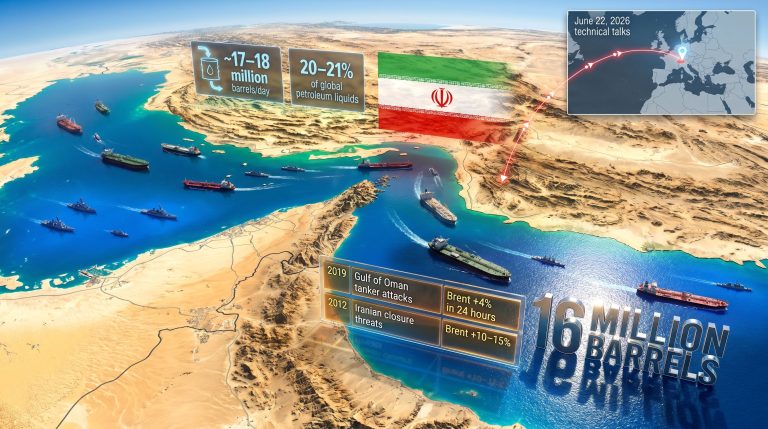
To understand the stakes, the arithmetic must come first. The Strait of Hormuz is a 33-kilometre-wide maritime passage connecting the Persian Gulf to the Gulf of Oman, bordered by Iran to the north and Oman to the south. Through this single corridor flows approximately one-fifth of all globally traded oil and liquefied natural gas, serving energy consumers across Asia, Europe, and North America.
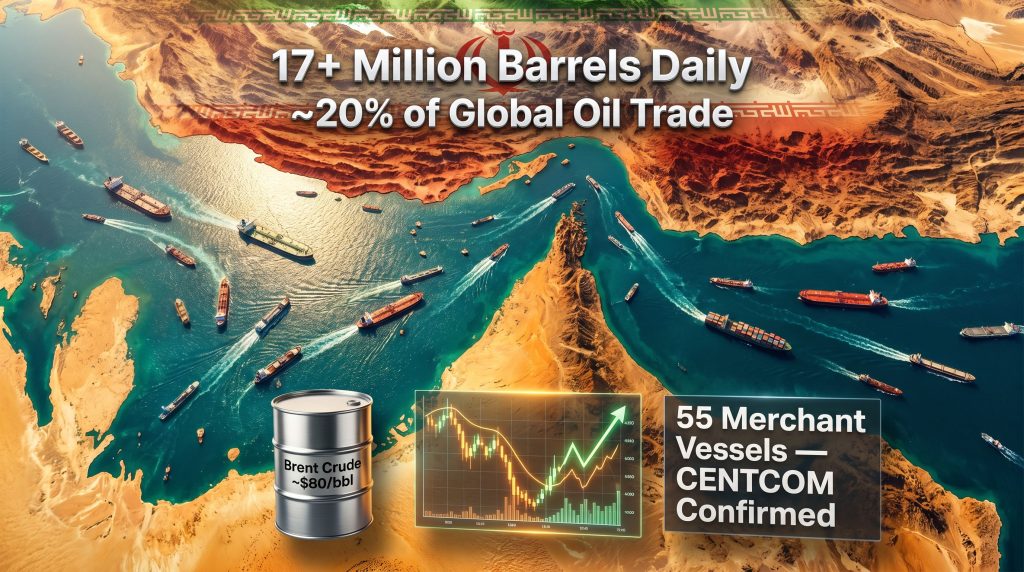
The scale of daily exposure is not abstract. U.S. Central Command confirmed that 55 merchant vessels carrying more than 17 million barrels of oil transited the waterway within a single recent 24-hour monitoring window. That figure alone illustrates why any credible disruption to Hormuz transit carries systemic consequences for energy markets, particularly when you consider oil prices and geopolitics and their compounding effects on global supply chains.
"The Strait of Hormuz is the world's most strategically sensitive energy chokepoint. Approximately 20% of global oil trade and a significant share of LNG shipments pass through this narrow passage daily, with no viable full-volume alternative route currently available at short notice."
Several structural features amplify this dependency beyond what the tonnage figures alone suggest:
- The navigable shipping lanes within the strait are constrained to a narrow band defined by the Iranian and Omani coastlines, leaving vessels with limited routing flexibility
- No existing large-scale pipeline or alternative shipping corridor can absorb full Hormuz-equivalent volumes on short notice, making physical substitution effectively impossible in the near term
- The UAE's Abu Dhabi Crude Oil Pipeline and Saudi Arabia's East-West Pipeline (Petroline) offer partial bypass capacity, but combined they fall well short of replacing the strait's throughput
- Reports of mines deployed in portions of the central waterway during the preceding conflict period have already forced commercial operators to adopt coastline-adjacent routing, increasing transit time, fuel consumption, and navigational complexity
Marine war risk insurance premiums for Hormuz-transiting vessels have remained elevated throughout the disruption period, functioning as a persistent structural cost embedded in every cargo movement through the strait, regardless of whether a formal closure is in effect.
Declaratory Closure vs. Operational Closure: Why the Distinction Matters
When Iran closes Strait of Hormuz again through official announcement, the immediate credibility question that market analysts, shipping operators, and diplomatic observers confronted was whether this represented a physical interdiction of vessels or a political declaration designed to maximise negotiating pressure.
The distinction is not semantic. It defines whether this is a market event requiring operational response or a geopolitical signal requiring diplomatic interpretation.
U.S. Central Command confirmed that commercial shipping traffic continued moving through the strait following the announcement. This gap between declaration and operational reality has become a recurring feature of Iran's Hormuz strategy. The pattern involves issuing closure announcements of sufficient credibility to generate market anxiety, without committing to the physical enforcement actions that would trigger full military escalation.
Atlantic Council Senior Fellow and former U.S. Ambassador to Israel Daniel Shapiro observed that Iran's announcement lacked operational clarity, particularly given that Iranian negotiators were simultaneously travelling to diplomatic talks in Switzerland. The concurrent posture of threatening closure while dispatching diplomats signals that Tehran is preserving strategic optionality rather than executing a final decision.
"When a state announces a chokepoint closure while simultaneously sending negotiators to talks, the closure itself becomes a bargaining instrument. The Hormuz declaration, in this context, functions as a pressure multiplier ahead of the Swiss negotiations rather than a commitment to physical interdiction."
This dual-track architecture has appeared in previous Iran-West negotiation cycles and represents a calculated approach: generate maximum external pressure without forfeiting the economic and diplomatic benefits that a deal would deliver. Sky News has covered the developing situation closely, with their reporting on the strait's current status providing useful real-time context for how the closure announcement has unfolded.
The Cross-Theatre Linkage: Lebanon, the Persian Gulf, and Expanded Leverage
Iran's stated rationale for the renewed closure connects Persian Gulf energy access directly to Israeli military activity in southern Lebanon and alleged violations of a ceasefire agreement that Iranian officials claim the U.S. failed to honour. This cross-theatre linkage is strategically deliberate.
By tying Hormuz transit to Lebanese ceasefire compliance, Tehran accomplishes several things simultaneously:
- It expands the negotiating surface, requiring counterparties to address Eastern Mediterranean conflict dynamics alongside any Persian Gulf energy agreement
- It signals to regional audiences that Iranian strategic interests span multiple theatres and are treated as interdependent
- It introduces additional uncertainty for energy markets, since resolution of the Hormuz situation now nominally depends on events in a separate conflict zone
The broader disruption environment has been building since late February, meaning global energy markets have been managing Hormuz-related uncertainty for approximately four months leading into this latest announcement.
The Interim Agreement That Briefly Settled Markets
The week preceding the renewed closure announcement had actually produced a partial stabilisation. An interim U.S.-Iran agreement raised market expectations that Iranian oil exports would gradually normalise, and Brent crude responded accordingly, falling sharply to settle near $80 per barrel on Friday.
Gulf producers had begun internal preparations to restore production volumes in anticipation of normalised Hormuz transit. This market optimism was genuine and quantifiable. Furthermore, the easing of oil market disruption risks had briefly encouraged renewed confidence across energy trading desks globally.
| Metric | Value |
|---|---|
| Brent Crude Price (Friday settlement) | ~$80/bbl |
| Price direction following interim deal | Sharp decline |
| Daily vessels confirmed in transit (CENTCOM) | 55 merchant vessels |
| Oil volume confirmed in transit | 17+ million barrels |
| Share of global oil and LNG trade via Hormuz | ~20% |
| Duration of prior disruption period | ~4 months (since late February) |
The renewed closure announcement directly threatens to reverse this partial stabilisation. Analysts have flagged that any confirmed operational disruption to vessel traffic could rapidly unwind the price decline when markets reopen, reinstating the Hormuz risk premium that temporarily retreated following the interim deal.
Iran's Chokepoint Leverage: A Structural Feature, Not an Anomaly
Understanding why Iran repeatedly uses Hormuz as a negotiating instrument requires recognising that it is a structural feature of Iran's geopolitical position, not an improvised tactical response to any specific event.
Iran's geographic control over the strait gives it asymmetric leverage in any negotiation with larger military or economic powers. The ability to credibly threaten one-fifth of global oil supply from a single position creates a disproportionate impact on counterparty risk calculations, regardless of the underlying military balance.
EOS Risk Group's head of advisory, Martin Kelly, assessed that further disruptions and contradictory signals should be expected throughout the ongoing negotiation period. His assessment frames Iran's repeated closure announcements not as erratic behaviour but as a deliberate, repeating exercise of structural leverage designed to keep counterparties uncomfortable and responsive.
Beyond the headline closure announcement, Iran has also indicated that government authorisation may be required for future vessel transits, with new insurance requirements reportedly under consideration. These structural transit rule changes represent a form of soft closure: even if the physical waterway remains technically open, administrative friction, mandatory authorisation processes, and elevated insurance costs collectively suppress shipping volumes and raise the effective cost of Hormuz-dependent supply chains.
The next major ASX story will hit our subscribers first
Three Scenarios for Energy Markets in the Weeks Ahead
Scenario 1: Diplomatic Resolution Produces Hormuz Guarantees
Swiss negotiations deliver a framework agreement that includes explicit transit security commitments. Iran's closure declaration is de-escalated as a tactical instrument that served its purpose. Brent crude consolidates near current levels, and Gulf producers complete production restoration on the anticipated timeline. The primary driver of this outcome is Iran's own economic incentive to restore export revenues under any new agreement.
Scenario 2: Protracted Ambiguity Keeps Markets on Edge
This represents the most probable near-term trajectory. Negotiations continue without resolution, and Iran issues periodic closure announcements to sustain pressure. Shipping companies adopt risk-adjusted routing and elevated insurance premiums persist as a structural cost. Oil prices remain volatile within a $75 to $90 per barrel band, reacting to each announcement cycle. The dual-track posture Tehran has already established makes this the path of least commitment for Iranian decision-makers.
Scenario 3: Physical Closure Triggered by Negotiation Breakdown
A tail-risk scenario requiring either a major diplomatic failure or a significant escalation event in Lebanon or elsewhere. Iran moves from declaratory to operational closure, deploying naval assets to interdict commercial traffic. Brent crude spikes sharply, emergency strategic reserve releases are activated by IEA member nations, and the global shipping industry faces its most severe acute disruption in decades.
Risk Warning: Scenario 3 remains a low-probability but high-consequence outcome. Even a 72-hour physical closure of Hormuz would remove approximately 17 to 20 million barrels per day from accessible markets, triggering immediate emergency response mechanisms. IEA strategic petroleum reserves are designed to buffer short-term shocks but would face genuine stress under a prolonged closure.
Market Psychology and the Announcement Fatigue Problem
One underappreciated dynamic in the current Hormuz environment is the gradual development of announcement fatigue among market participants. Each successive closure declaration that fails to produce verifiable operational changes reduces the immediate price impact of the next announcement.
This creates a dangerous asymmetry. Markets progressively discount declaratory risk, while the underlying structural risk remains unchanged. If and when Iran moves from declaration to physical enforcement, the gap between current market pricing and actual risk exposure could produce a disorderly price correction rather than a gradual adjustment.
Sophisticated energy market investors are increasingly distinguishing between two categories of Hormuz risk:
- Declaratory risk: Closure announcements without operational enforcement, creating volatility but not supply disruption
- Operational risk: Physical interdiction of vessels, representing a genuine supply shock requiring emergency policy response
Pricing exposure appropriately across these two categories requires continuous monitoring of vessel traffic data, naval positioning, and diplomatic communication, rather than relying solely on headline announcement flows.
Frequently Asked Questions on the Strait of Hormuz
Has Iran Successfully Closed the Strait of Hormuz Before?
Iran has issued closure threats on multiple occasions over the past four decades but has never executed a sustained full physical closure of the waterway. The current environment represents one of the most operationally credible threat settings in recent history, given the active conflict context and confirmed mine deployment in portions of the central strait.
What Alternative Routes Exist If Hormuz Is Closed?
Saudi Arabia's East-West Pipeline and the UAE's Abu Dhabi Crude Oil Pipeline provide partial alternative routing capacity for crude oil, but neither can absorb full Hormuz volumes. In addition, the LNG supply outlook becomes particularly strained in a physical closure scenario, as gas-consuming nations have even fewer credible bypass options available.
Why Does Iran Link Lebanon to Hormuz Access?
The cross-theatre linkage expands Iran's negotiating surface and creates a broader set of conditions that must be satisfied before shipping normalisation can be achieved. It also communicates to regional and global observers that Tehran treats its strategic interests as indivisible across conflict theatres.
What the Hormuz Standoff Reveals About the Future of Energy Security
The recurring Hormuz disruption cycle is producing lasting changes in how energy infrastructure investment decisions are evaluated. Each episode strengthens the investment and policy case for:
- Expanding pipeline bypass capacity that routes oil and gas exports around the strait
- Accelerating strategic petroleum reserve expansion among major consuming nations
- Diversifying energy supply geographies to reduce systemic dependence on any single transit corridor
- Investing in supply chain redundancy across fuel types and transport routes
The deeper structural insight is that geographic concentration of critical transit infrastructure creates permanent asymmetric leverage for controlling states. Iran's ability to credibly threaten one-fifth of global oil supply from a single geographic position is not a temporary anomaly. It is a durable feature of the global energy system that market participants, policymakers, and long-term investors must permanently price into their risk frameworks.
Consequently, OPEC's market influence and the structural dynamics surrounding Hormuz are increasingly viewed as interconnected forces rather than separate considerations. Any agreement would address the immediate political dispute, but Iran's geographic position over Hormuz remains unchanged. The leverage it confers does not disappear with a signed document.
For energy markets, that means the Hormuz risk premium is not a temporary discount to be arbitraged away. It is a structural feature of global oil and LNG pricing that will persist until the energy system develops genuinely viable alternatives to strait-dependent transit. Furthermore, energy supply diversification strategies across renewables and alternative fuels are increasingly viewed as long-term structural responses to precisely this kind of chokepoint vulnerability — a development that current infrastructure investment timelines suggest remains years away at minimum.
This article is intended for informational purposes only and does not constitute financial or investment advice. Energy market forecasts and scenario projections involve inherent uncertainty and should not be relied upon as predictions of future market conditions. Readers should conduct independent analysis before making investment decisions.
Want to Stay Ahead of the Commodity Shifts Driving ASX Mineral Discoveries?
Geopolitical disruptions like the Strait of Hormuz standoff reshape commodity markets in real time — and the most significant opportunities often emerge when supply chain stress accelerates demand for alternative energy and mineral resources. Discovery Alert's proprietary Discovery IQ model scans ASX announcements instantly, delivering real-time alerts on significant mineral discoveries across more than 30 commodities so subscribers can act on actionable opportunities before the broader market responds — start your 14-day free trial today, or explore historic discovery returns to understand just how transformative these moments can be.