June 7, 2026
Complex geopolitical tensions surrounding critical maritime chokepoints have historically driven nations toward multilateral coordination frameworks, yet the current crisis in the Strait of Hormuz represents an unprecedented convergence of energy security imperatives, international law challenges, and alliance burden-sharing dynamics. When approximately 25% of globally traded crude volumes become trapped behind a single waterway closure, the regulatory and policy mechanisms governing international response reveal both the strengths and limitations of existing maritime governance structures. Furthermore, the situation has created significant oil price movements that reflect broader market uncertainties beyond traditional supply and demand fundamentals.
Understanding the Legal Framework for Critical Shipping Lanes
The closure of the Strait of Hormuz since early March 2026 has exposed critical gaps in international maritime law enforcement mechanisms. With 19 million barrels per day of crude and petroleum products normally transiting through this narrow waterway, the legal framework governing such disruptions operates across multiple overlapping jurisdictions and regulatory authorities. However, these frameworks face additional complexity from broader economic tensions, as tariffs impact markets across multiple sectors simultaneously.
Under the United Nations Convention on the Law of the Sea (UNCLOS), Article 38 establishes the fundamental right of transit passage through straits used for international navigation. This provision permits all vessels, both military and civilian, to pass without impediment through territorial waters that would otherwise be subject to coastal state jurisdiction. Nevertheless, the practical enforcement of these rights during active conflict scenarios reveals significant regulatory challenges.
UNCLOS Framework Application includes:
- Territorial waters extending 12 nautical miles from coastal baselines, within which Iran exercises jurisdictional authority
- Exclusive Economic Zones (EEZ) spanning 200 nautical miles where coastal states maintain resource rights but cannot restrict navigation
- International waters beyond EEZ boundaries where freedom of navigation principles apply without restriction
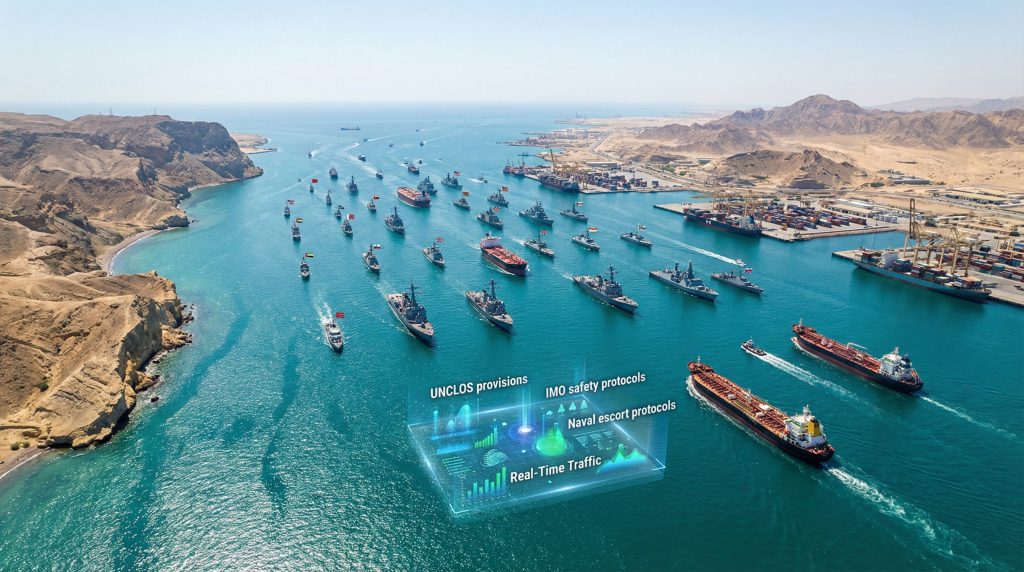
The International Maritime Organization (IMO) provides additional regulatory oversight through Safety of Life at Sea (SOLAS) conventions and Ship Security (ISPS) code provisions. The Strait of Hormuz Traffic Separation Scheme, established under IMO guidance, creates mandatory routing measures designed to reduce collision risks in the congested waterway. Yet these peacetime protocols lack enforcement mechanisms during active military hostilities.
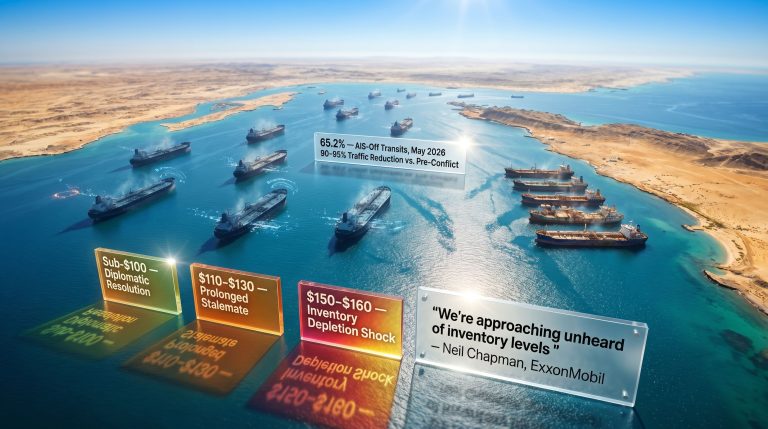
Current market responses demonstrate the economic impact of regulatory uncertainty. Nymex WTI April crude rose $2.98 per barrel to $98.71 on March 13, 2026, reaching its highest level in over three years as traders priced in enforcement challenges and timeline uncertainty for reopening operations.
| Legal Framework | Jurisdiction | Enforcement Authority | Current Application |
|---|---|---|---|
| UNCLOS Article 38 | International | Flag state + coastal state | Disputed during hostilities |
| IMO SOLAS | Flag state vessels | Port state control | Limited conflict zone coverage |
| Traffic Separation | IMO mandate | Coastal state enforcement | Suspended during closure |
| War Risk Insurance | Private insurers | Government indemnification | Coverage excluded in conflict zones |
When big ASX news breaks, our subscribers know first
Enforcement Mechanisms Under International Law
The practical enforcement of maritime law during the Hormuz crisis reveals fundamental tensions between legal theory and operational reality. Iran's new Supreme Leader Mojtaba Khamenei declared that the strait must remain closed, establishing clear state intention to maintain the closure despite international legal obligations. According to reports from the Guardian, this escalation has forced allied nations to reassess their maritime security strategies.
Naval escort operations under international law distinguish between peacetime coordination and conflict-zone deployments. Peacetime escorts typically require flag state agreement and territorial state notification, while conflict-zone operations demand rules of engagement harmonization and clear command structures. Senior US military officials declined to provide specific timelines or operational details as of March 13, 2026, indicating complex legal and practical implementation challenges.
Collective security frameworks face activation threshold questions under current circumstances. NATO Article 5 collective defense provisions apply only when member territories or vessels are explicitly targeted with armed force. The Iranian closure targets neutral shipping rather than specific NATO assets, complicating traditional collective defence invocation.
Insurance and liability frameworks have effectively suspended coverage in declared conflict zones. Private maritime insurers typically exclude war risk coverage, necessitating government indemnification programs or specialised war risk insurance pools. This regulatory gap leaves commercial operators financially exposed and reduces shipping willingness to transit disputed waters.
The UK weighs Trump request to help reopen Strait of Hormuz whilst Energy Minister Ed Miliband emphasised legal compliance priorities, stating that reopening efforts must coordinate with allies through established frameworks. The UK government's consideration of mine-hunting drone contributions rather than warship deployment reflects careful attention to proportionality and legal justification requirements under international law.
Key enforcement challenges include:
- Command authority clarification for multinational operations
- Rules of engagement harmonisation across participating nations
- Liability framework establishment for commercial vessel protection
- Escalation management protocols to prevent conflict expansion
NATO Article 5 and Maritime Security Obligations
The current Hormuz crisis tests NATO collective defence mechanisms in scenarios falling between traditional Article 5 triggers and individual member state interests. While the UK has been explicitly requested to contribute by President Trump, the broader NATO alliance has not issued formal guidance on collective response frameworks as of March 15, 2026. Moreover, these considerations occur against the backdrop of ongoing US–China trade war dynamics that complicate international alliance coordination.
NATO Article 5 activation criteria require determination that armed attacks occurred against member territories, armed forces, or vessels within NATO operational areas. Iranian attacks have primarily targeted UAE infrastructure and neutral shipping rather than NATO member assets, creating legal ambiguity regarding collective defence obligations.
Intelligence coordination through Five Eyes arrangements provides operational foundation for threat assessment and response planning. The Five Eyes alliance between the USA, UK, Canada, Australia, and New Zealand enables satellite intelligence, communications intercept, and human intelligence sharing specifically relevant to Iranian naval and drone capabilities affecting maritime security.
President Trump's burden-sharing emphasis reflects evolving alliance dynamics, stating that affected countries must take responsibility for waterway security whilst the US provides substantial support. This framework indicates preference for coalitions of the willing rather than formal NATO activation, particularly given broader concerns about Trump tariffs implications affecting allied economic relationships.
Multinational command structure requirements include:
- Unified command authority or clearly delineated Areas of Operations (AOs)
- NATO SHAPE coordination providing command structure templates for multinational operations
- Rules of Engagement (ROE) harmonisation preventing friendly-fire incidents and ensuring legal consistency
- Operational security protocols protecting sensitive intelligence and tactical information
The European Maritime Awareness Mission (EMASOH), established in 2020 as a French-led initiative, provides existing surveillance infrastructure in the Strait of Hormuz through participation by France, Germany, Netherlands, Belgium, Denmark, and Greece. However, EMASOH's mandate limits operations to surveillance rather than active escort or enforcement activities.
Current Sanctions Architecture and Economic Warfare
The intersection of existing sanctions regimes with active military conflict creates complex regulatory challenges for allied coordination and economic pressure maintenance. Current sanctions against Iran encompass oil export restrictions, financial sector isolation, technology transfer limitations, and secondary sanctions risks for third-party nations. Additionally, these measures operate alongside broader economic tensions, including US tariffs effects that affect global supply chain coordination.
Oil export restrictions under existing sanctions frameworks face enforcement challenges when Iran maintains effective control over the Strait. Approximately 20% of global LNG supply remains unable to transit the waterway, forcing importing nations to seek alternative supply sources and activating emergency procurement protocols.
Financial sector isolation affects maritime insurance markets and shipping finance mechanisms. The Swift banking system exclusions for Iranian entities create transaction processing challenges, whilst uncertainty over sanctions relief creates additional compliance risks for commercial operators attempting to maintain supply chain continuity.
Secondary sanctions coordination among allied nations requires careful synchronisation to prevent economic displacement effects. The EU's autonomous sanctions regime operates parallel to UN Security Council measures, whilst UK post-Brexit sanctions alignment with US policies creates implementation complexity during crisis response.
Sanctions regime components affecting maritime operations:
- Oil export ceiling enforcement through vessel tracking and financial restrictions
- Maritime insurance restrictions limiting coverage availability for Iran-related transactions
- Technology transfer prohibitions affecting navigation and safety equipment
- Port access limitations for vessels engaging in prohibited activities
Emergency Supply Protocols and Strategic Reserves
The current crisis has not yet triggered coordinated strategic reserve releases, despite oil prices reaching multi-year highs. The International Energy Agency (IEA) maintains emergency response mechanisms designed for supply disruption scenarios, yet activation requires member state consensus and careful consideration of market timing effects.
Strategic petroleum reserve coordination among IEA member states provides theoretical capacity to offset supply disruptions, though the geographic concentration of affected supplies in the Gulf region creates logistical challenges for reserve deployment. Alternative supply route activation procedures through overland pipelines and alternative shipping routes face capacity constraints and higher transportation costs.
Market regulation during supply disruptions involves trading halt mechanisms on commodity exchanges, price manipulation prevention during crisis periods, and force majeure declaration procedures affecting contract enforcement. These regulatory tools attempt to maintain orderly market function whilst preventing speculative exploitation of crisis conditions.
Emergency response framework includes:
- IEA emergency stock release protocols requiring 60-day supply coverage by member states
- Alternative supply route activation through Red Sea and Cape of Good Hope routing
- Price stabilisation interventions through coordinated central bank currency market operations
- Contract force majeure management balancing supplier protection with buyer security
What Role Does International Maritime Law Play?
The legal complexity of the Hormuz closure extends beyond immediate operational concerns to longer-term dispute resolution mechanisms and state liability determinations. The International Court of Justice (ICJ) provides precedential guidance through cases like Nicaragua v. United States, which established principles for naval operations affecting neutral shipping and commercial navigation rights.
ICJ precedents establish state responsibility doctrines for commercial shipping protection and freedom of navigation interpretations in disputed waters. However, interim measures authority for urgent maritime disputes faces enforcement limitations when parties refuse voluntary compliance with provisional orders.
The International Tribunal for the Law of the Sea (ITLOS) offers specialised jurisdiction for maritime disputes, including prompt release procedures for detained vessels and environmental protection obligations during naval operations. Arbitration mechanisms for shipping lane conflicts provide alternative dispute resolution pathways, though their effectiveness depends on party consent and good faith participation.
Judicial mechanism applications include:
- Prompt release jurisdiction for commercial vessels detained in conflict zones
- Environmental liability assessment for naval operations affecting marine ecosystems
- State responsibility determination for economic damages from waterway closure
- Arbitration panel establishment for multilateral shipping lane management
The next major ASX story will hit our subscribers first
Parliamentary and Congressional Oversight Frameworks
Democratic accountability mechanisms in participating nations create additional regulatory constraints on crisis response options. UK parliamentary scrutiny through the Defence Committee and Foreign Affairs Committee establishes oversight requirements for military deployment authorisation and public expenditure approval for extended naval missions.
UK constitutional requirements for military engagement authorisation vary depending on deployment scope, duration, and rules of engagement. The consideration of mine-hunting drones rather than warship deployment may reflect parliamentary consultation requirements and public support considerations for extended Middle East commitments.
US Congressional oversight operates through War Powers Resolution applicability to naval escort operations, requiring congressional notification for military deployments and appropriations authority for sustained operations. Intelligence committee briefing obligations ensure legislative oversight of threat assessments and operational planning.
Democratic oversight considerations include:
- Constitutional authorisation requirements for extended military commitments
- Public expenditure transparency for taxpayer-funded crisis response operations
- Intelligence community coordination with legislative oversight responsibilities
- Public opinion monitoring affecting political sustainability of international commitments
How Are Regional Partners Coordinating Response Efforts?
The Gulf Cooperation Council (GCC) provides established coordination mechanisms among Saudi Arabia, UAE, Qatar, Bahrain, Oman, and Kuwait, all economically dependent on Hormuz transit for energy exports and imports. Joint naval patrol frameworks with external partners and diplomatic mediation capabilities with Iran offer potential pathways for crisis de-escalation.
According to analysis from Argus Media, these regional partnerships face significant challenges in balancing sovereignty concerns with collective security needs.
United Nations Security Council engagement faces procedural limitations due to permanent member veto authority, though Chapter VII enforcement authority for maritime security and humanitarian corridor establishment protocols remain theoretically available for consensus-based responses.
Regional partnership frameworks demonstrate varied capacity for crisis contribution. The UK maintains naval support facilities in Bahrain, whilst forward-stationed HMS Queen Elizabeth carrier group assets provide potential operational capability for Hormuz operations. However, regional state sovereignty concerns and domestic political considerations limit coordination scope.
Multilateral coordination challenges include:
- Burden-sharing agreement negotiation among participating nations
- Command structure integration across different military and political systems
- Regional state sovereignty balance with external security provision
- Long-term relationship preservation beyond immediate crisis resolution
Risk Assessment and Policy Decision Frameworks
Intelligence community threat analysis for Hormuz operations requires multi-source intelligence fusion covering Iranian naval capabilities, drone technology assessments, and economic impact modelling on allied economies. Escalation scenario planning and response preparation must balance immediate waterway reopening objectives with broader regional stability considerations.
Regulatory compliance risk management involves international law violation consequence assessment for military actions, diplomatic relationship preservation during crisis response, and alliance cohesion maintenance under operational stress. These considerations affect timeline preferences and operational scope decisions among participating nations.
The UK weighs Trump request to help reopen Strait of Hormuz within this complex framework, recognising that any military intervention carries significant risks of escalation. Intelligence assessments must carefully evaluate Iranian defensive capabilities, including advanced drone systems and naval mines that could complicate reopening operations.
Policy decision factors include:
- Intelligence assessment reliability regarding Iranian military capabilities and intentions
- Economic impact projections on domestic energy prices and supply security
- Alliance relationship management balancing burden-sharing with operational effectiveness
- Domestic political sustainability for extended international crisis engagement
Furthermore, policymakers must consider the broader implications of intervention beyond immediate operational success. The precedent established by allied response to the Hormuz closure will influence future crisis management in critical maritime chokepoints worldwide.
Disclaimer: This analysis is based on publicly available information as of March 2026 and reflects ongoing developments in a fluid geopolitical situation. Policy positions and operational details may change rapidly as circumstances evolve. Readers should consult current official sources for the most up-to-date information on government policies and international legal developments.
Looking to Invest in Critical Infrastructure and Energy Markets?
Discovery Alert's proprietary Discovery IQ model delivers real-time alerts on significant ASX mineral discoveries, including critical minerals essential for energy transition and infrastructure development during global supply chain disruptions. Start your 14-day free trial today to identify actionable opportunities as geopolitical events reshape commodity markets and create new investment landscapes.