July 14, 2026
The World's Most Dangerous Energy Bottleneck: Inside the U.S.-Iran Strait of Hormuz Crisis
Few geographic features carry as much economic weight as a narrow strip of water barely 33 kilometres wide at its tightest point. The Strait of Hormuz has long functioned as the circulatory system of global energy trade, quietly channelling roughly one-fifth of the world's entire oil and gas supply through a corridor flanked by Iran on one side and Oman and the UAE on the other. U.S. strikes against Iran and Strait of Hormuz attacks have transformed what was once a theoretical vulnerability into an operational crisis that is reshaping global energy markets in real time.
What unfolded across three consecutive nights of U.S. military strikes, paired with Iranian retaliatory action against Gulf tankers and regional military installations, represents the most significant kinetic confrontation in this waterway in a generation. Understanding what happened, why it happened, and what it means for global energy markets requires moving beyond the daily news cycle and into the structural mechanics of the crisis itself.
When big ASX news breaks, our subscribers know first
How the Ceasefire Collapsed and Combat Began
From Interim Agreement to Open Conflict
Weeks before the July 2026 escalation, U.S. and Iranian negotiators had reached what appeared to be a workable interim arrangement. The agreement was designed to serve two purposes: reopening the Strait of Hormuz to commercial shipping and establishing a 60-day pause in hostilities during which more substantive negotiations could take place.
The framework unravelled when Iranian Islamic Revolutionary Guard Corps (IRGC) forces attacked between three and five commercial vessels transiting the waterway. Among the targeted ships was the Cyprus-flagged container vessel M/V GFS Galaxy. The attacks eliminated whatever diplomatic space remained. President Trump publicly declared the ceasefire finished, characterising the negotiation process as unproductive and signalling a return to direct military pressure.
Iran's decision to resume attacks on commercial shipping was not accidental or impulsive. The IRGC's targeting of civilian maritime traffic reflects a deliberate strategic calculation: that controlling, or credibly threatening, the Strait of Hormuz provides Iran with economic leverage that no other instrument in its arsenal can replicate. Every tanker captain who hesitates, every charterer who pauses a voyage decision, and every insurer who re-prices war risk coverage represents a measurable cost imposed on Iran's adversaries without requiring a conventional military engagement. Furthermore, the broader context of geopolitical tensions and trade disruptions has amplified the stakes considerably.
Three Nights of Strikes: What U.S. Forces Actually Targeted
U.S. Central Command's response unfolded across three separate nights in early July 2026, collectively striking more than 300 Iranian military targets. The campaign was structured and sequential rather than a single overwhelming assault, with each wave targeting distinct categories of Iranian military capability.
| Strike Date | Approximate Targets Hit | Key Infrastructure Targeted |
|---|---|---|
| July 7, 2026 | ~80 targets | 60 IRGC small boats, coastal maritime assets |
| July 8, 2026 | ~90 targets | Air defence systems, missile launch sites |
| July 12, 2026 | Dozens more | Coastal defence systems, maritime drone infrastructure |
The July 12 operation introduced a capability that had not been used in this context before: one-way attack sea drones. Their deployment marked a meaningful tactical evolution in how the U.S. Navy conducts maritime strike operations, reflecting broader trends in unmanned systems warfare that have accelerated significantly since the early 2020s. According to reporting by The Guardian, CENTCOM's stated objective across all three nights was the degradation of Iran's capacity to threaten civilian mariners and disrupt commercial shipping lanes, rather than targeting Iranian civilian or economic infrastructure directly.
Iranian authorities reported casualties from the strikes, with the country's Health Ministry indicating at least 14 people killed and 78 wounded across the initial strike days, with separate reporting citing 17 killed and 115 injured. Notably, U.S. operations extended to reach Tehran for the first time in this escalation cycle, representing a significant geographic expansion of the strike campaign.
Iran's Retaliatory Strikes and the Hormuz Closure Declaration
Tanker Attacks, Missile Sirens, and Gulf Ally Targeting
Iran's response to the U.S. campaign moved beyond the strait itself, extending its reach to Gulf partner states. Iranian cruise missiles struck two UAE national tankers, the Mombasa and the Al Bahiyah, inside Omani territorial waters within the strait's southern lane. The attack on the Mombasa killed one Indian crew member and injured eight others, with fires causing material damage to both vessels.
The decision to target UAE-flagged commercial ships inside Omani waters carries multiple strategic signals simultaneously. It demonstrates Iran's willingness to strike beyond its own territorial boundary, implicates Oman's waters in the conflict despite Oman's traditionally neutral posture, and sends a direct message to Gulf states that alignment with U.S. military operations carries tangible costs.
Bahrain, which hosts the U.S. Navy's Fifth Fleet at its primary Gulf operational hub, also came under renewed pressure. Missile-alert sirens activated across the island nation, according to reporting by CBS News, as Iran broadened its retaliatory strikes to encompass American military partners across the region. The UAE Defence Ministry responded by declaring maximum operational readiness and committing to counter any further attempts to threaten national security.
The Closure Declaration: Strategic Signal or Enforceable Blockade?
Iran's IRGC formally declared the Strait of Hormuz closed until further notice. CENTCOM disputed this characterisation, maintaining that commercial shipping continued to transit the waterway. The distinction between these two positions is critical to understanding how energy markets should interpret the situation.
A declared closure and an operational closure are fundamentally different instruments. Iran's announcement functions primarily as an economic weapon, designed to reshape trader and shipping company behaviour through uncertainty rather than physical interdiction alone. The market response to a credible threat of closure can be nearly as damaging as an actual blockade.
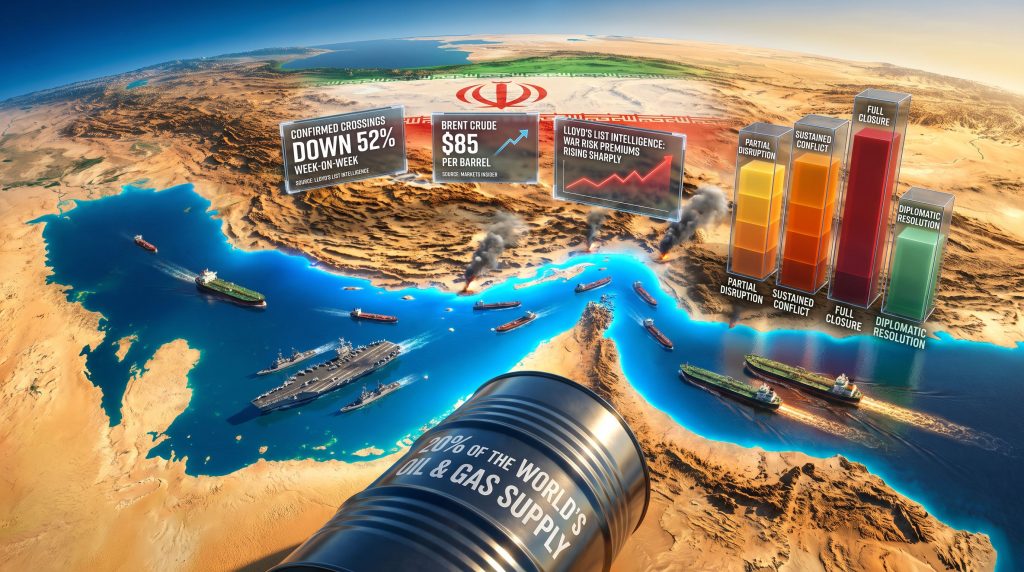
Traffic data from Kpler confirmed that crossings through the Strait of Hormuz declined by approximately 52% week-on-week between July 10 and 12, 2026. Crucially, the routing patterns that emerged were not random. Shipping companies shifted toward Iranian-controlled and unmonitored "dark routes," abandoning IMO-authorised corridors. This behavioural shift compounds the disruption: fewer vessels using transparent, trackable routes means reduced visibility across the entire supply chain, creating secondary uncertainty for buyers, traders, and insurers alike.
The practical responses from commercial operators included:
- Halting transits through the strait entirely pending clearer security assessments
- Rerouting tankers around Africa via the Cape of Good Hope, adding approximately 10 to 14 days to voyage times
- Adopting "dark routing" patterns that avoid IMO-authorised corridors
- Suspending voyage decisions while war risk insurance pricing remained in flux
Global Energy Market Consequences
Oil Price Response and What the Numbers Actually Mean
The immediate market reaction to the July 12–13 escalation was measurable but contained relative to worst-case scenarios. Brent crude rose 2% to approximately $85 per barrel, while U.S. West Texas Intermediate climbed 2.3% to approximately $80 per barrel. These movements place prices near levels last seen during the acute phase of the 2022 energy crisis. In addition, WTI and Brent oil futures are reflecting growing uncertainty across forward curves, with traders pricing in a sustained risk premium.
The relatively moderate initial price response reflects a market that has partially priced in Hormuz disruption risk over the preceding weeks of escalation. However, the more consequential pricing signals will emerge if the conflict extends beyond 30 days, at which point alternative routing infrastructure, strategic reserve logistics, and insurance market constraints begin to bind simultaneously. The crude oil volatility trends evident throughout 2025 have made traders particularly sensitive to any new supply-side shocks.
Shipping Insurance: The Hidden Transmission Mechanism
War risk premium dynamics represent one of the least visible but most consequential channels through which the Hormuz crisis transmits into broader economic pain. Lloyd's List Intelligence assessed that war risk premiums for Strait of Hormuz transits were expected to increase sharply as the conflict intensified, with shipowners and charterers already pausing transit decisions.
The cascade effect operates through several interconnected stages:
- Elevated war risk premiums increase the cost of insuring vessels transiting the strait
- Higher insurance costs translate directly into elevated freight rates for any cargo that does move
- Increased freight costs raise the landed cost of energy imports across Asia-Pacific and European markets
- Higher import costs feed through into domestic fuel pricing, industrial input costs, and consumer price inflation
- Sustained disruption compresses refinery margins and tightens regional crude differentials
Scenario Analysis: Four Disruption Outcomes
| Scenario | Hormuz Transit Volume | Estimated Oil Price Impact | Global Supply Risk |
|---|---|---|---|
| Partial disruption (current) | Down ~52% week-on-week | Brent +2 to 5% | Moderate to High |
| Sustained conflict (30+ days) | Down 60 to 75% | Brent +15 to 25% | Severe |
| Full closure (enforced) | Near zero | Brent +40%+ | Systemic crisis |
| Diplomatic resolution | Normalisation | Price correction downward | Low |
U.S. Naval Strategy and the Transit Toll Controversy
Trump's Blockade Order and the 20% Fee Proposal
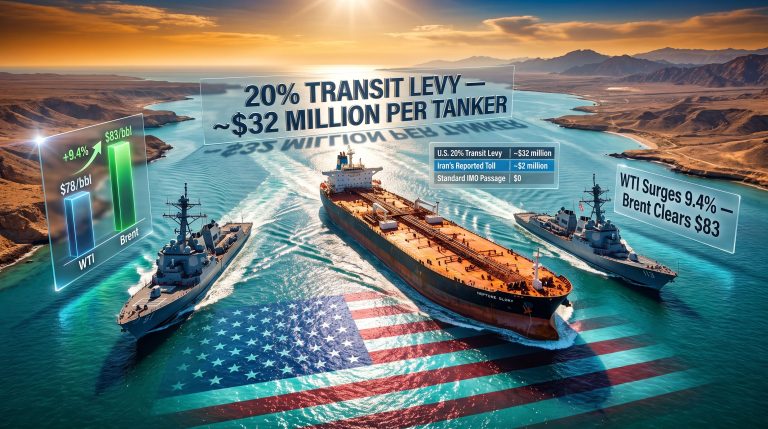
At 4:00 p.m. ET on July 13, 2026, President Trump reinstated a formal blockade on Iran within the strait. Alongside this order came a proposal to charge vessels a 20% toll for Hormuz transit rights, framed publicly as a mechanism to recoup U.S. military expenditure in the region.
The proposal has no established precedent under international maritime law. The United Nations Convention on the Law of the Sea (UNCLOS) enshrines freedom of navigation through international straits used for international navigation, a category that unambiguously includes the Strait of Hormuz. A unilateral toll imposed by one nation on vessels transiting waters partially under another nation's jurisdiction creates legal conflicts that would require resolution through mechanisms that operate on timelines far longer than the current crisis.
Beyond the legal questions, the economic intent is clear: applying financial pressure on the Iranian economy while simultaneously creating a deterrent cost structure for any vessel operator who might consider routing cargo through Iranian-controlled approaches. The trade war impact on oil prices seen throughout 2025 has already conditioned markets to absorb politically motivated disruptions, however this toll proposal introduces an entirely new dimension.
Fifth Fleet Operations and Gulf Partner Coordination
Bahrain's role as the operational home of the U.S. Navy's Fifth Fleet makes it both a strategic asset and a high-value target in Iran's retaliatory calculus. The activation of missile-alert sirens across Bahrain during Iran's retaliatory strikes illustrates how directly Iran is willing to signal its reach toward American forward-deployed forces.
The UAE's military posture, characterised by maximum readiness declarations following the tanker attacks, reflects the broader alignment of Gulf Cooperation Council states with U.S. operational objectives in the waterway. This alignment, in turn, shapes Iran's target selection, creating a feedback loop where partner state involvement invites further Iranian pressure on Gulf infrastructure and commercial assets.
Four Geopolitical Trajectories: Where This Crisis Could Go
Scenario 1: Controlled Escalation (Most Probable Near-Term)
U.S. strikes continue targeting IRGC maritime and missile capabilities on a targeted, responsive basis. Iran sustains low-level tanker harassment and periodic missile provocations against Gulf partner states. Oil markets remain elevated but below the threshold that triggers emergency IEA reserve releases. The conflict stays within the naval and aerial domain, with no ground engagement by either side.
Scenario 2: Diplomatic Re-engagement
Back-channel negotiations resume through third-party mediators, with Oman and Qatar representing the most plausible intermediary candidates given their existing diplomatic relationships with both Washington and Tehran. A revised ceasefire framework incorporates stronger verification mechanisms to prevent a repeat of the July breakdown. Hormuz transit volumes gradually normalise, and Brent crude retreats toward pre-conflict pricing levels.
Scenario 3: Regional Spillover
Iranian proxy networks operating in Iraq, Yemen, or Lebanon activate in coordinated solidarity with Tehran's position. Gulf Cooperation Council states face simultaneous pressure across multiple fronts. The U.S. is compelled to expand its operational footprint beyond naval and aerial assets. Global oil prices breach the $100 per barrel threshold, triggering demand destruction responses in the most price-sensitive consuming economies.
Scenario 4: Strait Enforcement Crisis
Iran successfully enforces a partial physical blockade using naval mines, IRGC small boat swarms, and maritime drone capabilities, some of which survived the U.S. strikes against Iran and Strait of Hormuz attacks. Global tanker rerouting via the Cape of Good Hope becomes the structural baseline rather than an emergency measure. The energy security crisis triggers coordinated emergency releases from IEA member strategic petroleum reserves. Consequently, the global LNG supply outlook faces structural reorganisation that could persist well beyond any immediate conflict resolution.
The next major ASX story will hit our subscribers first
The Hormuz Dependency Problem: Why There Is No Easy Alternative
The strait's importance derives not only from the volume of energy it carries but from the absence of any viable substitute routing at equivalent scale. At its narrowest point, the navigable channel is approximately 33 kilometres wide, with inbound and outbound shipping lanes each only about 3 kilometres across, separated by a 3-kilometre buffer zone.
The countries whose energy export revenues are most directly exposed to Hormuz disruption include:
- Saudi Arabia: the world's largest crude exporter, with partial pipeline capacity via the East-West Pipeline but insufficient to replace full export volumes
- UAE: a major crude and condensate exporter with growing LNG capacity
- Kuwait and Iraq: highly Hormuz-dependent with minimal alternative export infrastructure
- Qatar: the world's largest LNG exporter, with virtually all production transiting Hormuz
- Iran itself: dependent on the strait for the oil revenue it still generates under sanctions
On the demand side, the most import-exposed economies are Japan, South Korea, India, and China, all of which rely heavily on Gulf crude and LNG transiting Hormuz to sustain their industrial and energy systems. A sustained closure would force each of these nations into emergency procurement across spot markets, alternative suppliers, and strategic reserve drawdowns simultaneously, creating compounding price pressure across every energy commodity at once.
Frequently Asked Questions
Is the Strait of Hormuz Actually Closed?
Iran's IRGC declared the strait closed, but U.S. Central Command disputes this, maintaining that commercial shipping continues to move through the waterway. In practice, confirmed Hormuz crossings dropped approximately 52% week-on-week between July 10 and 12, 2026, according to Kpler, reflecting a de facto chilling effect driven by security uncertainty rather than a complete physical interdiction.
How Many Targets Has the U.S. Struck in Iran in July 2026?
CENTCOM conducted three consecutive nights of strikes, collectively targeting more than 300 Iranian military installations, spanning IRGC small boats, coastal defence systems, air defence infrastructure, missile sites, and maritime drone capabilities.
Why Is the Strait of Hormuz So Critical to Global Energy Markets?
Before the current conflict, the strait carried approximately 20% of the world's total oil and gas supply, making it the single most consequential maritime energy corridor on earth. Any sustained disruption to transit volumes produces immediate and cascading effects on crude and LNG prices globally.
What Is the Proposed 20% Hormuz Transit Toll?
President Trump proposed charging vessels a 20% fee to transit the Strait of Hormuz, framed as a mechanism to offset U.S. military expenditure in the region. The proposal has no established precedent under international maritime law and its enforceability remains legally contested under UNCLOS freedom of navigation provisions.
Which Countries Face the Greatest Risk from a Hormuz Disruption?
Japan, South Korea, India, and China carry the highest energy import exposure to Gulf Hormuz-transiting supplies. Within the Gulf, Saudi Arabia, the UAE, Kuwait, Iraq, and Qatar face the greatest export revenue vulnerability from any sustained closure.
Key Takeaways
- The July 2026 escalation of U.S. strikes against Iran and Strait of Hormuz attacks represents the most significant U.S.-Iran military confrontation in the Hormuz corridor in decades, with more than 300 targets struck across three operational nights
- Iran's core strategy centres on weaponising the world's most critical energy chokepoint to impose asymmetric economic costs on the U.S. and its Gulf partners
- The 52% week-on-week decline in confirmed Hormuz crossings signals a structural shift in global tanker routing behaviour, with compounding effects on freight costs and insurance premiums
- War risk premiums are rising sharply, with Lloyd's List Intelligence warning of further acceleration as the conflict continues
- Four distinct geopolitical trajectories remain plausible, ranging from diplomatic re-engagement to a full strait enforcement crisis, each carrying materially different consequences for global oil prices and energy security
- The 20% transit toll proposal, while unprecedented under international maritime law, reflects a broader U.S. strategy of using the strait itself as economic leverage against Tehran
This article is intended for informational purposes only and does not constitute financial or investment advice. Energy price projections and geopolitical scenario modelling involve significant uncertainty. Readers should consult qualified advisors before making investment decisions based on geopolitical risk assessments.
Want to Capitalise on the Market Volatility Unleashed by the Hormuz Crisis?
Discovery Alert's proprietary Discovery IQ model delivers real-time alerts on significant ASX mineral discoveries, instantly identifying actionable opportunities as energy-driven market volatility reshapes commodity valuations — explore historic examples of major discovery returns to understand the potential, and begin your 14-day free trial at Discovery Alert to position yourself ahead of the broader market.