August 25, 2026
When Geography Becomes Geopolitics: Understanding the Strait of Hormuz as a Commercial Battleground
There are very few places on Earth where a body of water simultaneously functions as a trade artery, a diplomatic lever, and a financial risk instrument. The Strait of Hormuz is one of them. Iraq and Qatar crude tenders in the Strait of Hormuz have recently drawn attention to how the strait operates as a commercial signalling mechanism, one where the willingness of producers to issue crude tenders, and the willingness of buyers to bid on them, reveals in real time how markets are pricing geopolitical risk. The recent decision by both Iraq's State Oil Marketing Organisation (SOMO) and QatarEnergy to simultaneously launch rare crude tenders requiring Hormuz-based loadings offers precisely this kind of signal, and it is worth unpacking carefully.
When big ASX news breaks, our subscribers know first
The Geography of the World's Most Consequential Oil Corridor
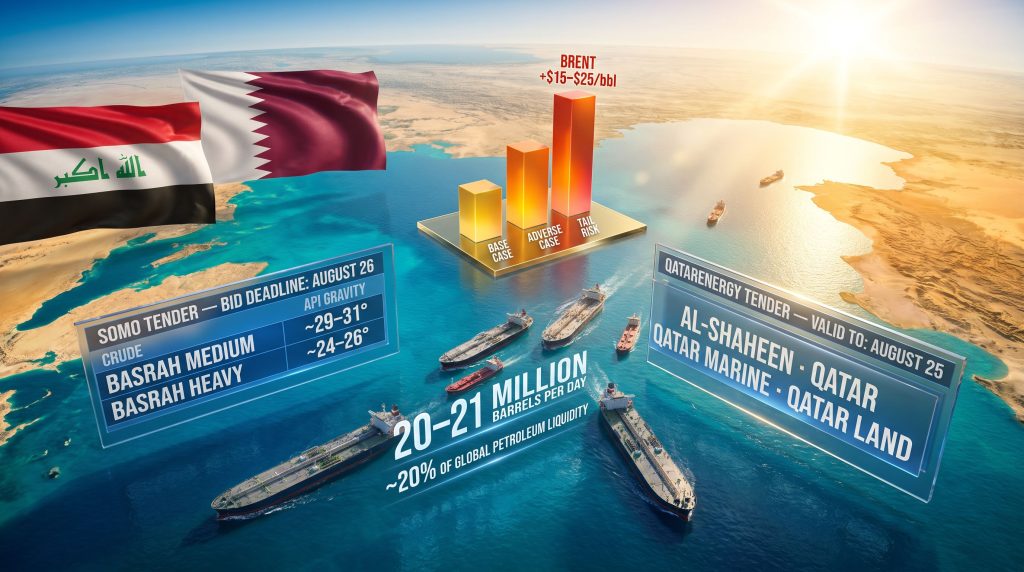
The Strait of Hormuz connects the Persian Gulf to the Gulf of Oman, creating the only maritime exit route for crude oil exports from Iraq, Iran, Kuwait, Qatar, Saudi Arabia, and the UAE. Approximately 20 to 21 million barrels per day of oil and petroleum products move through this corridor, representing roughly one fifth of globally traded petroleum liquidity. To contextualise that volume: it exceeds the combined throughput of the Suez Canal and the Turkish Straits, making Hormuz structurally irreplaceable in the global energy architecture.
What makes this geography particularly consequential is that the strait narrows to approximately 33 kilometres at its tightest navigable point, with commercial shipping constrained to designated inbound and outbound lanes separated by a buffer zone. Supertankers exceeding 300 metres in length must traverse a corridor only a small multiple of their own length in width, and every Gulf export stream that cannot be diverted overland converges on this single maritime funnel.
The bypass options that do exist are structurally insufficient:
- Saudi Arabia's East-West Petroline offers partial overland capacity, but it was designed as a complement to maritime exports rather than a replacement
- The UAE's Abu Dhabi Crude Oil Pipeline (ADCOP) provides additional relief capacity, terminating at Fujairah on the Gulf of Oman outside the strait
- Combined, these two pipelines cannot compensate for full Hormuz throughput during any sustained closure scenario
- Iraq has no viable pipeline alternative whatsoever for its southern export terminals
This last point deserves particular emphasis. Unlike Saudi Arabia or the UAE, Iraq's Basra Oil Terminal and associated single-point mooring facilities are positioned within or immediately adjacent to Hormuz transit lanes. There is no overland routing available to Baghdad. The chokepoint is not merely inconvenient for Iraq; it is structurally unavoidable.
Iraq's oil revenues account for more than 90% of its federal budget receipts, meaning that any sustained disruption to Hormuz transit does not simply reduce export earnings. It threatens the government's ability to pay public sector wages, fund infrastructure, and maintain political stability.
Furthermore, it is worth noting an under-appreciated dimension of the strait's strategic weight: most of the world's readily deployable spare crude production capacity is held by Gulf producers whose output must transit Hormuz. This creates a compounding vulnerability. When global markets tighten and additional supply is needed, the very barrels capable of stabilising prices must still pass through the same bottleneck. The strait simultaneously carries baseline supply volumes and the system's primary flexibility buffer. Understanding these crude oil volatility trends is essential for grasping why even minor disruptions carry outsized market consequences.
Understanding Crude Oil Tenders and Why FOB Loading Location Carries Commercial Weight
A crude oil tender is a formal competitive process through which a state oil company invites qualified buyers to submit bids for a specified cargo. Each tender document defines the crude grade, cargo volume, loading window, loading port, pricing benchmark, and deadline for bid submission. Spot tenders of this kind sit outside long-term term contract arrangements and are typically used when producers need to move incremental volumes or test buyer appetite under specific market conditions.
The significance of Free-On-Board (FOB) terms at Hormuz-adjacent loading ports is often underestimated by non-specialists. Under FOB conditions, title and risk transfer to the buyer at the point of loading. From that moment forward, the purchasing refiner or trading house bears full responsibility for vessel chartering, marine insurance, and any losses arising from transit complications.
| Delivery Term | Risk Bearer | Implication for Hormuz Tenders |
|---|---|---|
| FOB (Free-On-Board) | Buyer assumes all risk from loading port | Buyer absorbs Hormuz transit risk entirely |
| CIF (Cost, Insurance, Freight) | Seller arranges and insures shipping | Seller carries transit exposure |
| DES (Delivered Ex-Ship) | Seller liable until destination port | Maximum seller risk; rarely used for Gulf crudes |
When loading ports sit inside or adjacent to the Strait of Hormuz, FOB terms effectively transform a crude purchase into a geopolitical risk position. Buyers must factor war-risk insurance premiums, tanker availability constraints, and potential cargo delays into their bid pricing. In a normalised environment, these additional costs are modest. However, under elevated geopolitical conditions, they become material enough to reshape the entire economics of a cargo purchase. For a broader oil geopolitics analysis of how these structural pressures interact with diplomatic developments across the region, the dynamics extend well beyond individual tender activity.
Iraq's SOMO Tender: Basrah Grades, Terminal Infrastructure, and the Iranian Permission Architecture
What Grades Is SOMO Offering and Who Can Buy Them?
SOMO's tender covers September-loading cargoes of Basrah Medium and Basrah Heavy crude grades from the Basra Oil Terminal and its associated single-point mooring facilities. Bids closed on August 26. The tender is described by market participants as rare, not because SOMO does not regularly sell crude, but because it explicitly requires buyers to load within a corridor where passage is currently subject to elevated geopolitical friction.
The grade profiles of the two crudes being offered shape which refiners are commercially suited to participate:
| Crude Grade | API Gravity | Sulphur Content | Primary Buyer Markets |
|---|---|---|---|
| Basrah Medium | ~29-31° API | Medium-sour (~2.9% sulphur) | Indian, Chinese, South Korean refiners |
| Basrah Heavy | ~24-26° API | Heavy-sour (~3.5%+ sulphur) | Complex refineries in Asia and Europe |
Both grades are medium-to-heavy sour crudes that require secondary conversion units such as vacuum distillation and hydrocracking to maximise yield. They are not suited to simple refinery configurations, which naturally concentrates the buyer pool among sophisticated Asian and European industrial refiners. Indian and Chinese buyers have historically been the most consistent purchasers of Basrah grades, often accepting wider price discounts in exchange for volume certainty and supply diversification.
The Iranian Permission Architecture Underpinning Iraqi Exports
Layered beneath the commercial tender mechanics is a geopolitical architecture that most market commentary overlooks. Iran's state news agency IRNA confirmed that Tehran granted passage permission for a number of Iraqi oil tankers to transit the Strait of Hormuz, following repeated diplomatic requests from Baghdad through multiple channels. This is not a procedural footnote. It is a fundamental disclosure about the actual governance structure of Iraqi export continuity.
Despite Iraq being a sovereign OPEC member with internationally recognised territorial waters and export rights, its ability to move crude through the Strait of Hormuz is partially contingent on Iranian diplomatic acquiescence. This represents an asymmetric power dynamic with no obvious legal remedy and no formal guarantee of continuity.
The permission framework is functional but fragile. It is built on ongoing diplomatic goodwill rather than any binding legal instrument, meaning that a deterioration in Baghdad-Tehran relations, or a broader escalation in regional tensions, could withdraw the operating conditions under which the current tenders are premised. Buyers bidding on SOMO cargoes are therefore pricing not just crude quality and shipping logistics, but also the durability of an informal diplomatic arrangement. Consequently, the sanctions on oil trading applied to neighbouring producers further complicate how buyers assess regional supply reliability.
QatarEnergy's Concurrent Tender: Three Grades, Two Months, One Chokepoint
Running in parallel with SOMO's offering, QatarEnergy launched a tender covering three distinct crude grades for September and October loading on FOB terms at their respective Qatari loading ports. The tender was valid until August 25. According to reports from energy market sources, this simultaneous activity from two major Gulf producers signals a collective effort to test buyer appetite under current conditions.
| Crude Grade | API Gravity Profile | Key Characteristics | Typical Buyers |
|---|---|---|---|
| Al-Shaheen | ~24° API | Heavy-sour; elevated naphtha content | Asian complex refiners |
| Qatar Marine | ~36° API | Medium-sour; balanced yield profile | Asian and European refiners |
| Qatar Land | ~40° API | Light-sweet; condensate-adjacent quality | Premium refinery configurations |
Qatar's crude export volumes are comparatively modest when set against its dominant position in global LNG markets, which makes the issuance of a multi-grade, two-month-window crude tender an atypical commercial event. The fact that this tender emerged simultaneously with SOMO's offering suggests that Gulf producers are collectively testing buyer appetite under current Hormuz conditions rather than acting in commercial isolation.
Qatar's Dual-Commodity Exposure
The strategic complexity for Qatar is amplified by its dual-commodity exposure. QatarEnergy operates the world's largest LNG export complex at Ras Laffan Industrial City, supplying critical volumes to European and Asian buyers. Both LNG and crude oil exports require Hormuz transit for onward delivery to the vast majority of international customers. A sustained disruption to the strait would therefore carry consequences across both commodity streams simultaneously, making Qatar's exposure qualitatively different from producers with single-commodity profiles. In addition, OPEC's market influence over production coordination adds another layer of complexity to how these Gulf producers navigate ongoing transit pressures.
How Geopolitical Risk Translates Into Crude Pricing Mechanics
The commercial mechanism through which Hormuz risk enters crude pricing operates across several interconnected channels, each compounding the others.
War-risk insurance premiums represent the most direct transmission route. When specialist marine insurers assess elevated risk in the Hormuz corridor, they apply additional voyage premiums to tankers transiting the strait. These premiums are absorbed by vessel charterers, which under FOB terms means the crude buyer. Even if the headline FOB crude price remains unchanged, the effective acquisition cost rises as insurance costs increase, directly compressing refinery margins.
Seller discount mechanics function as an implicit risk-sharing instrument. To prevent unsold inventory accumulating at terminal storage and to maintain cargo offtake continuity, sellers like SOMO offer price discounts relative to benchmark assessments such as Dubai Platts. The scale of these discounts is a real-time barometer of perceived risk severity:
- Narrow discounts below $1/bbl: Market perceives transit risk as manageable; buyer pool remains competitive
- Moderate discounts of $1 to $3/bbl: Elevated caution; selective buyer participation with risk-adjusted pricing
- Steep discounts above $3/bbl: Significant buyer reluctance; sellers competing aggressively to clear cargoes with limited bidders
Tanker availability introduces a secondary constraint that operates independently of crude pricing. When vessel owners and operators assess Hormuz transit as unacceptably risky, they withdraw tonnage from the corridor, shrinking the pool of available shipping. Reduced tanker availability tightens the freight market, raising the total delivered cost even further beyond the FOB price. In severe scenarios, this creates a two-tier shipping market where Hormuz-transiting voyages command freight rates meaningfully above comparable non-Hormuz routes. Furthermore, the oil market trade impacts of these logistics constraints extend well beyond the Gulf region, affecting refinery margins and product availability in consuming nations as far as Europe and East Asia.
The next major ASX story will hit our subscribers first
Scenario Analysis: Mapping the Risk Spectrum for Hormuz Access
Understanding Iraq and Qatar crude tenders in the Strait of Hormuz requires situating current conditions within a realistic range of forward scenarios rather than treating any single outcome as predetermined.
Base Case: Controlled Risk Environment
Iran's diplomatic permission framework for Iraqi tankers holds. Gulf producers continue issuing tenders with moderate discounts, and Asian buyers accept transit risk for price-adjusted cargoes. War-risk insurance premiums remain elevated but manageable, and tanker availability is constrained but not critically disrupted. Under this scenario, Brent and Dubai benchmarks carry a geopolitical risk premium estimated in the range of $3 to $8 per barrel without structural supply disruption.
Adverse Case: Escalating Restriction
Iran withdraws or conditions tanker passage permissions following a diplomatic breakdown. SOMO becomes unable to clear Basrah cargoes at scale, and terminal storage approaches capacity limits. Tanker owners begin withdrawing from Hormuz transits, effectively seizing the freight market for Gulf-origin cargoes. Historical analogies and market modelling suggest Brent could spike by $15 to $25 per barrel depending on duration, triggering coordinated strategic petroleum reserve releases by IEA member countries.
Tail Risk: Full Strait Closure
A complete closure of Hormuz to commercial shipping, whether through military action, mining operations, or unilateral interdiction, would remove approximately 20% of global daily oil supply from the market with no short-term pipeline alternative capable of compensating. Historical precedents from the 1973 oil embargo and the 1979 Iranian Revolution suggest potential price doubling within weeks, alongside emergency IEA coordination, diplomatic crisis escalation, and long-term structural reconfiguration of energy security planning.
Disclaimer: Scenario projections and price range estimates presented here are analytical frameworks based on historical precedents and publicly available information. They are not investment advice and should not be relied upon as predictions of future market conditions. Readers should conduct independent research and seek qualified financial advice before making investment decisions.
What Gulf Producer Behaviour Reveals About Collective Adaptation Strategy
The concurrent tender activity from SOMO and QatarEnergy is not an isolated pair of commercial decisions. It forms part of a broader Gulf producer adaptation pattern that includes adjustments by the UAE and Kuwait to their crude marketing approaches under current Hormuz risk conditions. The collective response reflects a shared producer interest in maintaining export revenue continuity despite logistical friction.
It signals, furthermore, that major Gulf producers are willing to accept wider price discounts and share transit risk with buyers rather than allow export disruptions to accumulate. From an energy security perspective, the pattern also reveals a structural tension at the heart of the global oil system. The world's most consequential crude export corridor is governed not by international treaty or commercial law alone, but by a combination of geography, military posture, and bilateral diplomatic arrangements that can shift rapidly.
The issuance of rare Hormuz-loading tenders is, in this sense, both a commercial act and a confidence signal: producers signalling that the corridor remains open, and buyers being invited to price their own assessment of that claim. For market participants monitoring Iraq and Qatar crude tenders in the Strait of Hormuz, the most important analytical variable is not the headline crude price or even the discount level. It is the durability of the informal Iranian permission architecture that currently underpins Iraqi export continuity, and whether the diplomatic channels sustaining it can withstand whatever broader regional developments emerge in the coming months.
Readers seeking ongoing coverage of Gulf producer crude tender activity, regional export developments, and Middle Eastern energy policy can access dedicated energy and oil and gas reporting through ZAWYA's business coverage at zawya.com.
Want to Know Which ASX Resource Companies Could Benefit From Rising Oil Price Volatility?
Discovery Alert's proprietary Discovery IQ model scans ASX announcements in real time, delivering instant alerts on significant mineral and resource discoveries so investors can act ahead of the broader market — explore the historic returns major discoveries have generated and begin your 14-day free trial at Discovery Alert today.