August 5, 2026
Understanding the Strait of Hormuz: The World's Most Critical Energy Chokepoint
Global energy markets operate within a complex web of geographic constraints, none more significant than the narrow waterways that control access to major hydrocarbon reserves. These maritime chokepoints represent single points of failure that can transform regional conflicts into worldwide economic disruptions within hours. The potential for a Strait of Hormuz closure represents one of the most significant risks to global energy security in the modern era.
Geographic Significance and Strategic Location
The Persian Gulf's connection to international waters depends entirely on a 21-mile-wide passage at its narrowest point. This strategic waterway provides the only maritime route for major oil-producing nations including Saudi Arabia, the United Arab Emirates, Kuwait, Iraq, and Iran to reach global markets. The channel's shallow depth and narrow shipping lanes create natural bottlenecks that limit the size and number of vessels that can transit simultaneously.
Alternative export routes remain severely limited in capacity. The East-West Pipeline across Saudi Arabia can handle approximately 5 million barrels per day, while other regional pipelines combined offer less than 3 million barrels daily of additional capacity. These alternatives represent only a fraction of the normal oil market volatility that would result from a major waterway disruption.
Current Energy Flow Statistics Through the Strait
Table: Daily Energy Flows Through Hormuz (2025 Data)
| Energy Type | Daily Volume | Global Share |
|---|---|---|
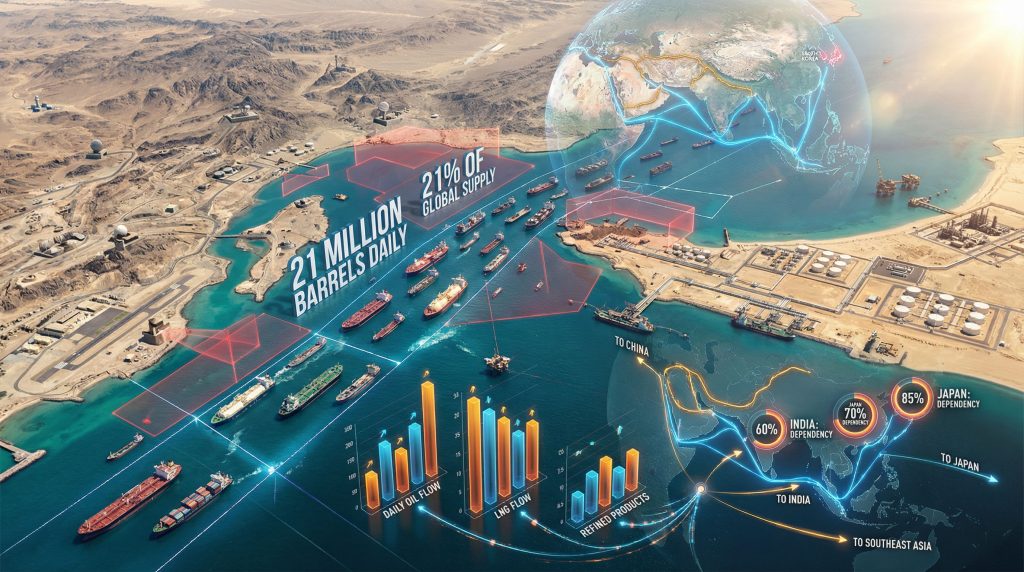
| Crude Oil | 21 million barrels | 21% of global supply |
| Refined Products | 3.2 million barrels | 8% of global trade |
| LNG | 60 million cubic meters | 25% of global LNG |
| Petrochemicals | Various | 15% of Middle East exports |
The concentration of energy flows creates vulnerability beyond simple supply mathematics. Approximately 35% of all seaborne petroleum passes through this single chokepoint, making it the most critical energy transit route globally. Natural gas liquefaction facilities throughout Qatar, the world's largest LNG exporter, depend entirely on Hormuz access for their 77 million tonnes of annual production capacity.
When big ASX news breaks, our subscribers know first
How Could Iran Execute a Strait of Hormuz Closure Strategy?
Military Assets and Tactical Capabilities
Iran's asymmetric naval doctrine focuses specifically on denying access to superior conventional forces through the strategic waterway. The Islamic Revolutionary Guard Corps Navy operates over 1,000 fast attack craft designed for swarm tactics in shallow coastal waters. These vessels, combined with shore-based anti-ship missile batteries positioned along the Iranian coastline, create overlapping fields of fire across the entire strait.
Key Iranian Naval Capabilities:
- Advanced missile systems: Khalij Fars anti-ship ballistic missiles with 300-kilometre range
- Submarine fleet: Ghadir-class midget submarines optimised for shallow water operations
- Mining capabilities: Historical precedent from 1980s operations during the Tanker War
- Unmanned systems: Naval drones and underwater vehicles for persistent surveillance
The geographic advantages favour defensive operations significantly. Iran's coastline extends for over 1,500 kilometres along the Persian Gulf, providing multiple launch points for coordinated attacks. Mobile missile launchers can relocate rapidly between prepared positions, complicating targeting for potential coalition responses.
International Maritime Law Implications
Under the United Nations Convention on the Law of the Sea, the Strait of Hormuz contains territorial waters belonging to Iran and Oman. However, the doctrine of transit passage guarantees international navigation rights through such strategic waterways. Iran's theoretical right to regulate traffic conflicts with established principles of freedom of navigation that have governed international commerce for decades.
Legal Framework Complications:
- Territorial sovereignty: Iran controls northern approaches and shipping channels
- International obligations: UN Charter provisions regarding threats to peace
- Blockade definitions: Distinction between partial restrictions and complete closure
- Coalition response authority: NATO Article 5 and regional defence agreements
What Are the Immediate Economic Consequences of Hormuz Disruption?
Oil Market Volatility and Price Mechanisms
Financial markets would respond to Strait of Hormuz closure scenarios within minutes of credible threats materialising. Commodity trading algorithms programmed to react to supply disruptions could trigger immediate price spikes before physical shortages develop. Historical precedent from the 2019 tanker attacks demonstrated how limited incidents can move global prices by 15-20% within hours.
Scenario Analysis: Price Impact Projections
- Partial Disruption (50% flow reduction): $120-150/barrel crude oil
- Complete Closure (90%+ disruption): $180-220/barrel crude oil
- Extended Closure (30+ days): $250+/barrel with supply rationing
- Refining margin impacts: 300-500% increases in crack spreads
The petroleum product cascade would amplify crude oil price increases. Diesel fuel shortages would impact transportation and logistics networks within days, while aviation fuel rationing could ground commercial flights across affected regions. Furthermore, natural gas price trends would experience similar volatility patterns due to increasingly connected global LNG trade.
Regional Energy Security Vulnerabilities
Asia-Pacific economies face the most severe exposure to Strait of Hormuz closure disruptions due to geographic distance from alternative suppliers. Japan imports 85% of its crude oil through the waterway, representing approximately 3.2 million barrels daily. South Korea's 75% dependency equals 2.8 million barrels, while India's 65% share amounts to 3.1 million barrels of daily imports.
Critical Infrastructure Dependencies:
- Refining capacity: Regional facilities designed for Middle Eastern crude specifications
- Strategic reserves: Varying national stockpile levels and release mechanisms
- Power generation: Natural gas dependency for electricity production
- Industrial feedstocks: Petrochemical supply chains serving manufacturing sectors
European Union members would face secondary impacts through LNG shortages affecting industrial production and heating supplies. Germany's recent transition away from pipeline gas increases reliance on waterborne LNG imports, much of which originates from Qatar and other Gulf producers.
Which Alternative Energy Routes Could Compensate for Hormuz Closure?
Existing Pipeline Infrastructure Capacity
Table: Alternative Export Routes and Limitations
| Route | Current Capacity | Maximum Potential | Key Constraints |
|---|---|---|---|
| Saudi East-West Pipeline | 5 million bpd | 5 million bpd | Red Sea security risks |
| UAE-Oman Pipeline | 1.5 million bpd | 2 million bpd | Limited expansion potential |
| Iraq-Turkey Pipeline | 0.6 million bpd | 1.2 million bpd | Political instability |
| Iran Goreh-Jask | 0.3 million bpd | 1 million bpd | Sanctions complications |
The Saudi East-West Pipeline represents the largest alternative route, capable of transporting crude from Eastern Province fields to Red Sea export terminals. However, this infrastructure has faced repeated attacks from regional conflicts, highlighting vulnerabilities that could compound Strait of Hormuz closure scenarios. Recent tensions documented in March 2026 demonstrate how quickly regional conflicts can escalate to threaten critical energy infrastructure.
Pipeline capacity limitations become apparent when compared to normal Hormuz flows. The combined maximum potential of all alternative routes totals approximately 9.2 million barrels per day, representing less than 45% of typical strait throughput. This capacity deficit would require dramatic demand destruction or alternative supply sources to balance global markets.
Emergency Shipping Route Diversification
Maritime alternatives involve significantly longer transit times and higher transportation costs. Cape of Good Hope routing adds 14-21 days to delivery schedules while increasing shipping expenses by approximately 15-20%. Suez Canal capacity constraints limit northbound crude flows to roughly 5.5 million barrels daily, well below normal Hormuz volumes.
Alternative Routing Challenges:
- Tanker availability: Limited very large crude carrier (VLCC) fleet capacity
- Port infrastructure: Loading and discharge facility limitations
- Insurance costs: War risk premiums for alternative routes
- Weather constraints: Seasonal limitations for Arctic shipping possibilities
How Would Different Industries Respond to Supply Disruptions?
Petrochemical Manufacturing Adjustments
Global petrochemical production would face immediate feedstock shortages affecting everything from plastics manufacturing to pharmaceutical intermediates. Priority allocation systems would likely emerge, focusing available supplies on essential chemicals for medical applications, food packaging, and critical infrastructure maintenance.
Regional manufacturing shifts would accelerate toward areas with secure feedstock access. North American shale gas derivatives could partially substitute for Middle Eastern products, though price differentials would make many industrial processes temporarily uneconomical. Asian manufacturers dependent on naphtha and other petroleum-based feedstocks would face the most severe operational challenges.
Industry Adaptation Strategies:
- Production curtailment: 40-60% capacity reductions across affected regions
- Product substitution: Alternative raw materials where technically feasible
- Inventory management: Extended stockpiling periods for critical materials
- Regional consolidation: Temporary closure of less efficient facilities
Transportation Sector Adaptations
Aviation fuel shortages would force immediate route optimisation and capacity reductions across international carriers. Airlines serving Asia-Pacific markets would face the most severe constraints, potentially requiring 20-30% schedule reductions within weeks of sustained scenarios.
Maritime shipping would implement widespread slow steaming practices to conserve marine fuels whilst cargo prioritisation systems would focus on essential goods. Ground transportation networks would likely see diesel allocation preferences for commercial freight over passenger vehicles, particularly affecting long-haul trucking operations.
What Military and Diplomatic Solutions Could Reopen the Strait?
Naval Coalition Operations Framework
Historical precedent from Operation Earnest Will during the 1987-1988 Tanker War demonstrates both the possibilities and limitations of international naval intervention. That operation successfully protected Kuwaiti tankers through convoy escort systems, though it required sustained commitment from multiple navies over 18 months.
Modern coalition responses would likely involve expanded multinational task forces including United States, United Kingdom, France, and regional allies. Mine clearance operations would require specialised vessels and equipment, with typical timeline estimates ranging from 2-6 weeks depending on the extent of underwater obstacles deployed.
Military Response Capabilities:
- Naval escort systems: Coordinated protection for commercial traffic
- Air defence networks: Protection against anti-ship missile attacks
- Intelligence gathering: Surveillance of Iranian military movements
- Humanitarian corridors: Safe passage for non-combatant vessels
Economic Sanctions and Diplomatic Pressure
Escalating economic pressure would likely follow established patterns of financial system isolation and technology export controls. SWIFT banking network disconnection, already demonstrated during recent geopolitical conflicts, could severely limit Iran's ability to conduct international commerce beyond energy exports.
Escalation Ladder Analysis:
- Financial System Isolation: SWIFT disconnection and banking restrictions
- Technology Export Controls: Advanced equipment and software limitations
- Secondary Sanctions: Third-party compliance enforcement
- Diplomatic Isolation: UN Security Council resolution attempts
The effectiveness of such measures would depend partly on international cooperation levels and alternative payment systems available to sanctioned parties. China and Russia's development of independent financial networks could limit Western sanctions impact compared to previous situations, contributing to global market impacts beyond the immediate energy sector.
The next major ASX story will hit our subscribers first
Which Countries Face the Greatest Strategic Vulnerabilities?
Import-Dependent Economies Risk Assessment
High-Risk Nations (>70% Hormuz Dependency):
- Japan: 85% oil imports, 45% LNG imports, 60-day strategic reserve capacity
- South Korea: 75% oil imports, 35% LNG imports, 90-day government stockpiles
- India: 65% oil imports, limited strategic reserves, growing demand trajectory
Medium-Risk Nations (40-70% Dependency):
- China: 45% oil imports, expanding strategic reserve capacity, domestic production
- Thailand: 55% oil imports, regional refining hub serving Southeast Asia
- Singapore: 60% imports, major trading and refining centre for region
Japan's vulnerability extends beyond simple import dependency to include limited alternative supplier diversity and geographic isolation from overland energy routes. The country's nuclear power reduction following Fukushima has increased reliance on imported fuels for electricity generation, compounding risks associated with chokepoint vulnerabilities.
Energy Security Mitigation Strategies by Region
Northeast Asian cooperation mechanisms would likely activate emergency sharing protocols similar to International Energy Agency frameworks. Coordinated strategic petroleum reserve releases could provide 60-90 days of supply continuity, though sustained closures would require demand rationing measures.
Regional Response Frameworks:
- Supply sharing agreements: Bilateral arrangements for emergency allocation
- Demand management: Industrial priority systems and rationing protocols
- Alternative supplier development: Accelerated negotiations with non-Gulf producers
- Infrastructure adaptation: Temporary modifications to handle different crude grades
European Union solidarity mechanisms would prioritise LNG allocation for heating and power generation over industrial applications during winter months. Germany's recent energy security legislation provides frameworks for emergency supply management, though practical implementation would face significant political and economic challenges.
How Long Could a Hormuz Closure Realistically Last?
Historical Precedent Analysis
The 1980-1988 Tanker War period provides the most relevant historical comparison for sustained disruptions. During that conflict, periodic attacks on shipping reduced but did not eliminate commercial traffic, with international intervention ultimately maintaining limited access through convoy operations.
More recent incidents, including the 2019 tanker attacks attributed to Iranian forces, demonstrate how quickly diplomatic pressure can develop around Hormuz-related tensions. Those events, while limited in scope, prompted immediate international naval deployments and emergency diplomatic consultations.
Conflict Duration Factors:
- Domestic pressure: Economic costs for Iran and coalition partners
- International mediation: Third-party diplomatic intervention efforts
- Military effectiveness: Success rates of closure vs. reopening operations
- Economic tolerance: Global recession risks forcing resolution
Economic Sustainability Factors
Iran would face immediate revenue losses of $200-300 million daily from halted oil exports, representing roughly 15-20% of total government revenues. Domestic fuel shortages would likely develop within 45-60 days as refining capacity becomes isolated from crude supplies, creating internal political pressure for resolution.
Iran's Economic Constraints:
- Budget dependency: Oil revenues fund 40-50% of government operations
- Domestic consumption: Internal fuel demand exceeding local production
- International isolation: Limited alternative revenue sources during conflict
- Infrastructure vulnerability: Refining and distribution system exposure
Global economic pressure points would emerge more rapidly than during previous energy crises. Strategic petroleum reserves among major consuming nations total approximately 4.1 billion barrels, providing 120-180 days of supply cushion at normal consumption rates. However, considering the OPEC production impact and tariff economic implications, economic recession risks would materialise within 30-45 days of complete scenarios.
What Long-Term Changes Would Result from Extended Closure?
Energy Infrastructure Investment Shifts
Sustained disruptions would accelerate pipeline development projects that have faced economic or political obstacles. The Trans-Arabian Pipeline expansion and new Iraq-Turkey capacity additions would receive priority funding as energy security concerns override cost considerations.
Renewable energy deployment would likely experience crisis-driven acceleration as governments seek to reduce hydrocarbon import dependencies. Solar and wind project timelines could compress by 2-3 years through emergency regulatory procedures and expanded public financing mechanisms.
Infrastructure Investment Priorities:
- Alternative pipelines: $50-100 billion in new construction projects
- LNG import terminals: Accelerated facility construction in vulnerable regions
- Strategic storage expansion: Doubled reserve capacity targets for major consumers
- Renewable acceleration: Emergency deployment of domestic energy sources
Geopolitical Realignment Implications
Regional alliance structures would likely evolve toward enhanced military cooperation focused on energy security protection. Gulf Cooperation Council members would probably integrate naval and air defence systems more closely, potentially including permanent multinational maritime patrol arrangements.
Energy trade partnerships would shift toward bilateral security agreements that include explicit protection commitments. Long-term supply contracts might incorporate force majeure clauses specific to chokepoint disruptions, fundamentally altering how international energy commerce operates.
Conclusion: Preparing for Strait of Hormuz Contingencies
Risk Mitigation Framework for Stakeholders
Government preparedness requires comprehensive emergency response protocols extending beyond traditional crisis management approaches. Strategic petroleum reserve policies need updating to account for extended disruption scenarios lasting 6-12 months rather than the 90-day periods most current stockpiles address.
Industry contingency planning must incorporate supply chain diversification strategies that balance cost efficiency with security considerations. Companies heavily dependent on Middle Eastern feedstocks should develop alternative sourcing capabilities, even if maintaining such options involves higher baseline costs.
Stakeholder Preparation Checklist:
- Emergency communication systems: Rapid coordination between industry and government
- Alternative supplier agreements: Pre-negotiated contracts for crisis activation
- Demand flexibility mechanisms: Industrial load reduction capabilities
- Financial hedging strategies: Price volatility protection instruments
Strategic Lessons for Energy Security Planning
Chokepoint vulnerability assessment must become a standard component of national energy security planning. The concentration risk evident in Strait of Hormuz closure dependencies mirrors similar exposures in other critical infrastructure systems, from natural gas pipelines to electricity transmission networks.
Investment in redundant energy pathways, whilst expensive during normal market conditions, represents essential insurance against catastrophic supply disruptions. The economic costs of maintaining alternative capabilities pale compared to the potential impacts of sustained energy shortages affecting entire economic regions.
Modern energy security planning requires integration across traditional sector boundaries, linking military capabilities, diplomatic initiatives, and economic policies into coherent strategic frameworks capable of responding to 21st-century chokepoint vulnerabilities.
Quick Answer: Strait of Hormuz Closure Impact
A complete Strait of Hormuz closure would disrupt 21% of global oil supply and 25% of LNG trade, potentially driving oil prices above $180/barrel within days. Major importers like Japan (85% dependency) and South Korea (75% dependency) would face severe shortages within 30-45 days, triggering global recession risks and emergency reserve deployments.
Ready to Navigate Market-Moving Energy Disruptions?
Discovery Alert's proprietary Discovery IQ model delivers instant notifications when significant ASX mineral discoveries emerge, including critical energy commodity discoveries that could reshape supply security amid global chokepoint vulnerabilities. Begin your 14-day free trial today to secure actionable insights and position yourself ahead of market-moving developments in commodities and energy investments.