August 5, 2026
The Hidden Architecture of Tungsten Scarcity: How Regulatory Layering Is Reshaping a Critical Market
Few industrial metals reveal the mechanics of supply concentration as clearly as tungsten. Unlike lithium or cobalt, which attract regular headlines for their role in battery technology, tungsten occupies a quieter but arguably more strategically sensitive position in the global materials economy. Its unique properties, including the highest melting point of any pure metal at 3,422 degrees Celsius, extreme density, and exceptional hardness, make it irreplaceable in aerospace components, armour-piercing munitions, cutting tools, and advanced electronics. There is no commercially viable substitute for most of these applications.
What makes the current moment particularly significant is not a single supply shock, but the convergence of multiple policy layers that are simultaneously narrowing the channels through which tungsten reaches global markets. Understanding how China mine safety rules tighten tungsten supply requires tracing that architecture from its regulatory foundations through to downstream price behaviour, and ultimately into the longer-term question of whether non-Chinese supply chains can meaningfully develop before the squeeze becomes acute.
When big ASX news breaks, our subscribers know first
Why China's Mine Safety Overhaul Is Not a Routine Compliance Exercise
China's National Mine Safety Administration has introduced comprehensive new requirements governing how excavation and stripping work is conducted across its metal and non-metal mining sector. The regulatory model being enforced is straightforward in concept but operationally demanding in execution: every mine must either maintain a permanent, qualified in-house excavation team or engage a fully compliant integrated contractor. The rules explicitly eliminate the fragmented subcontracting arrangements that have historically been the operational backbone of smaller mining operations across China's interior provinces.
The compliance calendar creates a hard enforcement timeline:
| Mine Type | Compliance Deadline |
|---|---|
| Underground mines | May 1, 2027 |
| Open-pit mines | May 1, 2028 |
Mines that fail to complete rectification by their applicable deadline face mandatory production suspension orders. This is not a graduated penalty system with warnings and fines as a first response. The consequence is operational shutdown, which transforms a regulatory calendar into a direct supply disruption mechanism. Furthermore, as new mine safety regulations continue to tighten, disruptions in the tungsten concentrates market are already becoming more visible.
Why Tungsten-Producing Regions Bear a Disproportionate Compliance Burden
China's tungsten production is geographically concentrated to a degree unusual even among critical minerals. Jiangxi and Hunan provinces together account for the overwhelming majority of wolframite extraction, and both regions are characterised by a fragmented producer landscape dominated by smaller, independently operated underground mines. These operations have historically depended on external labour contractors rather than permanent in-house mining crews, precisely the model now being prohibited.
The compliance burden falls unevenly across the industry:
- Smaller, fragmented producers in Jiangxi and Hunan face the steepest restructuring challenge, requiring capital investment to build internal teams, workforce recruitment, and training before firm deadlines
- Vertically integrated majors such as Xiamen Tungsten are structurally better positioned, having already resumed long-term contract quotations at 606,000 yuan per tonne, signalling confidence in their continued operational capacity
- Medium-sized operations with partial internal capabilities face the most uncertain compliance path, potentially reducing the total number of active supply sources even among producers who eventually achieve compliance
The elimination of multi-level subcontracting in underground environments is particularly significant for tungsten. China's wolframite deposits are predominantly underground rather than open-cut, meaning the May 2027 deadline for underground mines is the more consequential of the two regulatory thresholds.
The Cumulative Policy Stack: Export Controls, Quotas, and Now Safety Compliance
A critical analytical error in assessing the current tungsten supply situation is treating the mine safety regulations as an isolated policy event. They are not. They represent the most recent layer in a progressive tightening of China's tungsten supply framework that has been building since early 2025. The tungsten strategic importance to global industry is precisely why these compounding restrictions carry such significant downstream consequences.
The cumulative policy stack includes:
- Export licensing controls introduced in February 2025, restricting outbound tungsten shipments to a limited number of approved entities and creating immediate supply uncertainty in international markets
- A 2025 first-batch domestic mining quota of 58,000 tonnes, representing a reduction from prior quota allocations that already constrained the volume of concentrate available for processing and export
- Workforce compliance requirements under the new mine safety rules, adding a third independent constraint that operates through operational suspension rather than administrative quota
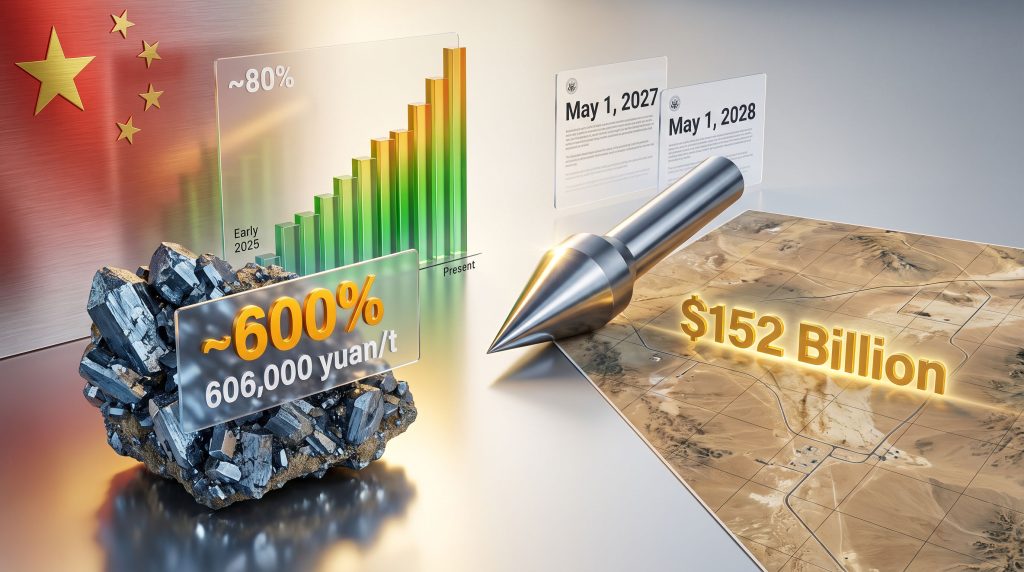
The consequence of this layering is visible in pricing data that would be dramatic by any historical standard. Tungsten prices have risen approximately 600% since early 2025, a magnitude of appreciation that reflects not a single supply event but the compounding effect of three distinct policy interventions operating simultaneously.
| Market Indicator | Data Point |
|---|---|
| Tungsten price increase since early 2025 | ~600% |
| Xiamen Tungsten long-term contract quotation | 606,000 yuan per tonne |
| Guangdong spot auction volume cleared | 156 standard tonnes (100% sold) |
| Guangdong low-grade ore price range | 337,000 to 349,000 yuan per tonne |
| China's share of global tungsten output | ~80% |
| 2025 first-batch domestic mining quota | 58,000 tonnes |
The Guangdong spot auction result deserves particular attention. The complete clearance of 156 standard tonnes of low-grade tungsten ore at prices ranging from 337,000 to 349,000 yuan per tonne signals that downstream buyers are absorbing every available unit of supply, including material at the lower end of the quality spectrum. When buyers compete for low-grade ore, it indicates that higher-grade material is either unavailable or has already been contracted through longer-term channels.
How Regulatory Pressure Transmits Into Market Tightening: The Step-by-Step Mechanism
Tracing the transmission pathway from regulatory requirement to market impact clarifies why China mine safety rules tighten tungsten supply rather than merely impose an administrative burden:
- Rule issuance establishes the new workforce model requirements and the applicable deadlines for underground and open-pit operations
- Compliance assessment forces each mine operator to evaluate their current labour structure against the new requirements, typically revealing gaps that require either hiring, contractor restructuring, or capital investment
- Rectification burden concentrates the compliance cost on smaller operations with subcontracted labour models, which must build internal capacity within a fixed timeframe
- Operational disruption risk emerges as mines unable to complete rectification face mandatory suspension, temporarily removing their output from an already constrained market
- Output concentration shifts production toward larger, compliant operators, reducing the total number of active supply sources and increasing the market's dependence on a smaller number of producers
- Market tightening follows as reduced supplier diversity and suspension-driven output gaps support elevated spot and contract prices
- Downstream response accelerates as buyers lock in long-term contracts, expand recycling capacity, and seek alternative supply sources outside China
This sequence explains why Xiamen Tungsten's decision to resume long-term contract quotations is significant beyond the price level itself. A major buyer willing to commit to supply at 606,000 yuan per tonne over an extended horizon is pricing in the expectation that the compliance consolidation will sustain elevated prices, not that they represent a temporary spike.
Nevada's $152 Billion Tungsten Resource: What the Numbers Actually Mean
Understanding the Resource Geometry at Railroad Valley
In Nevada's Railroad Valley, the largest disclosed tungsten resource in the United States has been assessed at an inferred resource of 1.78 million tonnes, carrying an estimated in-situ value of approximately $152 billion. The project has been placed into the US government's FAST-41 priority permitting programme, designed to streamline environmental review timelines for critical mineral projects.
However, the $152 billion figure requires careful contextualisation. Approximately 17 square miles, representing roughly one-third of the total claim area, was withdrawn from mineral development in 2023 under a NASA Bureau of Land Management land withdrawal. This means the resource estimate and its associated valuation are derived from approximately two-thirds of the project's total geological footprint.
The $152 billion valuation functions as a floor estimate rather than a ceiling. It reflects what has been assessed from accessible acreage, not the full geological potential of the claim area. If the withdrawn claims are restored to mineral development status, both the resource tonnage and the in-situ valuation would expand materially.
The project's proponents, including Chair and Chief Financial Officer Kevin Moore, have argued that the land withdrawal was imposed without access to complete geological data and carries national security implications that were not adequately weighed at the time of the decision. Congressional discussions around the withdrawal have been framed around these national security arguments, though the outcome remains unresolved.
Bear and Bull Scenarios for Railroad Valley
| Scenario | Conditions | Supply Impact |
|---|---|---|
| Bear Case | NASA withdrawal maintained; China deadlines proceed | Railroad Valley limited to ~67% of claim area; production minimum five years away; non-Chinese primary supply constrained |
| Bull Case | Congress reverses withdrawal; full claim area available | Resource base expands materially; development pipeline grows; production timeline remains minimum five years |
A point that is frequently underappreciated in coverage of this project is that even the most favourable permitting outcome does not accelerate the production timeline. The average discovery-to-production timeline for a new mine is approximately 17.9 years based on industry data. Consequently, even with FAST-41 compression of environmental review periods, Railroad Valley remains at minimum five years from first production under any scenario.
The Recycling Response: What Industrial Capital Allocation Reveals
Mitsubishi's €50 Million Signal
Mitsubishi Materials' commitment of €50 million to expand H.C. Starck's tungsten recycling capacity represents one of the clearest signals of how sophisticated industrial consumers are reading the current supply environment. This scale of investment in secondary recovery capacity, made before either China's compliance deadlines or the Railroad Valley land dispute have been resolved, reflects several converging assessments:
- Primary tungsten supply from China will remain structurally constrained through the combined effect of quotas, export controls, and compliance-driven consolidation
- Recycling offers a faster incremental supply pathway than greenfield mine development, with shorter lead times and no permitting exposure
- Long-term tungsten demand from defence and aerospace applications and advanced cutting tool sectors is expected to remain robust regardless of short-term economic fluctuations
Tungsten is one of the few critical minerals with a well-established recycling ecosystem. Carbide scrap, spent tooling, and manufacturing waste streams can be processed back into ammonium paratungstate, the primary intermediate product in the tungsten value chain. While recycling cannot fully replace primary mine output at global scale, it provides meaningful supply at the margin.
The Washington Supply Diversification Framework
Beyond the Railroad Valley project, the US government is reportedly considering up to $1.6 billion in financing support for a tungsten development project in Kazakhstan. This reflects a broader strategic pattern in which allied-nation projects in geopolitically aligned jurisdictions are being evaluated as alternatives to Chinese supply. In addition, new tungsten mining supply developments in regions such as Australia's Northern Territory are also entering the conversation as part of the broader Western diversification effort.
The next major ASX story will hit our subscribers first
Reading the Price Signals: What 606,000 Yuan Per Tonne Actually Tells the Market
The Benchmark That Matters Most
Xiamen Tungsten's long-term contract quotation of 606,000 yuan per tonne has become the primary market anchor for tungsten pricing in the current environment. Its significance extends beyond the absolute price level. The fact that major downstream buyers are willing to commit to this price over extended contract horizons indicates they expect supply tightness to persist, not resolve.
A sustained price decline toward the 337,000 to 349,000 yuan per tonne range observed at Guangdong's low-grade ore auction would carry a different interpretation entirely. That trajectory would suggest downstream demand is no longer fully absorbing available supply at current price levels, buyers are substituting lower-grade material, or alternative sources are beginning to offset the tightness created as China mine safety rules tighten tungsten supply.
The Two Indicators Worth Monitoring
| Indicator | What to Watch | Bullish Signal | Bearish Signal |
|---|---|---|---|
| SMM Tungsten Express daily quotations | Price direction vs. 606,000 yuan/t benchmark | Sustained prices at or above benchmark | Decline toward 337,000 to 349,000 yuan/t range |
| FAST-41 permitting updates for Railroad Valley | Milestone progression and land withdrawal status | Withdrawal reversal; permitting milestones met | Withdrawal upheld; permitting delays |
The Geopolitical Dimension: Why 80% Supply Concentration Is a Structural Vulnerability
Tungsten's concentration of approximately 80% of global output within a single country creates a supply vulnerability with direct implications for defence procurement, aerospace manufacturing, and advanced industrial production across Western economies. The broader critical minerals demand surge across Western economies has only amplified the urgency of addressing this concentration risk. This is not a new observation, but the progressive tightening of China's export and production policies since early 2025 has moved the risk from theoretical to operationally relevant.
The structural mismatch at the heart of the Western supply diversification challenge is the gap between the urgency of the problem and the timeline of the solution. Mine development timelines measured in years or decades cannot respond to regulatory changes measured in months. This means Western industrial buyers will remain substantially exposed to Chinese supply policy decisions for the foreseeable future, regardless of how many non-Chinese projects enter the development pipeline today.
Furthermore, the critical mineral shortage risks seen across defence and industrial sectors reinforce why tungsten's vulnerability deserves serious policy attention. Recycling capacity expansions represent the only near-term lever available for adding meaningful non-Chinese tungsten supply. The Mitsubishi investment in H.C. Starck reflects this reality. Primary mine alternatives, including Railroad Valley, represent long-term strategic positioning rather than near-term supply solutions. Analysts tracking China's tungsten export restrictions have noted that the cumulative policy tightening is reshaping global market dynamics in ways that may prove difficult to reverse.
Investor Note: All forward-looking statements regarding pricing trajectories, resource development timelines, land withdrawal outcomes, and supply diversification scenarios involve significant uncertainty. This article is intended for informational purposes only and does not constitute investment advice. Past price performance, including the approximately 600% gain since early 2025, does not guarantee future returns. Readers should conduct independent due diligence before making any investment decisions related to tungsten or related companies.
Frequently Asked Questions
What are China's new mine safety compliance requirements for tungsten mines?
China's National Mine Safety Administration has mandated that all metal and non-metal mine operators transition away from fragmented subcontracting models toward either a permanent in-house excavation and stripping team or a fully compliant integrated contractor. Multi-level subcontracting and the use of labour dispatch workers in underground environments are explicitly prohibited. Underground mines must achieve compliance by May 1, 2027, with open-pit operations following by May 1, 2028.
Why do these rules have an outsized effect on tungsten specifically?
China supplies approximately 80% of global tungsten output, and its production is heavily concentrated in Jiangxi and Hunan provinces, where many smaller underground mines have historically relied on external subcontractors. These operations face the steepest compliance burden and the highest risk of suspension, concentrating output among larger operators. Because tungsten deposits are predominantly mined underground rather than through open-cut methods, the 2027 deadline is the more immediately consequential threshold.
What is the current scale of the Railroad Valley tungsten resource?
Railroad Valley in Nevada holds an inferred resource of 1.78 million tonnes with an estimated in-situ value of approximately $152 billion, making it the largest disclosed tungsten resource in the United States. Approximately one-third of the total claim area remains excluded from this estimate due to a NASA Bureau of Land Management land withdrawal imposed in 2023, meaning the current valuation represents a floor rather than a ceiling.
When could Railroad Valley realistically begin producing tungsten?
Production at Railroad Valley is at minimum five years away under any scenario, regardless of permitting outcomes or the resolution of the land withdrawal dispute. The project's near-term strategic value lies in its resource development pipeline and its potential contribution to a non-Chinese tungsten supply ecosystem over a longer horizon.
What is driving tungsten's 600% price increase since early 2025?
The price appreciation reflects the cumulative effect of three distinct policy interventions: export licensing controls introduced in February 2025 restricting outbound shipments to approved entities, a reduction in domestic mining quotas for 2025, and now the addition of mine safety compliance requirements that are expected to concentrate production among fewer larger operators. The combination has created a structurally tighter market, which is precisely how China mine safety rules tighten tungsten supply beyond what any single policy measure could achieve in isolation.
Want to Track the Next Major Mineral Discovery Before the Market Catches On?
Discovery Alert's proprietary Discovery IQ model delivers real-time alerts on significant ASX mineral discoveries — transforming complex commodity data into actionable insights across critical minerals like tungsten and beyond. Explore historic discoveries and their extraordinary returns, then start your 14-day free trial at Discovery Alert to position yourself ahead of the broader market.