July 12, 2026
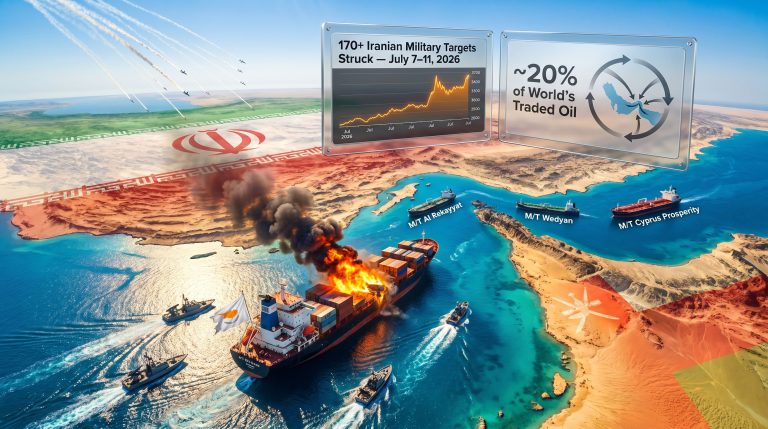
Global maritime networks operate under constant vulnerability pressures, with critical chokepoints serving as single-failure points that can cascade across entire economic systems. These narrow waterways, where geography forces massive cargo flows through confined spaces, represent systemic risks that extend far beyond immediate shipping disruptions. When these arteries experience blockages or conflicts, the ripple effects propagate through interconnected supply chains, affecting everything from energy prices to manufacturing costs worldwide.
Understanding chokepoint vulnerability requires examining how modern trade architecture has evolved to depend on specific geographic passages for economic efficiency, creating concentrated risk points that can trigger widespread market dislocations when compromised.
Geographic Foundations of the World's Most Critical Energy Chokepoint
The Strait of Hormuz represents the ultimate convergence of geographic inevitability and economic necessity in global energy markets. This narrow waterway measures approximately 54 miles at its widest point, but vessel traffic is compressed into designated shipping lanes spanning just 21 miles at the narrowest passage. The operational reality involves two distinct traffic corridors, each roughly 2 miles wide, separated by a buffer zone designed to prevent collisions between the massive vessels navigating these waters.
Physical Infrastructure and Traffic Management
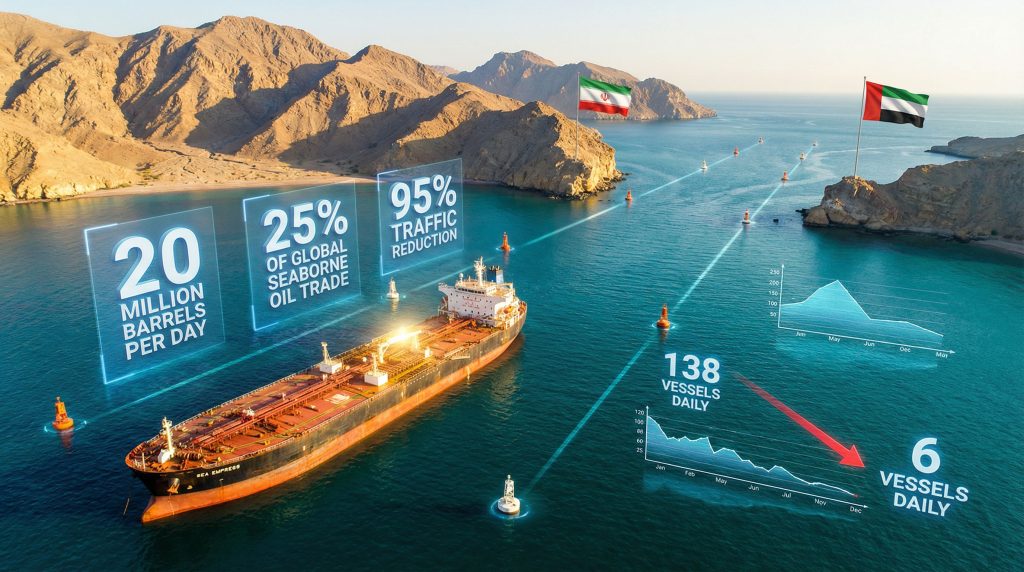
The strait operates under International Maritime Organization protocols with sophisticated Vessel Traffic Service systems managing vessel movements. Under normal conditions, between 100-138 commercial vessels transit daily through this confined space, with energy carriers comprising 50-60% of total traffic.
| Metric | Standard Capacity | Critical Significance |
|---|---|---|
| Daily Vessel Transits | 100-138 vessels | 15% of global maritime trade |
| Energy Carrier Share | 50-60 tankers | 20 million barrels daily |
| Shipping Lane Width | 2 miles each | Zero margin for disruption |
| LNG Transit Volume | 20-25% global share | Critical Asian supply link |
The physical constraints create operational bottlenecks even under ideal conditions. Seasonal variations compound these challenges, with winter monsoon periods from December through March typically seeing increased traffic as operators schedule voyages to avoid harsh summer conditions. This seasonal concentration likely contributed to the higher traffic volumes of 138 vessels recorded in late February 2026.
Alternative Route Limitations
The geographic monopoly of the Strait becomes evident when examining bypass options. The Suez Canal route adds 3,000-4,000 nautical miles and extends voyage times by 2-3 weeks, while circumnavigation via the Cape of Good Hope requires an additional 6,000-8,000 nautical miles with 4-6 weeks extended transit time.
Existing pipeline infrastructure provides minimal relief capacity. Saudi Arabia's Petroline system and UAE pipelines combined can handle only 3-5 million barrels per day, representing merely 15-25% of normal strait throughput. Furthermore, the Saudi exploration licenses impact on regional energy dynamics demonstrates how critical infrastructure investments become when traditional transport routes face disruption.
This infrastructure gap means that any significant disruption to maritime traffic cannot be compensated through alternative transportation methods.
When big ASX news breaks, our subscribers know first
Market Transformation During Geopolitical Crisis
The February 2026 escalation demonstrated how rapidly stable shipping operations can collapse when geopolitical tensions reach critical thresholds. The crisis timeline reveals the interconnected nature of modern supply chains and their vulnerability to single-point failures.
Crisis Development Pattern
February 28, 2026: Initial military operations between US-Israeli forces and Iran triggered immediate shipping industry responses. Insurance companies began reassessing risk premiums while shipping lines evaluated route alternatives.
March 1-8, 2026: Traffic in strait of Hormuz collapsed from 138 vessels to just 6 daily transits, representing a 95% reduction in normal operations. This dramatic decrease occurred as Iran's Revolutionary Guard Corps effectively declared the waterway closed except for designated "friendly nations."
March 11-28, 2026: Infrastructure attacks expanded beyond the strait itself, targeting regional ports including Salalah, Duqm, and Sohar. These strikes on alternative discharge points eliminated backup options for diverted cargo.
Supply Chain Disruption Magnitude
The systematic breakdown affected multiple transportation categories simultaneously:
- Oil Tanker Operations: Near-complete halt with 0-1 tankers daily versus pre-crisis levels of 50-60 vessels
- LNG Carriers: 75% reduction in liquefied natural gas transit affecting Asian spot markets
- Container Shipping: Major lines including Maersk and MSC suspended new bookings entirely
- Bulk Carriers: General cargo vessels carrying grains, fertilizers, and metals faced identical restrictions
Consequently, the disruption revealed how interconnected global markets respond to supply chain shocks, particularly regarding oil price movements amid trade war scenarios.
Economic Cascade Effects Across Multiple Markets
The strait closure triggered simultaneous disruptions across four distinct market categories, demonstrating the interconnected nature of modern commerce and the multiplicative effects of chokepoint disruptions.
Primary Cost Escalation
Shipping Economics: Alternative routing via Cape of Good Hope imposed additional costs of $100,000-150,000 per voyage in fuel expenses alone for Very Large Crude Carriers. Extended transit times doubled vessel utilization periods, effectively halving available fleet capacity for global operations.
Insurance Market Response: War risk premiums escalated from historical averages of $10,000-15,000 per voyage to prohibitive levels exceeding $50,000-100,000 per transit. Many Protection & Indemnity clubs simply withdrew coverage entirely, making commercial transit economically impossible regardless of cargo value.
Regional Port Infrastructure Impact
The March 11 and March 28 drone strikes on Salalah Port in Oman created operational disruptions beyond immediate damage assessment. Danish shipping firm Maersk implemented 48-hour operational suspensions, while German carrier Hapag-Lloyd moved vessels away from the facility as precautionary measures.
Port Damage Assessment:
- One crane damaged at Salalah terminal
- One expatriate worker injured
- Storage tank damage requiring extended repair periods
- Operational capacity reduced by estimated 30% during repair phase
Similar attacks on Duqm and Sohar ports eliminated alternative discharge options, forcing remaining cargo to seek facilities outside the immediate region entirely. In addition, these developments highlighted broader energy security challenges facing global supply chains.
Industrial Facility Targeting
The Al Taweelah aluminum smelter sustained significant damage during Iranian missile and drone attacks, directly impacting global aluminum supply chains. This facility produced 1.6 million tonnes of cast metal in 2025 and represents a critical link in global aluminum production networks.
The smelter's disruption affected multiple supply chain elements:
- Bauxite Import Disruption: EGA's shift from Australian bauxite imports (4.65 million tonnes in 2025) faced immediate logistical challenges
- Vessel Diversions: Capesize carriers destined for Al Taweelah were rerouted to alternative facilities, including options to discharge in Kandla, India
- Production Capacity Loss: 1.6 million tonnes annual capacity offline indefinitely
National Response Mechanisms and Selective Transit Policies
Iran's implementation of selective transit policies revealed sophisticated economic warfare tactics that targeted specific trading relationships while maintaining diplomatic flexibility with aligned nations.
Diplomatic Traffic Management System
The "friendly nations" policy granted passage rights to China, Russia, India, Iraq, and Pakistan, while effectively blocking vessels from Western-aligned countries. This selective enforcement created immediate commercial advantages for approved nations while imposing severe costs on excluded trading partners.
Pakistani Vessel Clearance Program:
- 20 Pakistani vessels approved for transit
- 2-vessel daily quota system implemented
- Confidence-building measure supporting diplomatic alignment
Documented transits included the M/V Lorax (also known as Karachi) carrying approximately 500,000 barrels of crude from UAE's Das Island to Karachi, and the M/V P Aliki transiting with nearly 600,000 barrels from Ras Tanura to Karachi.
Container Carrier Operations
Two ultra-large container carriers operated by China's Cosco became pivotal indicators of policy implementation effectiveness. The CSCL Indian Ocean and CSCL Arctic Ocean were initially turned back on March 27, but successfully completed transits on March 29-30, signaling Iran's commitment to friendly nation policies.
These vessels represent significant capacity with approximately 24,000 TEU capacity each, making their successful passage particularly important for global supply chain resilience and demonstrating the economic leverage available through selective enforcement. However, the broader implications mirror concerns about how tariffs impact on investments and international trade relationships.
Regional Conflict Expansion Through Maritime Networks
The strait crisis demonstrated how maritime chokepoints serve as transmission mechanisms for regional conflicts, spreading disruption far beyond initial conflict zones through interconnected shipping networks.
Attack Vector Expansion
Houthi Activation: Yemen's Iran-backed militants launched their first strikes against Israeli targets since the Gulf conflict began, expanding the geographic scope of maritime risk. This represented a strategic escalation that threatened to activate Red Sea shipping disruptions similar to the 2023-2025 campaign.
Infrastructure Target Selection: Iranian forces systematically targeted port facilities across multiple countries, demonstrating coordinated strategy to eliminate alternative routing options:
| Target Location | Facility Type | Strategic Impact |
|---|---|---|
| Salalah, Oman | Container Terminal | Alternative discharge point eliminated |
| Al Taweelah, UAE | Aluminum Smelter | Industrial capacity disruption |
| Duqm, Oman | Port Infrastructure | Backup facility compromised |
| Sohar, Oman | Multi-purpose Port | Additional routing option removed |
Economic Warfare Through Supply Chain Disruption
The coordinated targeting of both maritime passages and industrial facilities revealed sophisticated understanding of supply chain vulnerabilities. By simultaneously attacking the primary transit route and alternative discharge points, Iranian strategy effectively eliminated workaround options that might have mitigated economic impact.
Risk Transmission Patterns:
- Port infrastructure attacks reduce alternative capacity
- Industrial facility strikes disrupt end-user demand
- Shipping lane control creates bottleneck pressure
- Insurance market responses amplify commercial costs
For instance, these patterns reflect broader economic concerns about US tariffs and inflation affecting global trade stability.
Long-term Implications for Global Energy Security Architecture
The 2026 Strait of Hormuz crisis exposed fundamental vulnerabilities in global energy distribution systems that extend far beyond immediate supply disruptions. The 95% reduction in traffic and near-complete tanker halt revealed how modern economic efficiency has created concentrated single-failure points.
Structural Vulnerability Assessment
Chokepoint Dependency Patterns: Current global energy architecture relies on approximately 12 critical maritime passages for 60% of seaborne trade. The Strait of Hormuz handles the largest volume, but similar vulnerabilities exist at the Strait of Malacca, Suez Canal, and Strait of Gibraltar.
Geographic Concentration Risks: Over-reliance on Middle Eastern energy corridors means that regional conflicts can trigger worldwide supply disruptions within days rather than weeks. Alternative sources in North America, South America, and Africa cannot rapidly compensate for Gulf production losses.
Infrastructure Resilience Requirements
Pipeline Network Expansion: Current bypass capacity represents only 15-25% of strait throughput, indicating massive infrastructure gaps that require decades and hundreds of billions in investment to address meaningfully. Furthermore, developing new energy corridors requires extensive international cooperation among nations.
Strategic Reserve Implications: Most major consuming nations maintain 60-90 day petroleum reserves, but these stockpiles assume gradual draw-downs rather than sudden complete supply cut-offs. Crisis scenarios require fundamentally different reserve strategies and much larger storage capacity.
Investment and Policy Framework Evolution
Energy Infrastructure Spending: The crisis accelerated investment discussions in alternative transportation corridors, including expanded pipeline networks, Arctic shipping routes, and renewable energy acceleration to reduce chokepoint dependency.
Geopolitical Risk Pricing: Financial markets began incorporating higher structural premiums for chokepoint-dependent energy flows, fundamentally altering long-term energy project economics and financing structures. The World Economic Forum has extensively documented how geopolitical risks reshape global investment patterns.
Diplomatic Crisis Management: Enhanced regional cooperation frameworks became essential for managing future disruptions, requiring new institutional arrangements beyond traditional bilateral agreements.
The next major ASX story will hit our subscribers first
What Are the Long-term Strategic Implications?
The Strait of Hormuz crisis fundamentally altered global perceptions of maritime security and economic vulnerability. The traffic in strait of Hormuz disruption revealed how quickly modern supply chains can collapse when critical chokepoints face sustained pressure.
Strategic Infrastructure Dependencies
The crisis exposed how global trade architecture has evolved to prioritise cost efficiency over resilience, creating systemic vulnerabilities that extend far beyond energy markets. Manufacturing supply chains, food security networks, and financial systems all demonstrated interconnected dependencies on stable maritime passage through this single geographic bottleneck.
Geopolitical Leverage Mechanisms
Iran's selective enforcement policies demonstrated how control over critical passages enables sophisticated economic warfare targeting specific nations whilst maintaining flexibility with aligned partners. This capability transforms maritime chokepoints from simple transportation bottlenecks into powerful geopolitical leverage mechanisms.
Risk Management Evolution
The crisis accelerated development of more sophisticated risk management approaches that account for cascading supply chain failures rather than isolated disruptions. Financial institutions, insurers, and multinational corporations began incorporating chokepoint vulnerability assessments into fundamental business planning processes.
Redefining Maritime Security in an Interconnected Global Economy
The Strait of Hormuz crisis fundamentally demonstrated how single geographic chokepoints can cascade disruptions across integrated global systems within days. The documented traffic in strait of Hormuz collapse from 138 vessels daily to just 6 represents more than a shipping disruption; it reveals systemic vulnerabilities in modern economic architecture that prioritises efficiency over resilience.
The selective transit policies implemented during the crisis showed how control over critical passages enables sophisticated economic warfare that can target specific nations whilst maintaining flexibility with aligned partners. This capability transforms maritime chokepoints from simple transportation bottlenecks into powerful geopolitical leverage mechanisms.
Understanding these vulnerability patterns enables more sophisticated risk management approaches, strategic infrastructure investment decisions, and diplomatic frameworks for crisis prevention. The economic implications extend far beyond immediate fuel price increases, affecting manufacturing costs, supply chain reliability, and long-term investment security in an increasingly complex geopolitical landscape.
The crisis highlighted urgent requirements for diversified energy corridors, enhanced diplomatic mechanisms, and resilient supply chain architecture capable of maintaining function during extended disruption periods. Future global economic stability depends on addressing these chokepoint vulnerabilities before the next crisis tests system resilience.
Disclaimer: This analysis involves examination of ongoing geopolitical events and market disruptions. Economic forecasts, supply chain assessments, and policy implications discussed represent analysis of available information and should not be considered investment advice or definitive predictions of future market conditions. Readers should consult independent sources and professional advisors for specific investment or operational decisions.
Are You Positioning for the Next Major Commodity Discovery?
Discovery Alert's proprietary Discovery IQ model provides instant notifications on significant ASX mineral discoveries, helping investors identify actionable opportunities before broader market recognition. With critical chokepoints like the Strait of Hormuz demonstrating how supply disruptions reshape global commodity markets, subscribers gain essential market-leading insights into emerging opportunities across over 30 commodities. Begin your 14-day free trial today to secure your advantage ahead of the market.