May 22, 2026
The Hidden Architecture of Global Economic Fragility
Every complex system has a single point of failure that, when stressed, reveals just how interconnected everything else truly is. For the global economy, that point is a narrow corridor of water in the Middle East measuring roughly 33 kilometres across at its most constrained navigable passage. The Strait of Hormuz does not merely carry oil. It carries the assumption of stability that underpins trillions of dollars in trade, investment, and industrial planning worldwide.
Understanding the full consequences of a closure of the Strait of Hormuz and global economy disruption requires moving beyond the obvious oil price narrative. The real story is systemic: a multi-commodity artery whose interference simultaneously destabilises energy markets, food systems, manufacturing supply chains, financial markets, and geopolitical relationships across every continent.
When big ASX news breaks, our subscribers know first
Why Hormuz Is Unlike Any Other Chokepoint
The Strait of Hormuz occupies a category of its own when ranked against other maritime chokepoints such as the Suez Canal, the Strait of Malacca, or the Bab el-Mandeb. While each of those passages carries significant trade volumes, none concentrate as much energetically critical cargo within such a confined and geopolitically exposed corridor.
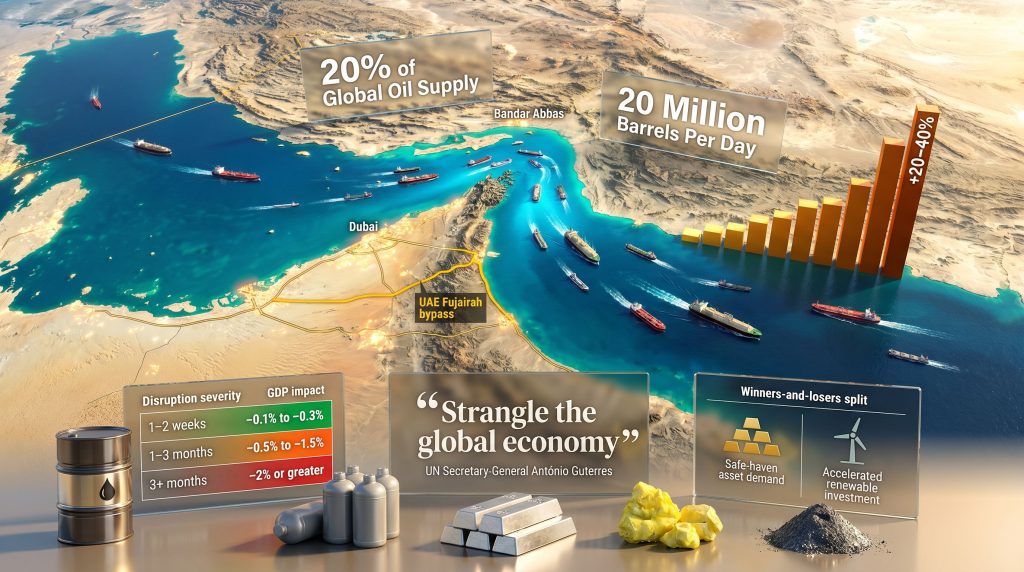
Approximately 20 million barrels of crude oil and petroleum products move through this passage every single day, representing close to 20% of total global oil supply. Qatar, the world's leading exporter of liquefied natural gas by some measures, routes the overwhelming majority of its exports through the same chokepoint. The LNG supply outlook for global markets therefore hinges significantly on this single passage remaining open.
What makes Hormuz particularly dangerous from a systemic perspective is the commodity diversity it carries beyond hydrocarbons:
- Ammonia and nitrogen fertilizers produced in Gulf states and critical to global agriculture
- Methanol, a key feedstock in plastics, adhesives, and fuel blending
- Aluminum, of which the Gulf region is a significant producer due to cheap energy inputs
- Sulfur, a byproduct of oil refining used extensively in fertilizer production
- Graphite, with implications for battery supply chains and advanced manufacturing
This commodity diversity means that the consequences of a Hormuz closure extend far beyond filling up a vehicle or heating a home. They reach into the food on grocery shelves, the vehicles being assembled in factories, and the batteries powering the energy transition.
The Soft Closure Problem: Why a Full Blockade Is Not Required
A critical and often underappreciated dynamic in Hormuz risk analysis is that a formal military blockade is not necessary to produce near-equivalent economic damage. Shipping markets operate on risk perception, not just physical obstruction. When war-risk insurance underwriters assess elevated threat levels in a region, premiums for vessels transiting those waters can increase by hundreds of thousands of dollars per voyage within days of an escalation event.
Shipowners facing premium spikes of this magnitude often make a commercially rational decision: avoid the route entirely until conditions stabilise. The result is functionally equivalent to a partial blockade, with cargo volumes falling sharply, freight rates rising, and downstream buyers scrambling for alternative supply. Historical experience from the Tanker War phase of the Iran-Iraq conflict (1980 to 1988) demonstrated exactly this dynamic, as hundreds of vessel attacks produced sustained oil market anxiety far exceeding the physical volume of cargo actually lost.
The lesson from the 1980s Tanker War is that market psychology, not just physical reality, determines how severely a chokepoint disruption transmits into global prices. Fear-driven avoidance can throttle supply just as effectively as a mine field.
How Oil and Energy Markets Respond to Hormuz Stress
The Mechanics of Risk Premium Expansion
Oil futures markets are forward-looking instruments that price in probability-weighted supply scenarios. When Hormuz tension escalates, traders do not wait for actual supply disruption to occur before adjusting prices. The risk premium embedded in crude futures expands almost immediately, with oil price movements driven by scenario modelling rather than observed inventory changes.
Analysis of historical disruption events suggests that even a temporary interference lasting 5 to 10 days can generate oil price increases in the range of 20 to 40%, contingent on pre-existing inventory levels and the available spare production capacity within OPEC member states. The key variable is how much cushion the system has before physical shortages materialise.
LNG spot markets face additional vulnerability because Qatar's export infrastructure has limited alternative routing options. Unlike crude oil, which can theoretically be sourced from multiple global suppliers, specific long-term LNG contracts tied to Gulf production cannot be easily substituted in the short term. Economists have warned that even a brief standoff could be sufficient to trigger a global recession.
The Strategic Petroleum Reserve Buffer and Its Limits
The US Strategic Petroleum Reserve and coordinated IEA member nation reserves represent the primary institutional mechanism for absorbing short-duration Hormuz shocks. However, the protective window this infrastructure provides is finite. Coordinated reserve releases have historically demonstrated the capacity to suppress price pressure for approximately 30 to 60 days before market fundamentals begin to reassert themselves.
For import-dependent economies across South Asia and Southeast Asia, this buffer is largely irrelevant. Nations without substantial domestic reserves face immediate price pass-through with no meaningful cushion between a Hormuz disruption event and higher fuel costs reaching consumers and industry.
Who Gains When Hormuz Is Disrupted
| Beneficiary Category | Mechanism of Gain |
|---|---|
| Non-Gulf oil exporters (US, Russia, Norway) | Higher benchmark prices amplify export revenue |
| Renewable energy developers | Fossil fuel spikes accelerate clean energy economics |
| Gold and precious metal holders | Capital flight from risk assets increases demand |
| Defense and security contractors | Government procurement budgets expand rapidly |
| Alternative logistics infrastructure operators | Rerouting demand increases utilisation and pricing power |
The Supply Chain Cascade: From Shipping to Shelves
Maritime Transport and the Rerouting Penalty
Maritime shipping carries approximately 80% of global trade by volume, making it the circulatory system of the world economy. When Hormuz becomes inhospitable, vessels face a stark choice: transit the risk zone with elevated insurance costs, or reroute around the Cape of Good Hope, adding approximately 10 to 15 additional sailing days per voyage and substantially higher fuel expenditure.
The compounding effect of simultaneous rerouting decisions across hundreds of vessels creates systemic port congestion at alternative transit hubs. This backlog effect does not stay contained to shipping schedules. It propagates downstream through distribution networks, manufacturing plants, and ultimately retail supply chains, with delays accumulating at each stage.
Manufacturing Sector Exposure Across Key Industries
Automotive industry vulnerabilities are multi-dimensional. Rising steel and aluminum costs compress margins at the production stage, while component shortages triggered by logistics delays can halt entire assembly lines. The just-in-time manufacturing model, which minimises inventory holdings to reduce cost, offers virtually no buffer against sustained disruption. Furthermore, electric vehicle supply chains carry specific additional exposure through graphite and aluminum dependencies, both of which have meaningful Gulf-region production linkages.
Chemical and petrochemical industries face direct feedstock cost increases. Petroleum-based inputs underpin the production of plastics, pharmaceuticals, synthetic fibres, fertilizers, and industrial chemicals. Gulf-region production of ammonia and methanol means that disruptions to Hormuz transit affect the input cost structure of a remarkably broad range of downstream industries, contributing to widespread supply chain disruption across multiple sectors simultaneously.
Heavy industry and construction face the dual burden of rising energy costs and delayed raw material delivery. Infrastructure projects extend in timeline and balloon in cost. Capital programs that appeared financially viable under stable energy price assumptions can rapidly become marginal or uneconomic when oil prices spike and logistics costs escalate simultaneously.
Inflation, Macroeconomic Stress, and the Stagflationary Trap
How Energy Shocks Transmit Into Broad Consumer Prices
Energy price increases function as an embedded tax across virtually every economic activity. Freight cost increases flow into retail prices for electronics, clothing, food, and household goods typically within 4 to 8 weeks of a sustained disruption. The inflationary transmission pathway is not limited to petrol prices at the pump. It reaches into the cost of every product that was transported, manufactured with energy, or grown with fertilizer.
This dynamic creates a particularly difficult environment for central banks. Raising interest rates to combat inflation simultaneously suppresses economic growth that is already weakened by supply chain disruption and elevated input costs. The stagflationary scenario, combining persistent inflation with stagnant or negative growth, is the outcome that policymakers most fear and have the fewest effective tools to address.
Disruption Duration and Economic Severity
| Disruption Duration | Estimated GDP Impact | Inflation Effect | Recession Risk |
|---|---|---|---|
| 1 to 2 weeks (soft disruption) | Minimal (-0.1% to -0.3%) | Moderate (+1 to 2% energy CPI) | Low |
| 1 to 3 months (partial closure) | Moderate (-0.5% to -1.5%) | Significant (+3 to 5% broad CPI) | Elevated in import-dependent economies |
| 3+ months (sustained blockade) | Severe (-2% or greater) | Acute inflationary shock | High; recession probable in vulnerable markets |
Emerging Market Vulnerability and Disproportionate Burden
The distributional consequences of a Hormuz disruption are deeply unequal. Advanced economies with diversified energy sources, substantial reserves, and fiscal capacity to implement subsidy programs can absorb significant shocks before welfare impacts reach ordinary citizens. Import-dependent emerging economies, particularly across South Asia, Sub-Saharan Africa, and Southeast Asia, have none of these cushions.
Higher fuel import costs simultaneously weaken currencies, increase domestic inflation, constrain government fiscal space, and reduce the policy options available to central banks. Countries relying on Gulf-sourced food and fertilizer imports compound this exposure further. The UN has assessed that in a severe and prolonged Hormuz disruption scenario, tens of millions of people could be pushed toward poverty and acute food insecurity. The IMF has similarly warned that a closure threatens the entire global economy, not merely regional stakeholders.
Food Security: The Slow-Moving Crisis Within the Crisis
Fertilizer Supply Chain Disruption and Lagged Agricultural Shocks
One of the least discussed but most consequential dimensions of a closure of the Strait of Hormuz and global economy instability involves fertilizer. The Gulf region is a major producer and exporter of ammonia-based fertilizers, which are fundamental inputs for global crop production. A disruption to fertilizer shipments does not manifest as an immediate food shortage. It operates on a lag of 6 to 12 months, as reduced fertilizer application in one growing season translates into lower crop yields in the following harvest period.
This delayed transmission makes the agricultural impact of a Hormuz closure particularly insidious. By the time food price pressures become acute, the window for policy intervention has largely passed. Countries in South Asia and Sub-Saharan Africa, already operating with thin food security margins, face the greatest exposure to this lagged shock.
Price Amplification Beyond Physical Supply
Higher fuel costs raise the operating expenses of agricultural machinery, irrigation systems, and food transportation networks simultaneously, compressing farm margins and lifting retail prices independent of any physical supply shortage. Shipping delays affecting time-sensitive agricultural imports can create localised scarcity even when global aggregate supply remains technically adequate.
Commodity futures markets add a further layer of amplification. Speculative positioning in grain and oilseed contracts typically intensifies at the first signal of Hormuz tension, front-running the physical supply effects and accelerating the price increases that eventually reach food retailers and consumers.
Food insecurity is not merely a humanitarian concern. It functions as a geopolitical accelerant, destabilising governments in import-dependent nations that are already operating under economic stress and reduced institutional capacity.
The next major ASX story will hit our subscribers first
Aviation and Tourism: Immediate Margin Compression
Jet Fuel Economics and Thin Margin Industries
The aviation sector's Hormuz exposure is direct and rapid. Jet fuel pricing tracks crude oil benchmarks closely, meaning that a Hormuz-driven oil price spike transmits into airline operating costs almost immediately. Airline profit margins in favourable conditions typically range between 2 and 5%, leaving almost no buffer against sustained fuel cost increases.
Hedging programs can provide protection extending 3 to 12 months forward depending on contract positions, but they offer no shelter beyond their horizon. Airlines with shorter hedge books face full exposure faster. Compounding the fuel cost issue, conflict escalation may force airspace rerouting that extends flight times, burns additional fuel, and increases crew costs simultaneously.
Middle Eastern hub carriers occupy a uniquely exposed position given their geographic positioning within the affected region, their dependence on connecting traffic flows through Gulf hub airports, and their relative concentration of routes transiting or originating near the conflict zone.
Tourism and hospitality sectors experience disruption through a different mechanism: risk perception altering travel behaviour. Geopolitical instability reduces traveller confidence not only for destinations within conflict zones but for neighbouring regions perceived as proximate risks. The economic consequences include flight cancellations, hotel revenue decline, and significant damage to economies with high tourism-to-GDP ratios.
Structural Beneficiaries and Long-Term Redirections
Defense, Renewables, and Alternative Corridors
While the near-term economic picture of a Hormuz closure is overwhelmingly negative, specific sectors and long-term structural trends benefit from the disruption dynamic. Defense and security industries experience a surge in government procurement during periods of elevated regional tension, with NATO member nations and Gulf Cooperation Council states among the most likely accelerators of weapons, cybersecurity, and surveillance investment.
Renewable energy development historically accelerates when fossil fuel prices remain elevated for extended periods. Solar, wind, and battery storage projects gain economic competitiveness relative to fossil fuel alternatives when oil prices rise sharply, while governments facing energy security pressure become more willing to fast-track domestic clean energy capacity development.
In addition, gold safe-haven demand surges during periods of heightened geopolitical tension, as investors seek to preserve capital outside of risk-exposed asset classes. This dynamic is reinforced by central bank gold demand, which tends to accelerate when confidence in the broader financial system comes under stress.
Existing bypass infrastructure gains significant strategic value during Hormuz crises. The UAE's Fujairah pipeline, with a capacity of approximately 1.5 million barrels per day, and Saudi Arabia's East-West Pipeline both provide routing options that circumvent Hormuz entirely, though their combined capacity falls far short of replacing the full volume that normally transits the strait.
Long-term, sustained disruption risk reinforces the post-pandemic trend toward supply chain regionalisation. Corporations that learned from COVID-era bottlenecks are now accelerating supplier diversification and buffer inventory strategies that reduce single-geography dependencies.
A Strategic Response Framework for Policymakers, Investors, and Businesses
For Policymakers
- Strengthen strategic reserve coordination through IEA mechanisms to ensure rapid and effective release capacity is maintained
- Invest in alternative energy infrastructure to structurally reduce Hormuz dependency over a 10 to 20 year horizon
- Build food security buffer stocks in import-dependent nations before a crisis materialises, not during it
- Maintain multilateral diplomatic frameworks focused on navigational freedom and conflict de-escalation
For Institutional Investors
- Reassess portfolio exposure to sectors with high Hormuz sensitivity including airlines, shipping, and energy-intensive manufacturing
- Consider commodity hedge positions in oil, gold, and agricultural futures as risk management instruments
- Evaluate defense sector allocations as a geopolitical risk hedge within broader portfolio construction
- Monitor emerging market currency exposure in South Asian and African economies most vulnerable to import cost shocks
- Treat geopolitical risk as a permanent structural variable in portfolio modelling rather than a periodic tail risk event
For Corporate Supply Chain Leaders
- Conduct thorough Hormuz dependency audits across tier-1 and tier-2 supplier networks to identify hidden concentrations
- Develop contingency routing plans that include alternative ports, overland logistics options, and buffer inventory thresholds
- Review war-risk insurance coverage to ensure adequacy and currency in a rapidly changing threat environment
- Accelerate supplier diversification away from single-geography input dependencies before disruption forces the issue
Frequently Asked Questions: Strait of Hormuz and the Global Economy
What percentage of global oil supply passes through the Strait of Hormuz?
Approximately 20% of global oil supply, equivalent to roughly 20 million barrels per day, transits the Strait of Hormuz daily, making it the world's single most critical energy chokepoint by volume concentration.
Has the Strait of Hormuz ever been fully closed?
The strait has never been fully closed in the modern era. However, during the Iran-Iraq War (1980 to 1988), the Tanker War phase involved hundreds of vessel attacks that created sustained shipping disruption and contributed to prolonged oil market volatility without a formal blockade ever being declared.
What commodities beyond oil are affected by a Hormuz closure?
Beyond crude oil and petroleum products, a closure disrupts LNG exports from Qatar, ammonia and fertilizer shipments, methanol, aluminum, sulfur, and graphite, creating cascading effects across agriculture, high-tech manufacturing, chemical industries, and clean energy supply chains.
How long would supply chains take to recover from a sustained Hormuz closure?
UN assessments indicate that supply chain recovery following a serious disruption could require months even under optimistic assumptions, with longer-duration blockades potentially triggering structural shifts in trade routing, energy sourcing, and supplier relationships that extend recovery timelines well beyond the period of physical disruption itself.
Which countries are most vulnerable to a Strait of Hormuz closure?
Import-dependent economies across South Asia, including India, Pakistan, and Bangladesh, as well as nations across Southeast Asia and Sub-Saharan Africa, face the greatest compounded exposure due to high fuel import dependency, limited strategic reserves, constrained fiscal capacity, and significant reliance on Gulf-region fertilizer and food imports.
Does a Hormuz closure benefit any economies or sectors?
Yes. Non-Gulf oil exporters including the United States, Russia, and Norway benefit from higher global benchmark prices. Defense contractors, gold producers, renewable energy developers, and operators of alternative logistics infrastructure also tend to experience increased demand and investment during periods of sustained Hormuz tension.
The Long Game: Resilience as the New Strategic Currency
The recurring threat of closure of the Strait of Hormuz and global economy disruption is gradually reshaping how governments, corporations, and investors think about risk itself. What was once modelled as an infrequent tail risk scenario is increasingly being treated as a structural feature of the global operating environment that must be continuously managed rather than occasionally planned for.
Nations most exposed to Hormuz disruption are among the most motivated to accelerate domestic renewable capacity, energy storage infrastructure, and grid modernisation, recognising that energy security and decarbonisation serve the same strategic objective. Corporate supply chains are shortening, diversifying, and building redundancy in ways that would have seemed unnecessarily costly before the post-pandemic era rewrote the risk calculus.
Investment in alternative trade corridors, including expanded Gulf pipeline infrastructure and broader regional connectivity projects, reflects a structural response to chokepoint vulnerability that will outlast any individual escalation episode. The organisations and nations that embed resilience as a core operational capability, rather than treating it as a contingency budget item, will be disproportionately better positioned to navigate the increasingly fragmented and volatile global order that is now taking shape.
Disclaimer: This article contains forward-looking assessments, economic projections, and scenario analyses drawn from publicly available research and institutional reports. These projections involve inherent uncertainty and should not be construed as investment advice or predictive guarantees. Readers are encouraged to consult qualified financial, economic, and geopolitical advisers before making investment or strategic decisions based on any of the scenarios described.
Want To Stay Ahead of ASX Mineral Discoveries Amid Global Market Volatility?
When geopolitical shocks like a Hormuz disruption send commodity prices surging, being first to identify significant ASX mineral discoveries can be the difference between capturing opportunity and missing it entirely — Discovery Alert's proprietary Discovery IQ model delivers real-time alerts on significant ASX mineral discoveries, instantly translating complex commodity data into actionable insights for both short-term traders and long-term investors. Explore how historic mineral discoveries have generated substantial returns and begin your 14-day free trial today to position yourself ahead of the broader market.