August 6, 2026
Energy market participants worldwide face unprecedented uncertainty as geopolitical tensions reshape traditional supply chain risk assessments. Maritime chokepoints, which have historically operated under relatively stable security frameworks, now require comprehensive reevaluation of protective mechanisms and insurance structures. The convergence of naval security operations, political risk insurance mechanisms, and energy infrastructure vulnerability creates a complex strategic landscape that demands multi-dimensional analysis.
How Critical Is the Strait of Hormuz to Global Energy Security?
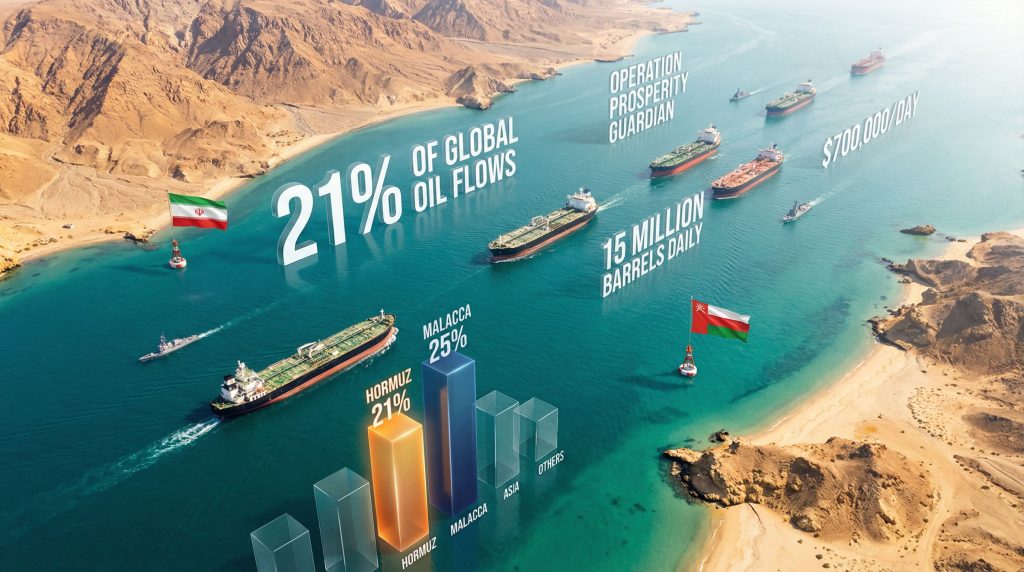
The Strait of Hormuz represents one of the world's most strategically significant maritime passages, with approximately 21 million barrels per day of crude oil and petroleum products transiting through this narrow waterway. According to the U.S. Energy Information Administration, this volume accounts for 20.8% of globally traded crude oil and 21% of all liquefied natural gas (LNG) flows worldwide.
Understanding the Chokepoint Economics
Global energy security hinges on several critical maritime passages, each presenting unique vulnerabilities and strategic importance:
| Chokepoint | Daily Transit Volume | Global Share | Strategic Importance |
|---|---|---|---|
| Strait of Hormuz | 21 million barrels | 21% of oil flows | Persian Gulf exports |
| Suez Canal | 5-6 million barrels | 12% of maritime trade | Europe-Asia connection |
| Strait of Malacca | Various commodities | 25% of traded goods | Asia-Pacific gateway |
| Panama Canal | Mixed cargo | 6% of global trade | Americas connector |
The economic implications of Hormuz closure extend far beyond simple supply mathematics. Regional production dependencies create cascading vulnerabilities throughout global energy markets. Countries such as India rely on approximately 60% of their oil imports transiting through Hormuz, while Japan and South Korea depend on this passage for 80% and 70% of their respective oil imports.
Economic Vulnerability Assessment
Geographic constraints amplify the strategic vulnerability of this passage. At its narrowest point, the Hormuz Narrows span only 21 nautical miles, creating a natural bottleneck that concentrates enormous economic value within a restricted area. Over 95% of Middle Eastern oil exports must transit this strait, with no viable alternatives existing for comparable volume capacity.
Alternative routing options present significant cost and time penalties:
• Cape of Good Hope routing: Adds 3,000+ nautical miles to typical voyages
• Suez Canal rerouting: Limited capacity for diverted Hormuz volumes
• Existing pipeline infrastructure: Insufficient capacity for full substitution
• Strategic petroleum reserve releases: Temporary mitigation requiring coordination
Furthermore, analysts suggest that comprehensive oil price rally insights demonstrate how supply disruptions amplify price volatility beyond fundamental supply-demand calculations.
A complete closure scenario would theoretically eliminate 21 million barrels daily from global markets, though alternative routing and demand destruction mechanisms could partially offset this disruption through costly and time-intensive adaptations.
Historical precedents during the 1980-1988 Iran-Iraq conflict demonstrated how maritime security threats translate into sustained price volatility. The "Tanker War" phase witnessed significant insurance cost escalation and supply chain diversification efforts that permanently altered global energy trading patterns.
When big ASX news breaks, our subscribers know first
What Naval Assets Would Be Required for Effective Tanker Escort Operations?
Modern naval escort operations demand sophisticated coordination between multiple vessel classes, each contributing specialised capabilities to comprehensive maritime security. The complexity of Trump US Navy escort tankers Strait of Hormuz operations requires careful analysis of force structure requirements and operational precedents.
Historical Precedents and Operational Models
Operation Earnest Will (1987-1988) provides the most relevant historical framework for understanding escort operation requirements. This 14-month mission involved:
| Operation Component | Assets Deployed | Operational Duration | Key Capabilities |
|---|---|---|---|
| Reflagged Kuwaiti tankers | 11 vessels | July 1987 – September 1988 | Commercial cargo capacity |
| U.S. Navy warships | 21 vessels (various classes) | 14 months | Combat protection systems |
| Mine countermeasure vessels | 6-8 specialised ships | Throughout operation | Route clearance operations |
| Support vessels | 3-4 logistics ships | Sustained presence | Maintenance and resupply |
Contemporary operations like Operation Prosperity Guardian in the Red Sea (2023-2024) demonstrate evolved multinational approaches to maritime security. This coalition effort incorporates vessels from the United States, United Kingdom, Canada, France, and other allied nations, showcasing modern coordination capabilities.
Force Structure Requirements Analysis
Effective escort operations integrate multiple naval platforms, each addressing specific threat vectors:
Primary Combat Vessels:
- Aegis-equipped destroyers (Arleigh Burke-class): Advanced phased-array radar systems (AN/SPY-1D) providing comprehensive air defence
- Guided-missile frigates: Modular mission packages enabling flexible response capabilities
- Multi-mission combat ships: Integrated combat management systems for real-time threat assessment
Specialised Support Assets:
• Mine countermeasure vessels: Hull-mounted sonar systems and autonomous mine detection capabilities
• Aviation support platforms: MH-60 Seahawk helicopters for reconnaissance and rapid response
• Unmanned aerial systems: MQ-4C Triton platforms providing persistent surveillance coverage
• Logistics vessels: Underway replenishment ships maintaining sustained operational tempo
Force protection requirements extend beyond individual vessel capabilities. Suppressing Iranian maritime threats could require 3-6 weeks of preliminary operations before effective escort services commence, according to defence analysts familiar with regional threat assessments.
Modern technological advantages since the 1987-1988 precedent include:
- Advanced radar surveillance systems with automated threat detection algorithms
- Precision-guided defensive weapons enabling selective engagement protocols
- Real-time intelligence sharing networks connecting coalition assets
- Integrated cyber defence capabilities protecting combat management systems
How Do Political Risk Insurance Mechanisms Function in Maritime Operations?
The withdrawal of commercial war risk insurance creates market voids that government intervention mechanisms must address through alternative risk management frameworks. Understanding how political risk insurance operates reveals the complexity of Trump US Navy escort tankers Strait of Hormuz insurance components.
U.S. International Development Finance Corporation Role
The DFC, established in January 2020 through consolidation of previous development finance functions, traditionally mobilises private capital for emerging market investments. However, emergency applications of DFC authority can extend into strategic maritime insurance provision during crisis periods.
Standard Political Risk Insurance Coverage:
• War and civil unrest disruptions
• Expropriation and asset confiscation risks
• Currency inconvertibility scenarios
• Government contract breach situations
The mechanism announced for Hormuz operations represents unprecedented application of DFC authority to commercial shipping insurance. Traditional DFC mandates focus on long-term development finance rather than short-term maritime risk coverage, creating operational questions about implementation timelines and coverage scope.
Commercial Insurance Market Dynamics
Maritime insurance markets demonstrate predictable response patterns during geopolitical escalations. Major maritime insurance mutuals withdrew war risk coverage for Persian Gulf operations as risk assessment models failed to quantify unprecedented threat levels.
Insurance Cost Escalation Patterns:
| Risk Environment | Premium Rate | Coverage Availability | Market Response |
|---|---|---|---|
| Pre-conflict conditions | 0.05-0.1% of vessel value | Standard commercial terms | Competitive pricing |
| Active conflict zones | 0.5-2.0% of vessel value | Limited availability | Risk assessment challenges |
| High-risk crisis periods | Up to 5% of vessel value | Market withdrawal | Government intervention required |
Private insurers utilise actuarial models based on historical loss data, but unprecedented threat scenarios create pricing uncertainty that drives market withdrawal. This pattern occurred during recent Red Sea disruptions when Houthi attacks prompted similar insurance coverage gaps.
Moreover, detailed oil price crash analysis reveals how insurance market dynamics correlate with broader commodity price volatility during geopolitical crises.
Commercial insurers viewed the geopolitical risk as unquantifiable using standard pricing models, creating market conditions that necessitate government-backed insurance alternatives.
What Are the Military-Strategic Considerations for Escort Operations?
Naval escort effectiveness depends critically on comprehensive threat suppression capabilities extending beyond simple vessel protection. The strategic framework for Trump US Navy escort tankers Strait of Hormuz operations must address multiple threat vectors simultaneously.
Threat Assessment Framework
Iranian naval capabilities present layered challenges requiring coordinated countermeasures:
- Anti-ship cruise missile systems: Land-based and naval-launched platforms with extended range capabilities
- Naval mine deployment capacity: Both conventional and smart mine technologies threatening navigation channels
- Fast attack craft swarm tactics: Asymmetric engagement strategies utilising speed and numbers
- Unmanned aerial vehicle threats: Surveillance and attack drones providing reconnaissance and strike capabilities
Geographic factors compound these threat challenges. The strait's 21-nautical-mile width at its narrowest point creates concentrated engagement zones where defensive systems face maximum stress. Shallow water conditions limit submarine operations but enhance mine warfare effectiveness.
Operational Complexity Analysis
Successful escort operations require preliminary threat suppression phases before merchant vessel protection can commence. Defence analysts project that neutralising Iranian maritime capabilities could require 3-6 weeks of preliminary operations involving:
• Mine countermeasure sweeps of designated shipping corridors
• Air defence suppression targeting anti-ship missile installations
• Electronic warfare operations disrupting command and control networks
• Intelligence gathering missions identifying mobile threat platforms
Rules of engagement considerations must balance vessel protection requirements with escalation management. Coalition partnership opportunities could distribute operational burdens while providing diplomatic legitimacy for sustained operations.
Force protection extends beyond immediate escort duties. Logistics sustainment requires secure bases, maintenance facilities, and resupply coordination. Historical analysis of Operation Earnest Will indicates that 3-4 logistics support vessels maintained every 6-8 combat ships during peak deployment periods.
Consequently, the broader US-China trade war impact on regional security calculations influences alliance coordination requirements and resource allocation priorities.
How Might Energy Markets Respond to Escort Announcements?
Market psychology during geopolitical crises creates complex price discovery mechanisms that extend beyond simple supply and demand calculations. Oil price responses to escort operation announcements reflect trader scepticism about implementation timelines and operational effectiveness.
Price Volatility Modelling
Energy market responses vary significantly based on perceived escort operation effectiveness:
| Escort Effectiveness Scenario | Brent Crude Price Range | Market Confidence Level | Risk Premium Component |
|---|---|---|---|
| Full protection achieved | $75-80/barrel | High confidence | Minimal risk premium |
| Partial protection maintained | $85-95/barrel | Moderate confidence | Elevated uncertainty |
| Failed protection operations | $110-130/barrel | Low confidence | Maximum risk pricing |
Initial market reactions to escort announcements demonstrate trader scepticism about rapid implementation. Brent crude trading near $80 per barrel after escort announcements reflected partial risk premium reduction while maintaining substantial uncertainty components.
Price volatility exceeding 10% increases since conflict initiation indicates market recognition that effective escort operations require weeks rather than days for full implementation. This timeline creates sustained uncertainty periods where speculative trading amplifies price movements.
Additionally, examining WTI/Brent futures outlook provides insight into how longer-term market expectations adjust to escort operation effectiveness assumptions.
Strategic Petroleum Reserve Implications
Government intervention capabilities extend beyond naval escorts through strategic petroleum reserve coordination. The U.S. Strategic Petroleum Reserve maintains capacity for substantial releases that could offset supply disruptions during escort implementation periods.
Reserve Release Mechanisms:
• Emergency authorisation procedures enabling rapid market intervention
• Allied coordination frameworks synchronising releases with partner nations
• Market stabilisation targets balancing supply support with reserve conservation
• Price threshold triggers activating automatic release protocols
Historical precedents indicate that strategic reserve releases provide temporary price stabilisation while longer-term supply security measures develop operational effectiveness.
What Are the Geopolitical Ramifications of Unilateral U.S. Action?
Regional alliance structures face significant stress when unilateral military interventions occur without comprehensive multilateral coordination. The broader implications of Trump US Navy escort tankers Strait of Hormuz operations extend beyond immediate maritime security concerns.
Regional Alliance Dynamics
Gulf Cooperation Council member states maintain complex relationships with both Iran and the United States, creating diplomatic challenges for escort operation support:
• Saudi Arabia: Strategic petroleum reserve coordination and alternative pipeline utilisation
• United Arab Emirates: Port facilities and logistics support for naval operations
• Kuwait: Historical precedent from Operation Earnest Will reflagging programmes
• Qatar: LNG export security concerns and regional stability priorities
European Union energy security interests align with escort operation success while creating diplomatic complications regarding military escalation. EU member states depend heavily on Middle Eastern energy imports but prefer multilateral rather than unilateral security solutions.
Furthermore, the broader global market tariff effects create additional complexity in alliance coordination as economic and security priorities sometimes conflict.
International Law and Freedom of Navigation
Naval escort operations must conform to established international legal frameworks governing maritime security:
United Nations Convention on the Law of the Sea (UNCLOS) Article 87 establishes freedom of navigation principles that support escort operations in international waters. However, proportionality requirements demand that defensive measures remain consistent with threat levels and avoid unnecessary escalation.
Legal precedents from Operation Earnest Will provide established frameworks for reflagging merchant vessels under U.S. registry, enabling direct naval protection under domestic maritime law. This mechanism transforms commercial shipping into vessels entitled to U.S. naval protection.
International law supports naval escort operations in international waters provided they maintain defensive postures and avoid disproportionate responses to regional threats.
Coalition building strategies could enhance legal legitimacy while distributing operational responsibilities. NATO Article 5 collective defence provisions do not automatically apply to commercial shipping protection, requiring separate alliance coordination for multilateral operations.
The next major ASX story will hit our subscribers first
How Could This Conflict Reshape Global Energy Infrastructure?
Crisis-driven infrastructure development typically accelerates long-term strategic projects that enhance supply chain resilience. The current Hormuz crisis catalyses investments in alternative energy transportation systems and strategic independence initiatives.
Alternative Supply Route Development
Existing pipeline infrastructure provides limited alternative capacity for Hormuz transit volumes:
| Pipeline System | Current Capacity | Expansion Potential | Strategic Significance |
|---|---|---|---|
| Saudi East-West Pipeline | 5 million bpd | Limited expansion | Red Sea alternative route |
| Iraq-Turkey Pipeline | 1.6 million bpd | Moderate expansion | Mediterranean access |
| UAE-Oman Pipeline | 1.5 million bpd | Significant expansion | Arabian Sea routing |
The Saudi East-West Pipeline represents the most significant existing alternative, capable of transporting 5 million barrels per day from Persian Gulf fields to Red Sea terminals. However, this capacity addresses only approximately 25% of normal Hormuz transit volumes.
Infrastructure development timelines extend far beyond immediate crisis resolution periods. Major pipeline construction requires 3-5 years for completion, while port facility expansion demands 2-3 years for substantial capacity additions.
Long-term Strategic Energy Independence
Crisis periods accelerate renewable energy adoption as nations seek reduced dependence on volatile supply chains. Historical analysis indicates that energy security concerns drive infrastructure investments exceeding $50 billion annually during sustained geopolitical uncertainties.
Accelerated Development Areas:
- Strategic reserve expansion programmes increasing national emergency capacity
- Alternative fuel infrastructure supporting LNG and renewable integration
- Regional energy trading networks reducing single-point-of-failure vulnerabilities
- Advanced storage technologies enabling extended supply chain disruption management
European energy independence initiatives, accelerated by previous supply disruptions, demonstrate how geopolitical crises reshape long-term energy policy frameworks. Similar accelerations could emerge globally as nations reassess supply chain vulnerabilities.
What Lessons Can Be Applied from Previous Maritime Security Operations?
Historical maritime security operations provide essential frameworks for understanding contemporary escort operation requirements and likely outcomes. Operation Earnest Will remains the most directly applicable precedent for current Hormuz escort considerations.
Operation Earnest Will Case Study Analysis
The 1987-1988 operation demonstrated both capabilities and limitations of naval escort systems during sustained regional conflicts:
Operational Successes:
• Zero reflagged vessel losses during 14-month operation period
• Effective mine countermeasure operations maintaining navigation channel security
• Coordinated air defence systems protecting convoy formations
• Sustained logistics support enabling continuous presence operations
Operational Challenges:
• Extended implementation timeline requiring months for full effectiveness
• Significant resource commitments involving 21+ naval vessels at peak deployment
• Limited commercial shipping participation due to insurance and risk concerns
• Diplomatic complications with regional allies regarding military escalation
Tactical evolution during the operation revealed adaptive threat responses requiring continuous countermeasure development. Iranian forces modified attack patterns, mine deployment strategies, and engagement protocols throughout the 14-month period.
Modern Technological Advantages
Contemporary naval capabilities provide substantial improvements over 1987-1988 technological frameworks:
- Advanced surveillance systems with automated threat detection reducing human error factors
- Precision defensive weapons enabling selective engagement without collateral damage
- Real-time intelligence networks connecting global intelligence assets
- Autonomous systems integration supplementing human decision-making capabilities
However, threat evolution parallels defensive improvements. Modern anti-ship missiles, smart mine technologies, and swarm attack capabilities present challenges unknown during Operation Earnest Will.
Key Strategic Adaptations Required:
• Cyber defence integration protecting combat management systems from electronic warfare
• Coalition coordination protocols enabling multinational force integration
• Rules of engagement frameworks addressing autonomous weapon system deployment
• Escalation management procedures preventing conflict expansion beyond maritime domains
Frequently Asked Questions About Naval Escort Operations
How Long Would Escort Operations Take to Implement?
Deployment timelines for effective naval escort systems require comprehensive preparation phases extending beyond initial announcements. Based on historical precedents and modern force structure requirements:
Phase 1 – Initial Deployment (2-3 weeks):
• Naval asset positioning in regional waters
• Intelligence gathering and threat assessment completion
• Initial escort capability for limited vessel numbers
Phase 2 – Full Operational Capacity (4-6 weeks):
• Complete mine countermeasure operations
• Comprehensive air defence network establishment
• Sustained logistics support system activation
Phase 3 – Optimised Long-term Operations (8-12 weeks):
• Refined escort procedures based on operational experience
• Enhanced coalition integration and burden-sharing
• Established maintenance and rotation schedules
Insurance framework establishment periods run parallel to naval deployment but involve separate approval and implementation processes requiring coordination between military and civilian agencies.
What Would Be the Cost to U.S. Taxpayers?
Operational cost estimates for sustained naval escort operations reflect complex resource requirements:
| Cost Category | Daily Operational Cost | Monthly Estimate | Annual Projection |
|---|---|---|---|
| Destroyer deployment | $700,000/day | $21 million | $255 million |
| Air cover operations | $300,000/day | $9 million | $110 million |
| Intelligence/surveillance | $200,000/day | $6 million | $73 million |
| Total Core Operations | $1.2 million/day | $36 million | $438 million |
Additional cost factors include:
• Logistics and maintenance support: Approximately 40% premium on operational costs
• Coalition coordination expenses: Administrative and communication system costs
• Insurance programme subsidies: Government premium support for commercial shipping
• Strategic reserve utilisation: Opportunity costs of reserve oil releases
These estimates assume moderate threat levels requiring standard escort configurations. High-intensity conflict scenarios could double or triple operational expenses through increased force requirements and accelerated equipment replacement needs.
How Effective Are Naval Escorts Against Modern Threats?
Success rate analysis from recent maritime security operations provides mixed effectiveness indicators depending on threat sophistication and operational parameters.
High Effectiveness Scenarios:
• Conventional anti-ship missile threats: 85-95% interception rates with modern defence systems
• Mine warfare threats: 90-95% route clearance success with dedicated countermeasure vessels
• Small craft swarm attacks: 70-85% threat neutralisation through coordinated defence
Moderate Effectiveness Scenarios:
• Advanced cruise missile salvos: 60-80% interception rates depending on simultaneous threat numbers
• Smart mine technologies: 75-85% detection and clearance rates with autonomous systems
• Coordinated multi-domain attacks: 50-70% threat mitigation through layered defence
Risk Mitigation vs. Elimination Expectations:
Naval escorts provide risk reduction rather than complete threat elimination. Even highly effective operations maintain residual risk levels requiring commercial insurance coverage and contingency planning for escort system failures or gaps.
Modern threat evolution continues challenging defensive capabilities through:
• Artificial intelligence integration in autonomous weapon systems
• Electronic warfare capabilities targeting naval combat management systems
• Multi-domain coordination combining air, sea, and cyber attack vectors
• Adaptive tactics responding to observed defensive patterns
For instance, recent developments in naval escort operations demonstrate both the capabilities and challenges facing modern maritime security missions.
This analysis is provided for educational and informational purposes only and does not constitute investment advice. Energy markets carry significant risks, and geopolitical events can create unpredictable price movements. Readers should conduct independent research and consult qualified financial advisors before making investment decisions related to energy securities or commodities.
Tracking the Next Energy Discovery Opportunity?
Discovery Alert's proprietary Discovery IQ model delivers real-time alerts on significant ASX mineral discoveries, including energy sector breakthroughs that could capitalise on market volatility from geopolitical developments like Strait of Hormuz tensions. With energy infrastructure reshaping and supply chain disruptions creating new investment opportunities, subscribers gain immediate insights into actionable energy and mineral discoveries ahead of broader market recognition.