August 6, 2026
How Critical Is the Strait of Hormuz to Global Energy Security?
The intersection of geography and energy security creates vulnerability points that can reshape global markets within hours. Among these critical junctures, maritime chokepoints represent the ultimate stress tests for international energy resilience, where narrow waterways control vast economic flows and strategic relationships.
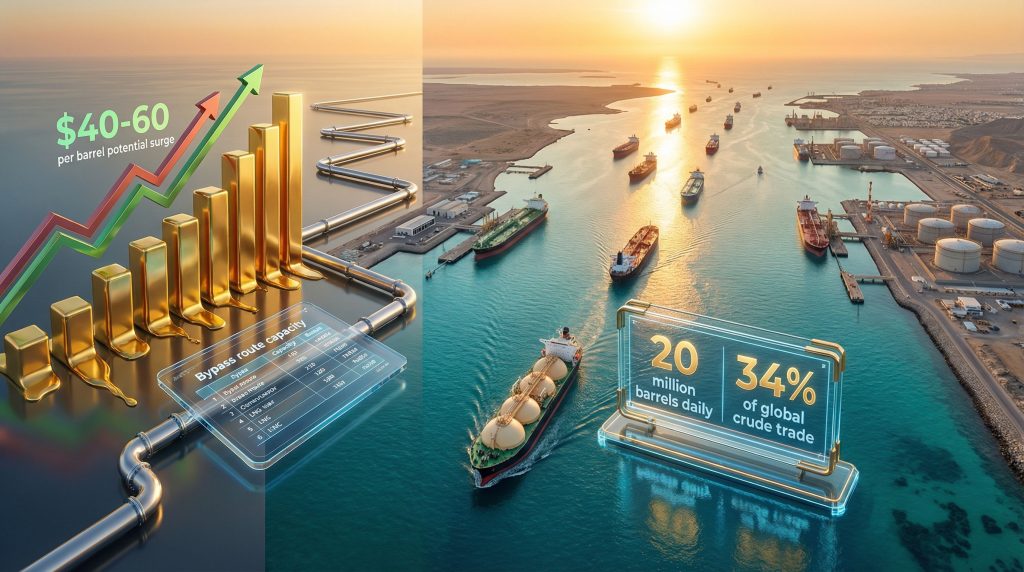
The Strait of Hormuz exemplifies this dynamic perfectly. This 21-mile-wide passage between Iran and Oman has evolved beyond a simple shipping lane into the world's most strategically significant energy artery, handling approximately 20 million barrels per day of oil flow as of 2024. Current geopolitical tensions add layers of complexity to this critical chokepoint, where oil price movements and broader market dynamics intersect with strategic vulnerability.
Understanding the World's Most Vital Energy Chokepoint
According to U.S. Energy Information Administration data, this represents roughly 20% of global petroleum liquids consumption, making any Strait of Hormuz oil supply disruption a matter of international concern. The strait's strategic importance extends beyond crude oil, encompassing Qatar's massive LNG exports that supply energy markets across Asia and Europe.
Key Strategic Dependencies:
- Daily oil throughput: 20 million barrels (2024 average)
- Global crude trade share: Approximately one-third of seaborne volumes
- LNG transit volumes: Significant portion of Qatar's exports
- Economic value: Exceeding $1.2 trillion in energy commodities annually
The concentration of energy flows through this narrow passage creates what analysts term "chokepoint vulnerability," where geographic constraints amplify any operational disruption's global impact.
Geographic and Infrastructure Vulnerabilities
Physical geography constrains the strait's capacity and creates inherent security challenges. At its narrowest shipping lanes, the passage compresses maritime traffic into predictable corridors, making vessels vulnerable to various interference methods.
Current bypass infrastructure remains limited, creating strategic dependencies that few alternatives can address:
| Bypass Route | Capacity (Million bpd) | Operational Status | Strategic Limitations |
|---|---|---|---|
| Saudi East-West Pipeline | 5.0 | Fully operational | Limited to Saudi crude only |
| UAE ADCOP Pipeline | 1.5 | Active utilisation | UAE production constraints |
| Iran Goreh-Jask Route | 1.0 | Significantly underutilised | Political barriers, limited usage |
Energy Information Administration data confirms that Iran possesses the Goreh-Jask pipeline and Jask export terminal on the Gulf of Oman, designed to circumvent the Strait of Hormuz entirely. However, this infrastructure has seen minimal utilisation over recent years, reflecting both political considerations and operational preferences.
When big ASX news breaks, our subscribers know first
What Economic Scenarios Could Unfold During a Strait Disruption?
Energy markets operate on anticipation as much as actual supply flows, creating price volatility that often precedes physical disruptions. Historical market behaviour suggests that threat perception alone can trigger significant commodity price movements, while actual supply interruptions generate exponential responses.
Immediate Market Response Framework
Analysis of market psychology reveals distinct phases of price reaction corresponding to escalating threat levels. According to Andy Lipow, president of Lipow Oil Associates, market responses follow predictable patterns: "concerns about potential closure typically add several dollars per barrel, while complete closure scenarios could trigger $10 to $20 per barrel increases."
Graduated Price Impact Assessment:
- Threat Assessment Phase: $3-5 per barrel premium above baseline
- Limited Operational Interference: $8-12 per barrel market response
- Partial Flow Restriction: $15-25 per barrel sustained increase
- Theoretical Complete Closure: $10-20 per barrel according to expert analysis
Current market conditions provide context for these projections. As of January 2026, Brent Crude reached $64 per barrel while WTI Crude approached the critical $60 threshold, representing the breakeven point for most U.S. shale producers.
Cascading Economic Effects
Energy price shocks transmit through interconnected economic systems via multiple channels, creating amplified impacts across manufacturing, transportation, and consumer sectors. These transmission mechanisms operate simultaneously, compounding overall economic effects.
Primary Economic Transmission Pathways:
- Direct Energy Cost Escalation: Immediate increases in fuel and electricity pricing
- Transportation Network Disruption: Elevated shipping and logistics expenses
- Manufacturing Sector Impact: Production slowdowns in energy-intensive industries
- Consumer Price Inflation: Rising costs across essential goods and services
- Financial Market Volatility: Currency fluctuations and commodity market instability
The interconnected nature of global supply chains means these effects compound rapidly, particularly affecting economies with limited strategic petroleum reserve capacity or high energy import dependencies. Furthermore, current tensions around US-China trade tensions could amplify these economic impacts through multiple channels.
How Would Different Disruption Scenarios Play Out?
Strategic analysis requires examining multiple disruption pathways, each carrying distinct probability assessments and impact profiles. Historical precedent suggests that complete closure represents an extremely low-probability event, while various forms of operational interference carry higher likelihood but more manageable consequences.
Scenario 1: Asymmetric Harassment Campaign
This represents the most probable disruption pattern, involving targeted interference rather than complete waterway closure. Such operations might employ naval mines, drone technologies, or proxy maritime forces to create shipping delays and elevate insurance costs.
Operational Characteristics:
- Probable Duration: 2-6 months of intermittent activity
- Flow Impact: Moderate reduction of 15-25% in daily throughput
- Market Response: $8-12 per barrel risk premium
- Mitigation Prospects: High effectiveness through naval escort operations
Historical analysis suggests this approach maximises political impact whilst avoiding direct military confrontation that could trigger overwhelming international response.
Scenario 2: Coordinated Infrastructure Strikes
A more severe scenario involving attacks on regional port facilities, loading terminals, or critical pipeline infrastructure. This approach targets the broader energy export capacity rather than maritime chokepoints specifically.
Strategic Parameters:
- Recovery Timeline: 6-18 months depending on damage severity
- Production Impact: 30-50% regional capacity reduction
- Price Volatility: $15-25 per barrel sustained elevation
- Escalation Risk: High probability of international military response
This scenario carries greater implementation complexity but potentially more lasting economic effects, making it attractive to actors seeking maximum disruption impact. Additionally, the oil chokepoints analysis shows how these vulnerabilities interconnect with broader geopolitical strategies.
Scenario 3: Full Maritime Blockade
The most extreme scenario involving complete strait closure through naval blockade or extensive mining operations. Military analysts consider this approach nearly impossible due to U.S. naval presence in the region, though it represents the ultimate market fear.
Crisis Framework:
- Implementation Probability: Extremely low (estimated under 10%)
- Global Impact: Severe disruption of 60-80% of normal flows
- Economic Consequences: Energy crisis comparable to 1970s oil shocks
- International Response: Immediate and overwhelming military intervention
Significantly, the Strait of Hormuz oil supply disruption has never experienced complete closure throughout its history, demonstrating that previous threats have not materialised into actual blockade attempts.
What Strategic Response Options Exist for Different Stakeholders?
Global energy security depends on coordinated response mechanisms spanning producer nations, consumer countries, and international organisations. Each stakeholder group maintains distinct capabilities and strategic interests that influence crisis management effectiveness.
Producer Nation Strategies
Gulf oil producers have developed varying levels of strategic flexibility to manage strait-related risks. Their response capabilities directly influence global market stability during crisis periods, with bypass infrastructure serving as critical backup systems.
Saudi Arabia's Strategic Positioning:
- East-West Pipeline capacity enabling 5 million bpd Red Sea exports
- Extensive strategic petroleum reserves exceeding 180-day supply
- Market stabilisation role as swing producer
- Regional leadership in crisis coordination
UAE Diversification Framework:
- ADCOP pipeline utilisation for bypass capability
- Fujairah terminal development as alternative export hub
- Strategic storage facility expansion
- Economic diversification reducing oil dependency
Notably, the region's approach mirrors broader patterns in energy security planning, including Saudi exploration strategy for ensuring supply chain resilience.
Consumer Nation Contingency Planning
Major oil-importing economies maintain sophisticated strategic petroleum reserve systems specifically designed for chokepoint disruption scenarios. These emergency stockpiles provide crucial buffer capacity during supply interruptions.
Strategic Reserve Deployment Capabilities:
| Country/Region | Reserve Duration | Release Authority | Coordination Protocol |
|---|---|---|---|
| United States | 90+ day supply | Presidential directive | IEA multilateral coordination |
| China | 100+ day capacity | State Council authorisation | Bilateral partnership agreements |
| Japan | 200+ day reserves | METI ministerial approval | Regional sharing mechanisms |
| European Union | 90+ day minimum | Commission coordination | Collective response framework |
These reserves represent over 1.5 billion barrels of emergency release capacity, providing substantial market intervention capability during crisis periods.
International Response Mechanisms
The International Energy Agency maintains comprehensive emergency protocols for major supply disruptions, including coordinated strategic reserve releases and demand management measures across 31 member countries.
Multilateral Crisis Response Tools:
- Coordinated emergency reserve releases across member nations
- Emergency oil sharing agreements and allocation mechanisms
- Demand restraint measures targeting transportation and industrial sectors
- Alternative supply source activation through non-OPEC producers
These mechanisms proved effective during previous energy crises, though Strait of Hormuz oil supply disruption would represent an unprecedented scale of intervention requirement.
How Do Current Geopolitical Tensions Affect Disruption Probabilities?
Contemporary geopolitical dynamics create multiple layers of escalation risk and deterrent factors that influence disruption probability assessments. Current tensions between the United States and Iran, combined with regional proxy conflicts, shape both threat credibility and response calculations.
Iran's Strategic Calculus
Iranian decision-making regarding strait-related threats reflects complex domestic and international pressures. Recent protest suppression and renewed U.S. sanctions create political incentives for demonstrating strength, whilst economic realities constrain extreme escalation options.
Escalation Pressure Factors:
- Domestic political instability requiring regime strength demonstrations
- Economic sanctions intensifying financial pressures
- Regional proxy conflicts creating spillover tensions
- Nuclear programme negotiations influencing diplomatic positioning
Strategic Deterrent Considerations:
- Iran's own energy export dependence on strait transit
- Risk of complete international isolation
- Overwhelming military retaliation probability
- Regional stability concerns affecting neighbouring allies
Current U.S. administration policies add complexity to Iranian calculations. President Trump's January 2026 announcement of 25% tariffs on countries conducting business with Iran demonstrates escalating economic pressure that could influence Iranian strategic responses. These developments connect to broader patterns of tariffs and trade impact on global market stability.
Regional Power Dynamics
Gulf region alliance structures create multiple conflict potential sources and resolution mechanisms simultaneously. Regional powers maintain cooperative relationships in energy markets whilst competing for political influence.
Key Regional Strategic Positions:
- Saudi Arabia: Market stability leadership and bypass infrastructure control
- UAE: Commercial hub protection and alternative route development
- Qatar: LNG export security and neutral mediation capabilities
- Kuwait and Iraq: Production continuity concerns and transit dependencies
- Oman: Geographic positioning and historical neutral mediation role
These complex relationships create both conflict escalation risks and diplomatic resolution pathways that influence crisis development patterns. Moreover, tensions between major powers continue to shape regional strategic calculations.
The next major ASX story will hit our subscribers first
What Long-Term Strategic Adaptations Are Emerging?
Persistent Strait of Hormuz vulnerability has accelerated infrastructure investments designed to reduce chokepoint dependency. These developments represent fundamental shifts in global energy geography and strategic relationships that extend beyond immediate crisis management.
Infrastructure Diversification Initiatives
Regional powers continue developing alternative energy transportation routes that could reshape traditional dependency patterns. Whilst these projects require substantial investment and time, they offer long-term risk reduction benefits.
Major Infrastructure Development Projects:
- Saudi-Jordan pipeline proposals for Mediterranean access
- UAE-India energy connectivity initiatives
- Iran-Pakistan regional gas pipeline development
- Qatar-Kuwait causeway enhancing distribution networks
These projects reflect broader trends toward energy route diversification, though implementation timelines span multiple decades and require sustained political commitment.
Alternative Energy Transition Impact
Global renewable energy adoption creates new strategic dynamics around traditional chokepoint vulnerabilities. Whilst reducing long-term fossil fuel dependency, this transition simultaneously creates new critical material supply chain vulnerabilities.
Strategic Energy Transition Considerations:
- Critical mineral supply chain concentration in specific regions
- Renewable energy infrastructure security requirements
- Electrical grid interconnection vulnerability points
- Energy storage system material dependencies
These emerging dependencies suggest that energy security challenges will evolve rather than disappear as global energy systems transition toward alternative sources. However, current energy transition challenges demonstrate the complexity of this process across different economic contexts.
Technological Mitigation Solutions
Advanced monitoring and response technologies offer new approaches to managing chokepoint risks through improved situational awareness and crisis response coordination.
Emerging Technological Capabilities:
- Advanced satellite monitoring systems for real-time traffic analysis
- Autonomous shipping platforms reducing human crew vulnerabilities
- Floating storage solutions providing flexible capacity
- Enhanced crisis response coordination through digital platforms
These technological developments provide additional tools for risk management, though they cannot eliminate fundamental geographic vulnerabilities created by energy flow concentration.
The Strait of Hormuz oil supply disruption scenario remains among the most significant risks facing global energy markets. Whilst complete closure appears highly unlikely given current deterrent factors, various forms of operational interference carry higher probability and substantial economic consequences. Strategic preparations across producer nations, consumer countries, and international organisations provide multiple layers of crisis response capability, though the scale of potential disruption would test these systems' ultimate effectiveness.
Understanding these dynamics requires balancing theoretical worst-case scenarios against practical political and military realities that constrain extreme escalation options. Market participants continue pricing uncertainty rather than catastrophe, reflecting expert assessments that favour limited disruption scenarios over complete chokepoint closure.
Looking for Early Insights Into Energy Market Disruptions?
Discovery Alert's proprietary Discovery IQ model delivers real-time alerts on significant ASX mineral discoveries, helping subscribers identify actionable opportunities including energy sector developments ahead of market movements. Stay informed about critical developments that could impact your portfolio by beginning your 30-day free trial today and secure your competitive advantage in volatile markets.