
June 24, 2026
The World's Most Vulnerable Energy Corridor Is Back in Motion
Every barrel of oil and every cubic metre of LNG that leaves the Persian Gulf carries with it an invisible geopolitical premium — one priced by the ever-present possibility that the Strait of Hormuz could close. For most of the past several decades, this risk remained theoretical. In early 2026, it became reality.
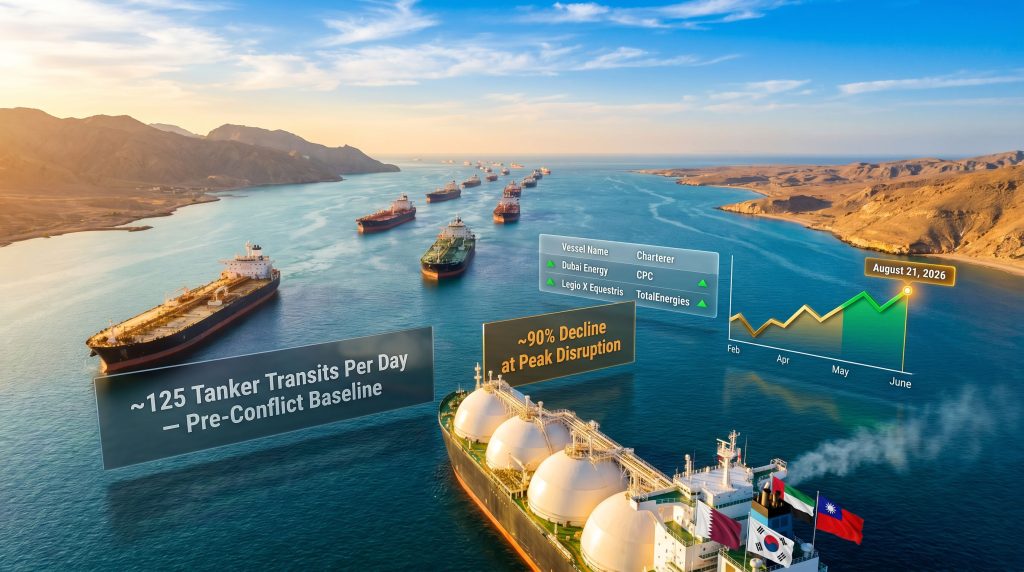
The near-total suspension of tanker traffic through the strait following US and Israeli military strikes against Iranian targets on February 28, 2026 represented the most severe disruption to Gulf energy logistics in modern history. At its worst, traffic through the waterway declined by approximately 90% compared to pre-conflict baseline levels — a collapse that sent shockwaves through LNG spot markets, crude oil benchmarks, and energy security planning rooms from Tokyo to Brussels.
Now, ship-tracking data from Vortexa and Kpler is showing something the energy world has been waiting months to see: Gulf gas shipping resuming in the Strait of Hormuz, however cautiously, however partially. Understanding what this recovery actually represents — and what it does not — requires looking beyond the headline vessel movements and into the structural mechanics of how energy chokepoints, insurance markets, and diplomatic frameworks interact.
When big ASX news breaks, our subscribers know first
Why the Strait Cannot Be Bypassed or Replicated
Before examining the recovery data, it is worth appreciating just how irreplaceable the Strait of Hormuz is within global energy infrastructure. At its narrowest navigable point, the waterway spans roughly 33 kilometres, yet it functions as the sole maritime exit for hydrocarbon exports from Qatar, the UAE, Kuwait, Iraq, and Iran combined.
Prior to the February 2026 disruption, the strait accommodated approximately 125 tanker transits per day, encompassing both crude oil supertankers and LNG carriers. Analysts estimate that around 20-21% of global oil trade and close to one-third of global LNG supply pass through this single passage annually, according to figures widely cited by the US Energy Information Administration and energy market analysts. The global LNG supply outlook makes clear just how structurally exposed the world remains to this single corridor.
The absence of any viable bypass route is what elevates Hormuz from a significant chokepoint to a genuinely systemic one. Consider the alternatives:
| Alternative Route | Core Limitation | Additional Transit Time |
|---|---|---|
| Suez Canal via Red Sea | Limited VLCC compatibility | +7 to 10 days |
| Cape of Good Hope | No bypass infrastructure | +15 to 20 days |
| Trans-Arabian Pipeline (IPSA) | Crude only, partial volume capacity | Partial relief only |
| Strait of Malacca | Downstream transit, no upstream bypass | Not applicable |
Crucially, Qatar has no alternative export route for its LNG output whatsoever. Unlike Saudi Arabia, which can divert some crude volumes through the East-West Pipeline to Yanbu on the Red Sea coast, Qatari LNG produced at Ras Laffan has only one way out: through the Persian Gulf and the strait. This structural reality means that any sustained disruption to Hormuz is, by definition, a disruption to global LNG supply architecture.
What the February 2026 Disruption Actually Did to Shipping Markets
The mechanics of how a military conflict translates into a shipping market collapse involve three distinct layers operating simultaneously, and understanding them helps explain why the recovery is proceeding so carefully.
Layer one was direct security risk. Tanker operators faced a credible threat environment that made transit commercially indefensible regardless of cargo value. Vessel crews, owners, and charterers all carried liability exposure that no freight rate could adequately compensate.
Layer two was the physical mine threat. Mine deployments within the primary pre-conflict shipping lane created an obstacle that persisted independently of geopolitical developments. Diplomatic progress does not deactivate ordinance. This meant that even as bilateral tensions began to ease, the operational environment remained hazardous for vessels attempting to use historically established transit corridors.
Layer three was insurance market withdrawal. War risk premiums escalated to levels that made commercial operations economically unviable for the majority of operators. Shipping insurance markets function on forward-looking probabilistic models, and underwriters require sustained evidence of incident-free transits — typically measured in weeks rather than days — before normalising their pricing. Elevated premiums effectively act as a secondary blockade even when the geopolitical one begins to lift.
The interaction between these three layers explains a counterintuitive dynamic: diplomatic breakthroughs can improve geopolitical risk optics almost immediately, but they cannot produce an overnight recovery in physical shipping volumes. The mine clearance problem and the insurance repricing process both operate on their own independent timelines.
How Do Oil Market Disruptions Compare Historically?
The oil market disruption risks seen during this period are broadly consistent with patterns observed during other major geopolitical flashpoints. However, the 2026 Hormuz crisis is distinctive in its simultaneous impact on both crude oil and LNG flows, making it structurally more complex than previous disruption events. Furthermore, the geopolitical oil price drivers at play here extend well beyond the strait itself, encompassing US-Iran diplomatic dynamics and broader regional instability.
Reading the Recovery Data: What Ship-Tracking Actually Shows
The vessel movements documented by Vortexa and Kpler in mid-to-late June 2026 represent the most meaningful positive signal in Gulf energy logistics since the conflict began. However, the data needs to be interpreted carefully rather than treated as evidence of a return to normalcy.
Documented movements as of late June 2026:
- Seven QatarEnergy-controlled ballast LNG tankers transited westward into the Gulf between June 11 and June 22 — the first such movements recorded since February 28
- Three previously stranded supertankers successfully navigated the strait outbound
- Two Trafigura-operated Very Large Crude Carriers, each carrying approximately 2 million barrels of crude oil, exited the strait
- Iranian-linked tankers increased transit frequency from Monday, June 23, as US-Iran talks progressed
The charterer identities embedded in this data are particularly revealing:
| Vessel | Operator | Charterer | Cargo |
|---|---|---|---|
| Dubai Energy (VLCC) | Trafigura | CPC, Taiwan state energy | ~2 million barrels crude |
| Legio X Equestris (VLCC) | Trafigura | TotalEnergies | ~2 million barrels crude |
| Universal Glory (VLCC) | Independent | GS Caltex, South Korea | ~2 million barrels Saudi crude |
| 7x QatarEnergy LNG tankers | QatarEnergy | Internal reloading operations | Ballast (inbound, empty) |
The participation of state-backed energy firms from Taiwan and South Korea as early-mover charterers is not incidental. Both countries are heavily dependent on Gulf crude imports and experienced acute supply anxiety during the disruption period. Their willingness to re-engage before the broader market suggests that energy security imperatives are overriding normal commercial risk-aversion frameworks — a signal that Asian buyers are prioritising supply restoration over price optimisation.
The Diplomatic Architecture Driving the Recovery
The resumption of tanker movements did not emerge organically from improved security conditions alone. It was directly catalysed by a specific sequence of diplomatic developments that compressed the perceived risk timeline significantly.
- Sunday, June 22, 2026: The first round of formal US-Iran talks commenced
- Monday, June 23, 2026: Talks concluded with both parties agreeing to a roadmap targeting a permanent agreement within 60 days
- Concurrent announcement: The US confirmed a sanctions waiver valid until August 21, 2026, reducing enforcement pressure on Iranian oil export flows
- Market response: Global oil and LNG prices moved lower as the supply risk premium embedded in forward contracts began to deflate
It is important to distinguish between what this diplomatic progress actually achieved and what it did not. The sanctions waiver is a time-bounded instrument, not a structural resolution. The 60-day framework for a permanent deal means the window between late June and late August 2026 represents the decisive period for determining whether the Hormuz recovery acquires durable foundations or remains fragile.
The waiver's expiry on August 21 creates a hard deadline that energy markets cannot ignore. If negotiations stall or collapse before that date, the risk environment could deteriorate rapidly, and the tentative recovery in shipping volumes could reverse just as quickly as it began.
What Role Does OPEC Play in This Environment?
In addition to the diplomatic dynamics, OPEC's market influence remains a critical variable. OPEC members within the Gulf are directly affected by restricted access to the strait, and the organisation's ability to manage collective output decisions is itself constrained when physical export infrastructure is compromised. Consequently, a durable Hormuz recovery is also a precondition for meaningful OPEC supply management.
Quantifying the Gap: How Far the Recovery Still Has to Travel
Encouraging as the early vessel movements are, the current operational picture remains a substantial distance from pre-conflict conditions:
| Metric | Pre-Conflict Baseline | Late June 2026 Status |
|---|---|---|
| Daily tanker transits | ~125 per day | Significantly below baseline |
| QatarEnergy LNG westbound sailings | Regular, continuous | 7 vessels over an 11-day window |
| Traffic decline at peak disruption | Baseline | ~90% reduction at worst point |
| ADNOC ballast vessel movements | Regular | Not widely observed |
| Primary shipping lane status | Fully operational | Partially restricted by mine threat |
The absence of widespread ADNOC ballast vessel movements stands out as a meaningful data point. The Abu Dhabi National Oil Company's more conservative re-entry posture compared to QatarEnergy suggests that different operators within the Gulf Arab producer group are applying different risk tolerances — and that institutional confidence has not yet reached the threshold required for broad-based operational normalisation.
The next major ASX story will hit our subscribers first
Three Barriers That Diplomatic Progress Cannot Resolve Alone
Mine clearance and lane safety remains the most operationally immediate obstacle. Mines within the historically dominant shipping corridor cannot be neutralised by diplomatic agreements. Until formal mine clearance operations are confirmed or alternative routes are insurer-approved, vessel operators face an unresolved physical hazard that constrains their choices regardless of the geopolitical backdrop.
War risk insurance market repricing operates on a timeline determined by actuarial logic rather than diplomatic calendars. Underwriters observe incident-free passage over sustained periods before adjusting risk models downward. Until premiums normalise, the commercial economics of full-volume operations remain impaired for many operators, effectively acting as an invisible ceiling on recovery speed.
The 60-day diplomatic clock introduces structural uncertainty that shapes forward planning across the entire supply chain. Charterers booking voyages, refineries planning feedstock schedules, and LNG buyers managing contract positions all face the same underlying question: does the current recovery environment persist beyond August 21, or does it unravel? According to UN reporting on the crisis, the humanitarian and economic stakes of a renewed disruption would be considerable, adding further pressure to negotiators on both sides.
What a Full Recovery Would Mean for Global Energy Pricing
The partial resumption of Gulf gas shipping through the Strait of Hormuz has already begun exerting downward pressure on energy markets, as the risk premium built into crude oil and LNG contracts starts to unwind. Moreover, the broader oil price movements observed in global markets reflect just how sensitively benchmarks respond to Hormuz-related developments. A complete operational recovery would carry considerably more significant pricing consequences across multiple markets simultaneously.
- LNG spot markets: European and Asian spot prices incorporated a substantial Hormuz disruption premium throughout the conflict period. Full restoration of Qatari LNG flows would apply structural downward pressure as supply normalises relative to contracted volumes
- Crude oil benchmarks: The return of stranded Gulf Arab cargoes to global circulation would weigh on both Brent and WTI, particularly as accumulated inventory shortfalls in Asian refining systems get addressed
- Asian refinery input costs: South Korean, Taiwanese, Japanese, and Indian refiners — all structurally dependent on Gulf crude — would experience meaningful feedstock cost relief
- Energy security planning: The disruption has accelerated conversations about the strategic value of US LNG export capacity as a geographically diversified, Hormuz-independent supply source
A less commonly appreciated dynamic involves the stranded cargo overhang. Multiple supertankers loaded with Gulf crude have been effectively immobilised for months. As these vessels begin moving, they create a short-term supply surge that could temporarily overshoot market expectations on the downside for crude pricing — a phenomenon sometimes described in tanker markets as a cargo release event.
The Longer-Term Structural Question Hormuz Has Raised
Beyond the immediate recovery narrative, the 2026 Strait of Hormuz crisis has reframed a debate that energy security strategists have long treated as theoretical: what happens when the world's single most consequential energy chokepoint actually closes?
The answer, it turns out, involves cascading effects across insurance markets, refinery feedstock planning, LNG spot pricing, and diplomatic frameworks simultaneously — and the recovery proves to be considerably slower and more conditional than the disruption itself. This asymmetry between how quickly a chokepoint can be closed and how slowly confidence can be rebuilt is perhaps the most important structural lesson of the 2026 Hormuz event.
For energy market participants, the current moment demands a dual-track assessment: monitoring the near-term vessel movement data for evidence of sustained recovery momentum, while simultaneously tracking the US-Iran diplomatic process as the variable that will ultimately determine whether Gulf gas shipping resuming in the Strait of Hormuz translates into a durable new baseline or a temporary reprieve before the next disruption.
This article contains forward-looking statements and market assessments based on available ship-tracking data and publicly reported diplomatic developments as of late June 2026. Energy market conditions can change rapidly, and readers should not treat any analysis herein as financial or investment advice. Independent verification of all data points is recommended before making commercial or investment decisions.
Want to Capitalise on Energy Market Shifts Before the Broader Market Catches On?
Discovery Alert's proprietary Discovery IQ model delivers real-time alerts on significant ASX mineral discoveries — including those tied to the energy commodities most sensitive to geopolitical disruptions like the Hormuz crisis — instantly translating complex market signals into actionable opportunities for both traders and long-term investors. Explore how historic discoveries have generated substantial returns on Discovery Alert's dedicated discoveries page, and begin your 14-day free trial today to position yourself ahead of the market.