August 9, 2026
The global energy system faces unprecedented vulnerabilities as critical maritime passages become flashpoints for economic disruption. The Strait of Hormuz impact exemplifies how geographic bottlenecks can transform regional tensions into worldwide economic crises, affecting everything from household cooking fuel to industrial production across multiple continents.
Understanding the Strategic Importance of Global Energy Transit Routes
Modern energy security depends heavily on a small number of critical maritime passages that channel the majority of global hydrocarbon flows. These chokepoints represent fundamental vulnerabilities in the international energy system, where geographic constraints create unavoidable concentration risks for energy-dependent economies.
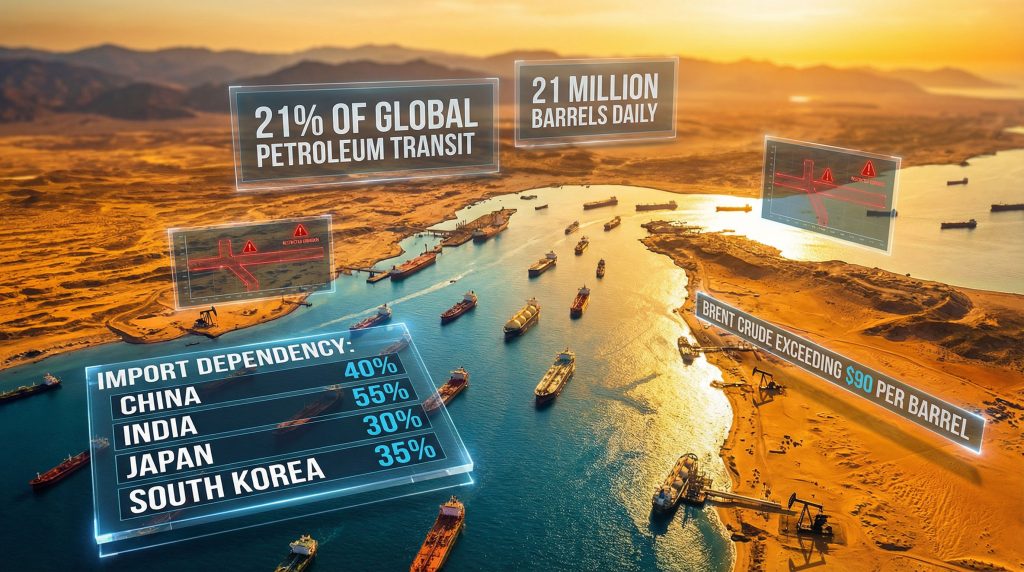
The Strait of Hormuz impact demonstrates how a narrow waterway measuring just 21 miles at its widest point can control approximately 21% of global petroleum liquids transit. This passage facilitates daily throughput exceeding 21 million barrels of crude oil, making it the primary arterial system for global energy commerce. The strategic constraints are severe: navigation channels are restricted to 2-mile corridors in each direction, separated by a 2-mile buffer zone, creating operational bottlenecks even during normal conditions.
Key Geographic Vulnerabilities:
• Navigation channels limited to 4 miles total width for bidirectional traffic
• Single maritime exit serving six major hydrocarbon producers
• No viable pipeline alternatives for Gulf state petroleum exports
• 50-mile passage length creating extended vulnerability zone
• Iranian territorial waters adding geopolitical complexity
The passage serves as the sole maritime exit for major oil and gas producing nations including Saudi Arabia, Kuwait, Iran, Iraq, Qatar, and the United Arab Emirates. This geographic concentration means that any disruption whether military, accidental, or weather-related has immediate cascading effects across global energy markets with no short-term alternative routing available.
When big ASX news breaks, our subscribers know first
Energy Import Dependencies Create Regional Vulnerability Patterns
Asian economies demonstrate particularly acute exposure to chokepoint disruptions due to their heavy reliance on energy imports and geographic distance from alternative supply sources. This structural vulnerability reflects decades of economic development prioritising cost efficiency over supply chain resilience.
India exemplifies these dependencies, importing approximately 88% of its crude oil, 50% of its LNG requirements, and 60% of its LPG needs, with the majority transiting through affected corridors. Furthermore, the nation's LPG consumption totalled 31.3 million tonnes in 2024-25, with only 12.8 million tonnes produced domestically, creating substantial import dependency for this essential household fuel.
Regional Import Dependency Analysis:
| Economy | Crude Oil Import Ratio | LNG Dependency | Primary Supply Route |
|---|---|---|---|
| India | 88% imports | 50% LNG needs | Strait of Hormuz |
| China | Substantial dependency | 30% LNG imports | Multiple routes |
| Japan | High import reliance | Critical LNG needs | Pacific shipping |
| South Korea | Major importer | Significant LNG use | Northeast Asia routes |
Before the current disruption, approximately 55% of India's LPG supplies used for cooking arrived through the affected route, with 85-90% of LPG imports originating from Gulf countries that depend on the strait for transit. This concentration creates immediate household-level impacts when disruptions occur, forcing governments to implement emergency measures and alternative fuel strategies.
The challenge extends beyond crude oil to refined products and LNG. While crude oil markets offer greater flexibility for source diversification, LPG sourcing proves more constrained due to limited global production capacity concentrated in the Gulf region, United States, and Canada. Alternative sourcing from North America involves 60+ day transit times compared to 10-14 days from Gulf sources, creating working capital and inventory management pressures.
Market Mechanisms Driving Energy Price Escalation During Supply Shocks
Energy price formation during chokepoint closures reflects multiple simultaneous market forces operating across different timeframes. Physical supply constraints interact with risk premium incorporation, inventory management responses, and speculative positioning to create price effects that exceed simple supply-and-demand calculations.
Current market conditions demonstrate classic supply shock characteristics, with Brent crude exceeding $90 per barrel and trajectory toward $100+ scenarios. The disruption has eliminated daily flows of 20-21 million barrels, representing approximately one-fifth of global oil transit and creating immediate scarcity premiums across energy markets. Consequently, this has had significant OPEC production impact on global stabilisation efforts.
Price Escalation Components:
• Physical supply loss: 20-21 million barrels daily capacity
• Risk premium incorporation: $10-15 per barrel additional cost
• Strategic reserve depletion: Accelerated inventory drawdown
• Futures market speculation: Forward contract premium expansion
• Insurance cost multiplication: War risk premium escalation
The two-week duration of the current disruption has created one of the most severe energy supply shocks in recent decades. Insurance markets have responded with substantial war risk premium increases, while freight costs have multiplied due to alternative routing requirements and vessel availability constraints. These transmission mechanisms mean that price increases compound as they move through the supply chain from crude oil to refined products to end consumers.
Inventory management becomes critical during extended disruptions. Refineries are operating at high capacity utilisation, in some cases exceeding 100%, attempting to maximise production from available crude oil supplies. Strategic petroleum reserves provide temporary buffering, but release volumes must be carefully managed to avoid exhausting emergency supplies during uncertain disruption timelines.
Alternative Supply Chain Adaptations and Their Limitations
Energy market disruptions accelerate structural shifts in global trade flows, forcing importers toward geographically diversified sourcing strategies. However, these adaptations reveal both the flexibility and constraints inherent in global energy infrastructure.
India's response illustrates both possibilities and limitations. The government reports sourcing LPG cargoes from the United States, Norway, Canada, Algeria, and Russia, representing significant diversification from pre-crisis Gulf concentration. For crude oil, India has expanded its source base to approximately 40 countries from 27 previously, demonstrating crude market flexibility.
Moreover, tracking WTI & Brent trends has become crucial for understanding global pricing dynamics during these supply disruptions.
Supply Source Diversification Outcomes:
• Domestic production increase: LPG output expanded 28% through refinery redirection
• Geographic expansion: Alternative sourcing from 5+ new countries
• Transportation cost increases: Longer shipping distances from North American sources
• Working capital pressures: Extended transit times requiring inventory financing
• Quality specification challenges: Different crude grades requiring refinery adjustments
However, structural limitations constrain full supply replacement. LPG sourcing faces particular challenges because global production capacity remains concentrated in specific regions, and maritime transport cannot replicate the speed and cost efficiency of pipeline delivery. The 60+ day transit time from North American LPG sources versus 10-14 day Gulf transit creates substantial working capital and inventory management burdens.
Pipeline infrastructure represents a fundamental constraint on alternative sourcing speed. While crude oil can be redirected relatively quickly through existing global shipping networks, the lack of pipeline connections from alternative LPG sources to Asian markets means that replacement supplies must utilise slower maritime transport with inherently higher costs.
Multi-Sector Economic Disruption Patterns
Energy supply shocks propagate through interconnected industrial systems via multiple transmission channels, creating cascading effects across sectors with different exposure timelines and substitution possibilities. The severity and speed of impact depend on energy intensity, inventory buffers, and alternative fuel availability.
Government response measures reveal the prioritisation hierarchy during supply constraints. Oil marketing companies allocate 20% of average monthly commercial LPG demand to ensure essential businesses continue receiving supplies, indicating severe supply constraints requiring explicit rationing mechanisms.
Sectoral Impact Transmission Timeline:
| Sector | Primary Impact | Timeline | Secondary Effects |
|---|---|---|---|
| Household cooking | Direct fuel rationing | Immediate | Kerosene substitution |
| Hospitality | Commercial LPG restrictions | 1-2 weeks | Alternative fuel adoption |
| Manufacturing | Energy cost increases | 2-4 weeks | Production adjustments |
| Agriculture | Fertiliser input costs | 4-8 weeks | Food price pressures |
| Transportation | Fuel price escalation | Immediate | Logistics cost inflation |
The hospitality sector demonstrates adaptation mechanisms under regulatory flexibility. Environmental regulators permitted biomass, refuse-derived fuel (RDF) pellets, and coal as alternate fuels for hotels and restaurants for one month, indicating that regulatory constraints limiting fuel substitution become binding during emergencies.
Manufacturing impacts manifest through both direct energy costs and supply chain disruptions. The 20% commercial LPG allocation reflects that industrial users requiring LPG receive substantially curtailed supplies, forcing production reductions or costly alternative fuel adoption. Industries with high energy intensity per unit output experience proportionally greater pressure.
Agricultural sector vulnerabilities emerge through fertiliser production constraints. Natural gas and LPG serve as essential inputs for fertiliser manufacturing, and disruption of these energy sources constrains agricultural input availability, ultimately pressuring food prices with 4-8 week lag times as inventory buffers are depleted.
Central Bank Policy Dilemmas During Energy-Driven Inflation
Monetary policy frameworks confront fundamental challenges during energy supply shocks, as these disruptions simultaneously reduce productive capacity and increase price levels. Central banks must navigate complex trade-offs between supporting economic growth and containing inflation expectations under unprecedented supply-side constraints.
Energy price shocks create particularly acute policy dilemmas for emerging market central banks because petroleum products represent essential production inputs that cannot be eliminated through demand management. Tightening monetary policy to control inflation may compound real economic damage by reducing demand precisely when productive capacity has declined due to energy constraints.
Additionally, the US-China trade war has complicated global supply chains, making energy security even more critical for emerging economies.
Central Bank Policy Considerations:
• Core versus headline inflation targeting: Energy volatility treatment
• Currency stability maintenance: Import price pass-through effects
• Financial stability implications: Energy importer stress management
• Fiscal policy coordination: Government subsidy and rationing measures
• International cooperation: Reserve sharing and emergency protocols
Emerging market economies face additional currency pressures as energy import costs increase in foreign currency terms. Central banks must balance exchange rate stability against domestic inflation control, particularly when energy import bills represent substantial portions of foreign exchange reserves.
The distinction between temporary supply shocks and persistent inflation becomes crucial for policy calibration. If disruptions are viewed as temporary, central banks may accommodate price increases to avoid unnecessary economic contraction. However, if energy costs remain elevated or inflation expectations become unanchored, more aggressive monetary tightening becomes necessary despite real economy costs.
The next major ASX story will hit our subscribers first
Strategic Reserve Management and International Cooperation
Government strategic petroleum reserves serve as critical buffer mechanisms during extended disruptions, though utilisation strategies vary significantly based on reserve sizes, economic priorities, and international coordination frameworks. These reserves provide temporary supply augmentation but cannot substitute for restored normal energy flows during prolonged crises.
Strategic Reserve Deployment Considerations:
• Coordinated International Energy Agency releases: Multilateral response protocols
• Bilateral reserve sharing agreements: Regional cooperation frameworks
• Commercial inventory supplementation: Private sector coordination
• Refined product versus crude oil prioritisation: End-use targeting
• Reserve replenishment strategies: Post-crisis inventory restoration
The effectiveness of strategic reserves depends on coordination mechanisms and scale relative to supply disruption magnitude. Daily flow disruptions of 20-21 million barrels require substantial reserve releases to maintain market stability, but finite reserve capacities limit sustainable intervention duration without compromising long-term energy security.
International cooperation through organisations like the CSIS provides essential analysis for member countries, though participation varies based on reserve levels and domestic political priorities. Regional energy partnerships can supplement global frameworks, particularly for countries with shared supply vulnerabilities or geographic proximity.
Maritime Insurance and Shipping Market Adaptations
Energy chokepoint disruptions create immediate pressures on maritime insurance and freight markets, with rate structures rapidly adjusting to reflect elevated risk assessments and operational constraints. These market adaptations represent critical transmission mechanisms from geopolitical risk to end-consumer energy prices.
War risk insurance premiums escalate substantially during regional conflicts, with insurers reassessing vessel transit probabilities and potential loss scenarios. These costs flow directly through to tanker operators and ultimately to cargo prices, creating systematic cost increases across all energy shipments regardless of actual incident occurrence.
Maritime Market Risk Adjustments:
• War risk insurance escalation: Premium multiplication during conflict
• Alternative routing calculations: Longer distance cost premiums
• Vessel availability constraints: Fleet reallocation to alternative routes
• Charter rate volatility: Spot market premium incorporation
• Port congestion effects: Alternative facility capacity limitations
Charter rates demonstrate particular volatility as available vessel capacity becomes concentrated on longer alternative routes, reducing fleet availability for normal operations. Port congestion multiplier effects emerge as alternative facilities experience capacity constraints from redirected cargo volumes.
The insurance market's risk assessment mechanisms create forward-looking price premiums that persist even after immediate threats subside, as insurers build longer-term risk scenarios into premium calculations. This creates persistent cost increases that maintain elevated energy prices beyond the duration of acute supply disruptions.
Long-Term Energy Security Infrastructure Implications
Current disruptions catalyse strategic reassessments of energy security frameworks across multiple jurisdictions, potentially accelerating infrastructure investments and policy reforms designed to reduce chokepoint vulnerabilities. These structural adaptations represent the most significant long-term economic implications of current supply shocks.
Infrastructure Development Priorities:
• Pipeline capacity expansion: Overland alternatives to maritime transit
• Renewable energy acceleration: Domestic supply diversification
• Strategic reserve expansion: Enhanced emergency buffer capacity
• Regional cooperation deepening: Shared infrastructure and emergency protocols
• Supply chain resilience investment: Redundancy over cost optimisation
Pipeline infrastructure development receives renewed attention as governments recognise the vulnerability of maritime-dependent energy systems. However, pipeline construction involves multi-year development timelines and substantial capital requirements, limiting short-term vulnerability reduction. Furthermore, countries like Australia face particular challenges with their energy export challenges in adapting to these new realities.
Renewable energy transition acceleration represents both a strategic and economic response to supply shock vulnerabilities. Domestic renewable capacity reduces import dependency and provides supply security independent of geopolitical disruptions, though intermittency and storage challenges require complementary infrastructure investments.
Regional energy cooperation frameworks gain strategic importance as countries seek to pool resources and share emergency capacity. These partnerships can provide more rapid response capabilities than global coordination mechanisms, particularly for countries with shared geographic vulnerabilities or complementary energy resource profiles.
Investment Positioning Strategies for Extended Chokepoint Scenarios
Energy supply disruptions create complex investment implications spanning multiple asset classes and geographic regions, with positioning strategies requiring careful assessment of duration probabilities, policy responses, and structural market changes. Investors must balance immediate energy sector opportunities against longer-term inflation hedging and infrastructure themes.
Investment Scenario Analysis Framework:
| Disruption Scenario | Probability Assessment | Duration Estimate | Price Target | Strategic Focus |
|---|---|---|---|---|
| Limited disruption | 65% likelihood | 1-2 months | $85-95/barrel | Energy infrastructure equity |
| Extended closure | 30% probability | 2-6 months | $100-120/barrel | Alternative supply chains |
| Severe escalation | 5% possibility | Variable timeline | $140+/barrel | Strategic reserves/renewables |
Energy sector equity valuations reflect both current price benefits and longer-term structural changes in energy security priorities. Companies with production capacity outside affected regions capture immediate market share gains, while those with alternative supply infrastructure benefit from strategic premium valuations.
Asset Class Positioning Considerations:
• Energy infrastructure debt: Alternative route financing opportunities
• Currency hedging strategies: Energy importer protection mechanisms
• Commodity futures positioning: Energy complex risk management
• Renewable energy acceleration: Long-term beneficiary identification
• Strategic reserve contractors: Government emergency response providers
Infrastructure investment opportunities emerge from government and private sector recognition of chokepoint vulnerabilities. Pipeline development, LNG terminal expansion, and strategic reserve construction represent multi-year investment themes supported by enhanced energy security priorities. Additionally, monitoring oil price movements becomes essential for timing these investments effectively.
Inflation hedging becomes crucial as energy price increases propagate through economic systems. Traditional inflation-protected securities provide partial protection, but real asset exposure through energy infrastructure, agricultural land, and commodity-linked investments offers more comprehensive coverage against supply shock-driven price increases.
Policy Coordination and Crisis Management Frameworks
International cooperation mechanisms demonstrate varying effectiveness in managing energy supply shocks, with coordination challenges amplified by competing national interests and geopolitical tensions. Effective crisis management requires pre-established protocols and shared burden-sharing frameworks that can function under stress conditions.
Multilateral Response Coordination Options:
• International Energy Agency emergency protocols: Strategic reserve coordination
• G20 energy security frameworks: Major economy policy alignment
• Regional partnership activation: Geographic cooperation mechanisms
• Humanitarian corridor establishment: Essential supply prioritisation
• Diplomatic de-escalation prioritisation: Conflict resolution mechanisms
The International Energy Agency provides established protocols for member country coordination, including strategic reserve release guidelines and information sharing mechanisms. However, effectiveness depends on member compliance and the scale of coordination relative to disruption magnitude.
Regional partnerships offer more rapid response capabilities than global frameworks, particularly for countries with shared vulnerabilities or complementary resources. Bilateral reserve sharing agreements and regional energy infrastructure can provide more immediate assistance than multilateral negotiations.
Humanitarian corridor establishment becomes essential when disruptions threaten essential energy supplies for vulnerable populations. According to UNCTAD analysis, these mechanisms require careful balance between meeting immediate needs and avoiding the creation of parallel markets that undermine broader crisis response effectiveness.
How Can Countries Build Long-Term Resilience?
The Strait of Hormuz impact on global energy systems demonstrates the urgent need for comprehensive resilience strategies. Countries must diversify their energy portfolios, invest in strategic reserves, and develop alternative transportation routes to reduce dependency on critical chokepoints.
Renewable energy investments become particularly attractive during these periods, as they offer domestic supply security independent of geopolitical risks. However, the transition requires substantial infrastructure investment and cannot immediately replace existing energy systems during acute supply shortages.
In conclusion, the current energy crisis highlights fundamental vulnerabilities in global supply chains that require both immediate management responses and longer-term structural adaptations. Successfully navigating these challenges demands coordinated international cooperation, strategic investment in resilient infrastructure, and policy frameworks that balance immediate crisis response with sustainable long-term energy security objectives.
Disclaimer: This analysis is based on publicly available information and represents economic assessment rather than investment advice. Energy market disruptions involve substantial uncertainties, and actual outcomes may differ significantly from scenario projections. Investors should conduct independent due diligence and consider professional advice before making investment decisions related to energy security or geopolitical risk exposure.
Ready to Capitalise on Energy Market Disruptions?
Discovery Alert's proprietary Discovery IQ model delivers real-time alerts on significant mining and exploration discoveries that could benefit from energy sector volatility and commodity market shifts. With global supply chains under pressure and strategic resource security becoming paramount, positioning yourself ahead of major mineral discoveries through Discovery Alert's comprehensive monitoring system ensures you're prepared for the next wave of resource sector opportunities. Begin your 14-day free trial today to secure your market-leading advantage during these unprecedented times.