June 5, 2026
The Geopolitics of a 33-Kilometre Bottleneck: Why the World's Most Dangerous Shipping Lane Keeps India Up at Night
Imagine an economic artery so narrow that two hostile nations standing on opposite shores can, between them, decide whether the lights stay on in factories across South Asia, whether household stoves ignite in Mumbai and Chennai, and whether India's refineries receive the crude oil feedstock they need to keep running. That is the structural reality of the Strait of Hormuz, and it explains why a diplomatic exchange between Iran's Foreign Minister and Omani officials in late April 2026 landed with such significance in New Delhi.
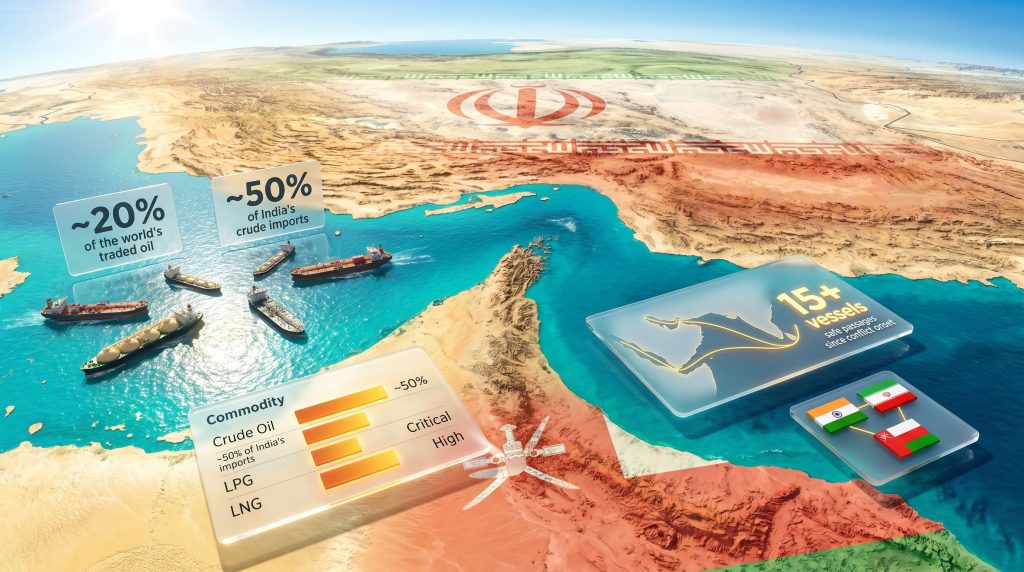
The strait is not merely a geographic curiosity. At roughly 33 kilometres across its narrowest navigable channel, it functions as a singular pressure point through which approximately 20% of the world's globally traded oil moves daily, alongside significant volumes of LNG and LPG. For India specifically, the stakes are magnified by the composition of its energy import portfolio: roughly half of the country's total crude oil imports pass through this passage, as does a growing and strategically important share of its liquefied natural gas supply. The global LNG supply outlook makes this dependency increasingly consequential for long-term planning.
Understanding why Strait of Hormuz safe transit for India has become a central foreign policy priority requires looking at both the physical geography of the waterway and the diplomatic architecture India has constructed to protect its access.
When big ASX news breaks, our subscribers know first
Why No Other Chokepoint Creates Quite This Level of Systemic Risk
Maritime chokepoints are not created equal. The Suez Canal, the Strait of Malacca, and the Panama Canal all create transit dependencies, but each has characteristics that limit their systemic leverage over any single country. Hormuz is different for several compounding reasons.
First, there is no bypass. Persian Gulf producers cannot pipe their way to alternative export terminals at a scale that replaces maritime Hormuz transit. Saudi Arabia's East-West Pipeline and the UAE's Abu Dhabi Crude Oil Pipeline provide partial relief, but their combined capacity covers only a fraction of total Persian Gulf export volumes. For Indian refineries calibrated to process Gulf crude grades, there is no practical substitute route in the short or medium term.
Second, unlike most maritime chokepoints which involve multiple littoral states and fall under complex multilateral maritime law jurisdictions, Hormuz is bordered by precisely two nations: Iran and Oman. This binary geography concentrates diplomatic leverage in an unusually tight configuration. Any disruption to transit requires only one of those two states to act, or to fail to act, and the global consequences cascade outward within days.
Third, the commodities transiting Hormuz are not interchangeable in their downstream sensitivity. Crude oil disruptions trigger refinery feedstock shortages, industrial fuel price increases, and long-term supply chain repricing. LPG disruptions hit household cooking fuel within weeks, creating immediate consumer-visible shortages with political consequences Indian governments cannot ignore. LNG disruptions affect power generation and industrial processes in ways that compound over time as inventory buffers deplete. Furthermore, oil's global economic role means these disruptions ripple well beyond India's borders.
| Commodity | India's Import Exposure via Hormuz | Primary Downstream Impact | Disruption Timeline to Consumer Visibility |
|---|---|---|---|
| Crude Oil | ~50% of total imports | Refinery feedstock, fuel pricing | Weeks to months |
| LPG | Significant share | Household cooking gas supply | Days to weeks |
| LNG | Growing share | Power generation, industrial fuel | Weeks |
How India's Supply Chain Becomes Operationally Fragile When Transit Slows
The operational consequences of Hormuz transit disruption are not hypothetical. In the period following conflict escalation beginning in early 2026, Indian shipping operators faced a situation where vessels were holding position west of the strait, awaiting transit authorisation from Iranian authorities on a case-by-case basis. Reports indicated that up to 22 ships were simultaneously stranded at various points during peak disruption periods.
LPG carriers represent the sharpest vulnerability in this scenario. Unlike crude tankers which can sustain longer holding periods with manageable cost implications, LPG carriers operate within supply window constraints that make extended delays operationally damaging. The cold-chain logistics requirements of liquefied petroleum gas mean that vessel scheduling is tightly integrated with receiving terminal capacity and domestic distribution infrastructure.
When a carrier sits west of Hormuz for an extended period, the downstream effect is not merely a delayed shipment but a misalignment of supply timing with consumer demand that can create visible shortages at the retail level. According to reporting on Indian seafarers in the strait, the Indian government has confirmed that firing incidents in the region have directly affected vessel movements, underscoring the human as well as commercial stakes involved.
Beyond commodity-specific dynamics, the financial cost of disrupted transit accumulates rapidly. Demurrage costs for large LPG carriers can reach significant daily rates, and when multiplied across multiple vessels and extended holding periods, the aggregate cost burden on Indian shipping operators and ultimately on import economics becomes material. Insurance surcharges for conflict-adjacent maritime zones add further cost layers, while freight rate volatility during periods of disruption creates pricing uncertainty across the entire supply chain.
The distinction between Indian-flagged and Indian-owned vessels becomes critically important during periods of selective transit negotiation. Vessels registered under India's national flag can benefit from diplomatic protection through bilateral channels, while Indian-owned vessels operating under flag-of-convenience registrations lack this protection and must navigate transit risk as commercial foreign-flagged shipping.
This flag distinction is a lesser-known but operationally significant aspect of how maritime transit diplomacy functions in practice. It means that India's government can negotiate transit permissions for a defined subset of its commercial shipping while the broader Indian-owned fleet operating under Panamanian, Liberian, or Marshall Islands registration faces standard commercial maritime risk without diplomatic backstop.
The Iran-Oman Framework: Why This Bilateral Dialogue Carries Weight Beyond Symbolism
When Iran's Foreign Minister Abbas Araghchi visited Oman in late April 2026 and signalled support for safe maritime passage through the strait, the significance extended well beyond diplomatic pleasantries. As the only two nations with territorial waters bordering Hormuz, Iran and Oman possess between them the practical authority to either restrict or facilitate commercial shipping through the waterway.
Araghchi's characterisation of both nations as having shared responsibility for ensuring passage that benefits regional neighbours and the broader global economy represents a form of joint institutional accountability that individual diplomatic assurances to trading partners cannot replicate. When both littoral states publicly commit to safe transit, they create a degree of reputational accountability that raises the political cost of unilateral disruption. The broader geopolitical risk landscape in 2026 has made such commitments all the more consequential for energy-dependent nations.
Oman's role in this dynamic deserves particular attention because it operates from a structurally unique geopolitical position. Muscat has maintained functional diplomatic relationships with both Tehran and Western capitals across decades of regional turbulence, including periods when most Gulf Arab states severed or severely curtailed Iran engagement. This consistency has given Oman a mediation credibility that cannot be quickly replicated by other regional actors.
For India, Oman's positioning matters for an additional reason: the two countries share what has been described as India's oldest strategic partnership in the Gulf region, built across centuries of civilisational, commercial, and increasingly defence-oriented ties. India's ability to leverage Oman's mediation capacity is therefore not a matter of transactional diplomacy but reflects genuine relationship depth that provides durable access to Omani channels. Detailed analysis of India's Hormuz dilemma suggests this relationship will remain central to any durable resolution.
A geopolitically significant but underreported development in this period involves Iran's shifting confidence in Pakistan. According to diplomatic sources, Iran's trust in Islamabad has eroded as Pakistan attempts to balance US demands related to regional peace negotiations. This dynamic indirectly benefits India's positioning in Tehran's confidence hierarchy, as New Delhi's consistent refusal to subordinate its Iran relationship to Western pressure distinguishes it from Pakistan's more accommodating posture.
India's Strategic Autonomy as a Practical Energy Security Tool
The concept of strategic autonomy is often treated as an abstract foreign policy philosophy, but in the context of Strait of Hormuz safe transit for India, it functions as a concrete operational asset.
India's refusal to formally align with any major power bloc means it maintains functional relationships with actors who are otherwise in direct opposition. New Delhi has sustained its diplomatic relationship with Tehran through periods of Western sanctions pressure, maintained close security coordination with Washington, and preserved relationships with Gulf Arab states whose political interests diverge sharply from Iran's. This multi-directional positioning is not diplomatic ambiguity but calculated strategic architecture. However, the trade war oil market impact adds further complexity, as shifting US-China dynamics reshape the broader energy trade environment in which India must operate.
The practical dividend of this posture is that India can approach Iran for transit permissions from a relationship base that most other major energy importers cannot access. Countries with explicit US security alignment, or nations that have voted against Iranian interests in multilateral forums, lack the diplomatic standing to negotiate individual vessel clearances with Tehran. India's vote at the United Nations condemning attacks on commercial shipping as violations of international maritime law, while carefully avoiding direct attribution to Iran, exemplifies the precision calibration involved in maintaining this balance.
India's approach to securing vessel transit permissions has involved several distinct diplomatic mechanisms operating simultaneously:
- Direct bilateral engagement with Iranian authorities through established foreign ministry channels
- Coordination with Oman as an intermediary with credibility in Tehran
- Participation in UK-hosted multilateral diplomatic talks where India's Foreign Secretary engaged Iranian counterparts
- Summoning of Iran's ambassador in New Delhi following specific maritime incidents, calibrated to signal concern without rupturing the broader relationship
- Communication between Prime Minister Modi and the US President to coordinate positions without formalising alignment
Furthermore, the US-China oil price tensions have indirectly shaped the environment in which India negotiates, as global crude pricing volatility during this period has heightened the urgency of reliable transit for all major importers.
A Documented Record of Transit Achievements Under Pressure
The concrete outcomes of India's diplomatic engagement, while incomplete relative to the full scope of the problem, are measurable. Since conflict escalation began in early 2026, Indian shipping has achieved transit for more than 15 vessels through a combination of coordinated diplomatic initiatives.
| Diplomatic Mechanism | Vessels Cleared | Primary Cargo |
|---|---|---|
| Initial post-conflict diplomacy | 9 vessels | Predominantly LPG |
| Foreign Secretary engagement at UK-hosted talks | 6 vessels | LPG and LNG |
| Intensified bilateral Tehran diplomacy | 2 vessels | LPG |
| Broader coordinated engagement (cumulative) | 10 vessels | Mixed cargo |
These numbers reflect genuine operational achievements, but they exist alongside a more sobering reality: approximately 15 Indian-flagged or Indian-owned vessels remained west of the strait awaiting authorisation as of late April 2026. A firing incident near the waterway during this period forced some vessels to reverse course temporarily, even while diplomatic engagement was actively underway. Transit has slowed in the most recent period, suggesting that diplomatic assurances have not yet produced normalised passage conditions.
External Affairs Minister S. Jaishankar's confirmation that no blanket transit arrangement exists, and that each vessel passage requires individual negotiation with Iranian authorities, underscores the fragility embedded in this system. It is a framework that works when bilateral relations are stable and Iranian authorities are responsive, but it provides no structural buffer against sudden deterioration.
The next major ASX story will hit our subscribers first
The Risk Scenarios That Could Rapidly Change the Equation
The current operational framework for Indian vessel transit rests on diplomatically negotiated access rather than legally guaranteed rights. Its stability depends on several conditions that are not fully within India's control.
Three scenarios represent the most material risk vectors:
- Nuclear negotiations breakdown: If US-Iran discussions over nuclear programme constraints collapse, Iran may respond through maritime pressure, including tightened transit restrictions for commercial shipping as leverage.
- Indian vessel incident escalation: A significant attack on an Indian-flagged vessel that produces casualties or major cargo loss could force New Delhi to issue a formal diplomatic response that damages the bilateral framework enabling transit negotiations.
- Oman mediation capacity constraints: If Oman faces pressure from Western partners or Gulf Arab states to harden its position on Iran engagement, its mediation capacity could diminish precisely when the situation requires it most.
Building Long-Term Resilience Beyond Diplomatic Improvisation
The immediate diplomatic work of securing vessel-by-vessel transit permissions addresses symptoms rather than the underlying structural vulnerability. A comprehensive energy security strategy requires systemic changes to both supply composition and infrastructure capacity.
On the supply diversification front, India has meaningful options across several dimensions:
- Crude oil sourcing: Accelerating procurement from West African producers, US exporters, and Russian suppliers to reduce Persian Gulf concentration in refinery feedstock
- LNG supply diversification: Expanding long-term contract coverage from Australian, East African, and American LNG exporters to reduce Persian Gulf LNG concentration below current levels
- Strategic petroleum reserves expansion: Increasing India's buffer stock capacity to extend the period during which domestic supply can be sustained without Hormuz-dependent imports
The Chabahar Port framework, while strategically significant for India-Iran relations and overland trade connectivity, has inherent limitations as a bulk energy bypass. Pipe-borne natural gas and bulk LPG and crude oil cannot realistically be rerouted through Chabahar's overland infrastructure at the volumes required to substitute for maritime Hormuz transit.
On the infrastructure and policy front, investment in floating storage capacity, domestic refinery flexibility to process a wider range of crude grades, and multilateral engagement with the International Maritime Organization to strengthen commercial shipping protections in conflict-adjacent zones all represent medium-term levers that reduce India's exposure to the leverage inherent in a 33-kilometre chokepoint.
Frequently Asked Questions: Strait of Hormuz and India's Energy Transit
Why is the Strait of Hormuz so critical to India specifically?
Approximately half of India's crude oil imports and a growing share of its LNG supply pass through the strait. No comparable maritime alternative exists for Persian Gulf energy exports at commercial scale, making unimpeded Strait of Hormuz safe transit for India functionally irreplaceable in the near to medium term.
How is India currently securing transit permissions?
India is negotiating transit authorisation on an individual vessel basis through direct diplomatic engagement with Iranian authorities, supplemented by coordination with Oman and communication with Western partners.
What makes Oman's role distinctive compared to other Gulf mediators?
As a Hormuz littoral state with decades of consistent diplomatic engagement with both Iran and Western powers, Oman possesses a combination of geographic authority and relationship credibility that other regional actors cannot replicate.
Has India formally criticised Iran's actions in the strait?
India has condemned attacks on commercial shipping at the United Nations as violations of international maritime law, while framing its position carefully to preserve its bilateral relationship with Tehran.
What would full Hormuz blockage mean for Indian consumers?
A complete disruption would produce immediate LPG shortages affecting household cooking fuel supplies, upward pressure on fuel and transport costs, and potential power generation constraints in LNG-dependent industrial zones, with cascading consumer price effects across the economy.
Disclaimer: This article draws on publicly reported information and diplomatic analysis available as of late April 2026. Forward-looking assessments regarding geopolitical scenarios, commodity supply impacts, and diplomatic outcomes are inherently speculative and should not be treated as investment advice or definitive policy forecasts. Energy security dynamics are subject to rapid change based on evolving regional conditions.
Want To Stay Ahead of the Resource Discoveries Shaping Energy Security Debates?
As geopolitical tensions reshape global energy supply chains, the commodities at the centre of these disruptions — oil, LNG, and LPG — are also driving renewed investor focus on domestic resource discovery. Discovery Alert's proprietary Discovery IQ model delivers real-time alerts on significant ASX mineral discoveries, transforming complex exploration data into actionable investment insights — explore historic discovery returns on the discoveries page and begin a 14-day free trial to position yourself ahead of the broader market.