August 7, 2026
The World's Most Pressurised Waterway Just Got More Complicated
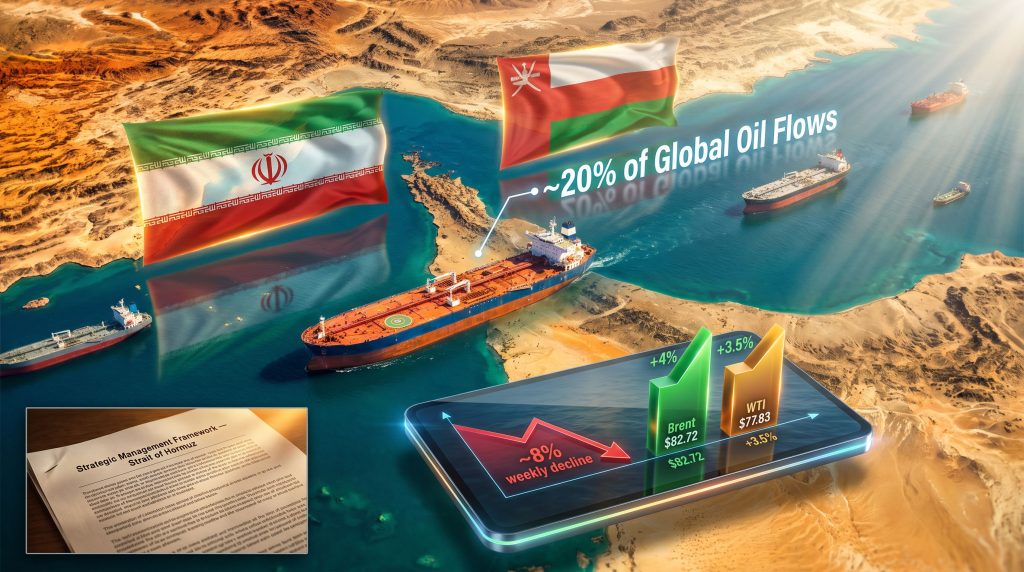
Energy markets have long understood that geopolitical risk does not require a physical event to move prices. A credible threat, a draft document, a state media publication at the wrong moment — any of these can shift billions of dollars in crude valuations within a single trading session. That dynamic was on full display in early August 2026, when the Iran draft plan for the Strait of Hormuz was published by Iranian state news agency Fars, sending Brent crude surging approximately 4% to $82.72 per barrel and U.S. West Texas Intermediate climbing roughly 3.5% to $77.83 per barrel.
For energy market participants, the publication served as a sharp reminder that the Hormuz risk premium had not disappeared — it had merely been temporarily suppressed by diplomatic optimism. Furthermore, understanding the crude price risk factors at play here requires looking well beyond surface-level price movements.
When big ASX news breaks, our subscribers know first
Understanding Why Hormuz Controls Global Energy Pricing
Before analysing the draft plan itself, it is worth grounding the discussion in the structural reality that makes this waterway so consequential. Roughly 20% of global oil supply transits the Strait of Hormuz under normal operating conditions, a figure that places it above every other maritime chokepoint in strategic importance, including the Suez Canal and the Strait of Malacca.
The nations most acutely exposed to any disruption in Hormuz transit rights are among the world's largest economies:
- China — the world's largest oil importer, with heavy reliance on Gulf crude
- Japan — a nation with virtually no domestic oil production and deep dependence on Middle Eastern supply
- South Korea — whose industrial economy depends on reliable tanker traffic through the strait
- India — a rapidly growing consumer whose refinery infrastructure is calibrated to Gulf crude grades
Any sustained restriction on Hormuz transit does not merely affect spot crude prices. It ripples into refinery throughput, energy-intensive manufacturing, inflation dynamics, and trade balances across multiple major economies simultaneously. That systemic exposure is precisely why even a draft legislative proposal — not yet enacted, not yet enforced — generates immediate and substantial market reactions.
What Iran's Draft Plan for the Strait of Hormuz Actually Proposes
The Fars publication describes the document as an initial draft of a strategic management framework for the strait. It is important to note that as of early August 2026, this draft remained under review by an Iranian parliamentary committee and had not been formally enacted into law. Analysts also note the current text may differ meaningfully from an earlier version circulated in May 2026, indicating the document has been actively revised through committee deliberation.
The core provisions of the draft, as reported, are summarised below:
| Provision | Key Detail |
|---|---|
| Vessel Bans | U.S. and Israeli-flagged or affiliated ships prohibited from transit |
| Hostile Nation Restrictions | Nations deemed to have harmed Iran blocked until compensation is received |
| Mandatory Permitting | All vessels required to obtain permits and disclose cargo contents |
| Cargo Seizure Penalties | Violations subject to penalties equivalent to 20% of cargo value |
| Enforcement Authority | Iran's armed forces general staff designated as the enforcement body |
| Sovereign Rationale | Framed as a formalisation of Iranian sovereignty over the waterway |
Several critical gaps in the draft deserve attention:
- The document does not specify enforcement procedures for vessels operating under complex ownership structures or third-party flags, which represent a substantial proportion of global tanker traffic
- It does not address how Iran intends to assert jurisdiction under existing international maritime law, specifically UNCLOS Article 38, which grants vessels the right of transit passage through international straits
- No implementation timeline or phased enforcement schedule has been attached to the draft in its currently reported form
These omissions are not trivial. They suggest the draft is either operationally incomplete or deliberately vague — both of which carry distinct strategic implications.
Iran's Dual-Track Hormuz Strategy: Coercion and Negotiation Running in Parallel
One of the most analytically significant features of Iran's current Hormuz posture is that the restrictive parliamentary draft does not exist in isolation. Simultaneously, Iran has reportedly pursued a separate diplomatic track involving Oman as a mediating party, aimed at conditionally reopening strait access under a negotiated framework.
This dual-track approach appears deliberate rather than contradictory. The comparison below illustrates how both tracks serve distinct but complementary strategic functions:
| Dimension | Parliamentary Draft | Diplomatic Track via Oman |
|---|---|---|
| Primary Objective | Assert sovereign control and impose transit restrictions | Negotiate a conditional reopening arrangement |
| Target Audience | Domestic political constituency within Iran | U.S., Oman, and international partners |
| Market Signal | Escalatory — price-positive for crude | De-escalatory — price-negative for crude |
| Enforcement Mechanism | Armed forces general staff | Multilateral negotiated framework |
| Legal Basis | Iranian domestic legislation | International agreement |
The Oman diplomatic track aligns with statements made by senior U.S. officials, including Treasury Secretary Scott Bessent and Secretary of State Marco Rubio, who in the days preceding the Fars publication indicated that a deal framework for normalising Hormuz traffic was approaching finalisation. Those statements had driven the approximately 8% weekly decline in oil prices that the draft publication then partially reversed.
Iran's dual-track strategy follows a well-established pattern in its foreign policy toolkit: domestic legislative pressure functions as a negotiating instrument rather than a firm commitment to escalation. The parliamentary draft may be better understood as a bargaining chip than an operational policy directive.
The Market Reaction: Reading Volatility as a Risk Signal
The price action surrounding the Fars publication illustrates a dynamic that energy traders and risk managers increasingly need to internalise: Hormuz-linked oil price risk is binary in structure. Markets are not pricing a smooth probability distribution of outcomes. They are oscillating sharply between two dominant scenarios — diplomatic resolution and supply disruption. This kind of market volatility reset is becoming an increasingly familiar feature of energy trading in 2026.
Consider the sequence of events:
- Senior U.S. officials signal a Hormuz deal is imminent, driving an approximately 8% weekly decline in crude prices
- Iranian state media publishes a restrictive draft transit plan, triggering a 4% single-session recovery in Brent crude
- The net effect is a week of extreme volatility without any physical change in actual oil flows
This pattern reveals something important about the current market environment: even draft legislative proposals that have not been enacted are sufficient to generate significant price movement. The market is not waiting for enforcement. It is pricing the probability distribution of enforcement and adjusting that distribution with each new signal from Tehran, Washington, and Muscat.
For institutional traders, this creates a challenging hedging environment where conventional fundamental analysis — focused on supply-demand balances — is temporarily subordinated to geopolitical signal interpretation.
Simultaneous Escalation Signals Across the Broader Gulf Region
The publication of the Hormuz draft did not occur in a vacuum. Concurrent developments across the Gulf region compounded the risk assessment for energy market participants. Indeed, the broader oil market disruption risk is being amplified by several simultaneous flashpoints:
- A tanker transiting the Strait of Hormuz reported hearing two explosions off the coast of Oman, according to a Wednesday incident report from the United Kingdom Maritime Trade Operations Centre (UKMTO). The crew and vessel were confirmed safe.
- Iran's Houthi allies in Yemen claimed attacks on Saudi Arabian military troop concentrations, while separately claiming a strike on a Saudi tanker in the Red Sea near the Yanbu export terminal.
These incidents introduce a critical structural dimension to Gulf energy risk that is sometimes underweighted in Hormuz-centric analysis: the Houthi variable creates a second simultaneous maritime chokepoint threat at the Bab-el-Mandeb Strait in the Red Sea.
Energy traders and shipping insurers are now required to price risk across two distinct but interconnected maritime threat environments at the same time. This materially increases war risk insurance premiums and rerouting costs, and introduces Saudi Arabia not only as a regional military actor but as a potential supply-side vulnerability in its own right.
The next major ASX story will hit our subscribers first
Can Iran Actually Enforce a Strait of Hormuz Restriction?
The legal and practical enforcement question is one that mainstream market commentary often oversimplifies. The reality involves several layered constraints.
The International Law Dimension
Under UNCLOS Article 38, vessels have an established right of transit passage through straits used for international navigation, and this right cannot be suspended even during peacetime. Iran and Oman share sovereignty over the strait's waters, but neither nation can unilaterally revoke transit rights under the prevailing international legal framework.
Iran has historically disputed the full applicability of UNCLOS to its territorial maritime claims, creating a legal grey zone that complicates any clean assessment of enforcement validity. This ambiguity is itself a strategic tool: it allows Tehran to assert the right to restrict passage without conceding that international law definitively prohibits it from doing so.
The Practical Operational Constraint
Iran's naval capacity to physically intercept and board large commercial tankers at scale faces significant logistical limitations, particularly against vessels operating under the flags of major naval powers with regional military presence. A comprehensive physical blockade of the kind envisaged by a strict reading of the draft plan would require sustained operational capability that Iran would struggle to maintain against likely countermeasures.
The more operationally realistic scenario is selective enforcement targeting smaller, less-protected vessels or those with indirect commercial links to U.S. or Israeli interests. This matters enormously for risk assessment:
Even partial or selective enforcement of the Hormuz draft plan would be sufficient to trigger insurance market responses, rerouting decisions, and supply disruption pricing effects — without Iran needing to physically block the strait. The economic consequences can precede and potentially exceed the physical enforcement action.
Scenario Framework: How Should Investors Map the Probability Space?
Given the complexity of overlapping signals, a structured scenario approach provides a more useful framework than a single base-case forecast. However, it is equally important to recognise how geopolitical trade tensions in other regions can interact with and amplify Hormuz-related risks.
Scenario A: Diplomatic Resolution
The Oman-mediated track produces a framework agreement normalising Hormuz transit. The parliamentary draft is shelved or significantly diluted as a concession. Brent crude returns toward pre-escalation price levels, and the geopolitical risk premium dissipates.
Scenario B: Legislative Passage Without Significant Physical Enforcement
The Iranian parliament passes a version of the draft plan, but enforcement remains selective and limited in practice. Shipping insurance premiums rise materially. Some operators reroute. Brent crude sustains a risk premium of roughly $5 to $10 per barrel above levels implied by fundamental supply and demand.
Scenario C: Physical Enforcement or Direct Interdiction
Iran moves to physically enforce transit restrictions, producing a confrontation with U.S. naval assets. Brent crude spikes significantly beyond the Scenario B range. Diplomatic channels collapse. Regional conflict risk becomes the dominant pricing variable.
Key Indicators to Monitor
- The Iranian parliamentary vote timeline on the draft plan and any committee amendments
- UKMTO incident reports from both the Strait of Hormuz and Red Sea corridors
- U.S. State Department and Treasury statements regarding deal progress and negotiating timelines
- Tanker war risk insurance premium movements, which function as a real-time market signal independent of official commentary
- Houthi operational tempo in the Red Sea as a correlated escalation indicator that can amplify Hormuz risk pricing
Frequently Asked Questions: Iran's Strait of Hormuz Draft Plan
What does the Iran draft plan for the Strait of Hormuz propose?
The draft plan, as reported by Iranian state news agency Fars, would impose strict controls on vessel transit through the strait. Core provisions include banning ships affiliated with the U.S. and Israel from passage, requiring all vessels to obtain permits and disclose cargo contents, and applying financial penalties equivalent to 20% of cargo value on any vessel found to be in violation.
Has the draft been officially enacted into law?
As of early August 2026, the draft remains under parliamentary committee review in Iran and has not been formally enacted. The full official text has not been publicly released in final form, and the proposal remains subject to further deliberation and potential modification before any parliamentary floor vote.
Why did oil prices rise so sharply on the day the draft was published?
The publication reversed a prior week of price declines that had been driven by optimism over a potential U.S.-Iran deal to normalise Hormuz traffic. The draft's restrictive provisions — particularly the proposed bans and the cargo penalty framework — were interpreted by markets as escalatory signals. Consequently, this increased the probability of supply disruption across a waterway through which roughly one-fifth of global oil flows. The oil price shock effect was felt immediately across global energy markets.
What is the difference between the parliamentary draft and the Oman diplomatic proposal?
The parliamentary draft is a hardline domestic legislative instrument designed to assert Iranian sovereign control over the strait and impose transit restrictions. The Oman diplomatic track is a separate negotiating framework aimed at conditionally reopening the strait under terms agreed with international partners. Both tracks have been simultaneously active in 2026, reflecting Tehran's strategy of maintaining pressure while preserving negotiating optionality.
Can Iran legally restrict transit through the Strait of Hormuz?
Under UNCLOS Article 38, the right of transit passage through international straits cannot be legally suspended. Iran disputes aspects of UNCLOS applicability to its territorial claims, creating legal ambiguity. A full physical blockade would face both international legal challenge and likely military response from naval powers with assets in the region.
Separating Strategic Signalling From Operational Policy
The publication of the Iran draft plan for the Strait of Hormuz through state media is most accurately understood as a strategic signalling event within an active negotiating process, rather than as an imminent shift in operational maritime policy. The simultaneous existence of a coercive parliamentary draft and a diplomatic mediation track through Oman reflects a deliberate pressure strategy designed to maximise Iran's leverage in any eventual agreement with the United States.
Markets that treat the draft as a definitive policy outcome risk mispricing the actual probability distribution of Hormuz scenarios. At the same time, markets that dismiss the draft as pure theatre risk underpricing the structural elevation of risk that now characterises this waterway.
The concurrent Houthi activity in the Red Sea adds a second layer of maritime threat complexity that extends well beyond the strait itself. For energy market participants navigating this environment, the essential analytical discipline is distinguishing between short-term price volatility driven by document publication and the longer-term structural risk trajectory. That trajectory will ultimately be determined by the outcome of U.S.-Iran negotiations, the operational choices of Iran's armed forces, and the diplomatic capacity of intermediaries like Oman to bridge a gap that remains, as of this writing, unresolved.
Disclaimer: This article contains forward-looking analysis, scenario projections, and market commentary. These represent analytical frameworks and should not be construed as investment advice. Oil prices, geopolitical developments, and legislative processes are subject to rapid and unpredictable change. Readers should conduct their own due diligence before making any investment or trading decisions.
Want to Capitalise on the Next Major Commodity Market Signal Before the Crowd?
Discovery Alert's proprietary Discovery IQ model scans ASX announcements in real time, instantly identifying actionable opportunities across more than 30 commodities — including energy-linked plays where geopolitical volatility creates the sharpest windows for decisive investors. Explore how historic mineral discoveries have generated substantial returns on Discovery Alert's discoveries page, and begin your 14-day free trial today to ensure you are positioned ahead of the broader market.