August 21, 2026
When Geography Becomes Destiny: The LNG Chokepoint That Changed Global Energy
Every decade or so, the global energy system experiences a structural shock that exposes just how fragile supply concentration really is. The 1973 oil embargo rewired Western energy policy for a generation. The 2011 Fukushima disaster upended nuclear energy's role in Asian power grids overnight. The Strait of Hormuz LNG supply loss now unfolding in 2026 belongs in that same category of defining ruptures — not because it was unpredictable, but because the concentration risk was always visible and largely unaddressed.
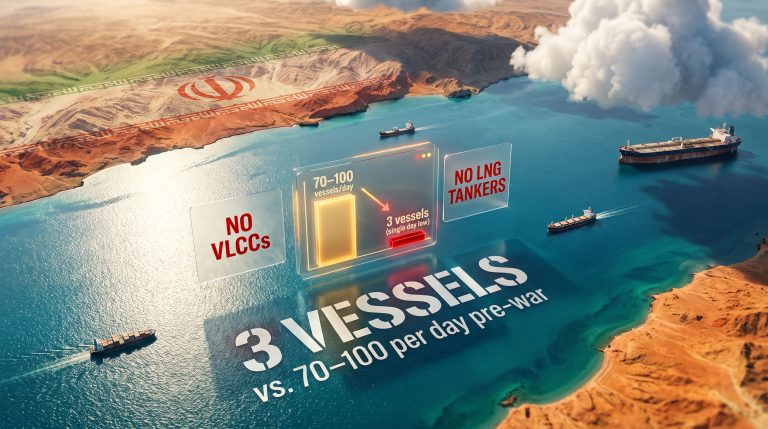
The mechanics of this crisis are deceptively simple. A single maritime passage, roughly 33 kilometres across at its narrowest navigable point, has historically served as the only viable exit route for the overwhelming majority of Gulf-origin LNG. When that passage closes, supply does not reroute. It simply stops.
When big ASX news breaks, our subscribers know first
The Architecture of a Single-Point Failure
Why the Strait Cannot Be Bypassed at Scale
Understanding the Strait of Hormuz LNG supply loss requires grasping a structural reality that took decades to embed itself into global energy infrastructure. Qatar and the UAE built their LNG export industries around the assumption of uninterrupted maritime transit through this waterway. There are no overland pipeline alternatives capable of handling LNG volumes at commercial scale, and no alternative sea route exists that connects Gulf-origin gas fields to the open ocean without passing through the Strait.
This is not merely a geopolitical inconvenience. It is a hard physical constraint. Qatar's entire LNG export architecture is anchored at Ras Laffan Industrial City, located on the northeastern coast of the Qatar Peninsula. Every liquefaction train, every loading berth, and every export cargo that leaves this facility must transit north through the Persian Gulf and out through the Strait before reaching international waters. The UAE's Das Island LNG terminal faces the same routing dependency.
The combined monthly export volume of Qatar and the UAE flowing through the Strait under normal operating conditions amounts to approximately 10 billion cubic metres (bcm) per month, according to the International Energy Agency's quarterly natural gas outlook. That single figure defines the magnitude of what is lost for every calendar month the waterway remains inaccessible to LNG carriers.
Qatar's North Field and the Scale of What Is at Stake
Qatar's dominance in global LNG markets stems from its position atop the North Field, the world's largest single natural gas reservoir, which it shares with Iran's South Pars structure across their maritime boundary. This geological endowment gave Qatar the resource base to build one of the most concentrated LNG export complexes on the planet — all located within a single industrial city and dependent on a single exit corridor.
That concentration delivered extraordinary commercial efficiency during stable periods. It now translates directly into extraordinary vulnerability during disruption. Furthermore, the broader geopolitical risk landscape across the region has compounded the structural fragility of these supply chains considerably.
Quantifying the Strait of Hormuz LNG Supply Loss: What 120 BCM Actually Means
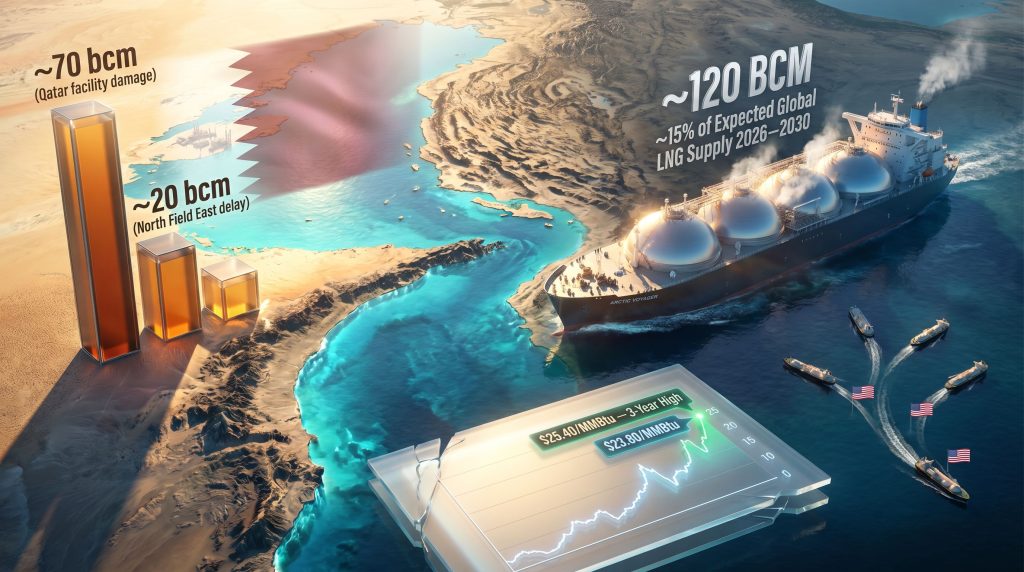
The International Energy Agency assessed in its quarterly natural gas outlook that the Middle East conflict could produce a cumulative LNG supply loss of approximately 120 bcm between 2026 and 2030, equivalent to roughly 15% of expected global LNG supply across that entire five-year window. (Reuters, Nina Chestney, April 28, 2026)
This headline figure is composed of three structurally distinct loss categories, each with a different recovery timeline:
| Loss Component | Estimated Volume | Recovery Pathway |
|---|---|---|
| Monthly transit disruption (per month closed) | ~10 bcm | Resumes when Strait reopens |
| March–April 2026 combined Qatar/UAE losses | ~20 bcm | Already crystallised |
| Qatar facility damage impact (4-year repair assumption) | ~70 bcm by 2030 | Medium-term structural loss |
| QatarEnergy North Field East expansion delay | ~20 bcm | Delayed capacity addition |
| Total cumulative projected loss (2026–2030) | ~120 bcm | Partially offset post-2027 |
The IEA noted that while new liquefaction capacity coming online elsewhere will ultimately compensate for this deficit, the impact on supply growth will be concentrated in 2026 and 2027, effectively delaying what had been widely anticipated as a major wave of global LNG supply expansion from new projects. (Reuters, Nina Chestney, April 28, 2026)
The Layered Nature of the Loss
What makes this disruption particularly difficult to model is the coexistence of two separate damage mechanisms operating simultaneously.
The first is a flow disruption: the Strait closure prevents cargoes from leaving, creating an immediate supply gap regardless of whether Qatar's production capacity is intact. The IEA confirmed that LNG supply growth came to a halt in March following the closure, with Qatar and UAE combined production effectively reduced by approximately 10 bcm for the month. (Reuters, Nina Chestney, April 28, 2026)
The second is capacity destruction: attacks on Qatar's LNG facilities at Ras Laffan caused physical damage estimated to affect nearly one-fifth of Qatar's total LNG production capacity. With a four-year repair period assumed by the IEA, this component generates a structural output reduction of approximately 70 bcm through to 2030, independent of whether the Strait eventually reopens. (Reuters, Nina Chestney, April 28, 2026)
The third dimension is project delay: the North Field East expansion, which was expected to add significant new liquefaction capacity and drive a meaningful portion of Qatar's anticipated volume growth, is now delayed. The IEA assessed this delay at nearly 20 bcm of supply reduction across the 2026–2030 period. (Reuters, Nina Chestney, April 28, 2026)
Key Analytical Point: The 120 bcm figure does not represent one problem. It represents three overlapping problems with different timelines, different recovery mechanisms, and different implications for global LNG market structure. Resolving the transit disruption does not resolve the facility damage. Repairing the facility damage does not restore the expansion capacity that has already been deferred.
Force Majeure and the Contractual Cascade
One dimension of the Strait of Hormuz LNG supply loss that receives insufficient analytical attention is its commercial and legal architecture. Long-term LNG supply agreements, particularly those connecting Qatari supply to Asian and European buyers under take-or-pay structures, allocate volume risk and price exposure between buyers and sellers. Force majeure declarations shift that risk allocation fundamentally, moving buyers from fixed-price contracted supply toward spot market exposure at precisely the moment when spot prices are most elevated.
Analysis from Edison suggests that Qatar may extend its gas force majeure declarations, with U.S. LNG positioned as the primary mechanism for bridging the volume gap during the disruption period. (Zawya, Edison Says Qatar May Extend Gas Force Majeure, Sees US LNG Filling Gap) This represents a structural commercial transformation, not merely a short-term contract interruption. Consequently, the global LNG supply outlook has shifted materially in response to these developments.
Asia Bears the Structural Weight of This Disruption
Asymmetric Regional Exposure
The geographic distribution of Hormuz-dependent LNG flows creates profoundly uneven regional exposure. Asia as a whole accounts for approximately 85–90% of Qatar and UAE LNG offtake, a concentration that reflects decades of long-term supply contract development between Gulf producers and Asian importers. Europe, by contrast, has a more diversified supply base with lower structural dependency on Hormuz-transiting volumes.
This asymmetry means that the disruption lands hardest on economies that were already managing tight energy balances. The countries facing the most acute supply compression include:
- Pakistan, which relies on Qatari LNG to meet a substantial share of its gas supply needs and has limited alternative import infrastructure
- Bangladesh, which sources a significant portion of its LNG imports from Strait-transiting volumes and faces direct power generation exposure
- India, which sources a substantial share of both its total gas supply and its LNG imports through the Strait, with industrial sector impacts already visible
- China and Taiwan, which hold major Qatari long-term contracted volumes and face the challenge of re-entering spot markets at elevated price levels
The industrial consequences are already being measured. India's oil-to-chemicals sector has reported output compression attributable to feedstock disruption, illustrating how LNG supply shocks propagate beyond power generation into industrial production chains.
Europe's Partial Insulation and Its Limits
Europe entered this disruption period with a structurally lower dependency on Hormuz-transiting LNG than its Asian counterparts. The build-out of European regasification infrastructure following the 2022 energy crisis, combined with Norwegian pipeline gas and Atlantic Basin LNG supply, provided a degree of natural insulation.
However, this insulation is partial rather than absolute. The redirection of flexible spot LNG cargoes toward price-premium Asian buyers reduces the volume available for European summer storage refill. If the disruption extends through the second and third quarters of 2026, European storage targets face meaningful pressure heading into winter 2026–2027.
Price Mechanics: How the Supply Shock Rewired Spot Markets
The JKM Surge and Spot Market Repricing
Asia's Japan-Korea Marker, the benchmark price for spot LNG delivered to northeast Asian ports, surged to approximately $25.40/MMBtu in the wake of the Hormuz closure, reaching its highest level in three years. Following U.S. commitments to provide naval escort support and facilitate tanker insurance for vessels attempting transit, the JKM retreated modestly to around $23.80/MMBtu, though this still represents roughly double the price level that prevailed before the conflict escalated.
A related headline from Zawya confirmed that oil prices reached $110 per barrel as the Iran impasse deepened, creating a dual commodity price shock that compounded energy cost pressures across import-dependent economies. (Zawya, Oil Prices Hit $110 While Stocks Waver on Iran Impasse) This dual shock mirrors the mechanics of a classic energy price shock, though its structural drivers are considerably more severe.
The simultaneous repricing of both LNG and crude oil is significant because many long-term LNG supply contracts in Asia use Brent-linked pricing mechanisms. When oil prices rise sharply, the pricing formula on remaining contracted volumes that are still being delivered increases independently of spot market dynamics, creating a secondary price pressure channel.
A Structural Market Inversion
The Hormuz closure has produced an unusual structural inversion in global LNG market dynamics. Normally, Asian buyers compete with European counterparts for flexible Atlantic Basin cargoes when Middle East supply tightens. This dynamic is now intensified, with Asian buyers facing the most acute supply deficit and the strongest incentive to outbid European counterparts for every available flexible cargo from U.S. Gulf Coast, West African, and other non-Gulf sources.
Meanwhile, LNG tanker charter rates face downward pressure as loading volumes at Ras Laffan collapse, creating the paradoxical situation of cheaper shipping costs against sharply more expensive gas — a market configuration that benefits cargo aggregators and traders with access to both shipping and supply flexibility.
Alternative Supply Sources and the Scale of the Gap
U.S. LNG as the Primary Replacement Mechanism
The U.S. LNG export complex represents the most immediately scalable alternative supply source for buyers affected by the disruption. Facilities including Sabine Pass, Freeport LNG, Corpus Christi LNG, Cove Point, and Calcasieu Pass collectively represent the largest flexible LNG export base outside the Gulf region. However, as analysis from Investing.com highlights, U.S. LNG faces real limits when it comes to replacing lost Qatari supply at scale.
U.S. LNG cannot fully bridge the deficit in the near term for several reasons:
- Voyage distance: U.S. Gulf Coast to Asian markets requires significantly longer transit times and shipping costs than Middle East origins, increasing delivered prices and reducing effective competitiveness for price-sensitive buyers
- Capacity constraints: U.S. export facilities are already operating at high utilisation rates, leaving limited headroom for incremental volume
- Contract structure mismatch: Much of U.S. LNG capacity is allocated under existing long-term agreements, reducing the proportion available for spot or short-term diversion to disruption-affected markets
Other Supply Sources and Their Constraints
The broader alternative supply landscape offers partial relief but no complete solution:
- Australian LNG (Northwest Shelf, Ichthys, Wheatstone, Prelude) provides geographically proximate supply for Asian buyers but is operating close to capacity with limited swing volume available
- Russian LNG from Yamal and other facilities faces separate geopolitical constraints that limit Western buyer access and complicate broader market utilisation
- West African LNG from Nigerian and Equatorial Guinean facilities offers some flexible volume but at insufficient scale to compensate for the Gulf supply deficit
- LNG Canada Phase 1, Mozambique LNG, and additional U.S. expansion projects represent meaningful new capacity additions, but most of this supply will not reach full operational ramp-up until 2027 or later
This timing mismatch — between immediate supply loss and delayed new capacity — creates a structural price floor for LNG markets through at least mid-2027 under most scenario assumptions.
The next major ASX story will hit our subscribers first
Three Scenarios for the Disruption's Duration and Depth
Scenario 1: Short-Duration Closure (1–3 Months Total)
Under this pathway, diplomatic resolution or a ceasefire enables partial tanker transit resumption within the near term. Cumulative supply loss remains in the range of 20–30 bcm. Spot LNG prices begin normalising as transit resumes, though Qatar's facility damage continues to suppress output through at least 2027 regardless of transit status.
Scenario 2: Extended Closure (6–12 Months)
Prolonged conflict with intermittent transit disruption produces cumulative supply losses of 60–80 bcm within the closure window alone. Asian industrial rationing deepens across Pakistan, Bangladesh, and parts of India. European storage refill season is severely compromised, creating elevated TTF pricing through winter 2026–2027.
Scenario 3: Full Structural Impairment Through 2030
The complete IEA scenario materialises, with the four-year Qatar repair timeline, North Field East delays, and extended transit uncertainty combining to produce the full 120 bcm cumulative deficit. This scenario permanently alters the global LNG supply curve through 2030 and triggers a structural shift in long-term contract geography, with buyers accelerating diversification away from Gulf-origin supply.
Speculative but Plausible: A fourth, less-discussed scenario involves partial transit resumption under naval escort arrangements that enable some cargo movement while uncertainty persists. This would create a bifurcated market where escorted cargoes command insurance and security premiums that become a new permanent component of Middle East LNG delivered pricing, permanently widening the cost differential between Gulf and Atlantic Basin supply for risk-adjusted buyers.
Long-Term Consequences for Global LNG Supply Architecture
The Strait of Hormuz LNG supply loss will outlast the immediate conflict that triggered it. The structural consequences for how global LNG markets are organised, contracted, and financed are already becoming visible. In addition, the oil price rally that accompanied the conflict has further complicated the cost environment for energy-importing economies across Asia and Europe.
National energy security reviews are underway across major Asian importing economies, focused specifically on reducing single-chokepoint dependency. This is accelerating a shift that was already slowly developing in the aftermath of previous supply disruptions: buyers are now willing to pay a structural premium for LNG supply that carries no Hormuz transit exposure.
This repricing of geographic risk has direct investment implications. LNG project developers with supply assets in the Atlantic Basin, Pacific Basin, and East Africa now operate in a commercial environment where the absence of Hormuz dependency is itself a marketable differentiator. Projects that would previously have struggled to compete on cost grounds against efficient Qatari supply now have a structural argument for long-term contract allocation from security-conscious Asian buyers.
The IEA's assessment that new liquefaction capacity will ultimately offset the 120 bcm cumulative loss confirms that the market will rebalance. The critical variable is timing. The concentration of impact in 2026 and 2027 means that the rebalancing arrives after buyers and importing economies have already absorbed the most acute phase of the disruption. Moreover, monitoring current crude oil prices remains essential for understanding how Brent-linked LNG contract repricing will evolve over this period.
Key Metrics: The Strait of Hormuz LNG Supply Loss in Numbers
| Metric | Figure |
|---|---|
| Monthly LNG supply loss per closure month | ~10 bcm |
| March–April 2026 combined Qatar/UAE loss | ~20 bcm |
| Qatar facility damage impact through 2030 | ~70 bcm |
| North Field East expansion delay impact | ~20 bcm |
| Total cumulative projected loss (2026–2030) | ~120 bcm |
| Share of expected global LNG supply affected | ~15% |
| Asia's share of Qatar/UAE LNG offtake | 85–90% |
| JKM spot price peak | ~$25.40/MMBtu |
| Concurrent Brent crude price | ~$110/barrel |
Disclaimer: This article is based on publicly available reporting, including the International Energy Agency's quarterly natural gas outlook as reported by Reuters (Nina Chestney, April 28, 2026) and related Zawya energy coverage. Figures relating to scenario projections, price forecasts, and supply gap estimates reflect analytical assessments subject to revision as geopolitical and market conditions evolve. This article does not constitute financial or investment advice. Readers should consult independent professional advisors before making any decisions based on the information presented here.
Want to Stay Ahead of the Commodity Shifts Driving This Energy Crisis?
When geopolitical shocks reshape global energy markets at this speed, identifying the investment opportunities that emerge requires real-time intelligence — Discovery Alert's proprietary Discovery IQ model scans ASX announcements daily, delivering instant alerts on significant mineral and energy-related discoveries so subscribers can act ahead of the broader market. Explore historic examples of major discovery returns or start your 14-day free trial today to position yourself at the forefront of the next major market opportunity.