
August 14, 2026
Geographic Vulnerabilities and Strategic Dependencies
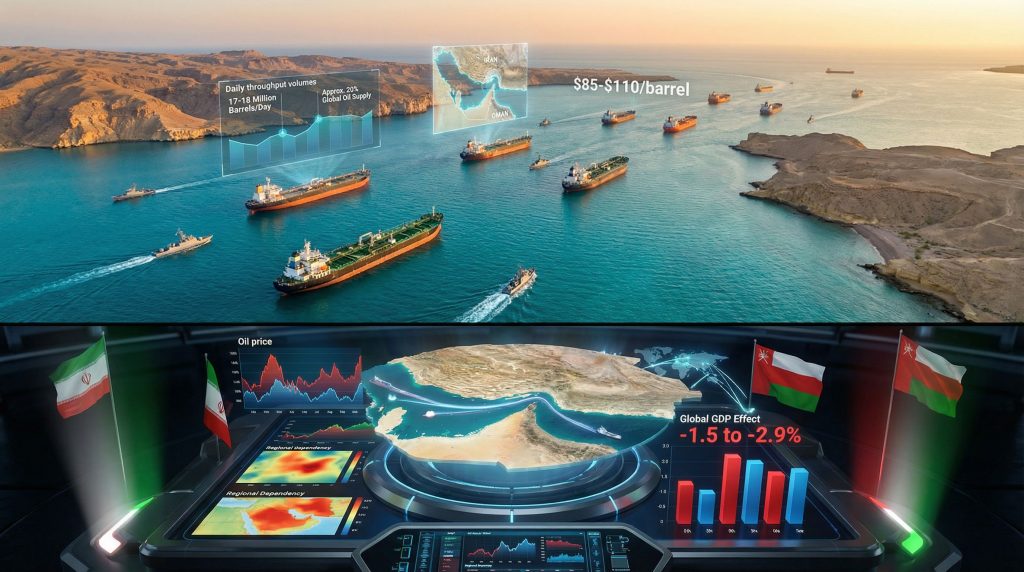
The global energy system's reliance on narrow maritime passages creates systematic vulnerabilities that extend far beyond immediate supply calculations. A potential Strait of Hormuz oil crisis represents one of the most significant structural risks in the contemporary global economy, where geographic constraints combine with geopolitical tensions to create worldwide economic disruption potential.
Understanding these vulnerabilities requires examining both physical limitations and strategic dependencies that have evolved over decades of energy trade patterns. The concentration of global oil flows through specific chokepoints demonstrates how localized conflicts can rapidly transform into systemic threats requiring comprehensive trade war strategies for effective mitigation.
Physical Constraints and Navigation Challenges
The Strait of Hormuz demonstrates how geographic constraints create irreplaceable strategic bottlenecks in global energy infrastructure. At its narrowest point, the waterway measures approximately 21 nautical miles wide, with navigable channels of roughly 2 nautical miles in each direction for commercial tanker traffic.
These physical limitations mean that 21 million barrels per day of crude oil and petroleum products must transit through this constrained passage, representing approximately 21% of global petroleum trade. The annual volume reaching 7.7 billion barrels underscores the scale of potential disruption from any closure scenario affecting the Strait of Hormuz oil crisis response mechanisms.
Modern Very Large Crude Carriers, with capacities up to 320,000 deadweight tonnage, can navigate these channels only under specific conditions. Seasonal weather variations, particularly during monsoon periods from June through September, can reduce effective transit capacity by 10-15%, creating additional vulnerability windows that compound existing energy security challenges.
The technical specifications reveal deeper strategic concerns. The Strait comprises two shipping lanes separated by a 2-nautical-mile buffer zone under international maritime law, but these lanes must accommodate an average of 300+ commercial vessels monthly, with peak periods seeing over 400 transits.
Regional Dependency Variations and Vulnerability Mapping
Asian economies demonstrate the highest vulnerability to Strait of Hormuz disruptions, with dependency patterns that have intensified over recent decades. Analysis of import flows reveals critical concentration risks that could trigger widespread economic consequences during a Strait of Hormuz oil crisis.
| Region | Hormuz Dependency | Daily Volume Impact |
|---|---|---|
| Asia-Pacific | 60-65% of imports | 11.0-13.2 million barrels |
| Japan | 88% of crude imports | 3.5 million barrels |
| South Korea | 96% from Middle East | 2.8 million barrels |
| China | 45% of total imports | 4.0-4.5 million barrels |
| India | 68% of crude imports | 3.2 million barrels |
These dependency levels create asymmetric vulnerability patterns across the global economy. European markets face lower direct exposure at 10-12% of imports, while the Americas maintain minimal dependency at 0.2-0.5 million barrels daily, illustrating the regional variations in potential disruption impacts.
Alternative Transportation Route Limitations
The Cape of Good Hope routing around Africa represents the primary alternative for oil shipments, but capacity constraints and economic penalties make this option insufficient for full replacement. The alternative route adds 3,000-4,000 nautical miles to journeys, increasing transit time by approximately 12-15 days and raising shipping costs significantly.
Current global tanker fleet capacity cannot simultaneously accommodate both normal routing patterns and the additional vessels required for Cape routing of Hormuz volumes. The mathematical reality reveals a structural gap: replacing 21 million barrels daily through longer routing would require approximately 25-30% additional tanker capacity that does not currently exist in global markets.
Pipeline alternatives face similar constraints. Saudi Arabia's East-West pipeline system provides some backup capacity, but current throughput capabilities of 5-6 million barrels daily represent only a fraction of Hormuz volumes. Furthermore, the Saudi exploration impact on global markets demonstrates how regional production capabilities affect overall supply security.
When big ASX news breaks, our subscribers know first
Escalation Dynamics and Market Psychology
The transformation of geopolitical tensions into energy supply shocks follows predictable patterns that reveal both the mechanics of crisis escalation and potential intervention points. Historical analysis demonstrates how localized conflicts can rapidly cascade into global economic disruptions through interconnected systems of trade, finance, and strategic calculation.
Understanding these escalation dynamics provides crucial insights for both risk assessment and crisis management. The interplay between military action, diplomatic positioning, and market psychology creates feedback loops that can either contain or amplify initial disruptions affecting the Strait of Hormuz oil crisis trajectory.
Trigger Event Classification and Response Protocols
Energy supply shocks typically emerge through three primary pathways, each with distinct characteristics and timeline patterns. Intentional embargo or closure by controlling state actors represents the most severe scenario, as demonstrated during the 1973-74 Arab oil embargo when global supply decreased by 4-5 million barrels per day, representing approximately 10% of world output.
Military conflict affecting infrastructure or shipping creates more unpredictable disruption patterns. The September 2019 attacks on Saudi Arabia's Abqaiq and Kurais processing facilities reduced Saudi crude production by 5.7 million barrels daily, approximately 5% of global supply, causing crude oil prices to increase from $59 per barrel to $71 per barrel.
This represented a 20.3% single-day increase that demonstrates the market sensitivity to supply disruption threats. Such volatility patterns require sophisticated tariff market impact analysis to understand the broader economic consequences.
Insurance market reactions provide early warning indicators of escalation risk. War Risk Insurance premiums for tankers increase from baseline rates of $10,000-20,000 per voyage to elevated risk rates of $50,000-150,000 per voyage during heightened tension periods.
Strategic Calculations and Leverage Mechanisms
State actors face complex cost-benefit calculations when considering the weaponization of energy flows. Iran's potential economic cost of Strait closure, estimated at $1-2 billion weekly in foregone oil revenues, creates natural escalation boundaries that influence strategic decision-making.
Historical precedent reveals escalation fatigue effects. Iran's repeated threats to close Hormuz during 2011-2012 created measurable market impacts initially, with oil prices exhibiting sustained 15-20% volatility premiums. However, threat credibility declined over repeated instances without execution, demonstrating how market psychology adapts to rhetorical versus actual risk.
Non-state actors introduce additional unpredictability factors. Recent Houthi attacks on shipping demonstrate how groups with limited actual capacity to close the Strait can create market disruption disproportionate to their capabilities through psychological impact and insurance cost effects.
The critical intervention window analysis suggests a 72-120 hour period exists between initial escalation triggers and market pricing fully incorporating closure risk. During this window, diplomatic intervention can prevent permanent economic damage, as demonstrated by successful crisis resolution during previous energy crises.
Economic Impact Modelling and Historical Parallels
Energy supply disruptions create economic consequences that extend far beyond immediate price increases, generating complex transmission effects through inflation, monetary policy, and financial markets. Historical analysis provides frameworks for understanding how localized supply shocks can transform into systemic economic crises with global implications.
The magnitude and duration of economic impacts depend critically on disruption characteristics, policy responses, and the broader economic context. Scenario modelling reveals how different closure durations and alternative supply activation can determine whether disruptions remain manageable or escalate into severe economic contractions.
Price Volatility and Economic Transmission Mechanisms
Modelled scenario ranges based on combined historical and econometric analysis suggest systematic relationships between disruption duration and economic impact. Extended disruptions create escalating consequences through multiple transmission channels that compound over time and amplify the overall Strait of Hormuz oil crisis effects.
Disruption Impact Framework:
- 30-90 Day Scenarios: Price ranges of $85-$110 per barrel, with global GDP effects of -1.5% to -2.9%
- 90-180 Day Scenarios: Price ranges of $110-$130 per barrel, with GDP impacts of -3.2% to -4.1%
- 180+ Day Scenarios: Price ranges of $130-$160 per barrel, with GDP contractions of -4.5% to -6.2%
These ranges reflect the compounding nature of extended disruptions, where initial supply constraints create secondary effects through manufacturing cost increases, consumer demand destruction, and monetary policy responses that can amplify economic contraction.
Stagflation Precedents and Modern Parallels
The 1970s oil crises provide crucial historical context for understanding potential economic consequences. During the 1973-74 embargo period, oil prices roughly quadrupled, contributing to severe stagflation characterised by simultaneous high inflation and economic stagnation.
Key Economic Indicators from Historical Crises:
- US headline inflation reached 12% in 1974 and peaked near 15% in 1980
- The S&P 500 declined more than 40% during the 1973-74 bear market
- Traditional portfolio diversification failed as both stocks and bonds fell simultaneously
- Gold outperformed as an inflation hedge, increasing from approximately $65 per ounce in 1973 to $184 per ounce in 1980
The stagflation transmission mechanism operates through multiple channels that create self-reinforcing economic deterioration. Moreover, the connection between energy disruptions and broader market instability becomes evident when examining oil price rally analysis from recent periods.
Supply Chain Cascade Effects
Manufacturing sectors face disproportionate impacts during energy crises due to both direct energy costs and transportation expense increases. Energy-intensive industries including steel, aluminium, chemicals, and cement experience immediate margin compression that can force production curtailments or facility closures.
Transportation cost inflation creates broader supply chain disruptions beyond energy sectors. Normal tanker freight costs through Hormuz of $0.80-2.00 per barrel can escalate to $2.50-4.50 per barrel during elevated risk scenarios, with severe crisis conditions potentially reaching $4.50-8.00 per barrel.
Strategic petroleum reserve deployment represents a critical policy tool for mitigating supply disruptions. The International Energy Agency coordination protocols enable emergency oil releases, with member countries maintaining obligations for reserve deployment during crisis periods.
Regional Vulnerability Assessment
Global energy markets exhibit highly asymmetric vulnerability patterns to Strait of Hormuz disruptions, with certain regions facing potentially catastrophic supply shortages while others maintain relative insulation. These vulnerability differentials create opportunities for both crisis mitigation and economic exploitation during disruption periods.
Understanding regional vulnerability patterns requires analysing both immediate supply dependency and medium-term adaptation capacity. The interaction between existing energy infrastructure, alternative supply sources, and strategic reserve adequacy determines how quickly different regions can respond to supply disruptions.
Asian Market Exposure and Strategic Constraints
Asian economies demonstrate the highest systematic vulnerability to Hormuz disruptions, with dependency patterns that have intensified alongside economic growth over recent decades. The concentration of Asian energy imports through this single chokepoint creates potentially severe economic consequences for the world's most dynamic growth region.
Japan exemplifies extreme vulnerability with 88% of crude oil imports transiting the Strait, totalling approximately 3.5 million barrels daily. The island nation's limited domestic energy resources and constrained geographic position provide few alternatives during supply disruptions.
Strategic petroleum reserves provide some buffer capacity, but current reserve levels could sustain normal consumption for only 90-120 days during complete supply cutoff. This limited duration underscores the critical nature of rapid crisis resolution for maintaining economic stability.
South Korea faces similar constraints with 96% of Middle Eastern crude imports dependent on Hormuz transit. The nation's 2.8 million barrels daily import volume through the Strait represents nearly total dependency on this single route.
European Energy Diversification Challenges
European markets face lower direct crude oil exposure to Hormuz disruptions at 10-12% of total imports, but liquefied natural gas dependency creates additional vulnerability dimensions. Qatar's LNG exports, which supply approximately 11% of global LNG, transit through the Strait, creating potential natural gas supply constraints for European markets.
Seasonal demand variations create additional complexity for European energy security. Winter heating demand peaks coinciding with potential supply disruptions could force difficult choices between industrial production curtailments and residential heating priorities.
Industrial competitiveness threats represent longer-term consequences beyond immediate supply disruption. European manufacturing sectors, already facing high energy costs relative to global competitors, could experience permanent market share losses during extended disruption periods.
Historical Crisis Analysis and Modern Applications
Energy crisis precedents provide crucial insights for understanding potential economic trajectories and policy responses during contemporary supply disruptions. The pattern analysis reveals both successful crisis management strategies and policy failures that amplified economic damage beyond the original supply constraint.
Modern energy markets differ substantially from 1970s conditions in terms of financial sophistication, strategic reserves, and alternative energy sources. However, fundamental economic transmission mechanisms remain similar, suggesting that historical precedents maintain relevance for contemporary crisis planning.
Monetary Policy Responses and Inflation Dynamics
Central bank responses during the 1970s crises demonstrate how monetary policy miscalibration can amplify and prolong economic damage from energy supply shocks. The Federal Reserve's retrospective analysis concludes that maintaining overly accommodative monetary policy while inflation surged created sustained inflationary expectations that proved difficult to reverse.
The modern policy environment provides both advantages and constraints relative to 1970s conditions. Independent central banks with inflation targeting mandates possess greater credibility for managing inflationary expectations, but current high debt levels limit fiscal policy flexibility for crisis response measures.
Contemporary monetary policy tools including quantitative easing and forward guidance were unavailable during 1970s crises. However, these tools' effectiveness during energy-driven inflation remains uncertain, as their primary development focused on demand-side economic constraints rather than supply-side disruptions.
Portfolio Performance Patterns During Energy Crises
Asset class performance during historical oil shocks reveals systematic patterns that inform contemporary investment strategy during crisis periods. Traditional portfolio diversification between stocks and bonds proved ineffective during 1970s stagflation, as both asset classes declined simultaneously.
Historical Asset Performance During Oil Shocks:
- Equity markets: -40% to -50% peak declines during crisis periods
- Bond markets: Negative real returns due to inflation acceleration
- Commodities: Outperformed financial assets, particularly precious metals
- Real estate: Mixed performance depending on financing costs and regional exposure
Gold demonstrated particular effectiveness as an inflation hedge, with the 183% return from 1973-1980 contrasting sharply with -48% equity returns during the same period. However, gold's performance variability suggests that timing entry and exit points remains crucial for capitalising on crisis-driven opportunities.
Crisis Management Tools and International Coordination
Emergency response systems developed since the 1970s provide governments and international organisations with tools for mitigating energy supply disruptions. The effectiveness of these tools depends critically on coordination timing, reserve adequacy, and political willingness to implement potentially costly intervention measures.
Strategic petroleum reserve systems represent the primary buffer against supply disruptions, but reserve levels and deployment coordination remain contentious policy issues. Alternative transportation route activation provides additional capacity, but logistical constraints and cost increases limit practical effectiveness.
International Energy Agency Emergency Protocols
The IEA emergency response system enables coordinated oil releases from strategic reserves across member countries during supply disruptions. Member country obligations require maintaining strategic reserves equivalent to 90 days of net imports and participating in collective response measures during crisis periods.
Historical deployment scenarios demonstrate mixed effectiveness depending on crisis characteristics and coordination quality. The 1991 Gulf War reserve release of 2.5 million barrels daily for 30 days helped stabilise markets during military action, but the response timing and magnitude required extensive negotiations that delayed implementation.
Emergency release mechanisms can provide 60-90 days of buffer capacity for IEA member countries, but coordination challenges and political considerations can significantly delay activation. The system's effectiveness assumes normal alternative supply sources remain available, creating potential inadequacy during broader regional disruptions.
Alternative Infrastructure Activation
Pipeline diversification projects provide some backup capacity for crude oil transportation, but current alternative infrastructure remains insufficient for replacing Hormuz volumes. Saudi Arabia's East-West pipeline system offers 5-6 million barrels daily capacity with expansion potential, representing the largest single alternative route.
Overland pipeline networks through Turkey, Central Asia, and Russia could provide additional replacement capacity, but political considerations and existing capacity commitments limit emergency availability. Combined alternative pipeline capacity might replace 8-12 million barrels daily under optimal coordination conditions, leaving significant shortfalls for full Hormuz closure scenarios.
Tanker fleet redeployment represents another mitigation tool, but global tanker capacity constraints limit effectiveness. Activating reserve tanker capacity and extending voyage times through Cape routing could potentially provide additional 3-5 million barrels daily replacement capacity.
The next major ASX story will hit our subscribers first
Investment Strategy and Risk Management
Energy supply disruptions create both severe portfolio risks and significant opportunities for investors who position appropriately before and during crisis periods. Understanding sector-specific impacts and historical performance patterns provides frameworks for crisis-period investment strategy and risk mitigation.
The challenge for investors involves balancing preparation for low-probability, high-impact events against the costs of maintaining defensive positions during normal market conditions. Portfolio construction during energy crisis periods requires fundamental reassessment of traditional diversification assumptions and risk-return relationships.
Sector-Specific Impact Analysis
Transportation and logistics sectors face immediate margin compression during energy crises due to fuel cost increases that cannot be immediately passed through to customers. Airlines, trucking companies, and shipping operators typically experience 15-25% cost increases for each $10 per barrel oil price increase.
Energy-intensive manufacturing including steel, aluminium, chemicals, and cement face double impacts from both direct energy costs and reduced demand as economic growth slows. These sectors often demonstrate 2-3x sensitivity to energy price changes compared to broader market indices, creating both substantial risks and potential recovery opportunities.
Utility companies present mixed risk profiles depending on fuel source composition and regulatory frameworks. Natural gas-fired power generation creates exposure to energy price volatility, while renewable energy and nuclear generation provides relative insulation from commodity price shocks.
Inflation-Protected Investment Strategies
Treasury Inflation-Protected Securities (TIPS) and similar inflation-linked bonds provide some protection against energy-driven inflation, but effectiveness depends on the duration and severity of price increases. TIPS performance during energy crises has historically lagged precious metals and commodities, but provides more stable returns with lower volatility.
Historical Crisis Portfolio Performance:
- Precious metals: Strong outperformance during sustained inflation periods
- Energy commodities: Volatile but substantial gains during supply disruptions
- Real estate: Mixed results depending on financing costs and regional factors
- Agricultural commodities: Benefits from increased transportation and fertiliser costs
Real asset allocation including commodities, real estate, and infrastructure can provide inflation protection, but selection requires careful analysis of specific exposure patterns. Energy infrastructure investments may benefit from higher prices but face operational risks during geopolitical crises.
Resolution Scenarios and Market Normalisation
Crisis resolution pathways determine both the duration of economic disruption and the longer-term structural changes in global energy markets. Understanding potential resolution mechanisms provides frameworks for assessing investment recovery timing and identifying permanent market structure shifts.
Historical precedent suggests that energy crises typically resolve through either diplomatic agreements that restore normal supply flows or alternative supply activation that reduces dependence on disrupted sources. The speed and effectiveness of resolution determines whether crises create temporary market disruption or permanent strategic realignment.
Diplomatic Resolution Frameworks
Successful diplomatic intervention requires addressing underlying political conflicts while providing economic incentives for cooperation. The 1973-74 embargo resolution through shuttle diplomacy demonstrated how sustained negotiation combined with strategic concessions could restore normal energy flows.
International mediation effectiveness depends on the availability of credible mediators acceptable to all parties and the existence of mutually beneficial resolution frameworks. Economic pressure points including financial sanctions and alternative supply arrangements provide negotiation leverage, but success requires careful calibration to avoid escalation.
Timeline projections for diplomatic resolution typically range from 3-12 months depending on conflict complexity and stakeholder incentives. Crisis periods extending beyond 12 months often indicate fundamental strategic disagreements that may require military intervention or permanent market structure changes to resolve.
Post-Crisis Market Structure Evolution
Energy crises accelerate long-term trends toward supply diversification and alternative energy development. The 1970s crises stimulated North Sea oil development, strategic petroleum reserve creation, and initial renewable energy research programmes that permanently altered global energy markets.
Contemporary crisis scenarios would likely accelerate renewable energy deployment, domestic production expansion, and supply chain diversification initiatives. These structural changes can create permanent alterations to energy trade patterns and regional competitive advantages that persist long after immediate supply disruptions resolve.
Infrastructure investment priorities shift during and after energy crises toward reducing single-point-of-failure risks in critical supply systems. Pipeline diversification projects, strategic reserve expansion, and alternative transportation route development receive accelerated funding and political support during crisis periods.
The investment implications extend beyond energy sectors to include technology companies developing energy alternatives, infrastructure firms building diversification projects, and regions with advantageous resource endowments. Crisis-driven market structure evolution creates both risks from stranded assets and opportunities from accelerated development of alternative systems.
Ready to Capitalise on Energy Market Volatility?
Given the complex dynamics affecting global energy markets through critical chokepoints like the Strait of Hormuz, identifying profitable trading opportunities requires sophisticated market intelligence and rapid response capabilities. Discovery Alert's proprietary Discovery IQ model provides instant notifications on significant ASX mineral discoveries, enabling investors to position themselves ahead of market-moving announcements in energy-related commodities including uranium, oil and gas exploration stocks. Begin your 14-day free trial today to transform complex commodity market disruptions into actionable investment insights.