August 6, 2026
When a Waterway Becomes a Weapon: Understanding the Hormuz Crisis Through an Energy Security Lens
Energy security specialists have long operated with a foundational assumption: that the global oil market, however imperfect, would self-correct around disruptions through rerouting, reserve deployment, and supply substitution. The prolonged closure of the Strait of Hormuz has stress-tested that assumption to its breaking point. What is now unfolding is not simply a supply shock in the conventional sense. It is a structural confidence crisis that may permanently alter how energy markets price geopolitical risk, how Asian economies design their import strategies, and how capital flows into alternative energy infrastructure for decades to come.
The stakes are not abstract. When a single narrow corridor handles approximately one-fifth of all globally traded oil and liquefied natural gas, its disruption does not merely inconvenience energy markets. It destabilises the foundational logistics architecture that underpins agricultural supply chains, aviation fuel networks, petrochemical production, and consumer energy costs across four of the world's largest economies simultaneously.
When big ASX news breaks, our subscribers know first
The Geography of Dependency: What Strait of Hormuz Oil Flows Actually Represent
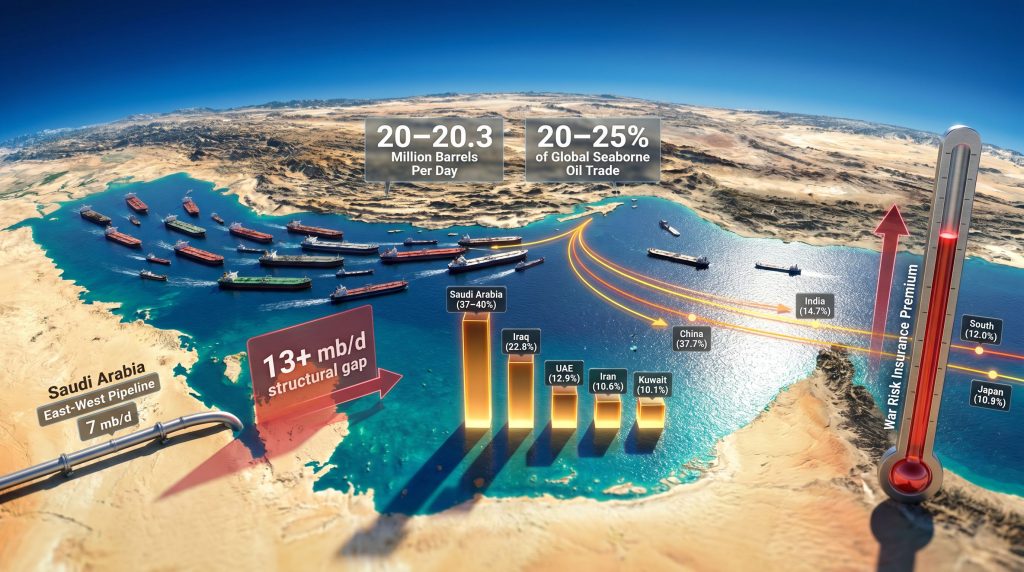
The Strait of Hormuz is approximately 21 miles wide at its narrowest navigable point, yet the volume of hydrocarbons that passed through it prior to the 2026 disruption was staggering in its global significance. Pre-crisis throughput sat at approximately 20 to 20.3 million barrels per day of crude oil and condensate, representing somewhere between 20 and 25 percent of all seaborne petroleum trade worldwide. Layered on top of that crude flow, roughly 20 percent of global LNG trade also passed through this same corridor, the majority of which originated from Qatari export terminals.
The concentration of exporting nations was equally striking. Five countries collectively accounted for nearly 93.6 percent of all Hormuz oil exports during the first quarter of 2025, creating an inherently fragile supply architecture with minimal redundancy. Furthermore, OPEC's market influence over these exporting nations means that any disruption carries amplified consequences across the broader global supply picture.
Export Concentration by Nation (Q1 2025)
| Exporting Nation | Share of Total Flows | Estimated Volume |
|---|---|---|
| Saudi Arabia | 37 to 40% | 5.5 to 6.2 mb/d |
| Iraq | 22.8% | ~3.2 mb/d |
| UAE | 12.9% | ~2.0 mb/d |
| Iran | 10.6% | ~1.3 mb/d |
| Kuwait | 10.1% | ~1.5 mb/d |
Asia's Asymmetric Exposure
What transforms this data from an interesting statistic into a systemic vulnerability is the demand-side picture. Asian economies absorbed approximately 89.2 percent of all Hormuz oil exports in the pre-crisis period, with China alone receiving 37.7 percent of total flows. India accounted for 14.7 percent, South Korea 12.0 percent, and Japan 10.9 percent.
This geographic concentration of demand is critical to understanding the crisis's severity. A disruption at one narrow waterway simultaneously threatens the energy security of the world's second, fourth, twelfth, and thirteenth largest economies. No other single geographic chokepoint on Earth carries that particular combination of supply-side concentration and demand-side vulnerability. According to analysis from the CSIS, the corridor's strategic importance has only grown as Asian energy consumption has expanded over recent decades.
Destination Breakdown: Where Strait of Hormuz Oil Flows (Pre-Crisis)
| Destination | Share of Flows |
|---|---|
| China | 37.7% |
| India | 14.7% |
| South Korea | 12.0% |
| Japan | 10.9% |
| Other Asian Markets | 13.9% |
From 20 Million Barrels to Near Zero: Quantifying the Supply Collapse
The transition from pre-crisis normalcy to active disruption was not gradual. Strait of Hormuz oil flows collapsed from approximately 20 mb/d to roughly 1 mb/d following the outbreak of hostilities, a reduction exceeding 90 to 95 percent of prior volumes. Vessel tracking data recorded periods where as few as one to four tanker transits per day occurred through the waterway, compared to the dense continuous traffic that previously defined the corridor.
The residual flow of approximately 1 mb/d consisted primarily of Iranian-flagged tankers operating under military escort toward Chinese ports, effectively representing the last functioning commercial passage through the strait rather than a meaningful recovery in throughput. This scale of oil market disruption has few modern parallels, and the consequences have reverberated well beyond the immediate region.
The Dual Blockade: An Unprecedented Geopolitical Configuration
What distinguishes the 2026 Hormuz crisis from all prior disruption episodes, including the 1980s Tanker War and the 2019 Gulf tensions, is the simultaneous imposition of transit restrictions from both sides of the geopolitical divide. The United States and Iran each applied enforcement mechanisms that made the waterway effectively inaccessible, creating what energy security analysts have described as a dual-sided blockade without modern precedent.
Crucially, this was not a crisis of threats and brinkmanship. Prior episodes involved significant posturing but ultimately preserved commercial shipping continuity. The 2026 scenario involved active enforcement that removed the transit option even for neutral-flagged vessels carrying non-sanctioned cargoes. War risk insurance premiums for Persian Gulf voyages surged to levels that rendered most commercial voyages economically non-viable, effectively accomplishing through financial markets what physical enforcement alone might not have achieved.
Cascading Effects Beyond Crude Oil
The disruption extended well beyond petroleum markets into interconnected commodity and logistics systems:
- Refined petroleum product supply chains serving Asian and South Asian markets faced severe shortages
- Petrochemical feedstock availability tightened globally, affecting plastics and chemical manufacturing
- Agricultural input costs escalated as fertiliser production, which depends heavily on natural gas feedstocks, was disrupted
- Aviation fuel supplies became constrained across multiple Asian hub airports
- Nations with limited strategic petroleum reserve capacity, particularly several Southeast Asian importers, faced acute near-term exposure with few available buffers
The IEA warned that sustained disruption carries meaningful upside risk to global inflation metrics and poses a direct drag on GDP growth trajectories across import-dependent economies. The breadth of these second-order effects underscored a point that is often underappreciated in energy security analysis: petroleum chokepoint disruptions are not simply energy market events. They are macroeconomic events with multi-sector transmission mechanisms.
Bypass Infrastructure: The Gap Between Theory and Physical Reality
Saudi Arabia's East-West Pipeline: The Most Significant Alternative
Saudi Arabia's East-West Pipeline represents the most substantial existing bypass infrastructure, with a rated capacity of up to 7 mb/d. This overland route connects eastern Saudi oil fields to Red Sea export terminals at Yanbu, theoretically allowing Saudi crude to circumvent Hormuz transit entirely.
However, this capacity addresses only one exporting nation's volumes. Iraqi, Kuwaiti, UAE, and Qatari exports have no comparable overland alternative at meaningful scale. Even at full utilisation, existing pipeline bypass infrastructure could theoretically offset no more than approximately 35 percent of pre-crisis Hormuz volumes, leaving a structural supply gap exceeding 13 mb/d with no viable near-term solution.
The Red Sea Complication
The alternative routing calculus is further complicated by events that preceded the current crisis. The Bab al-Mandeb Strait at the southern end of the Red Sea experienced its own period of elevated disruption during 2024, demonstrating that alternative corridors are not geopolitically insulated from contagion effects. A bypass route that runs through a secondary chokepoint facing its own instability provides limited security assurance.
Rerouting entirely around the Cape of Good Hope adds 10 to 15 days to voyage times between Persian Gulf origin ports and major Asian or European destination terminals. This transit time extension translates into substantially higher freight costs, increased vessel utilisation requirements, and a tightening of effective supply availability even when physical crude volumes remain theoretically accessible.
Strategic Petroleum Reserves: A Time-Limited Instrument
Coordinated SPR releases by IEA member nations represent a legitimate short-term cushion but carry an inherent structural limitation. Strategic reserves are explicitly designed as emergency tools calibrated to short-duration disruptions, typically benchmarked against 90-day supply coverage. Once a crisis extends beyond that timeframe, the buffer capacity begins eroding even among the most well-stocked member economies, and the release mechanism transitions from a solution to a delay mechanism.
The Confidence Destruction Problem: Why Physical Recovery Is Not Full Recovery
Perhaps the most important long-term dimension of the Hormuz crisis is one that receives insufficient analytical attention: the permanent damage to market confidence in the waterway's reliability as an energy artery. Indeed, this global oil price shock has demonstrated just how rapidly investor and market confidence can unravel when a critical transit corridor is threatened.
IEA Executive Director Fatih Birol, speaking to reporters in Vienna ahead of a meeting with OPEC Secretary General Haitham Al Ghais, articulated a structural concern that extends well beyond the physical question of when shipping resumes. Birol characterised the disruption in terms of irreversible reputational damage, making clear that even restored physical access does not restore the market's prior confidence in the corridor's security. He further noted that the world was moving through a historical period in energy, foreign policy, and geopolitics, with devastating economic consequences that would become apparent in the near term. (World Oil, May 11, 2026)
The critical insight embedded in that assessment is this: energy infrastructure confidence does not operate symmetrically. It accumulates gradually over decades of reliable operation but can be destroyed rapidly by a single sustained disruption. The Hormuz closure has now provided the market with proof of concept that this corridor can be closed, enforced, and sustained.
Risk Premium Institutionalization
The practical consequences of this confidence destruction will manifest across multiple financial and contractual dimensions:
- War risk insurance: Premiums for Persian Gulf voyages surged to levels that made commercial shipping non-viable. Even after physical flows resume, underwriters will embed a persistent Hormuz risk premium into policy pricing that reflects demonstrated rather than theoretical vulnerability.
- Long-term contract restructuring: Asian refiners and utilities that previously relied on spot and short-term Gulf supply agreements face structural pressure to diversify. Atlantic Basin, West African, and US suppliers are likely to see accelerated interest in long-term offtake agreements.
- Infrastructure investment reallocation: Capital allocation toward bypass pipeline capacity, floating storage, and regional strategic reserve expansion in Asia will accelerate as a direct consequence of demonstrated chokepoint vulnerability.
Geopolitical Winners in a Disrupted Market
| Beneficiary | Mechanism of Advantage |
|---|---|
| United States LNG exporters | Asian buyers accelerate long-term US LNG offtake agreements |
| West Africa (Nigeria, Angola) | Atlantic Basin crude gains relative price competitiveness |
| Australia (LNG) | Positioned as a geopolitically stable Pacific LNG supplier to Northeast Asia |
| Pipeline gas suppliers | European and Asian buyers reassess alternative pipeline options |
Macroeconomic Transmission: How Hormuz Flows Into Consumer Prices
The inflation transmission mechanism from Hormuz disruption to consumer price indices operates through three primary channels. First, direct fuel cost increases flow through to transportation and heating costs for households and businesses. Second, freight cost escalation passes through supply chains as higher input costs across virtually every manufactured good category. Third, agricultural input cost increases, particularly for fertilisers derived from natural gas feedstocks, transmit into food price inflation.
Historical oil price shocks of comparable magnitude, including the 1973 embargo, the 1979 Iranian revolution, and the 1990 Gulf War disruption, produced GDP contractions of one to three percentage points in heavily import-dependent economies within 12 to 18 months of sustained disruption. The 2026 scenario adds complexity because it operates on a baseline already stressed by prior global trade fragmentation pressures, meaning the growth drag compounds rather than operates in isolation. This broader oil market disruption echoes earlier trade war tensions that had already introduced elevated volatility across energy markets.
The IEA's position on the resolution pathway carries important implications for markets. Birol was explicit that the solution to this problem does not run through the energy sector. Diplomatic resolution between the parties controlling waterway access is the only mechanism capable of restoring full commercial shipping. This creates a structural ceiling on market-based responses: no volume of SPR release, cargo rerouting, or demand destruction can fully substitute for restored diplomatic access to the world's most critical energy corridor. (World Oil, May 11, 2026)
The next major ASX story will hit our subscribers first
Three Structural Shifts That Will Outlast the Crisis
Regardless of when physical strait access is restored, the 2026 Hormuz disruption has already catalysed structural changes that will reshape global energy architecture over the medium to long term.
1. Supply Chain Diversification Acceleration
Asian refiners and utilities will structurally reduce their dependency on single-corridor Gulf supply. Long-term contract growth for Atlantic Basin, US LNG, Australian LNG, and East African suppliers will accelerate as purchasing officers and energy ministers internalise the concentration risk that Hormuz dependency creates.
2. Infrastructure Investment Reallocation
Capital will flow toward bypass pipeline capacity expansion, floating storage solutions capable of bridging supply disruptions, and regional strategic reserve expansion across Asia. The economic case for these investments, previously difficult to justify against the lower cost of Gulf supply through Hormuz, has been materially strengthened by demonstrated vulnerability.
3. Risk Premium Institutionalisation
Persian Gulf supply will carry a permanently elevated geopolitical risk premium embedded in shipping insurance frameworks, long-term supply contract pricing, and energy infrastructure investment discount rates. This repricing of Hormuz corridor risk is not reversible through physical restoration of flows alone.
The Energy Transition Dimension
A secondary consequence of sustained oil price elevation deserves consideration. Historical precedent consistently demonstrates that significant and durable energy price increases accelerate the economics of renewable energy deployment and electric vehicle adoption, particularly in price-sensitive import-dependent markets. India and South Korea, as heavily exposed importers, may find the economic case for an energy transition shift strengthened considerably by this crisis.
However, the same energy security imperative that could accelerate clean energy investment is also likely to trigger near-term coal production increases and domestic gas development as governments prioritise supply security over emissions reduction targets. In addition, renewable energy investment strategies may need to be recalibrated to account for the new geopolitical realities reshaping how nations approach long-term energy planning. The short-term response and the long-term structural shift may therefore operate in opposite directions simultaneously, creating a complex and non-linear energy transition trajectory.
Frequently Asked Questions: Strait of Hormuz Oil Flows
How much oil passes through the Strait of Hormuz?
Prior to the 2026 disruption, approximately 20 to 20.3 million barrels per day of crude oil and condensate transited the strait, representing roughly 20 to 25 percent of global seaborne oil trade. An additional 20 percent of global LNG trade also passed through the waterway, predominantly from Qatar.
Which countries are most affected by a Hormuz closure?
Asian economies carry the greatest structural exposure. China, India, South Korea, and Japan collectively accounted for the vast majority of pre-crisis Hormuz throughput, with Asian destinations absorbing approximately 89.2 percent of total strait oil flows.
Are there viable alternative routes if Hormuz is closed?
The Saudi East-West Pipeline offers up to 7 mb/d of bypass capacity for Saudi crude, but no equivalent infrastructure exists for Iraqi, Kuwaiti, or Qatari volumes. At best, existing bypass infrastructure can offset approximately 35 percent of prior Hormuz throughput. Furthermore, the IEA's emergency response frameworks acknowledge that Cape of Good Hope rerouting adds 10 to 15 days to voyage times and substantially increases freight costs.
Can this crisis be resolved through energy market mechanisms alone?
The IEA's assessment is unambiguous on this point. Because the closure is a geopolitical construct rather than an infrastructure failure, market-based responses including SPR releases, rerouting, and demand destruction are insufficient substitutes for a negotiated diplomatic resolution between the parties controlling waterway access.
What is the long-term impact on energy market confidence in Hormuz oil flows?
Even after physical flows resume, the demonstrated vulnerability of the strait is likely to produce durable structural effects including elevated shipping insurance premiums, accelerated supply diversification by Asian buyers, and increased capital investment in alternative infrastructure corridors. The market's prior assumption of Hormuz reliability has been permanently altered.
This article contains forward-looking analysis and references to macroeconomic projections. Readers should note that energy market outcomes, geopolitical developments, and GDP impact estimates involve significant uncertainty. Historical parallels and analytical projections referenced herein do not constitute investment advice. For upstream industry developments and energy market analysis, visit worldoil.com.
Want to Stay Ahead of the Next Major Resource Discovery Reshaping Global Markets?
As geopolitical disruptions reshape energy supply chains and accelerate demand for alternative resources, Discovery Alert's proprietary Discovery IQ model delivers real-time alerts on significant ASX mineral discoveries — instantly translating complex data into actionable opportunities for investors at every level. Explore how historic discoveries have generated extraordinary returns and begin your 14-day free trial today to position yourself ahead of the market.