June 19, 2026
When a Strait Is Open But the Market Is Closed
The global energy system has always contained a fundamental paradox: physical infrastructure and financial infrastructure do not operate on the same clock. Pipelines, tanker lanes, and terminal facilities can be cleared, reopened, or repaired within days. Insurance markets, reinsurance pools, and institutional risk frameworks operate on entirely different timelines, governed not by diplomatic calendars but by actuarial evidence accumulated over months.
This paradox sits at the centre of what is unfolding right now across the Strait of Hormuz. Despite the formal signing of a U.S.-Iran memorandum, the lifting of the U.S. naval blockade, and the early movement of some tanker traffic, the question of whether oil flows through Hormuz as insurers remain wary tells the more complete and commercially significant story. The strait may be politically open. Commercially, it remains in a state of suspended function.
When big ASX news breaks, our subscribers know first
The Chokepoint That Has No Equal
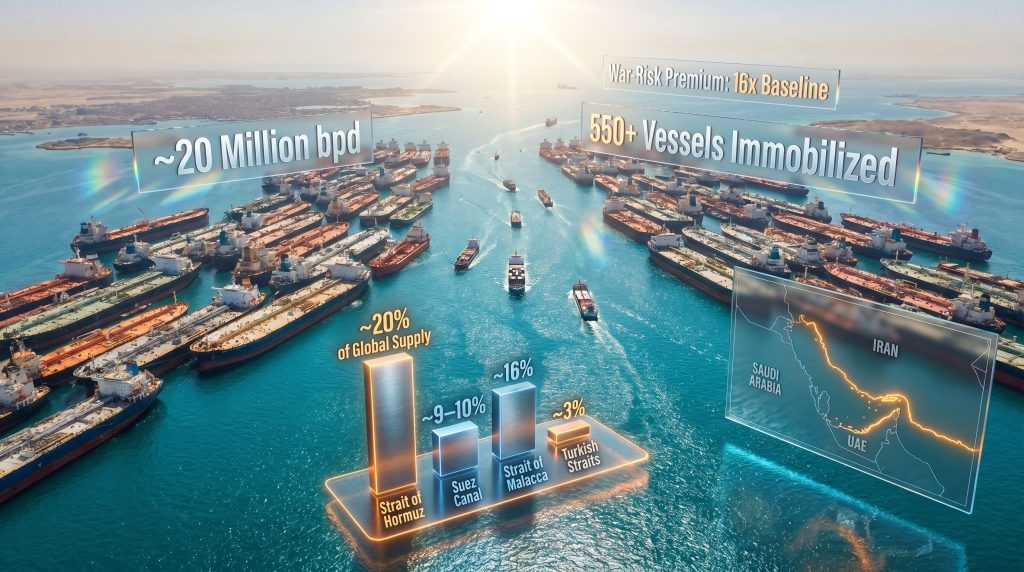
No single passage in the world concentrates as much energy risk as the Strait of Hormuz. Approximately 20% of global oil consumption transits a passage just 33 kilometres wide at its narrowest navigable point. In volume terms, this translates to roughly 20 million barrels per day, a figure that dwarfs the throughput of every other maritime chokepoint by a considerable margin.
The comparison to other critical passages is instructive:
| Chokepoint | Daily Volume (Approx.) | % of Global Supply | Viable Bypass Route? |
|---|---|---|---|
| Strait of Hormuz | ~20 million bpd | ~20% | Partial (Saudi East-West Pipeline) |
| Strait of Malacca | ~16 million bpd | ~16% | Limited |
| Suez Canal / Red Sea | ~9-10 million bpd | ~9-10% | Yes (Cape of Good Hope) |
| Turkish Straits | ~3 million bpd | ~3% | No |
What distinguishes Hormuz from every entry on that list is the near-absence of a credible bypass alternative. Saudi Arabia's East-West Pipeline offers partial relief, but its capacity is structurally insufficient to absorb full Hormuz volumes. The Red Sea disruption of recent years at least offered the Cape of Good Hope routing as a costly but viable workaround. Hormuz has no equivalent fallback.
When this passage faces closure or even credible threat of closure, the entire architecture of Persian Gulf energy exports is compromised. Furthermore, the oil price geopolitical factors at play here extend well beyond the strait itself, influencing everything from futures pricing to long-term procurement strategy.
How Marine War-Risk Insurance Actually Functions
Understanding why commercial confidence has not followed the diplomatic agreement requires understanding how marine insurance works, particularly the specialist layer known as war-risk coverage.
Standard marine insurance protects against conventional perils: weather, collision, mechanical failure. War-risk insurance is an entirely separate policy layer covering losses arising from armed conflict, mines, acts of terrorism, and hostile naval actions. Without it, a tanker operator cannot satisfy the insurance requirements embedded in vessel financing agreements, charter party contracts, and cargo sale terms.
A ship without war-risk coverage is, from a commercial and legal standpoint, effectively unable to operate on institutional routes regardless of whether the water is physically navigable. The institutional architecture governing this coverage involves several layers:
- Primary marine insurers underwrite initial coverage for hull and cargo.
- Protection and Indemnity (P&I) clubs provide mutual indemnity for liability risks.
- The Joint War Committee (JWC), a market body linked to Lloyd's of London, designates high-risk zones and publishes listed areas that trigger additional war-risk conditions.
- Reinsurers absorb excess risk from primary insurers, functioning as the backstop that makes coverage commercially viable.
Critical Insight: When reinsurers decline to absorb primary insurers' exposure, the coverage gap does not simply raise costs. It eliminates the commercial viability of the route entirely. A ship without adequate war-risk coverage cannot legally transit most institutional financing covenants, regardless of whether the strait is physically passable.
The current situation reflects precisely this dynamic. War-risk premiums for Hormuz transits have surged to levels exceeding 16 times their pre-conflict baseline. Marine hull insurance rates are being repriced across the Persian Gulf corridor, with increases in the range of 25-50% being projected by market participants. More significantly, several reinsurers have declined to absorb primary insurers' Hormuz exposure entirely, triggering what underwriters technically classify as an "unpriceable risk" scenario. According to a detailed Howden Re analysis of Hormuz risk, this dynamic is particularly acute when diplomatic signals outpace actuarial evidence.
The Ground-Level Reality: Vessels, Volumes, and Backlogs
What Do the Numbers Actually Reveal?
The operational picture at the strait reflects the gap between political announcement and commercial reality with stark clarity.
| Metric | Status (Post-Announcement) |
|---|---|
| Commercial vessels transited | ~21 (initial window) |
| Vessels immobilised at strait | 550+ |
| Crude queued for transit | 80+ million barrels |
| War-risk premium level | 16x+ normal baseline |
| Estimated normalisation timeline | 3-4 months (analyst consensus) |
| Western-flagged vessel activity | Largely suspended |
| Iranian/Chinese-flagged activity | Continuing |
The asymmetry between Iranian-flagged and Chinese-flagged vessels continuing transit while Western-flagged tonnage holds position reveals the insurance market's geographic and institutional specificity. Western institutional operators are bound by financing covenants and charter party terms that require specific insurance coverage. Operators outside those institutional frameworks face different constraint structures.
The 80+ million barrels of crude queued for exit represents an enormous logistical pressure point. However, commercial operators will not accelerate movement simply because the cargo backlog is large. The fundamental constraint is not motivation. It is coverage availability at economically viable premium levels.
Major commodity trading houses have suspended Hormuz shipments despite the diplomatic agreement. Some vessels reversed course mid-voyage after updated risk assessments were received. This is commercial risk management operating exactly as designed, and no diplomatic announcement changes the underlying actuarial calculus until a sustained track record of incident-free transit is established.
Analyst consensus places the minimum timeline for meaningful insurance market normalisation at 3 to 4 months of demonstrated, incident-free transit. This is not a soft estimate. It reflects the historical pattern of how long marine underwriters require before meaningfully compressing premiums following high-risk designations. The 2019 Gulf of Oman tanker attacks provide a relevant precedent, and normalisation in that case took considerably longer than the political resolution might have suggested.
Consequently, these oil market disruptions compound existing vulnerabilities in global energy supply chains, adding further complexity to an already uncertain landscape.
Lebanon: The Variable That Could Unravel Everything
Why Does a Third-Party Front Matter So Much?
The U.S.-Iran memorandum contains a structural complexity that extends well beyond bilateral compliance. The agreement commits both parties and all allied forces to cease military operations across every active front, explicitly including Lebanon. This creates an immediate and unresolved tension.
Israel has publicly stated its intention to maintain a security presence in southern Lebanon. Iranian officials have indicated that continued Israeli military presence in the country could constitute grounds for treating the agreement as void. Israeli military activity in southern Lebanon has not fully ceased since the memorandum was signed.
Structural Risk: A bilateral agreement between the United States and Iran cannot legally or practically bind a third-party actor operating under entirely separate strategic mandates. The memorandum's language requires compliance across all fronts, but the enforcement mechanism for third-party behaviour does not exist within the agreement's framework.
This creates a scenario where the durability of the Hormuz reopening depends heavily on a Lebanese front that neither Washington nor Tehran controls absolutely. The scenario modelling for Hormuz recovery must therefore incorporate a Lebanon variable that sits outside the direct negotiating parties' authority to resolve.
| Trigger Scenario | Risk Level | Hormuz Impact |
|---|---|---|
| Israeli-Lebanese military escalation | Moderate | High, Iranian annulment risk |
| Iranian naval incident (non-state actor) | Low-moderate | Immediate premium spike |
| 60-day negotiation breakdown | Moderate | Gradual traffic reversal |
| U.S. military posture shift in region | Low | Indirect confidence erosion |
| Sustained 90-day incident-free transit | Moderate-high | Gradual insurance normalisation |
The 60-day post-memorandum negotiation period is designed to address the formal security guarantees, mine clearance verification, and navigational safety protocols that shipowners require before normalising operations. The distinction here is critical: shipowners do not require political assurances. They require formal, verifiable, and legally actionable security guarantees that satisfy their underwriters. These are fundamentally different documents requiring fundamentally different processes to produce.
In addition, the broader geopolitical risk landscape across the Middle East and beyond continues to create cascading uncertainty for commodity markets well outside the energy sector alone.
How Major Energy Importers Are Recalibrating
What Signals Is Asia Sending?
The behavioural response among major energy-importing nations reveals that the Hormuz crisis has accelerated structural supply chain repositioning that was already underway.
India is a particularly instructive case. Despite the strait's reopening, India has chosen not to immediately resume Middle Eastern crude purchases, signalling that procurement managers have used the crisis period to begin building alternative sourcing strategies. India's energy import bill surged by 82% during the conflict period, a fiscal shock significant enough to drive a major strategic oil reserve expansion order.
Asia-Pacific importers more broadly are contending with elevated tanker rates that continue to impose economic disruption even as physical flows begin to resume. High freight costs effectively extend the economic impact of the Hormuz closure well beyond the period of physical restriction, since the cost of moving crude from the Persian Gulf to Asian refiners remains materially elevated.
Qatar's LNG restart preparations represent another dimension of the normalisation challenge. The global LNG supply outlook has been meaningfully disrupted by the Hormuz closure, with LNG carrier insurance presenting similar, though not identical, challenges to crude tanker coverage.
The European Central Bank has assessed that the Iran peace agreement will not fully erase the energy price shock absorbed by European economies during the conflict period. This conclusion reflects the asymmetric structure of energy price dynamics: supply disruptions transmit rapidly into consumer prices, while supply restoration transmits much more gradually into price relief.
TotalEnergies has assessed that Saudi refinery capacity damaged during the conflict period is unlikely to fully recover before 2027, adding a supply-side constraint to the demand-side uncertainty. Furthermore, OPEC market influence over production decisions during this period has complicated the IEA's projection of a significant oil surplus emerging in that same year.
The next major ASX story will hit our subscribers first
The NATO Fracture and Its Implications for Future Security Missions
A dimension of the Hormuz crisis that carries long-term significance beyond the immediate insurance and traffic questions involves the condition of the transatlantic alliance itself.
U.S. Defense Secretary Hegseth used NATO meetings during the conflict period to directly and publicly criticise several European allies for refusing requests to provide access to bases and airspace during the Iran conflict. A formal six-month review of the U.S. military footprint in Europe was announced as a consequence.
The strategic implications for Hormuz specifically are substantial. The historical model of U.S. naval presence as the implicit guarantor of freedom of transit through Persian Gulf chokepoints has rested on the assumption of a capable and willing multilateral security architecture. If the 2026 Iran crisis produced no coordinated Western naval response, and if the alliance fracture that became visible during that period persists, the institutional credibility of any future multilateral Hormuz security mission is materially weakened.
Marine war-risk underwriters assess geopolitical stability signals continuously, and the condition of the NATO alliance is among the macro variables that inform their risk classifications. A weakened or fragmented multilateral security architecture for the Persian Gulf region is not a neutral signal for insurance market normalisation.
Cyclical Disruption or Permanent Structural Change?
The most consequential analytical question now facing energy markets is whether the Hormuz disruption represents a cyclical event from which full recovery is achievable, or whether it has introduced permanent behavioural changes among shippers, insurers, and importers.
Goldman Sachs has warned that Hormuz traffic patterns may never fully recover to pre-conflict levels, a thesis that deserves serious analytical weight given the bank's direct exposure to commodity trading and shipping finance. The structural disruption argument rests on several compounding factors:
- Supply chain managers at major energy importers are actively building Hormuz-bypass optionality into long-term procurement frameworks.
- Insurance underwriters are repricing Persian Gulf risk permanently upward, not simply applying temporary surcharges.
- Tanker operators and shipowners are recalibrating fleet routing strategies to account for persistent elevated risk.
- Importing nations that experienced the 82% energy import bill surge are politically motivated to reduce chokepoint dependency through strategic reserve expansion and supply diversification.
Goldman Sachs Structural Thesis: The distinction between a cyclical disruption and a structural one will define the medium-term trajectory of Persian Gulf oil economics. If shipper, insurer, and importer behaviour has permanently shifted, the pre-conflict traffic baseline may represent a historical ceiling rather than a recovery target.
The IEA's projection of a substantial oil surplus by 2027 as Middle East supply returns assumes a normalisation pathway that remains contingent on factors outside any single actor's control. According to CNBC's analysis of the Hormuz reopening, shipping confidence has not returned in line with political announcements, reinforcing the structural concern.
The pace of Hormuz traffic normalisation, the durability of the U.S.-Iran agreement, the resolution of the Lebanon front, and the gradual re-engagement of marine war-risk reinsurers will collectively determine whether that surplus materialises on the projected timeline.
A Framework for Monitoring the Recovery
For market participants tracking the normalisation trajectory, the following milestone framework provides a structured monitoring approach:
Weeks 1-4: Physical mine clearance progress reports; vessel transit data compared to pre-conflict baselines; first signals from JWC zone designation reviews; P&I club advisory updates.
Months 1-3: Sustained incident-free transit record accumulation; initial reinsurer re-engagement signals; war-risk premium trajectory data; first major trading house resumption announcements.
Months 3-6: Tanker rate normalisation toward pre-conflict ranges; backlog clearance progress; Lebanon front stability assessment; formal post-memorandum negotiation outcomes.
Beyond 6 months: Structural assessment of whether pre-conflict traffic patterns are recoverable; long-term insurance market repricing conclusions; importer procurement strategy crystallisation.
The Hormuz situation is a case study in the gap between political resolution and commercial restoration. Diplomatic agreements create the necessary precondition for normalisation. They do not create the normalisation itself. That process belongs to underwriters, shipowners, trading houses, and importers operating on their own risk frameworks and timelines. Until demonstrated stability replaces declared stability across the Persian Gulf corridor, oil flows through Hormuz as insurers remain wary will remain the accurate description of the situation.
Disclaimer: This article is for informational purposes only and does not constitute financial or investment advice. Forecasts, analyst assessments, and scenario projections referenced herein are subject to material uncertainty and should not be relied upon as predictions of future outcomes.
Want to Position Yourself Ahead of the Next Major Commodity Market Shift?
The same geopolitical forces reshaping Hormuz oil flows are creating significant discovery opportunities across ASX-listed resource stocks — and Discovery Alert's proprietary Discovery IQ model delivers real-time alerts the moment significant mineral discoveries hit the ASX, transforming complex commodity data into actionable insights for investors at every level. Explore how historic discoveries have generated substantial returns and begin your 14-day free trial at Discovery Alert to ensure you're positioned ahead of the market.