June 27, 2026
The Mechanics Behind the World's Most Consequential Shipping Lane
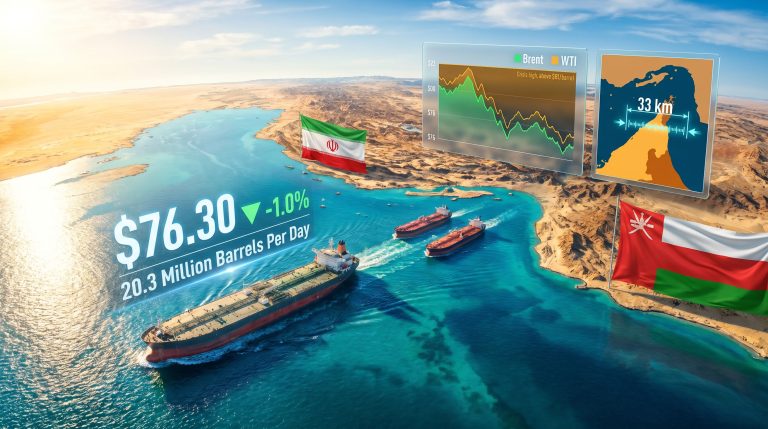
Every time a tanker navigates the narrow passage between Oman and Iran, it carries with it the weight of global economic stability. The Strait of Hormuz, stretching just 33 kilometres at its narrowest point, functions less like a geographic feature and more like a pressure valve for the entire international energy system. When that valve tightens, oil price movements are felt within hours. When it reopens, the unwinding is slower, messier, and far more conditional than headline price moves suggest.
Understanding what is happening to Strait of Hormuz oil flows after US-Iran peace talks requires looking beyond the diplomatic theatre and into the physical realities of tanker logistics, reserve depletion, and the structural economics of a waterway that may never fully return to its pre-conflict operating norms.
When big ASX news breaks, our subscribers know first
Why the Strait of Hormuz Commands Unrivalled Market Attention
The Arithmetic of Energy Dependency
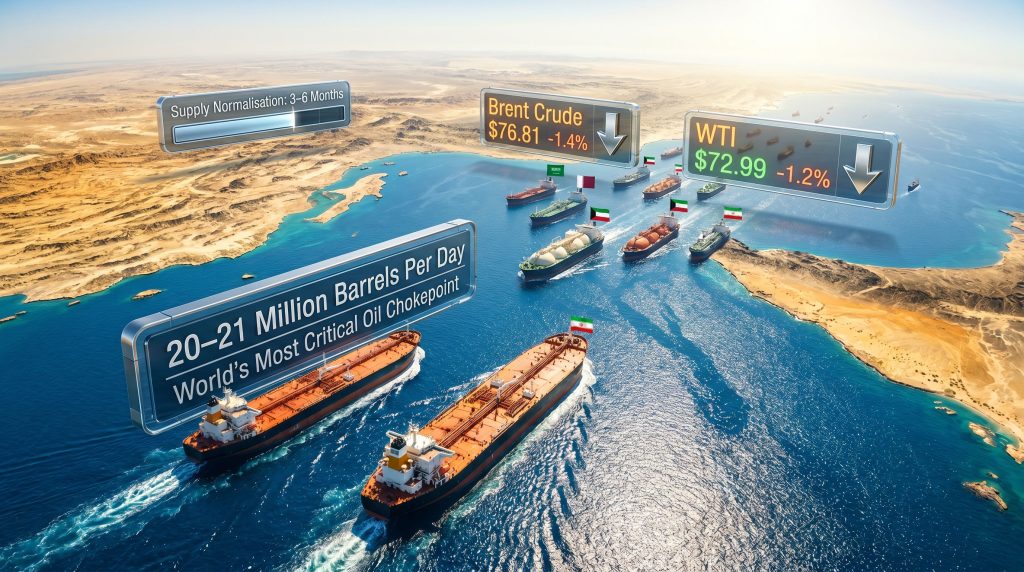
Under stable geopolitical conditions, approximately 20 to 21 million barrels of petroleum liquids transit the Strait of Hormuz each day. That single figure accounts for roughly 20% of total global petroleum liquids consumption, positioning this 33-kilometre channel as the most consequential maritime chokepoint in energy history.
No other single passage concentrates this level of supply exposure. The Suez Canal, the Malacca Strait, and the Danish Straits each carry meaningful volumes, but none approaches the systemic risk concentration of Hormuz. A sustained closure does not merely inconvenience importers; it structurally disconnects a fifth of global supply from markets within days.
The waterway serves as the primary export corridor for Saudi Arabia, Iran, Kuwait, the UAE, Qatar, and Iraq. Among the commodities passing through it are crude oil, refined petroleum products, and liquefied natural gas, making it a dual chokepoint for both liquid fuels and the gas markets increasingly critical to European and Asian energy security.
What Ship-Tracking Data Is Actually Showing
In the days immediately following the interim US-Iran peace accord, vessel movements through the strait began to recover from their conflict-period lows. According to reporting from Reuters, ship-tracking data confirmed that vessels from Saudi Arabia, Qatar, Kuwait, and Iran carrying crude oil and liquefied natural gas were transiting the waterway. On one notable day during the early post-accord period, two crude tankers carrying just under 2 million barrels passed through the strait, signalling that the recovery in traffic, while modest, was directionally real.
Taken in aggregate, nearly 10 million barrels of oil were either transiting or had recently cleared the strait in the days following the agreement. The market registered this, but not with optimism.
How Oil Prices Responded to the Hormuz Reopening
A Counterintuitive Reaction That Reveals Market Logic
The immediate price response to improved Hormuz transit was a continuation of the downward trend that began when the accord was first announced. By the morning session on 23 June 2026:
| Benchmark | Price | Change | Movement |
|---|---|---|---|
| Brent Crude Futures | $76.81 per barrel | -$1.09 | -1.4% |
| WTI Crude Futures | $72.99 per barrel | -$0.87 | -1.2% |
| Prior Session (Monday) | Multiple benchmarks | Broader decline | Greater than -3% |
This reaction pattern is not irrational. When a conflict-driven supply disruption eases, the geopolitical risk premium that had been artificially supporting prices begins to deflate. Analysts at ING described the dynamic plainly: the gradual increase in oil flows through the strait was continuing to weigh on the market, functioning as a supply recovery signal even before physical volumes had normalised. Understanding the broader crude oil market dynamics helps explain why this counterintuitive response is structurally predictable.
The critical distinction here is between anticipated supply recovery and actual supply restoration. Markets price the former immediately and adjust for the latter over weeks and months. The current oil price environment reflects front-running of a normalisation that has not yet materialised in full.
Tanker Transit as a Dual Market Signal
Commodity analysts at Sparta Commodities observed that rising transit volumes were functioning as a real-time proxy for two distinct market variables simultaneously: the physical availability of crude oil and the durability of the diplomatic framework itself. The logic is straightforward. If tanker operators, who carry significant commercial and insurance risk, are willing to commit vessels to Hormuz transits, they are implicitly pricing the political risk as manageable.
The market, in turn, interprets sustained transit volumes as confirmation that the accord is holding. The inverse is equally powerful. A sudden drop in transits, even without an explicit geopolitical event, would likely trigger immediate risk premium repricing across both crude benchmarks.
Analysts at Sparta Commodities noted that the market appeared likely to remain in a bearish, risk-off but cautiously optimistic posture until the conditions driving that assessment materially changed, with tanker transits serving as the primary real-time signal.
The Trust Deficit That Is Slowing Full Price Recovery
Washington and Tehran: A Structural Credibility Problem
The US-Iran relationship carries decades of institutional mistrust that no single accord can dissolve. Tim Waterer, chief market analyst at KCM Trade, observed that prevailing market scepticism, rooted in the deep-seated adversarial history between Washington and Tehran, makes any swift return to pre-war oil price levels unlikely. The market's base case is a delayed, gradual process rather than an immediate reset.
This scepticism is not speculative; it is structurally informed. The accord currently in place is underpinned by a 60-day sanctions waiver, a temporary mechanism that grants Iran partial relief from economic penalties to facilitate the early stages of diplomatic engagement. Sixty days is a defined diplomatic clock. When it expires, the terms of any continuation are unknown, and markets will price that uncertainty progressively as the deadline approaches.
The Weekend That Nearly Unravelled the Deal
The fragility of the current framework was demonstrated sharply during the weekend preceding the June 23 session. US President Donald Trump publicly warned that military operations could resume if Iran moved to obstruct Strait of Hormuz shipping. Tehran had separately declared the waterway closed, a statement that introduced acute uncertainty into an accord less than two weeks old. That weekend proved the market's caution was well-founded: the peace framework is conditional, not permanent. Furthermore, it illustrated how geopolitical trade tensions can rapidly unsettle even the most carefully negotiated diplomatic arrangements.
The Physical Delay Problem: Why Supply Recovery Is Slower Than Headlines Suggest
Tanker Cycle Times and the Built-In Lag
One of the least discussed but most consequential structural features of Hormuz supply recovery is tanker cycle economics. A standard round trip between Singapore and the Persian Gulf takes one to two months. This means that even if transits normalise immediately, the downstream effect on Asian and European crude inventories will not be felt for weeks. The supply chain simply cannot accelerate faster than the physics of maritime freight allow.
This creates a predictable timeline framework for how Strait of Hormuz oil flows after US-Iran peace talks will actually translate into market normalisation:
| Phase | Timeframe | Expected Market Condition |
|---|---|---|
| Early Transit Recovery | Weeks 1-2 post-accord | Sporadic movements; well below pre-conflict volumes |
| Inventory Drawdown Period | Through August 2026 | Regional stockpiles continuing to decline |
| First Full Tanker Cycles Complete | 1-2 months post-reopening | First tangible inventory replenishment begins |
| Trajectory Normalisation | 3-6 months (estimated) | Flows approaching pre-war operational patterns |
Regional oil stockpiles are projected to continue declining through August 2026 before inventory builds begin to resume. This extended drawdown period creates a floor of fundamental supply tightness even within a diplomatic de-escalation environment, which partially explains why prices have not collapsed further despite the bearish headline narrative.
Iran's New Conditions: The Strait Is Open, But on Different Terms
A Reopening With Caveats
Iran has publicly declared the Strait of Hormuz open to commercial shipping, however Iranian authorities have signalled that the waterway will not return to its exact pre-conflict operational status. Among the mechanisms under discussion are transit service fees applicable to vessels passing through Iranian-administered zones within the strait. If implemented, these fees would represent a structural alteration to Hormuz shipping economics that would persist beyond any individual diplomatic cycle.
The market implications of each scenario differ meaningfully:
| Scenario | Near-Term Probability | Oil Market Impact |
|---|---|---|
| Full, unconditional reopening | Moderate | Strongest bearish price pressure |
| Reopening with transit fees | Moderate-High | Mild cost pass-through; modest price support |
| Partial disruption resumes | Lower (near-term) | Sharp spike; risk premium returns immediately |
| Accord collapses entirely | Low (near-term) | Severe supply shock exceeding pre-accord price levels |
Transit fees, if formalised, would raise operating costs for tanker operators and could gradually reshape which routes remain commercially viable. Vessel operators running on thin freight margins through the strait would face a permanent cost increase that would ultimately be passed through to crude importers.
The next major ASX story will hit our subscribers first
US Strategic Petroleum Reserve: A 43-Year Low Changes the Calculus
The SPR as a Negotiating Variable
US Strategic Petroleum Reserve stocks fell to 331.2 million barrels during the conflict period, the lowest level recorded since June 1983. This drawdown was a direct consequence of supply tightening triggered by the US-Iran hostilities, and it carries implications that extend beyond domestic energy security.
A depleted SPR narrows the US government's ability to buffer against renewed supply shocks. Historically, the SPR has functioned as a strategic backstop that moderates the domestic political cost of international oil market disruptions. With reserves at a four-decade low, any resumption of Hormuz disruptions would translate more rapidly and more severely into domestic fuel price increases than would have been the case before the conflict.
Analysts polled by Reuters anticipated further declines in US crude, distillate, and gasoline inventories for the prior reporting week, suggesting the drawdown trajectory had not yet reversed at the time of the accord. Monitoring current crude oil prices alongside SPR data provides a more complete picture of the supply-side pressures currently shaping the market.
Gulf Producers Signal Confidence Through Output Acceleration
Kuwait's Production Ramp-Up as a Credibility Indicator
Kuwait's decision to begin increasing oil output following the accord, with production targets aimed at exceeding 2 million barrels per day within one week of the agreement, carries significant signal value. Gulf state oil producers, whose revenue models depend entirely on consistent export flows, do not accelerate production commitments into an unstable diplomatic environment.
Kuwait's move suggests that at the operator level, the accord is perceived as sufficiently durable to justify near-term supply commitments. This producer-level confidence, while not a guarantee of diplomatic stability, provides a market signal that complements the tanker transit data. In addition, OPEC's market influence over collective Gulf output decisions means that Kuwait's acceleration may signal broader coordinated intent among member states.
Saudi Arabia's Pipeline Infrastructure: A Resilience Lesson
Saudi Arabia's overland pipeline capacity, specifically designed to provide export routing that bypasses Hormuz dependency, demonstrated measurable strategic value during the conflict period. The Public Investment Fund governor highlighted the long-term planning embedded in this infrastructure, describing it as a global energy lifeline during the period of peak strait disruption.
The broader lesson for Gulf energy infrastructure investment is clear: redundant export routes are not merely contingency measures. They are active risk management assets whose value crystallises precisely when the primary route becomes inoperable.
Frequently Asked Questions
How much oil flows through the Strait of Hormuz under normal conditions?
Approximately 20 to 21 million barrels per day transit the strait under stable operating conditions, representing around 20% of global petroleum liquids consumption.
Why did oil prices fall after the Hormuz reopening?
Improving transit volumes reduced the geopolitical risk premium embedded in crude prices during the conflict period. The market treats rising transits as a supply recovery signal, even before physical inventories have normalised.
How long will it take for Hormuz oil flows to fully normalise?
Analysts estimate three to six months for flows to approach pre-conflict levels, given tanker round-trip cycle times of one to two months and a regional inventory drawdown projected to continue through August 2026. As Bloomberg reports, Strait of Hormuz oil flows after US-Iran peace talks are recovering gradually rather than snapping back immediately.
What is the 60-day sanctions waiver?
A temporary suspension of economic penalties on Iran, granted to facilitate early diplomatic engagement. It does not represent a permanent policy shift and introduces a defined expiry date that markets will monitor closely.
What happened to US Strategic Petroleum Reserves during the conflict?
SPR stocks fell to 331.2 million barrels, the lowest level since June 1983, as the US drew down reserves to partially offset the supply disruptions caused by the conflict.
Key Market Takeaways for the Post-Accord Period
- Tanker transit volumes are rising but remain materially below pre-conflict norms; the market is in a transitional state, not a normalised one
- Oil price declines reflect anticipated supply recovery, not confirmed supply restoration
- The 60-day sanctions waiver creates a defined diplomatic expiry that markets will price increasingly as it approaches
- SPR depletion at a 43-year low reduces the US buffer capacity against any renewed supply shock
- Iran's potential transit fee regime introduces a structural cost variable that could permanently alter Hormuz shipping economics
- Kuwait's production acceleration and Saudi pipeline utilisation both signal producer-level confidence in near-term accord durability
This article contains forward-looking analysis, price projections, and scenario assessments that are inherently speculative in nature. Market conditions, geopolitical developments, and diplomatic outcomes may change materially and without notice. Nothing in this article constitutes financial or investment advice. Readers should conduct independent research before making any investment decisions.
Want to Stay Ahead of the Next Major Resource Discovery Before the Market Moves?
While geopolitical shifts in the Strait of Hormuz reshape global energy flows, Discovery Alert's proprietary Discovery IQ model scans ASX announcements in real time, instantly identifying significant mineral discoveries across oil, gas, and more than 30 other commodities — explore historic discoveries and their market-moving returns, then begin your 14-day free trial at Discovery Alert to position yourself ahead of the broader market.