June 24, 2026
The Fragile Architecture Behind the World's Most Critical Oil Corridor
The global energy system did not emerge from careful design. It evolved organically over seven decades of post-war industrial expansion, and in doing so, it created a structural dependency on a 21-nautical-mile stretch of water between Iran and Oman that no amount of pipeline construction or alternative routing has ever meaningfully resolved. The Strait of Hormuz is not simply a shipping lane. It is the load-bearing column of the world's oil supply architecture, and when it fails, the entire structure shakes.
Understanding why Strait of Hormuz oil flows after US-Iran peace talks remain uncertain requires looking beyond the diplomatic announcements and into the physical, financial, and psychological machinery that governs how energy actually moves from wellhead to refinery.
When big ASX news breaks, our subscribers know first
What Makes the Strait of Hormuz Structurally Irreplaceable
Approximately one-fifth of the world's total oil supply and a significant share of global LNG supply exports transit the Strait of Hormuz under normal operating conditions. No alternative pipeline corridor can absorb this volume. The existing overland pipeline infrastructure serving the Persian Gulf region operates at or near capacity and collectively handles less than half of what previously moved through the Strait on any given day.
Saudi Arabia's East-West Petroline system, the largest available alternative, can process approximately 5 million barrels per day under optimal conditions. However, the word "optimal" carries significant weight here. Sand intrusion during desert wind events can reduce capacity by up to 30%, and the system requires regular maintenance cycles that constrain sustained high-volume operation.
Qatar's position is arguably the most structurally exposed of all Gulf exporters. The Q-Max and Q-Flex LNG tankers that form the backbone of Qatar's export fleet are physically incapable of transiting the Suez Canal under standard commercial conditions. Their beam widths and draft requirements leave the Strait of Hormuz as the only viable export gateway, making Hormuz normalisation a prerequisite for any meaningful recovery in global LNG supply chains.
"The Strait of Hormuz is not merely a regional waterway. It functions as the single point through which decades of global energy infrastructure investment converge, and its closure represents a systemic failure, not a regional inconvenience."
How a Three-Month Closure Rewrote Global Energy Risk Models
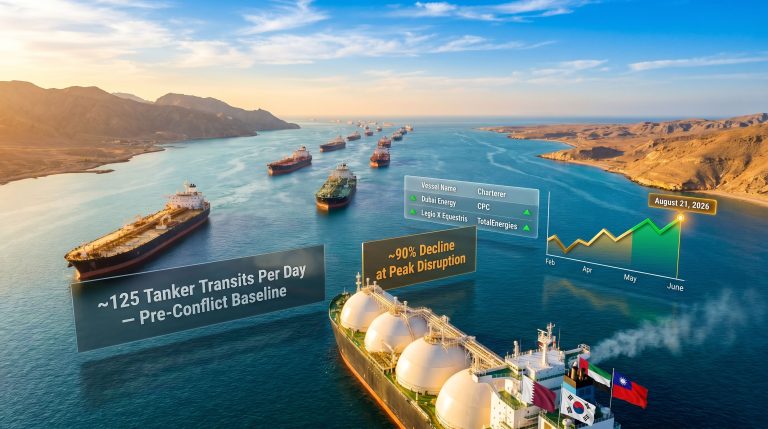
The Strait's closure beginning around February 28, 2026 did not unfold as a single decisive act. It developed through a sequence of escalating geopolitical oil price factors following US and Israeli military strikes that resulted in the death of Iran's supreme leader. Iran's response was to weaponise the waterway itself, obstructing passage as a strategic lever while the United States simultaneously imposed a naval blockade on Iranian ports.
The combined effect created an energy supply shock with no close parallel in modern history. The two primary disruption mechanisms — Iranian obstruction and the US blockade — operated in parallel rather than sequence, compressing the global oil system's ability to absorb or reroute supply.
The quantified scale of the disruption:
| Impact Category | Estimated Scale |
|---|---|
| Duration of Strait Obstruction | 3+ months (from approx. Feb 28, 2026) |
| Iranian Crude Export Freeze | Approximately 2 months |
| Vessels Stranded in the Gulf | Hundreds of ships |
| Seafarers Affected | Approximately 11,000 personnel |
| Iraqi Southern Oilfield Output (Recovery Phase) | Approximately 2.1 million barrels per day |
The humanitarian dimension of the crisis is frequently underweighted in market analyses. Approximately 11,000 seafarers remained stranded aboard vessels in the Gulf, prompting the United Nations' shipping agency to develop a coordinated evacuation and transit plan once the ceasefire framework took hold. The logistical complexity of clearing hundreds of ships from a partially reopened waterway adds yet another layer of operational friction to what markets initially treated as a simple diplomatic resolution.
Breaking Down the Peace Framework's Energy Provisions
The diplomatic breakthrough formalised through a memorandum of understanding between Washington and Tehran, with an official signing scheduled in Switzerland on June 19, 2026, introduced several immediate and conditional changes to the strait's operational status.
Key provisions of the peace framework:
-
60-Day Sanctions Waiver: The United States granted Iran a temporary suspension of sanctions, reducing immediate economic pressure and creating a window for oil flow normalisation.
-
Toll-Free Transit Commitment: The peace framework mandates that oil transits occur on a toll-free basis, removing a key Iranian leverage mechanism that had previously been floated as a potential monetisation strategy.
-
Coordinated Vessel Passage: A limited number of vessels are being cleared for daily passage through coordination with Iran's Revolutionary Guards Navy, representing a controlled rather than unrestricted reopening.
-
Mine Clearance Operations: Active programmes are underway to address physical hazards left in the waterway during the conflict period, though clearance timelines remain uncertain.
-
Oman's Facilitation Role: Oman and Iran agreed on June 24, 2026 to continue discussions on the future administrative framework governing navigation through the strait, including maritime services and cost structures.
The controlled nature of the reopening deserves particular emphasis. The phrase "oil is flowing again" implies a normalisation that has not yet occurred. What is actually happening is a carefully managed, daily-quota passage system operating under military coordination, not the unrestricted commercial shipping that underpinned pre-crisis energy supply chains.
Early Resumption Signals vs. Full Operational Recovery
The distinction between partial reopening and full operational normalisation carries direct implications for oil pricing, refinery procurement, and forward energy planning across Asia and Europe.
Confirmed early resumption indicators as of June 24, 2026:
-
Nearly 10 million barrels of oil were already navigating the strait or emerging from it in the immediate post-deal period.
-
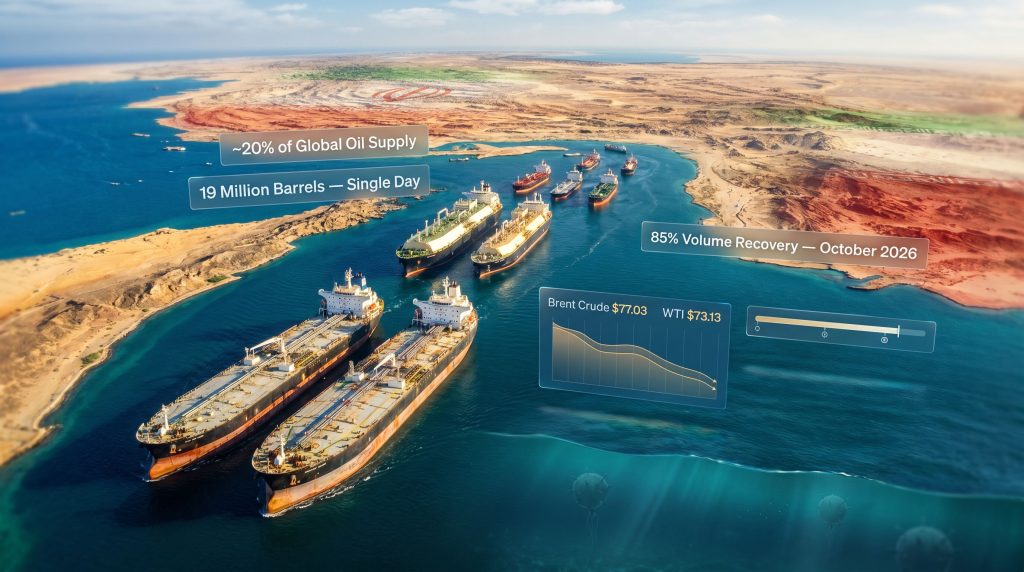
US President Donald Trump confirmed 19 million barrels flowed through the strait on a single day following the deal's announcement.
-
Two stranded supertankers successfully transited the strait following the ceasefire framework.
-
Seven empty Qatar-linked LNG tankers entered the strait in recent weeks, based on ship-tracking data, signalling early resumption of Gulf gas shipping.
-
The first Iranian crude shipments in two months departed the strait, verified through satellite imagery and shipping data.
-
Kuwait began ramping up oil output, targeting production exceeding 2 million barrels per day within a week of the deal.
-
Iraq increased output from its southern oilfields to approximately 2.1 million barrels per day, with tankers queuing at Gulf export terminals.
Oil price response as of June 24, 2026:
| Benchmark | Price / Movement | Context |
|---|---|---|
| Brent Crude | -$0.87 (-1.1%) to $77.03/barrel | Post-deal stabilisation |
| WTI Crude | -$0.73 (-1.0%) to $73.13/barrel | Near four-month low of $72.48 intraday |
| Monday Decline | More than 3% | Triggered by sanctions waiver announcement |
| Rabobank Q3 2026 Brent Forecast | $79/barrel | Revised down citing reduced Gulf disruption risk |
| Rabobank Q4 2026 Brent Forecast | $78/barrel | Continued easing assumption |
| US Retail Gas Prices | Below $4/gallon | White House-reported post-deal impact |
Why Markets Are Still Pricing in Residual Risk
The market's muted enthusiasm for the peace deal reflects a sophisticated understanding of the gap between diplomatic text and operational reality. Furthermore, analysts at SEB Research have noted that the memorandum of understanding between the US and Iran remains a new and inherently fragile arrangement, and that in the near term, the easing of sanctions is unlikely to exert significant downward pressure on oil prices until the agreement demonstrates sustained durability.
This is not reflexive pessimism. It is a recognition that the physical, structural, and geopolitical conditions required for genuine normalisation have not yet been met. For a broader crude oil market overview, these structural gaps help explain why price recovery remains tentative.
Analysts at PVM Oil Associates have emphasised that ship owners and operators will require verified assurances that mine threats have been fully neutralised before resuming normal commercial operations. Damaged port infrastructure, waterborne debris, and vessel congestion are compounding obstacles that diplomacy alone cannot dissolve.
Four persistent risk factors constraining full recovery:
-
Unexploded Ordnance and Mine Threats: Naval mines remain present in and around the strait. Shipping companies are demanding verified clearance programmes before committing to normal traffic schedules, and the verification process itself is time-intensive and technically complex.
-
Damaged Port and Terminal Infrastructure: Physical damage to loading terminals, port facilities, and navigational infrastructure across Iraq, Kuwait, and Iran requires extensive repair, with full restoration potentially extending into 2027.
-
Ceasefire Fragility in Lebanon: Hezbollah's claim that Israeli forces fired on civilians in southern Lebanon shortly after the ceasefire announcement, and the subsequent resumption of Washington-hosted talks, illustrates how rapidly regional instability can undermine confidence in broader peace frameworks.
-
The MOU's Nascent Status: By analyst consensus, the US-Iran agreement is new and untested. Speculative capital has already begun unwinding long positions in crude, but the structural floor provided by historically low US Strategic Petroleum Reserve levels is expected to limit further price deterioration.
"One of the most underappreciated risks in the current situation is the difference between a ceasefire and a stable operating environment. Shipping insurers, vessel operators, and port authorities all apply their own risk thresholds independently of political declarations, and these thresholds take months of incident-free operation to reset."
The next major ASX story will hit our subscribers first
The Hidden Complexity of LNG's Hormuz Dependency
Crude oil dominates the geopolitical narrative around the Strait, but the LNG dimension introduces a separate and arguably more constrained recovery pathway. Qatar is one of the world's largest LNG exporters, and its export capacity is almost entirely reliant on Hormuz transit. The Strait of Hormuz oil flows after US-Iran peace talks beginning to recover is encouraging, though the seven Qatar-linked LNG tankers observed entering the strait in recent weeks represent only the earliest observable signal, and this signal requires careful interpretation.
LNG tanker operators apply higher operational risk thresholds than crude carriers for several interconnected reasons:
-
LNG vessels carry cryogenic cargo that requires continuous temperature management, making extended delays in hazardous waters particularly costly.
-
Insurance underwriting for LNG tankers in conflict or post-conflict zones attracts significantly higher war risk premiums than crude carriers.
-
The specialised infrastructure required at both loading and receiving terminals means that any disruption to vessel scheduling creates cascading delays across entire supply chains.
-
The Q-Max class vessels used by Qatar have no viable alternative transit route, meaning they cannot simply be rerouted if the Strait remains operationally uncertain.
Full LNG shipping normalisation will likely lag crude recovery by weeks to months, with the timeline contingent on verified mine clearance, infrastructure repair at Qatari loading terminals, and the gradual unwinding of elevated war risk insurance premiums.
Competing Price Forces: What Else Is Shaping the Market
The Hormuz reopening does not operate in isolation from broader energy market dynamics. Several concurrent macro-energy developments are shaping the net price impact of the diplomatic breakthrough. In addition, the oil market trade risks stemming from global tariff tensions continue to complicate the demand-side outlook.
Bearish factors currently exerting downward price pressure:
-
Strait reopening restoring Gulf crude and LNG supply, even on a partial basis.
-
The 60-day US sanctions waiver on Iran reducing the geopolitical risk premium embedded in forward prices.
-
Rabobank revising its Brent forecasts lower for H2 2026, signalling reduced disruption risk in institutional price models.
-
Aggressive unwinding of speculative long positions that had accumulated during the peak of the crisis.
Bullish factors providing structural price support:
-
The US Strategic Petroleum Reserve sitting at its lowest level since June 1983, creating a structural demand floor that limits how far prices can fall as Gulf supply returns.
-
Expected declines in US crude oil, gasoline, and diesel stockpiles, based on preliminary Reuters polling conducted in late June 2026.
-
Russia's consideration of a diesel export ban, with Deputy Prime Minister Alexander Novak citing potential domestic fuel shortages, particularly in Crimea, as a driver for potential restrictions.
-
The shipping industry's cautious and staged re-engagement limiting the speed at which Gulf supply can realistically return to market.
Energy consultancy Gelber and Associates has noted that while the aggressive unwinding of speculative long positions has pulled prices down from prior highs, historically low US Strategic Petroleum Reserve levels are expected to maintain a firm structural floor under the market in the near term. This dynamic, combined with the factors behind the recent oil price rally, creates an unusual market configuration: the bears have momentum on the news flow side, but the fundamental supply-demand arithmetic limits how far that momentum can carry prices lower.
A Phased Recovery Timeline: What the Data Suggests
The path from partial reopening to full operational normalisation involves multiple interdependent variables spanning diplomatic, physical, financial, and logistical domains. Consequently, energy sector analysts have suggested approximately 85% of lost oil volumes could be restored by October 2026, though this estimate carries significant uncertainty given the unresolved physical hazards.
| Recovery Phase | Estimated Timeframe | Key Milestones |
|---|---|---|
| Initial Vessel Transit (Controlled) | Immediate (post-deal) | Supertankers, LNG carriers cleared under daily quota |
| Partial Volume Recovery | Weeks to 2 months | 50-60% of pre-war flows restored |
| 85% Volume Recovery | By October 2026 | Analyst projection subject to MOU durability |
| Full Infrastructure Restoration | Potentially into 2027 | Iraq, Kuwait port and terminal repairs |
| Shipping Industry Confidence Restored | 6-12 months sustained stability | Required before pre-war traffic volumes resume |
The gap between oil physically flowing and shipping companies voluntarily resuming full-scale operations represents what market analysts describe as a confidence interval. This interval is priced into forward crude curves, influences refinery procurement strategies across Asia and Europe, and determines when the full economic benefit of the diplomatic breakthrough translates into sustained price normalisation.
"Disclaimer: The recovery timeline estimates presented in this article are based on analyst projections and current market data as of June 24, 2026. They involve forward-looking assumptions that are subject to significant change based on geopolitical developments, physical clearance progress, and the durability of the US-Iran peace framework. This article does not constitute financial or investment advice."
FAQ: Strait of Hormuz Oil Flows After US-Iran Peace Talks
How much oil flows through the Strait of Hormuz under normal conditions?
Approximately one-fifth of the world's total oil supply, along with a significant share of global LNG exports, transits the Strait under normal operating conditions, making it the world's most strategically critical maritime energy chokepoint.
What caused the Strait of Hormuz to close in 2026?
The closure followed US and Israeli military strikes resulting in the death of Iran's supreme leader in early 2026. Iran responded by obstructing the waterway while the US imposed a naval blockade on Iranian ports, collectively removing millions of barrels of daily supply from global markets for more than three months.
Is oil flowing through the Strait of Hormuz again after the peace deal?
Yes, but only partially. Controlled vessel transits are underway on a daily quota basis under coordination with Iran's Revolutionary Guards Navy. Nearly 10 million barrels were already navigating the strait or exiting it in the immediate post-deal period. Full operational normalisation, including unrestricted commercial shipping, is expected to take months, with infrastructure repairs potentially extending into 2027.
What is the 60-day sanctions waiver and what does it mean for oil markets?
The United States granted Iran a 60-day temporary suspension of sanctions as part of the initial peace framework. While this reduces near-term geopolitical risk premium in oil pricing, the arrangement is described by analysts as new and fragile, limiting its immediate downward impact on crude prices.
What risks remain for shipping companies operating through the strait?
Key residual risks include uncleared naval mines, damaged port and terminal infrastructure, waterborne debris, vessel congestion, elevated war risk insurance premiums, and the broader geopolitical uncertainty stemming from ongoing Lebanon-Israel tensions and the untested nature of the US-Iran memorandum of understanding.
When will oil prices fully reflect the Hormuz reopening?
Markets have already priced in an initial risk-premium reduction, with Brent crude falling more than 3% on the day of the sanctions waiver announcement. Full price normalisation depends on the durability of the peace framework, verified mine clearance, infrastructure repair timelines, and the restoration of shipping industry confidence — a process analysts estimate could require six to twelve months of sustained stability.
Want to Stay Ahead of the Next Major Commodity Disruption?
When geopolitical shocks reshape global energy and resource markets, Discovery Alert's proprietary Discovery IQ model scans ASX announcements in real time, delivering immediate alerts on significant mineral discoveries so subscribers can identify actionable opportunities before the broader market reacts — explore historic discovery returns on Discovery Alert's discoveries page and begin your 14-day free trial today.