June 23, 2026
The Compliance Infrastructure Failure That Futures Markets Cannot Price
Every major oil supply shock in modern history has eventually resolved through one of two mechanisms: physical supply restoration or demand destruction sufficient to rebalance markets. What the current Strait of Hormuz oil shipping risk introduces is a third category that neither mechanism addresses directly — a systemic degradation of the compliance infrastructure that governs how physical oil cargoes are tracked, insured, financed, and legally verified. Understanding this distinction is what separates a superficial reading of Hormuz risk from an accurate one.
The conventional media framing reduces Hormuz to a binary status question: open or closed. This is not only analytically incomplete, it actively misleads market participants about where the real risk resides. The strait's navigability is one layer. The ability to generate legally and commercially usable voyage records for every cargo that transits it is an entirely different layer, and it is the second layer that is currently collapsing.
When big ASX news breaks, our subscribers know first
What Makes the Strait of Hormuz Structurally Irreplaceable
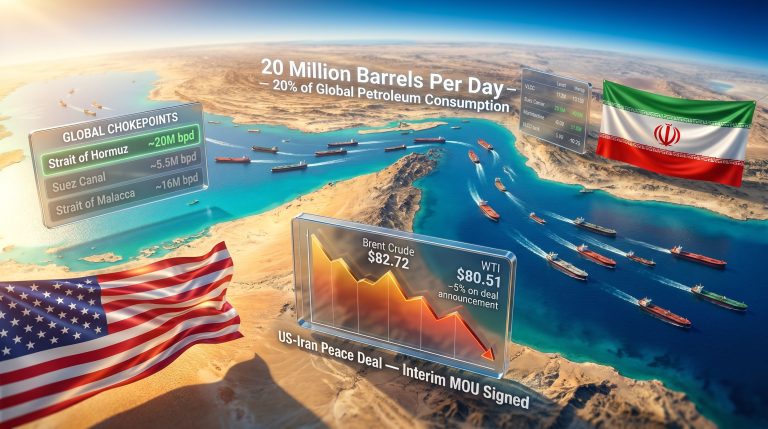
The Strait of Hormuz is approximately 21 nautical miles wide at its narrowest navigable point, with two formalised shipping lanes of roughly 2 miles each — one inbound and one outbound — separated by a 2-mile buffer zone. Through this confined corridor, approximately 20 million barrels per day of crude oil and petroleum products moved under pre-crisis conditions, representing roughly 20 to 21 percent of total global petroleum consumption.
No maritime alternative exists capable of absorbing that volume. The strait is not merely the most heavily trafficked oil corridor on earth; it is structurally irreplaceable across any short-to-medium term planning horizon, for one reason above all others: the producing nations whose exports depend on it have no credible bypass.
- Kuwait, Iraq, Qatar, and Iran possess no pipeline infrastructure connecting their export terminals to non-Hormuz maritime routes
- Qatar's Ras Laffan LNG facility, one of the world's largest, is entirely dependent on Hormuz for seaborne export access
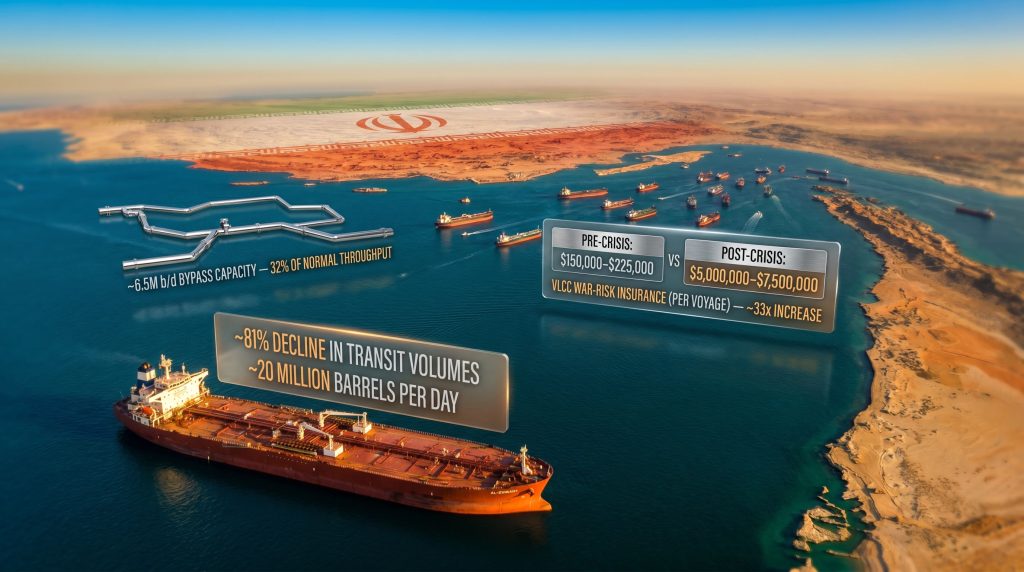
- Saudi Arabia's Petroline (East-West Pipeline) and the UAE's Abu Dhabi Crude Oil Pipeline (ADCOP) provide a combined bypass capacity of approximately 6.5 million barrels per day
- This combined alternative capacity covers only 32 percent of normal Hormuz throughput
| Pipeline | Operator | Capacity (b/d) | Export Destination |
|---|---|---|---|
| Petroline (East-West) | Saudi Aramco | ~5 million | Red Sea (Yanbu) |
| ADCOP | ADNOC | ~1.5 million | Gulf of Oman (Fujairah) |
| Total Bypass | ~6.5 million | Multiple |
The gap between 6.5 million and 20 million barrels per day is not bridgeable through any currently operational infrastructure. Accelerated pipeline investment discussions are ongoing across the region, however new capacity cannot materialise within the current disruption window regardless of capital commitment.
The 81% Transit Collapse: What the Numbers Actually Represent
Crude tanker transit volumes through the Strait of Hormuz have declined by approximately 81 percent compared to pre-crisis baseline levels. On the lowest-activity days recorded during this period, as few as one crude tanker completed a transit. According to Lloyds List reporting on Hormuz transits, an estimated 2,000 vessels are believed to be immobilised or holding position within Gulf waters.
To contextualise the scale of disruption implied by these figures, the approximately 14 million barrels per day of supply affected by the current crisis exceeds every prior documented oil supply disruption in recorded history.
| Disruption Event | Volume Removed (b/d) | Approximate Duration |
|---|---|---|
| 1973 Arab Oil Embargo | ~4.3 million | ~5 months |
| 1979 Iranian Revolution | ~5.6 million | ~12 months |
| 1990 Gulf War | ~4.3 million | ~7 months |
| Current Hormuz Crisis | ~14 million+ | Ongoing |
Goldman Sachs has noted in recent analysis that Hormuz traffic patterns may not fully recover even after formal hostilities cease — a position that reflects awareness of the structural compliance and insurance barriers discussed below, not merely the physical security risk. Furthermore, the geopolitical oil price analysis from energy market specialists reinforces this concern about prolonged structural disruption.
Compounding the physical backlog, an estimated 80 million barrels of crude are currently queued for Hormuz exit. Any reopening scenario must absorb this inventory overhang before normal flow rates can resume — a dynamic that creates its own logistics and pricing complexities entirely separate from the geopolitical question.
GNSS Spoofing: The Hidden Mechanism Degrading the Entire Compliance Chain
How Vessel Tracking Systems Function Under Normal Conditions
Under stable operating conditions, every commercial vessel transiting the Strait of Hormuz continuously broadcasts its identity, position, speed, and heading via its Automatic Identification System (AIS) transponder. This AIS data is derived from GNSS positioning signals — the same satellite-based navigation infrastructure underlying GPS systems globally.
Every party connected to an oil cargo transaction depends on the integrity of this data stream:
- Port-call verification: Confirms a vessel arrived at and departed from specific terminals on documented dates
- Sanctions exposure mapping: Identifies whether a vessel's routing pattern creates contact with sanctioned entities or jurisdictions
- Cargo chain-of-custody: Establishes a legally defensible record of where oil moved from origin to delivery
- Insurance claims processing: Provides the voyage reconstruction evidence underwriters require to assess and pay claims
- Trade finance milestone confirmation: Allows banks to release payment tranches tied to verified cargo movement events
What GNSS Spoofing Does to This Infrastructure
GNSS spoofing is the deliberate injection of false satellite positioning signals into a vessel's navigation environment, causing its onboard systems — including AIS transponders — to report fabricated coordinates. Unlike jamming, which simply blocks signal reception, spoofing generates a plausible false reality that the vessel's systems accept as genuine.
The consequences cascade across every layer of the compliance framework simultaneously. A vessel may complete a physical transit without obstruction, yet produce a voyage record so contaminated by spoofed positioning data that it becomes commercially and legally unusable. Port-call verification fails because the recorded arrival coordinates do not match the actual terminal. Sanctions screening breaks down because exposure mapping depends on accurate routing data.
Voyage reconstruction for insurance purposes becomes legally contested, and trade finance banks cannot confirm that cargo movement milestones occurred where and when the record claims. In this context, sanctions and oil trading frameworks developed during prior crises offer limited guidance, as they were not designed to address compliance failures driven by deliberate data manipulation.
Operational Risk Alert: The practical effect of sustained GNSS spoofing across the Hormuz corridor is that physical transit and compliance-grade voyage documentation have become decoupled. A cargo can move. Its paperwork may be worthless.
This is a form of strategic information warfare that imposes commercial and financial costs on shipping operations without requiring direct physical interdiction of vessels. It degrades adversarial shipping economics through the compliance layer rather than the physical layer — a far more efficient asymmetric instrument.
Why Existing Compliance Frameworks Cannot Adapt Quickly
Pre-conflict compliance frameworks across insurers, trade finance banks, commodity trading houses, and regulatory bodies were constructed on a foundational assumption: GNSS positioning data is reliable, continuous, and unmanipulated. That assumption has been invalidated across the entire Hormuz transit corridor.
Rebuilding compliance frameworks capable of operating under persistent spoofing conditions requires not only new technical standards but new legal agreements between counterparties about what constitutes acceptable voyage verification in a degraded data environment. Neither process moves quickly in industries where legal liability is paramount.
Iran's Persian Gulf Strait Authority: A Novel Jurisdictional Assertion
The compliance challenge does not end with GNSS spoofing. Iran has now established the Persian Gulf Strait Authority (PGSA) as the sole body authorised to issue transit permits for vessels passing through the Strait of Hormuz. The PGSA has also assumed authority to designate mandatory routing lanes that transiting vessels must follow.
Initial insurance coverage provided by the PGSA is currently offered at no charge to vessel owners, with the Iranian government covering associated costs. However, the PGSA has explicitly reserved the right to introduce mandatory insurance fees in subsequent periods, requiring vessel owners to purchase and renew coverage from the authority on an ongoing basis.
This creates several immediate and layered problems for Western shipping interests:
- Parallel insurance jurisdiction: PGSA coverage conflicts structurally with existing Lloyd's of London frameworks and Protection and Indemnity (P&I) Club coverage, which are the industry standard for maritime insurance globally
- Sanctions exposure risk: Formally accepting PGSA transit permits or insurance documentation may constitute a sanctionable transaction under U.S. OFAC regulations and equivalent EU frameworks, depending on jurisdictional interpretation
- Tiered access architecture: Vessels perceived as aligned with Iranian interests, or willing to engage PGSA administrative processes, may receive preferential routing or reduced interdiction exposure compared to vessels from adversarial nations
Compliance Warning: No vessel owner should engage with PGSA documentation or permit processes without first obtaining specific legal counsel regarding sanctions exposure under applicable U.S., EU, and UK regulatory frameworks. The jurisdictional implications of PGSA engagement remain legally untested and potentially severe.
The PGSA represents a genuinely novel form of maritime jurisdictional assertion. No established precedent in international maritime law addresses a transit permit regime of this character imposed unilaterally on a recognised international strait. The multilateral legal response to this development remains in its earliest stages.
The Insurance Cost Shock: From $225,000 to $7.5 Million Per Voyage
The financial arithmetic of Hormuz transit risk has been transformed entirely. Before active hostilities commenced, war-risk insurance for a Very Large Crude Carrier cost between $150,000 and $225,000 per voyage. Current market rates for the same coverage have risen to between $5 million and $7.5 million per voyage — a roughly 33-fold increase.
| Cost Category | Pre-Crisis | Post-Crisis | Multiplier |
|---|---|---|---|
| VLCC War-Risk Insurance (per voyage) | $150,000 – $225,000 | $5,000,000 – $7,500,000 | ~33x |
| War-Risk Premium (% of hull value) | <0.25% | ~5% | ~20x |
| Tanker Freight Rates | Baseline | +50% to +100% above baseline | Significant |
A standard VLCC carries approximately 2 million barrels of crude. At $75 per barrel, the cargo value of a fully laden VLCC approximates $150 million. Post-crisis insurance costs of $5 to $7.5 million therefore represent 3.3 to 5 percent of cargo value per voyage — a cost ultimately embedded in the physical price paid by end-market buyers.
Critically, these costs will not normalise upon ceasefire. Several structural factors ensure premiums remain elevated for an extended period:
- Information gaps created by GNSS spoofing during the conflict period will persist in historical voyage records and continue to generate underwriting uncertainty
- U.S. authorities have indicated mine-clearance operations in affected Hormuz shipping lanes may require up to six months to complete
- Actuarial models for war-risk insurance require multiple years of clean loss data before premium normalisation is mathematically justifiable
- The PGSA permit regime introduces ongoing jurisdictional uncertainty that underwriters must price into coverage terms
The next major ASX story will hit our subscribers first
The Physical-to-Paper Market Disconnect: What Brent Cannot Tell You
Futures markets for crude oil, including Brent and WTI benchmarks, respond primarily to narrative signals: diplomatic statements, ceasefire announcements, and headline transit updates. Physical delivery markets respond to operational reality: actual cargo availability, verified voyage records, insurance confirmability, and sanctions clearance status.
During periods of active Hormuz disruption, this divergence produces substantial and sustained price differentials between futures benchmarks and real physical delivery costs. The gap is not a market inefficiency in the traditional sense; it is a structural consequence of the fact that futures contracts do not expose their holders to voyage verification failures, spoofed AIS data, or PGSA permit complications.
Physical buyers — specifically refineries, national oil companies, and trading houses taking actual delivery of cargo — absorb the full operational cost burden. A Brent futures price does not capture a $7.5 million per-voyage insurance surcharge. It does not reflect the legal uncertainty surrounding PGSA documentation. It does not price the possibility that a completed voyage may generate an unusable compliance record. Consequently, the market volatility reset playing out across broader energy markets is amplifying these physical-to-paper disconnects in ways that standard benchmarks fail to represent.
Market Insight: For energy analysts and investors using futures benchmarks as primary risk indicators during active Hormuz disruption, those benchmarks are structurally incomplete. The physical market is pricing a fundamentally different risk environment than the paper market acknowledges.
How Major Importers Are Restructuring Supply Relationships
India's Strategic Recalibration
India's energy import bill surged 82 percent during the high-price period, generating acute fiscal pressure on an economy highly exposed to oil import costs. In response, India ordered a major expansion of its strategic petroleum reserve capacity. Despite signals of partial Hormuz reopening, India has shown significant reluctance to immediately revert to Middle Eastern crude supply, maintaining diversified sourcing relationships developed during the disruption.
India received its first post-deal LNG cargo through Hormuz as a test of transit viability, but the broader reorientation of its import strategy appears durable rather than temporary. This recalibration reflects precisely the kind of geopolitical trade disruption that permanently reshapes long-term supply chain architecture.
China's Parallel Adaptation
China accelerated construction of new LNG import hub infrastructure during the disruption period while simultaneously recording new highs in Russian crude imports as a structural alternative to Gulf supply. Chinese grid operators have also resisted renewable energy expansion plans that would reduce fossil fuel import dependency, creating a paradox in which the crisis simultaneously accelerated energy security planning and reinforced fossil fuel import patterns.
European Energy Security Pressures
European energy security faced a compounding risk scenario when heatwave conditions, active Hormuz threats, and an explosion at Qatar's Ras Laffan LNG facility pushed European gas prices higher in simultaneous fashion. Greece attracted $26 billion in energy investment as Europe accelerated efforts to diversify away from Russian pipeline gas. Germany began evaluating extensions of strategic oil reserve relief measures as price volatility persisted. The trade war impact on oil prices has further complicated European procurement strategies across this period.
Physical Threat Indicators and the Tiered Access Model
Iran's approach to Hormuz control is not structured as a binary blockade. It functions as a graduated access system designed to extract maximum geopolitical leverage while avoiding the full economic consequences of complete closure — which would also harm Iran's own export revenue and regional relationships.
Documented physical threat indicators during the active conflict period include:
- 15 vessels targeted during confirmed interdiction events
- 7 seafarers killed, prompting a UN Secretary-General statement characterising the strait as unsafe for commercial shipping
- Mining of shipping lanes confirmed, with clearance operations estimated to require up to six months
- Coordinated deployment of drone, missile, and fast-attack boat capabilities
The access model that emerges from this architecture is one in which perceived alignment with Iranian interests, or willingness to engage PGSA administrative processes, functions as a de facto risk-reduction mechanism. Vessels from adversarial nations face elevated interdiction exposure. This tiered structure is precisely what makes the PGSA permit regime analytically significant beyond its immediate insurance implications.
What Reopening Actually Means: The Structural Risk That Survives a Ceasefire
The open/closed narrative fails because it treats Strait of Hormuz oil shipping risk as event-contingent rather than structurally embedded. A ceasefire does not immediately restore the compliance infrastructure that GNSS spoofing has degraded. It does not resolve the legal uncertainty surrounding PGSA documentation. It does not compress mine-clearance timelines. It does not return war-risk insurance premiums to pre-crisis levels in the absence of years of clean actuarial data.
The 80 million barrels of crude currently queued for Hormuz exit represent a physical backlog that any reopening scenario must absorb before market normalisation begins. The processing of that backlog through a partially restored, compliance-degraded transit corridor will generate its own friction, pricing anomalies, and insurance complications. Al Jazeera's analysis of commercial shipping safety in the aftermath of the Iran conflict underscores precisely how prolonged the recovery timeline may prove to be.
For market participants navigating this environment, the following distinctions are essential:
- Shippers and vessel owners: Legal counsel must be engaged before any interaction with PGSA documentation; war-risk coverage status must be confirmed before Gulf transit commitments are made
- Commodity traders and refiners: Physical delivery cost models must incorporate post-crisis insurance benchmarks, not pre-crisis baselines
- Energy analysts and investors: Brent and WTI futures should be treated as incomplete risk indicators during active Hormuz disruption; the physical market is pricing a materially different risk environment
- Policy analysts: The PGSA represents a jurisdictional assertion without established precedent in international maritime law, requiring coordinated multilateral legal response that has not yet been formulated
The Strait of Hormuz crisis is, at its core, a stress test of the invisible infrastructure that global oil trade depends upon: the positioning data, voyage records, compliance frameworks, and insurance architectures that allow a physical commodity to move from producer to refiner across geopolitically contested waters. That infrastructure is under sustained attack by mechanisms that ceasefire agreements alone cannot repair.
This article is intended for informational purposes only and does not constitute financial, legal, or investment advice. All forecasts, projections, and scenario analyses involve inherent uncertainty and should not be relied upon as predictive of future outcomes. Readers should seek independent legal and financial counsel before making decisions related to the topics discussed.
Want to Stay Ahead of the Next Major Commodity Market Shift?
Discovery Alert's proprietary Discovery IQ model scans ASX announcements in real time, instantly identifying significant mineral discoveries and translating complex commodity data into actionable investment insights — so subscribers can position themselves before the broader market reacts. Explore how historic mineral discoveries have generated substantial returns or begin your 14-day free trial today to secure a market-leading edge.