August 14, 2026
The geopolitical tensions surrounding one of the world's most critical energy chokepoints continue to reshape global markets and strategic planning across multiple sectors. The strait of Hormuz oil supply disruption presents unique challenges that extend far beyond immediate price movements, creating cascading effects throughout interconnected energy systems worldwide. Understanding these complex dynamics becomes essential for organisations navigating an increasingly volatile energy landscape.
Geographic Constraints That Define Global Energy Security
The Strait of Hormuz represents one of the most critical bottlenecks in global energy infrastructure, where physical geography creates unavoidable vulnerability for international commerce. At its narrowest point, the waterway spans just 21 nautical miles, with shipping lanes restricted to approximately 2 nautical miles in each direction. This geographic constraint forces vessels to transit at reduced speeds of 10-12 knots while navigating a mandatory turn adjacent to strategic coastal positions.
Daily throughput statistics reveal the magnitude of global dependency:
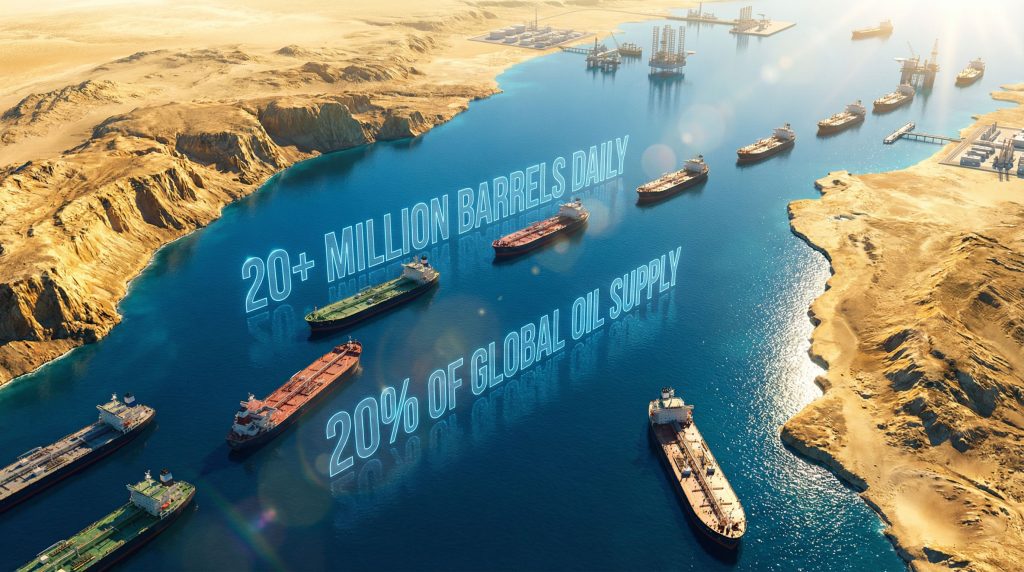
• 21 million barrels per day of crude oil and petroleum products pass through this single chokepoint
• Approximately 21% of global petroleum trade relies on Hormuz transit routes
• 95% of Persian Gulf crude exports must navigate through this waterway
• Over 2,000 vessel transits annually, with tankers representing 30-40% of total traffic
The strategic positioning between Persian Gulf producers and global markets creates a situation where alternative routing options require significant time and cost penalties. Historical data shows that during previous disruption periods, such as the 1980-1988 Iran-Iraq War, even partial restrictions on Hormuz transit caused substantial market volatility and supply chain realignments.
Recent events demonstrate the rapid impact of perceived security threats on commercial operations. According to Joint Maritime Information Center data, tanker traffic through the Strait fell by 94% from February 28 to March 1, 2026, illustrating how quickly shipping companies respond to elevated risk assessments.
Furthermore, infrastructure vulnerability extends beyond the waterway itself:
• Multiple underwater pipeline crossings create additional navigational complexity
• Depth constraints in certain sections limit maximum vessel sizes
• Seasonal weather patterns can further reduce operational flexibility
• Port terminal dependencies concentrate risk at specific loading facilities
The narrow shipping lanes also prevent implementation of effective convoy protection systems, making individual vessels particularly exposed during transit. Maritime security experts note that the physical geography inherently favors defensive positions over commercial shipping, creating asymmetric risk profiles for energy transportation.
When big ASX news breaks, our subscribers know first
Critical Export Dependencies and Pipeline Limitations
Persian Gulf nations exhibit varying degrees of dependency on Hormuz routing for their crude oil exports, with some countries possessing limited bypass capacity while others maintain complete reliance on the strategic waterway. Understanding these dependencies becomes crucial when assessing how OPEC production impact affects global supply security.
Current export volumes through Hormuz (2025 data):
| Country | Hormuz Exports (mb/d) | Pipeline Bypass Capacity | Coverage Ratio |
|---|---|---|---|
| Saudi Arabia | 5.3 | 7.0 (East-West Pipeline) | 132% theoretical |
| Iraq | 3.3 | 0.22 (suspended) | 7% operational |
| UAE | 2.1 | 1.5 (Adcop Pipeline) | 71% |
| Kuwait | 1.4 | 0 | 0% |
| Qatar | 0.8 | 0 | 0% |
Iraq's position appears particularly vulnerable, with approximately 3.3 million barrels per day exported from Basrah terminals requiring Hormuz transit. The country's northern export route through the Iraq-Turkey pipeline, with capacity of 220,000 barrels per day, was already suspended on security grounds as of early March 2026. This dual disruption forced Iraq to begin cutting crude production, according to ministry statements, as limited storage capacity cannot absorb continued output.
Saudi Arabia's East-West Pipeline theoretically provides 7 million barrels per day capacity to Red Sea terminals, but operational constraints limit practical utilisation. Loading capacity at Yanbu remains restricted, and the pipeline also serves refineries along the Red Sea coast, reducing available capacity for export diversification.
The UAE's Abu Dhabi Crude Oil Pipeline (Adcop) to Fujairah offers 1.5 million barrels per day capacity, covering approximately 71% of the country's usual Hormuz-dependent exports. However, recent targeting of Fujairah facilities demonstrates that alternative routes face their own security vulnerabilities.
Insurance market responses amplify infrastructure constraints:
• Additional War Risk Premiums increased from 0.15-0.2% to approximately 1% of vessel hull value
• Standard 2 million barrel VLCC tankers now face $1.34 million in additional insurance costs per transit
• Complete removal of war-risk cover by some insurers eliminates commercial viability for many operators
Consequently, Qatar's complete dependence on Hormuz routing led state-owned QatarEnergy to declare force majeure on LNG production at Ras Laffan facilities. This precautionary measure prevents onshore storage from overfilling but effectively removes significant LNG volumes from global markets.
Market Response Mechanisms and Price Discovery
Energy markets exhibit rapid price adjustments when the strait of Hormuz oil supply disruption risks materialise, with different commodity sectors showing varying degrees of sensitivity to geopolitical events. These oil price movements triggered immediate responses across crude oil, refined products, and natural gas markets.
Crude oil price volatility patterns:
• Brent crude front-month contracts gained over $10 per barrel from February 28 to March 4, 2026
• US WTI crude reached $77-80 per barrel in outright assessments
• Medium sour crude premiums achieved levels not seen since April 2020
The premium expansion in US Gulf crude markets reflects substitution effects as global supply patterns shift. Mars crude premiums reached $3.75-$5.00 per barrel over Domestic Sweet benchmark, while Heavy Louisiana Sweet achieved $5.25 per barrel premiums. These volume-weighted average gains of $1.15-$2.15 per barrel from prior sessions demonstrate rapid price discovery in illiquid market conditions.
Refined product market responses:
• European jet fuel values tripled in early swaps trading, reaching historic levels
• US Gulf coast jet fuel prices hit 29-month highs
• Dutch TTF natural gas contracts surged over 50% during peak trading
The refined product rally reflects both immediate supply concerns and longer-term substitution dynamics. Approximately 95% of Middle Eastern crude imports to US Gulf refineries consist of medium sour grades, creating direct competition with domestic production when international supplies face disruption.
Financial market correlation effects:
Options market volatility premiums expanded significantly across energy sectors, with implied volatility reaching levels associated with major supply disruptions. Calendar spread relationships in crude oil futures shifted toward backwardation, indicating market expectations of near-term supply tightness relative to forward months.
In addition, currency markets responded with typical patterns during oil price spikes, including US dollar strengthening against emerging market currencies and increased flows toward safe-haven assets. These secondary effects compound the direct impact of higher energy costs on import-dependent economies.
Regional Supply Chain Adaptation Strategies
Different regions exhibit varying capacity to adapt to Hormuz disruptions based on their import dependency levels, alternative supply infrastructure, and strategic stockpile positions. The speed and effectiveness of adaptation measures directly influence regional economic impacts and energy security outcomes. However, the trade war impact on supply chains adds another layer of complexity to these adaptation strategies.
Asia-Pacific region faces the most significant exposure:
• 65% of crude imports typically transit through Hormuz
• Alternative supply routes include Russian pipelines and African sources
• 2-4 weeks required for meaningful supply routing changes
• Indonesian refiners actively considering increased US crude imports
Asian markets demonstrate particular vulnerability due to their heavy reliance on Middle Eastern medium sour crudes, which match regional refinery configurations optimised for these specific grades. The quality composition of disrupted supplies means that alternative crudes may require operational adjustments or yield different product slates.
European markets show greater resilience:
The European Commission stated that gas storage levels remain stable with no immediate security of supply risks identified as of March 4, 2026. However, commission officials noted they would reassess the situation in case of prolonged closure without defining specific timeframes.
Europe's lower dependency on Hormuz routing, approximately 15% of crude imports, provides greater flexibility for supply substitution. North Sea domestic production, North African sources, and established trade relationships with non-Gulf producers enable 1-2 week response times for alternative supply arrangements.
North American markets experience indirect effects:
• 5% import dependency via Hormuz creates minimal direct exposure
• Domestic shale production provides supply flexibility
• Price impacts primarily reflect global substitution patterns rather than supply constraints
The substantial premium expansion in US Gulf crude markets demonstrates how global supply disruptions affect domestic pricing even when physical supply remains adequate. US producers benefit from reduced competition from Middle Eastern grades, while refiners face higher feedstock costs.
Production Response and OPEC+ Considerations
Oil producing nations face complex decisions when major transit routes become unavailable, balancing production optimisation against storage constraints and market share preservation. Current OPEC+ spare capacity of approximately 4.2 million barrels per day provides some buffer against supply disruptions, but geographical and quality considerations limit substitution effectiveness.
Gulf producer adaptation challenges:
• Iraq began cutting crude production due to export limitations and storage constraints
• Saudi Aramco's Ras Tanura refinery faced multiple targeting incidents, affecting 550,000 barrel per day capacity
• Kuwait and Qatar maintain no viable export alternatives to Hormuz routing
The production curtailment decisions reflect economic realities of continued pumping without export capacity. Storage limitations at producing fields mean that sustained output without corresponding export capability becomes technically and economically unsustainable.
Non-Gulf producer opportunities:
US shale production demonstrates rapid response capabilities during supply disruptions, with operators able to adjust drilling and completion activities based on price signals. However, logistical constraints and transportation capacity limit the speed at which additional volumes can reach global markets.
For instance, Russian export infrastructure provides alternative supply sources for Asian and European markets, though geopolitical considerations and existing sanction frameworks complicate trade relationships. West African and Latin American producers also benefit from reduced competition and higher netback pricing during Middle Eastern supply constraints.
Strategic reserve deployment mechanisms:
International Energy Agency coordination protocols enable strategic petroleum reserve releases during supply emergencies. Member countries maintain approximately 90-day import coverage targets, though the effectiveness of reserve drawdowns depends on refinery configurations and product specifications matching disrupted supplies.
Commercial inventory drawdown patterns typically precede strategic reserve releases, as market participants utilise existing stocks before triggering government intervention measures. The timing and magnitude of reserve releases significantly influence market psychology and price expectations.
Financial Market Implications and Risk Pricing
Energy commodity disruptions create complex financial market effects extending beyond direct price movements into currency relationships, equity valuations, and derivative market structures. Understanding these interconnections becomes crucial for portfolio management and risk assessment during geopolitical events. Moreover, gold safe-haven insights become particularly relevant during such periods of heightened uncertainty.
Oil futures market structure analysis reveals risk pricing mechanisms:
• Calendar spread relationships shifted toward backwardation, indicating near-term supply premium
• Options market implied volatility expanded across all contract months
• Basis relationships between different crude grades reflected quality and logistical premiums
The transition from contango to backwardation in crude oil futures demonstrates market expectations of immediate supply tightness relative to future delivery periods. This structure typically incentivises inventory drawdowns and discourages storage accumulation.
Energy sector equity implications:
Upstream producer valuations benefit from higher commodity prices and reduced competition from disrupted regions. Companies with production profiles similar to disrupted Middle Eastern grades experience particular valuation premiums as buyers seek alternative sources.
Furthermore, midstream infrastructure assets in non-disrupted regions gain strategic value as alternative routing becomes essential. Pipeline systems, storage facilities, and port terminals outside the affected area command premium utilisation rates and enhanced long-term contracts.
Currency and commodity correlation effects:
Emerging market currencies with significant energy import dependencies face dual pressures from higher commodity costs and capital outflows toward perceived safe-haven assets. The correlation between oil prices and currency performance intensifies during supply disruption periods.
Gold and other traditional safe-haven assets typically benefit from geopolitical uncertainty, though the relationship may be complicated by central bank policy responses and inflation expectations derived from higher energy costs.
The next major ASX story will hit our subscribers first
How Will This Affect Corporate Risk Management Strategies?
Organisations across different sectors must develop comprehensive risk management strategies addressing both immediate supply disruption impacts and longer-term structural changes in energy markets. Effective frameworks combine financial hedging tools with operational flexibility measures. Additionally, the integration of energy transition strategies becomes increasingly important in long-term planning.
Corporate hedging framework development:
• Financial derivative strategies for oil price exposure management across multiple time horizons
• Physical supply contract diversification requirements with alternative source development
• Force majeure clause evaluation ensuring protection during geopolitical events
• Supply chain stress testing for various disruption scenarios
Energy-intensive industries require particular attention to derivative market capacity during volatile periods. Options strategies may provide more effective protection than futures contracts when dealing with extreme price movements and basis risk between different crude grades.
Government policy response mechanisms:
Strategic petroleum reserve release coordination requires careful timing to maximise market impact while preserving reserves for extended disruptions. Emergency fuel allocation systems prioritise critical sectors such as aviation, emergency services, and essential industries.
International cooperation frameworks become essential during major supply disruptions. The US announced plans for naval escort operations and Development Finance Corporation political risk insurance, though implementation challenges and capacity constraints limit immediate effectiveness.
Investment portfolio adjustments:
• Energy sector allocation strategies during geopolitical uncertainty periods
• Geographic diversification requirements balancing return potential against political risk
• Alternative energy infrastructure investment acceleration as insurance against fossil fuel disruptions
"The combination of immediate supply constraints and longer-term energy security concerns creates investment opportunities in renewable energy infrastructure, storage technology, and alternative transportation systems."
Portfolio managers must balance increased energy sector allocations against concentration risk, particularly when geopolitical premiums may reverse rapidly following conflict resolution or alternative supply development.
What Does the Future Hold for Energy Security?
Modern conflict dynamics differ substantially from historical patterns due to technological advances in warfare capabilities, monitoring systems, and maritime security measures. These changes affect both the nature of potential disruptions and the effectiveness of protective measures.
Advanced warfare capabilities:
• Drone and cyber warfare technologies enable precise targeting of critical infrastructure
• GPS disruption capabilities complicate navigation through narrow waterways
• Multi-vector attack scenarios challenge traditional naval protection concepts
Shipbroker analysis indicates that even naval escort operations face limitations in protecting against simultaneous threats. A single destroyer can intercept missiles but cannot simultaneously sweep mines, counter drone-boat swarms from multiple directions, and manage electronic warfare disruptions.
Enhanced monitoring and early warning systems:
Satellite surveillance and real-time tracking systems provide improved situational awareness but also enable more precise targeting of commercial vessels. The transparency that aids legitimate commerce also assists potential attackers in identifying high-value targets.
Autonomous shipping technology development may reduce human crew exposure to dangerous transit routes, but also creates new vulnerabilities related to electronic systems and remote control capabilities.
Energy transition considerations:
Growing renewable energy penetration gradually reduces oil import dependency for electricity generation, but transportation fuel demand remains concentrated in petroleum products. Electric vehicle adoption timelines vary significantly by region, maintaining crude oil vulnerability for transport sectors.
Hydrogen economy development offers potential alternative energy vectors that bypass traditional chokepoints, though infrastructure requirements and cost competitiveness remain substantial barriers to rapid deployment.
Strategic Planning for Enhanced Energy Security
Future energy security planning must incorporate lessons from current and historical disruption events while adapting to changing technological and geopolitical landscapes. Effective strategies balance redundancy costs against vulnerability reduction benefits.
Infrastructure resilience enhancement priorities:
• Redundant supply route development through alternative pipeline systems
• Strategic storage capacity expansion at consuming and producing locations
• Cross-border pipeline interconnection projects reducing single-source dependencies
The development of alternative export infrastructure requires substantial capital investment and long development timelines. Bypass pipeline projects typically require 5-10 years from conception to operation, emphasising the importance of proactive planning rather than reactive responses.
Market mechanism improvements:
Emergency supply sharing agreements between allied nations can provide rapid response capabilities during disruption events. However, effectiveness depends on compatible refinery configurations and product specifications between sharing partners.
Price volatility dampening mechanisms, such as strategic reserve coordination and temporary tariff adjustments, require pre-negotiated frameworks to enable rapid implementation during crisis periods.
Policy framework evolution:
Energy security assessment methodologies must incorporate modern warfare capabilities and technological vulnerabilities alongside traditional supply and demand analysis. Regular stress testing of supply chains and emergency response procedures ensures preparedness for various disruption scenarios.
International cooperation mechanism strengthening involves both formal treaty arrangements and informal coordination protocols between key consuming and producing nations. The effectiveness of collaborative responses often determines the duration and severity of market impacts during geopolitical events.
The strait of Hormuz oil supply disruption demonstrates the interconnected nature of global energy systems and the cascading effects that arise when critical infrastructure faces security threats. Organisations that develop comprehensive risk management frameworks and maintain operational flexibility will be better positioned to navigate future disruption events while capitalising on the strategic opportunities they create.
This analysis is based on publicly available market data and should not be considered investment advice. Energy market participants should conduct their own risk assessments and consult with qualified professionals when developing hedging strategies or making investment decisions during volatile market conditions.
Ready to capitalise on energy market volatility?
Discovery Alert's proprietary Discovery IQ model delivers real-time alerts on significant ASX mineral discoveries, instantly empowering subscribers to identify actionable opportunities ahead of the broader market during periods of heightened geopolitical uncertainty. Begin your 14-day free trial today and secure your market-leading advantage when energy transitions create new opportunities in critical minerals and resources.