June 25, 2026
The World's Most Dangerous Shipping Lane Is Reopening — But the Crisis Is Far From Over
Energy markets have long operated on the assumption that the Strait of Hormuz would remain open. For decades, this assumption was treated as a near-certainty, a geopolitical constant woven into global supply chain planning, refinery scheduling, and crude oil futures pricing. The events of early 2026 shattered that assumption entirely, triggering a crisis that exposed just how fragile the architecture of global energy security really is.
The partial reopening of the strait following the U.S.-Iran Memorandum of Understanding framework marks a pivotal but incomplete turning point. Oil tankers exiting the Strait of Hormuz after the U.S.-Iran deal represent a significant development for global crude markets, yet the volumes flowing through the chokepoint today remain a fraction of what was transiting before hostilities began. Understanding what this means for prices, supply chains, and the broader geopolitical outlook requires unpacking each layer of a still-evolving situation.
When big ASX news breaks, our subscribers know first
Why the Strait of Hormuz Is Unlike Any Other Shipping Route
At just 33 kilometres wide at its narrowest navigable point, the Strait of Hormuz connects the Persian Gulf to the Gulf of Oman and onward to global ocean routes. Its physical dimensions are modest. Its strategic weight is almost incomprehensible.
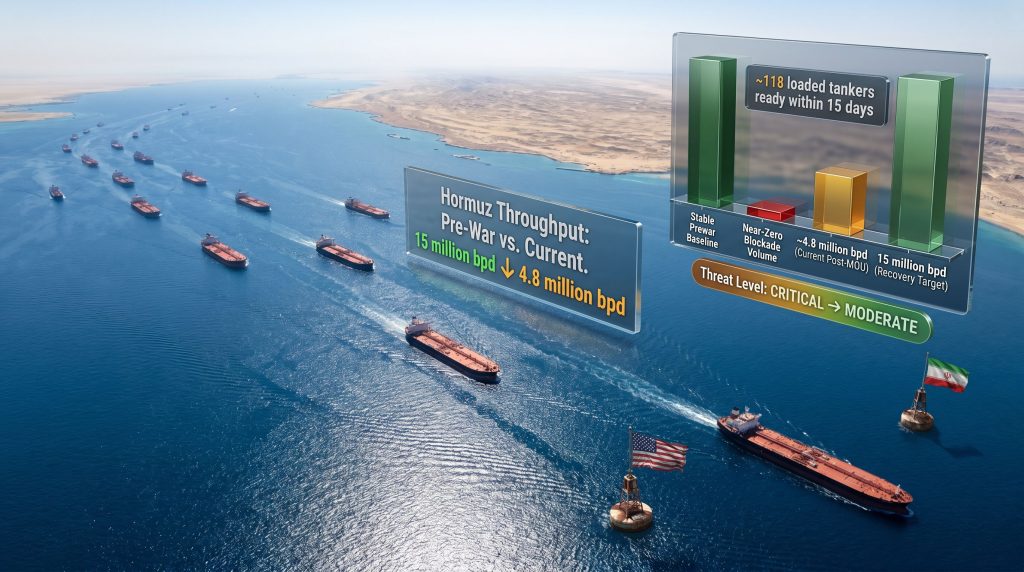
Before the conflict that began on February 28, 2026, roughly 15 million barrels per day (bpd) of crude oil and petroleum products transited the strait in an outbound direction, according to data from Kpler, a firm that tracks global commodity trade flows. This figure represents a significant share of globally traded seaborne oil, meaning any prolonged disruption would immediately ripple across Asian refining hubs, European energy markets, and benchmark crude prices worldwide.
No viable alternative exists at equivalent scale. The Suez Canal handles different cargo profiles and different trade lanes. The East-West Pipeline in Saudi Arabia offers some bypass capacity, but nowhere near enough to compensate for total Hormuz closure. The Cape of Good Hope routing adds weeks of transit time and dramatically increases shipping costs. The world built its energy architecture around Hormuz remaining open, and in early 2026, that architecture was tested in a way it had never been before.
From Free-Flowing to Frozen: How the Closure Unfolded
The sequence of events that paralysed the strait can be broken into distinct phases, each with its own market and humanitarian consequences. Furthermore, understanding these phases helps contextualise why the current crude oil volatility trends have been so pronounced, with crude oil volatility trends proving far more extreme than most analysts anticipated.
Phase One: Iran Weaponises the Chokepoint
Following the U.S. and Israeli military strike on Iran on February 28, 2026, Tehran moved quickly to restrict commercial shipping through the strait. The effective closure was not an immediate total blockade in the traditional military sense, but rather a combination of naval posturing, mine deployment, and the practical deterrence created by extreme security risk.
Commercial operators, insurers, and charterers responded rationally by halting transits, creating a de facto shutdown of one of the world's most critical energy arteries.
Phase Two: The U.S. Naval Blockade
American naval forces subsequently established a blockade perimeter, freezing tanker traffic in both directions. Dozens of vessels found themselves stranded inside the Persian Gulf with nowhere to go. Crude cargoes sat in limbo aboard fully loaded tankers while their owners, charterers, and destination refineries scrambled to find alternative supply solutions that largely did not exist at scale.
Phase Three: The MOU Framework Emerges
The Memorandum of Understanding framework between the United States and Iran established a conditional pathway toward reopening. The terms placed specific obligations on Iran, including:
- Reopening the Strait of Hormuz to international commercial shipping
- Removing all naval mines within 30 days of formal signing
- Imposing no transit tolls on commercial vessels for an initial 60-day period
These conditions created the legal and diplomatic scaffolding necessary for commercial operators and their insurers to begin reconsidering transit risk.
Phase Four: Tankers Move Before the Ink Is Dry
In a pattern consistent with how maritime markets typically behave when geopolitical risk softens, tanker movements began before formal deal signing. According to Al Jazeera, the first Iranian tankers exited the blockade zone ahead of peace talks, reflecting a fundamental characteristic of shipping markets: operators and charterers price in probability, not certainty.
Once the MOU framework became credible enough, commercial calculations shifted accordingly.
How Many Vessels Were Stranded, and What Was the Volume?
The scale of the backlog that built up during the closure was extraordinary. Data from Kpler confirms the following picture as of late June 2026:
| Metric | Confirmed Figure |
|---|---|
| Non-Iranian tankers exited since deal framework | At least 20 vessels |
| Crude oil carried by those stranded non-Iranian tankers | ~35 million barrels |
| Iranian tankers exiting Hormuz in June | Carrying ~21 million barrels |
| Total loaded tankers (late April onwards) exited in June | Carrying ~51 million barrels |
| Estimated tankers ready to depart within 15 days of formal signing | ~118 loaded vessels |
| Current confirmed throughput (post-framework) | ~4.8 million bpd |
| Prewar throughput benchmark | ~15 million bpd |
| Approximate share of normal tanker volume currently transiting | ~10% of usual levels |
One critical detail in Kpler's analysis deserves close attention: many of the tankers loaded since late April had their transponders turned off, meaning the actual volume of crude that has exited the strait is likely higher than what confirmed data captures. Automatic Identification System (AIS) tracking, the standard method for monitoring vessel movements, depends on transponders being active. When ships run dark, they disappear from the visible dataset entirely.
This transponder suppression practice, while not unusual in sanctioned trade environments, introduces significant uncertainty into any throughput estimate.
The final destinations of the exiting tankers are concentrated in Asia, with Kpler analysts indicating the vessels should reach their destinations by early August. This timing matters enormously for refinery operators across China, India, Japan, and South Korea, all of which had been managing the supply disruption through inventory drawdowns and alternative procurement.
The Policy Changes That Made Movement Possible
Three distinct developments converged to unlock tanker movements in late June 2026.
First, the U.S. Navy lifted its blockade on June 18, removing the hard security barrier that had frozen commercial traffic regardless of operator appetite for risk.
Second, the U.S. Treasury Department issued sanctions waivers on Iranian oil sales through August, creating a temporary legal window for commercial actors to engage without sanctions exposure. This waiver is time-limited and its expiry will become a critical pressure point if a permanent deal framework is not formalised before the deadline.
Third, the Joint Maritime Information Centre (JMIC), a U.S.-led maritime security coordination body based in Bahrain, downgraded its threat advisory for Hormuz transits from critical to moderate on June 23. The advisory noted that an attack remained possible but was no longer considered likely, citing the implementation progress of the MOU framework.
This is a significant shift from the JMIC's June 4 assessment, when the strait carried the organisation's highest possible threat classification.
The International Maritime Organization simultaneously announced an evacuation plan for the more than 11,000 seafarers still stranded in the Persian Gulf, backed by Iran, Oman, the United States, and other Gulf states. IMO Secretary-General Arsenio Dominguez stated that "necessary safety guarantees had been secured and conditions for safe navigation had been verified", signalling a level of multilateral coordination not seen during the conflict's peak.
Oil Prices: Why Markets Are Not Celebrating Yet
The partial reopening has not triggered the kind of sustained price decline that a simple supply-and-demand model might predict. This reflects several layers of market complexity, and the oil price trade war impact continues to compound the uncertainty already embedded in the current crude oil market.
S&P Global Vice Chairman Dan Yergin has characterised the $70 to $85 per barrel range as a reasonable corridor for oil prices given current conditions, reflecting the partial restoration of Hormuz flows against a backdrop of persistent uncertainty around full normalisation. However, the oil price trade war impact layered on top of the Hormuz disruption has created a uniquely complex pricing environment.
The market is pricing scenarios, not outcomes. Traders and risk managers are simultaneously holding the probability of full normalisation against the probability of deal collapse, sanctions reimposition, and renewed security incidents. Until the permanent deal is signed and the 30-day mine clearance timeline is completed without incident, neither bullish nor bearish trades carry full conviction.
| Market Phase | Conditions | Price Implication |
|---|---|---|
| Pre-conflict (before Feb. 28, 2026) | 15 million bpd flowing freely | Stable baseline pricing |
| Active conflict / blockade | Near-total closure; ~10% normal volume | Sharp geopolitical risk premium |
| Post-MOU framework (current) | Partial reopening; ~4.8 million bpd confirmed | Partial unwinding of risk premium |
| Full normalisation (projected) | 15 million bpd restored; sanctions lifted | Significant downside pressure possible |
If full normalisation does occur and 15 million bpd returns to the market, the resulting supply increase would likely apply significant downward pressure on Brent crude benchmarks. However, the pathway from current confirmed flows of 4.8 million bpd to that target is neither short nor certain.
The next major ASX story will hit our subscribers first
Winners, Losers, and the Freight Market Dimension
The partial reopening reshapes the competitive landscape across several stakeholder groups.
Asian importers stand to benefit most directly. China, India, Japan, and South Korea collectively represent the dominant destination base for Persian Gulf crude, and months of supply disruption forced each to navigate painful procurement alternatives. The return of Hormuz flows, even at partial levels, provides genuine relief, though refinery scheduling and inventory management will take time to normalise.
Middle Eastern producers, particularly Saudi Arabia, the UAE, Kuwait, and Iraq, had seen their export revenues compressed despite high global prices, because they lacked the physical ability to move barrels. Restored access to seaborne export routes dramatically improves their revenue outlook, though they must also navigate OPEC market influence and production discipline alongside any capacity expansion. In addition, the OPEC market influence on pricing decisions will be closely watched as export volumes begin recovering.
Shipping and freight operators experienced a period of extraordinary war risk premiums during the blockade. Those premiums are now compressing as insurers update their risk models in response to the JMIC threat downgrade. This rate normalisation reduces revenue for war risk-exposed operators but lowers costs for cargo owners and end consumers.
Why the Crisis Is Not Yet Resolved
Several structural risks ensure this situation remains fragile.
The mine clearance timeline is particularly concerning. A 30-day window to clear naval mines from one of the world's busiest shipping lanes is an optimistic benchmark. Mine clearance is technically demanding, weather-dependent, and dangerous. Any incident involving a commercial vessel during the clearance period could trigger immediate insurance pullback and effectively re-freeze tanker movements.
The August sanctions waiver expiry represents a hard deadline that could reassert significant market disruption if a permanent agreement is not reached. The temporary nature of the current waiver means commercial actors are operating on borrowed time, and medium-term investment and charter decisions remain constrained by this uncertainty.
The 11,000 stranded seafarers represent a humanitarian dimension that has received less coverage than the oil volumes. These are workers from dozens of nationalities whose vessels have been trapped for months. The IMO evacuation plan addresses this, but its execution depends on the security situation remaining stable.
The MOU is a framework, not a guarantee. Memoranda of understanding are not treaties. They do not carry the legal weight of formal international agreements and can be abandoned or reinterpreted under political pressure. The gap between an MOU and a durable diplomatic settlement is wide, and energy markets are experienced enough to know the difference.
Frequently Asked Questions
How many oil tankers have exited the Strait of Hormuz since the U.S.-Iran agreement?
At least 20 non-Iranian tankers carrying approximately 35 million barrels have exited the strait since the deal framework emerged. Iranian tankers carrying roughly 21 million barrels also exited in June 2026. In total, tankers loaded from late April onwards have exited with around 51 million barrels this month, per Kpler data.
What does current throughput represent compared to prewar flows?
Confirmed throughput has risen to approximately 4.8 million bpd, which represents less than one-third of the prewar benchmark of 15 million bpd. The actual figure may be modestly higher given transponder suppression among some vessels.
What does the MOU require from Iran?
The framework obligates Iran to reopen the strait to commercial shipping, clear naval mines within 30 days of formal signing, and refrain from imposing transit tolls for an initial 60-day window.
What happens if the August sanctions waiver expires without a permanent deal?
If the Treasury Department's sanctions waiver lapses without a successor arrangement, commercial operators and their insurers would face renewed legal and financial exposure from engaging with Iranian oil trade. This could trigger a rapid pullback in tanker activity and re-introduce significant supply uncertainty into global crude markets.
The Structural Lesson This Crisis Forces Us to Learn
Beyond the immediate market dynamics, oil tankers exiting the Strait of Hormuz after the U.S.-Iran deal have highlighted a vulnerability that energy policymakers, infrastructure investors, and corporate risk managers have long acknowledged but insufficiently acted upon: the global energy system remains deeply dependent on a single, irreplaceable chokepoint.
No serious alternative infrastructure exists at the scale required to substitute for Hormuz. The Saudi East-West Pipeline, the only significant land-based bypass, has a rated capacity of around 5 million bpd, less than one-third of prewar Hormuz throughput. All other alternatives either lack the capacity, the terminus infrastructure, or the geopolitical stability required to serve as genuine substitutes.
For Asian energy importers, this crisis has provided a visceral demonstration of the risks embedded in their supply architecture. Furthermore, the broader geopolitical trade tensions that contributed to this environment remain unresolved, and the geopolitical trade tensions reshaping energy trade in 2025 and 2026 have made long-term planning increasingly difficult.
As reported by CNBC, the movement of Iranian tankers through Hormuz following the deal framework signals cautious optimism, but the current crude oil market remains a long way from stability. For European policymakers watching from a distance, this reinforces the case for accelerating domestic renewable capacity and strategic reserve deepening. For global commodity markets, it is a reminder that geopolitical risk premiums are not noise — they are the signal.
Disclaimer: This article contains forward-looking analysis, market projections, and scenario-based assessments. These should not be construed as financial or investment advice. Oil market conditions, geopolitical developments, and trade flow data are subject to rapid change. Readers should consult qualified financial professionals before making investment decisions.
Want to Stay Ahead of ASX Mineral Discoveries Amid Global Market Volatility?
While geopolitical disruptions reshape energy markets worldwide, Discovery Alert's proprietary Discovery IQ model cuts through the noise by delivering real-time alerts on significant ASX mineral discoveries — transforming complex data across 30-plus commodities into clear, actionable insights for traders and investors at every level. Start your 14-day free trial today and explore how historic discoveries have generated substantial returns for those positioned early.