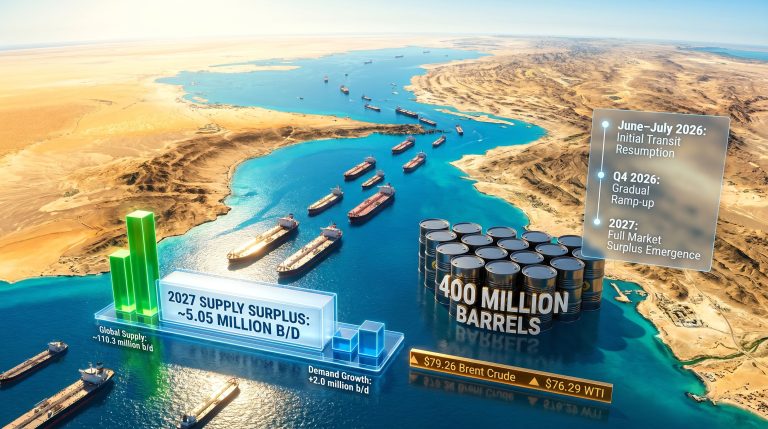
June 27, 2026
Chokepoints, Corridors, and Calculated Risk: How Global Energy Markets Navigate the World's Most Contested Waterway
Every maritime chokepoint carries a theoretical closure risk, but most remain abstract threats in the minds of freight operators, energy traders, and insurance underwriters. The Strait of Hormuz has always been different. Unlike the Suez Canal or the Strait of Malacca, Hormuz sits at the intersection of geography, geopolitics, and irreplaceability in a way that makes its disruption not merely inconvenient but systemically dangerous. When a waterway handling roughly one-fifth of the world's oil and gas exports becomes the subject of competing jurisdictional claims, vessel strikes, and suspended evacuation programmes, the entire architecture of global energy pricing is forced to recalibrate in real time.
What is unfolding in late June 2026 around Strait of Hormuz traffic on the disputed Oman route is not simply a shipping news story. It is a live stress test of the assumptions embedded in global energy security planning, and the data emerging from vessel tracking platforms is telling a more complicated story than either optimists or pessimists have so far acknowledged.
When big ASX news breaks, our subscribers know first
Why the Strait of Hormuz Remains Structurally Irreplaceable
The Strait of Hormuz occupies a unique position in the global energy system because no viable bypass exists at scale. Unlike some chokepoints where pipelines or alternative sea lanes can absorb a portion of disrupted flow, the strait's geography and the volume of trade it carries make substitution extremely costly and, in many cases, practically impossible on short notice.
Under normal peacetime conditions, the strait processes approximately 125 to 130 vessel transits per day across all commodity categories, according to Kpler tracking data. The cargo carried spans crude oil tankers serving Asian refiners, liquefied natural gas carriers bound for European and East Asian terminals, and dry bulk vessels transporting fertiliser inputs including urea and ammonia that feed agricultural supply chains across South Asia and Southeast Asia.
The fertiliser dimension is frequently overlooked in mainstream energy security commentary but carries significant downstream risk. A prolonged disruption to dry bulk traffic through the strait translates into fertiliser price spikes within weeks, which in turn affects crop yields and food commodity pricing across import-dependent nations. This cascading effect means that the Hormuz chokepoint is not merely an energy infrastructure issue but a food security variable with a lag of approximately one to two growing seasons.
Furthermore, the LNG supply outlook for Gulf-origin cargoes makes the situation particularly acute. Gulf-origin LNG cargoes have very limited re-routing options. Sending a cargo around the Cape of Good Hope adds weeks of transit time and substantially increases freight costs, compressing margins in spot markets and distorting benchmark pricing far beyond the Gulf region.
"The Strait of Hormuz is a structural dependency, not a routing preference. The global energy system was not designed with a credible Plan B for its sustained closure."
What Does the Traffic Data Actually Reveal?
According to the CSIS analysis of the Strait of Hormuz, the waterway's strategic significance is difficult to overstate. Vessel tracking confirms that the strait's role in global energy flows cannot be replicated by alternative routes without substantial cost and time penalties.
What the Oman Corridor Actually Is and Why Iran Rejects It
The corridor at the centre of the current dispute runs entirely within Omani territorial waters, tracing the coastline of the Musandam Peninsula. The route was established through coordination between Oman and the International Maritime Organisation without consultation with Tehran, a procedural decision that has become the core of Iran's objection.
The IRGC's position is unambiguous: it has formally declared that only transit lanes designated by the Islamic Republic of Iran carry legal authority within the strait's transit passage framework. This assertion places Oman and the IMO in direct jurisdictional conflict with Tehran, since the corridor was explicitly designed to allow commercial operators to avoid both Iranian-adjacent waters and the mine-threatened central channel that runs through the strait's core navigation zone.
The route's practical characteristics make it genuinely attractive to operators beyond the political controversy:
- It carries no toll requirements, operating on freedom of navigation principles under Omani authority
- It reduces exposure to the mine-risk zone in the strait's central channel, which has been the primary security concern for commercial operators since the crisis escalation
- It has IMO coordination behind it, providing at least a framework of institutional legitimacy that the IRGC-designated lanes lack from the perspective of most Western-flagged and internationally insured operators
- Oman has implemented structured transit guidelines including wait-time protocols and section-by-section passage management
The following table compares the two competing routing options:
| Feature | Oman Corridor | Iranian-Designated Route |
|---|---|---|
| Jurisdictional waters | Omani territorial waters | Iranian-adjacent waters |
| Mine risk exposure | Lower, bypasses central channel | Higher, central channel proximity |
| IMO coordination | Yes | No formal IMO endorsement |
| Toll requirements | None | Not applicable |
| Iran's recognition | Explicitly rejected | Endorsed by Tehran |
| Current commercial usage | Majority of active transits | Largely avoided by operators |
| Insurance underwriter preference | Cautiously preferred | Generally avoided |
Oman's role here reflects its long-established position as a neutral diplomatic actor in Gulf geopolitics. Muscat has maintained functional bilateral relationships with Tehran even during periods of wider regional tension, and active negotiations between Oman and Iran over a durable transit framework represent the most credible diplomatic channel currently operating.
Decoding the Vessel Movement Data: What Thursday and Friday Actually Show
The vessel traffic figures emerging from Kpler's tracking platform in late June 2026 reward careful interpretation rather than headline-level reading.
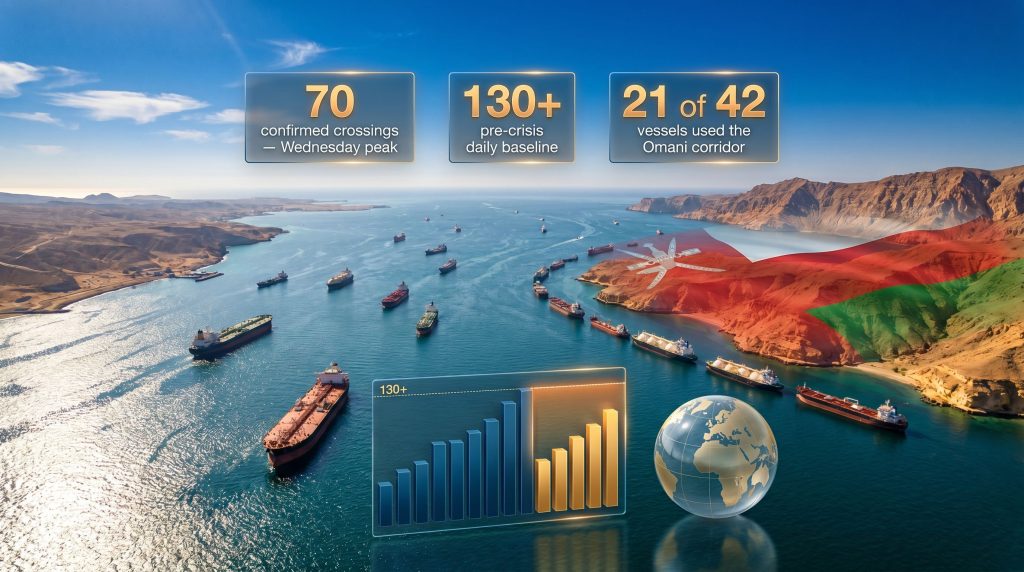
On Wednesday, the highest single-day figure since the crisis began was recorded: 70 confirmed crossings by all vessel types, including 57 commodity vessels specifically. This represented a significant recovery from the near-complete shutdown that followed the strait's initial closure, however it remained well below the 125 to 130 daily transits that characterise normal peacetime operations.
Thursday's figures showed a modest pullback from that peak:
- At least 42 commodity vessels crossed the strait
- 10 vessels entered the Gulf; 32 exited, reflecting the asymmetric demand pattern of a post-closure flush
- 21 of those 42 vessels, approximately 50%, used the Omani southern corridor
By Friday afternoon, an additional 29 commodity vessels had already transited, with 10 inbound and 19 outbound. Despite a confirmed projectile strike on a Singapore-flagged container ship earlier that morning, 17 of those 29 vessels continued routing through the Omani corridor.
The recovery trajectory against the pre-crisis baseline tells a structured story:
| Period | Daily Commodity Vessel Transits | Percentage of Pre-Crisis Baseline |
|---|---|---|
| Pre-crisis peacetime average | ~125 to 130 per day | 100% |
| Wednesday peak (crisis period) | 57 commodity / 70 all vessels | ~44 to 54% |
| Thursday | 42 commodity vessels | ~32 to 34% |
| Friday (partial, by afternoon) | 29 commodity vessels | Partial day, trajectory maintained |
"These numbers signal a meaningful but incomplete reopening. The gap between current throughput and the pre-crisis baseline represents a substantial volume of constrained energy trade, with real pricing consequences for crude, LNG, and fertiliser markets."
Consequently, oil price movements in global markets are responding directly to these throughput figures, with every percentage point of recovery below baseline carrying measurable implications for crude benchmarks.
The Singapore-Flagged Vessel Strike and Its Operational Consequences
At approximately 14:10 GMT on Thursday, a Singapore-flagged container ship reported being struck by a projectile while transiting the Omani corridor. The incident was documented by the United Kingdom Maritime Trade Operations (UKMTO) centre, which serves as the primary maritime security reporting hub for the region.
The immediate institutional response came from IMO Secretary-General Arsenio Dominguez, who announced a temporary suspension of the mariner evacuation programme. The rationale was straightforward: with approximately 11,000 mariners stranded by the strait's closure, any evacuation operation requires verified safety guarantees for vessels on the evacuation list, and the projectile strike created uncertainty about whether those guarantees remained intact.
What makes the subsequent commercial operator behaviour analytically significant is the contrast between the institutional pause and the market response. Marine Traffic data recorded approximately 15 tankers and cargo vessels crossing the strait between 14:10 GMT and midnight on Thursday alone, following the strike. Three vessels reportedly turned back due to security concerns, but at least 24 ships successfully completed Omani corridor transits since Thursday morning.
Named vessels using the corridor in this period include the Liberian-flagged Stoic Warrior and the British-flagged World Prize, suggesting that operators from multiple flag-state jurisdictions are making independent risk assessments and arriving at similar conclusions.
The calculus these operators are applying involves several interconnected variables:
- Delay costs: Every additional day a vessel sits outside the strait waiting for clarity generates demurrage charges and cargo delivery penalties
- Rerouting economics: Cape of Good Hope alternatives add weeks of transit time and significant bunker fuel costs
- Strike probability: A single confirmed projectile strike, while serious, does not statistically demonstrate systematic interdiction of the corridor
- Insurance exposure: War risk premiums have already been priced upward; the marginal cost increase from one incident is finite
The "Ketchup Bottle" Problem: Why Traffic Recovery Is Not Stability Recovery
Richard Meade, editor-in-chief of Lloyd's List, articulated the core analytical risk with precision in a statement published on Friday: the surge in vessel crossings following the ceasefire reflects accumulated demand from weeks of restricted access rather than a normalisation of underlying risk conditions. Meade's framing of this phenomenon as a ceasefire-driven release of pent-up demand, where pent-up supply is expelled rapidly before conditions can reassert themselves, is a useful corrective to superficial readings of the traffic data.
This distinction matters enormously for how energy markets should interpret the throughput recovery:
- Volume recovery measures how many vessels are crossing. It is improving.
- Risk recovery measures the security environment, governance certainty, and insurance cost normalisation. It has not materially improved.
- Structural recovery measures whether a formal, internationally recognised transit framework is in place. It has not yet occurred.
Treating the first metric as a proxy for the second and third is where analytical errors enter market pricing models.
Three Scenarios for Near-Term Strait Status
Scenario A: Negotiated Settlement (Optimistic)
Iran and the United States reach a formal agreement governing transit rights, with the Omani corridor receiving multilateral recognition. Traffic volumes recover to the 125 to 130 daily transit baseline within four to six weeks. War risk insurance premiums normalise. The IMO evacuation programme resumes and completes.
Scenario B: Managed Ambiguity (Base Case)
The ceasefire holds but no formal transit governance framework is agreed between Iran, the IMO, and Western maritime powers. Commercial operators continue using the Omani corridor under elevated risk premiums, accepting the legal ambiguity as a cost of doing business. Shipping insurance costs remain structurally elevated. Daily transits recover to perhaps 60 to 80% of the pre-crisis baseline but stall below full normalisation.
Scenario C: Renewed Escalation (Downside)
Further vessel strikes or IRGC interdictions force operators to reassess the corridor's viability. Renewed closures push global crude and LNG spot prices sharply higher. The IMO evacuation programme remains suspended indefinitely, creating a humanitarian dimension that adds diplomatic pressure but no near-term resolution.
The next major ASX story will hit our subscribers first
Energy Market and Insurance Implications
The financial consequences of the Hormuz situation extend well beyond freight rates. War risk insurance premiums for vessels transiting the strait have increased sharply since the crisis onset, and the Singapore-flagged vessel strike will likely sustain elevated premium levels regardless of traffic volume improvements. Underwriters price on expected loss, and a confirmed projectile strike updates expected loss calculations upward for the entire corridor.
In addition, the trade war oil impact on global benchmarks is compounding the disruption, as simultaneous geopolitical pressures from multiple directions create layered volatility that market participants are struggling to price accurately.
LNG freight benchmarks for Gulf-origin cargoes remain distorted relative to pre-crisis levels, with the distortion reflecting both the direct cost increase and the option value of flexibility that buyers are now pricing into long-term procurement decisions. Several Asian LNG importers have reportedly accelerated negotiations for Atlantic Basin supply as a partial hedge against further Hormuz disruption, a structural shift in procurement geography that may persist even after the strait fully reopens.
For crude oil markets, the key variable is not the current traffic figure but the trajectory toward the pre-crisis baseline. Furthermore, every 10 percentage points of throughput recovery below the 125 to 130 daily transit norm represents a measurable drag on Gulf producer export capacity, which feeds directly into global supply balances and OPEC market influence over pricing dynamics.
"Important disclaimer: Scenario projections and market impact assessments in this article reflect analytical frameworks based on publicly available data. They do not constitute investment advice, and readers should consult qualified financial and risk advisers before making decisions based on geopolitical energy security analysis."
What Genuine Normalisation Requires
Declaring the Strait of Hormuz operationally restored would require a confluence of developments that have not yet occurred:
- A formal post-ceasefire transit governance regime with defined, internationally recognised routing corridors accepted by all major parties including Iran
- Iran's explicit acknowledgment of the Omani route or agreement on a mutually acceptable alternative that does not require vessels to transit Iranian-designated lanes
- Full resumption of the IMO mariner evacuation programme with independently verified safety guarantees for all vessels on the evacuation list
- Sustained daily transit volumes recovering to and sustaining the 125 to 130 vessel per day pre-crisis baseline across multiple weeks
- War risk insurance premium normalisation, which typically lags physical security improvements by four to eight weeks as underwriters wait for sustained evidence before revising actuarial assumptions
Until these conditions are met, the Strait of Hormuz remains operationally reopening rather than operationally restored. The distinction carries significant weight for energy market participants, freight operators, and the approximately 11,000 mariners still awaiting evacuation from vessels stranded when the crisis began. Monitoring crude oil price trends in real time remains essential for understanding how each incremental development in the strait translates into broader market consequences. Strait of Hormuz traffic on the disputed Oman route is increasing, however the underlying structural questions that will determine long-term normalisation remain unanswered.
Real-time vessel tracking data continues to provide the most granular picture of how operators are navigating these competing pressures as the situation evolves.
Want to Stay Ahead of the Next Major Resource Discovery Triggered by Geopolitical Shifts?
When energy market disruptions reshape commodity valuations and redirect capital toward resource exploration, Discovery Alert's proprietary Discovery IQ model delivers real-time alerts on significant ASX mineral discoveries — instantly translating complex market conditions into actionable investment opportunities. Explore historic examples of exceptional discovery returns and begin your 14-day free trial at Discovery Alert to position yourself ahead of the market.