July 19, 2026
The Geometry of Global Risk: Understanding Why One Narrow Waterway Holds the World's Energy System Hostage
Every few years, a crisis somewhere along the Persian Gulf reminds the world of a structural vulnerability it prefers to ignore: the extraordinary concentration of global energy flows through a single geographic bottleneck. Project Freedom Strait of Hormuz, launched in May 2026, represents the most operationally significant chapter yet in a decades-long contest over access to this waterway. The strait, at its narrowest point spanning roughly 33 kilometres of open water between Oman and Iran, functions as the circulatory system of the global hydrocarbon economy.
Understanding why this operation matters requires looking beyond the immediate military headlines and examining the structural mechanics of what the strait actually does for the global economy, who bears the greatest risk when it falters, and what historical precedents tell us about the durability of any resolution.
When big ASX news breaks, our subscribers know first
Why the Strait of Hormuz Defines Global Energy Security
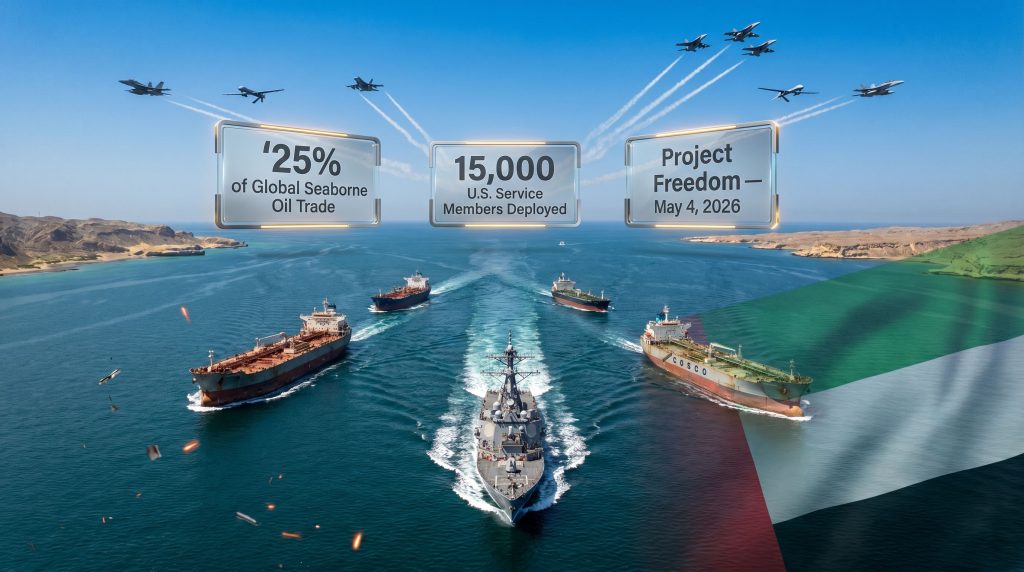
Approximately one quarter of all seaborne oil trade passes through the Strait of Hormuz each year. That single statistic, frequently cited but rarely fully appreciated, understates the waterway's true economic weight. The strait also serves as a primary transit corridor for liquefied natural gas, refined petroleum products, and bulk fertiliser feedstocks, meaning its disruption cascades across multiple commodity systems simultaneously, not just crude oil benchmarks.
The economic logic of the strait's importance works through several layers. Furthermore, understanding the LNG supply outlook helps contextualise just how much is at stake when this corridor is threatened:
- Crude oil flowing through the strait feeds refineries across East Asia, South Asia, and Europe, making it a critical input into transportation, manufacturing, and agricultural supply chains
- LNG cargoes originating from Qatar and other Gulf producers supply power generation capacity across Asia and increasingly across Europe, where alternative supply routes carry significantly higher cost structures
- Fertiliser feedstocks moving through the strait underpin agricultural production in economies that cannot easily substitute alternative supply sources in short timeframes
- Refined product flows affect aviation fuel availability, diesel pricing, and petrochemical manufacturing margins across multiple continents
The table below illustrates which regions face the most acute exposure to sustained Hormuz disruption:
| Region | Primary Dependency | Substitution Difficulty |
|---|---|---|
| East Asia (Japan, South Korea, China) | Crude oil and LNG imports | High – limited alternative routing |
| South Asia (India, Pakistan) | Crude oil, fertiliser feedstocks | High – significant import dependency |
| Western Europe | LNG and refined product flows | Moderate – Atlantic Basin alternatives exist but at cost |
| Gulf Cooperation Council States | Export revenue and re-export logistics | Very High – no alternative export route at comparable scale |
Key Market Insight: Traders and risk managers have historically observed meaningful oil price volatility during periods of Hormuz tension. Even threatened closures, rather than actual disruptions, are sufficient to compress refinery scheduling windows and trigger precautionary strategic petroleum reserve drawdowns among major importing nations.
What Is Project Freedom? Defining the Operation's Scope and Architecture
On Sunday, 4 May 2026, President Donald Trump announced Project Freedom, a U.S.-led military maritime operation designed to restore freedom of navigation for commercially registered merchant vessels transiting the Strait of Hormuz. The announcement followed what Secretary of State Marco Rubio confirmed were multiple formal requests from sovereign nations whose vessels and crew members were effectively immobilised within or near the waterway.
CENTCOM forces commenced operations on Monday, 5 May 2026, with a force structure that reflects the operational complexity of working in a contested maritime environment:
- Guided-missile destroyers providing active naval escort and surface threat suppression
- More than 100 land- and sea-based aircraft ensuring air superiority and persistent surveillance coverage across the operational theatre
- Multi-domain unmanned platforms supporting reconnaissance, threat identification, and targeted neutralisation
- 15,000 U.S. service members committed to the operation, constituting a substantial forward deployment by any measure
Rubio's characterisation of the operation framed it not as unilateral American military adventurism but as a multilateral response to humanitarian and trade imperatives. He confirmed that countries from around the world, the overwhelming majority of which had no direct involvement in regional military hostilities, were at risk of losing cargo and, critically, the lives of their own nationals because of the blockade.
Rubio described Iran's actions as a last-ditch act of economic arson, positioning the strait's closure as a destructive and internationally illegitimate measure rather than a defensible exercise of sovereign prerogative.
The Diplomatic Architecture Alongside Military Force
Project Freedom is not purely a kinetic operation. U.S. officials have described a diplomatic coordination layer running in parallel with military escort activities. The United Arab Emirates has been identified as an active partner, contributing regional intelligence sharing and situational awareness capabilities.
This hybrid model closely mirrors the framework employed during Operation Earnest Will from 1987 to 1988, when U.S. forces reflagged Kuwaiti tankers and provided convoy escort during the Iran-Iraq War, the largest naval convoy operation since World War II. The parallel between these two episodes is instructive: in both cases, the U.S. framed its intervention as a response to multilateral requests, and in both cases the operational challenge involved navigating a threat environment combining surface, aerial, and unconventional naval elements.
The Humanitarian Dimension: Stranded Vessels and Crew Welfare
One aspect of the Hormuz crisis that receives comparatively little attention in conventional geopolitical analysis is the welfare situation facing crews aboard stranded commercial vessels. At the time of Project Freedom Strait of Hormuz's launch, estimates indicated that hundreds of commercial vessels and more than 20,000 seafarers were effectively trapped within or adjacent to the strait, unable to transit safely in either direction.
Rubio drew explicit attention to this dimension, describing the deteriorating conditions aboard immobilised ships where food supplies, potable water, and essential medical resources become critically depleted within days to weeks of forced immobilisation. He characterised this situation as piracy, a term with specific legal weight under international maritime law, implying that Iran's actions constituted a violation of obligations that extend well beyond bilateral diplomatic disputes.
Humanitarian Context: Under international maritime law, flag states carry legal obligations to crew members that become impossible to fulfil when a waterway is unilaterally restricted. The welfare crisis facing stranded seafarers represents a dimension of this episode that extends well beyond geopolitical calculation.
The 20,000-plus seafarers figure is significant not just for its humanitarian implications but for what it reveals about the scale of commercial activity that had been immobilised. Commercial vessel operations involve complex crew rotation schedules, medical supply chains, and food provisioning logistics that cannot be sustained indefinitely at anchor or in holding positions outside a blockaded waterway.
The U.S. Capability Argument: Is American Power Truly Singular?
Rubio's assertion that the United States is the only country that can open the Strait of Hormuz back to its pre-war state deserves serious analytical examination. His statement reflects a genuine, if contested, asymmetry in global naval power projection capacity. No other nation currently maintains the combination of:
- Carrier strike group infrastructure capable of sustained high-tempo operations in a contested maritime environment
- Forward-deployed naval assets and regional basing infrastructure in the Persian Gulf
- Integrated multi-domain command architecture capable of simultaneously managing convoy escort, aerial threat neutralisation, and mine-clearing operations
- The logistical capacity to sustain 15,000 service members in active operations within a constrained geographic theatre
NATO allies possess sophisticated naval capabilities but lack the regional pre-positioning and logistics depth to independently sustain operations of this scale in the Persian Gulf. This capability asymmetry has been a structural feature of Gulf security arrangements since the 1970s, and it underpins the long-standing implicit bargain between Washington and Gulf state partners.
Historical precedent reinforces Rubio's argument. Operation Earnest Will established that the U.S. was willing and able to use naval force to protect freedom of navigation in the Gulf. Operation Praying Mantis in 1988 demonstrated American willingness to escalate directly against Iranian naval assets in response to mine-laying activities. Consequently, Project Freedom represents doctrinal continuity rather than strategic innovation, a point that matters for assessing its credibility as a deterrent signal.
Iran's Strategic Position and the Logic of Economic Leverage
Tehran's decision to restrict Hormuz access reflects a calculated, if high-risk, exercise in asymmetric leverage. The ability to threaten or close the strait represents one of the few instruments available to Iran that can impose meaningful costs on a far broader set of actors than those directly involved in the underlying political dispute. The broader geopolitical risk landscape across the region further compounds the complexity of resolving this standoff.
Iranian state media characterised Project Freedom as a violation of an existing ceasefire framework, framing Washington's naval activity as aggression rather than protection. Iranian officials demanded formal coordination protocols for any commercial vessel seeking passage, a position the U.S. rejected as effectively legitimising an illegal blockade under the cover of bureaucratic procedure.
The strategic calculation behind this position is worth understanding clearly:
- Iran derives leverage not from the strait's permanent closure but from the credible threat of closure, which imposes ongoing risk premiums on global energy markets
- Any diplomatic framework requiring vessels to seek Iranian permission for passage would establish a de facto toll regime that generates both economic and political returns
- Simultaneous targeting of UAE infrastructure during the operational window signals Tehran's intent to broaden the conflict theatre, raising the political cost of allied participation in Project Freedom
Strategic Observation: Iran's demand for formal coordination protocols for commercial transits is not simply a negotiating position. If accepted, it would fundamentally alter the legal status of the strait under international maritime law, transforming a recognised international waterway into a de facto Iranian-controlled corridor requiring sovereign permission for passage.
The next major ASX story will hit our subscribers first
How Does This Crisis Affect Global Oil Markets and Shipping?
The market implications of Hormuz disruption operate through several interconnected channels that compound one another during periods of sustained uncertainty. In addition, the crude oil price geopolitics driving current volatility make these dynamics even more pronounced for energy-dependent economies.
Immediate pricing effects: Even partial disruption or credible closure threats historically generate meaningful volatility in oil benchmark pricing. Refinery operators in Asia and Europe face feedstock scheduling uncertainty that cascades into downstream product pricing across aviation fuel, diesel, and petrochemical manufacturing. The oil price shock scenarios energy executives have long feared are now materialising in real time.
Strategic reserve dynamics: Prolonged disruption forces importing nations to draw down strategic petroleum reserves, compressing the buffer available for future supply shocks. The rate of drawdown matters as much as the absolute volume, since rapid depletion signals market stress and can amplify rather than dampen price movements.
Insurance market response: War risk insurance premiums for vessels transiting contested regions adjust rapidly to reflect operational risk assessments. During periods of active conflict, some underwriters suspend coverage entirely, which can effectively strand vessels even where military escort is technically available.
Reopening Scenarios and Economic Consequences
| Scenario | Near-Term Probability | Economic Outcome |
|---|---|---|
| Full reopening via diplomatic resolution | Moderate | Rapid oil benchmark normalisation; freight rate compression |
| Partial reopening under U.S. escort only | Higher (short-term) | Persistent risk premium in oil pricing; elevated insurance costs |
| Sustained closure with escalation | Lower (following pause) | Structural supply shock; SPR drawdowns; potential recession risk in highly import-dependent economies |
| Iranian-coordinated passage framework | Low | Politically untenable for U.S. and allies under current diplomatic posture |
What the Temporary Operational Pause Reveals About U.S. Strategy
The decision by President Trump to announce a temporary operational pause on 5 May 2026, citing progress in diplomatic negotiations with Iran, is analytically significant for several reasons that go beyond the immediate tactical situation.
It reveals a dual-track U.S. strategy in which military pressure and active diplomatic negotiation operate simultaneously rather than sequentially. The pause was framed as a humanitarian gesture while warnings of severe retaliation for any Iranian interference with future transits were maintained. This combination of demonstrated capability, willingness to escalate, and selective restraint is consistent with coercive diplomacy frameworks that seek to create space for negotiated resolution without removing the credible military threat that generates negotiating leverage.
The "Maritime Freedom Construct" diplomatic architecture running alongside military operations suggests the U.S. is attempting to build a multilateral framework for strait security that distributes burden-sharing responsibilities across allied partners. Whether this model proves durable depends on whether the underlying Iranian incentives driving the blockade can be addressed through the diplomatic channel that the military operation is designed to support.
Structural Implications for Long-Range Energy Security Planning
Regardless of how the immediate Project Freedom Strait of Hormuz situation resolves, the episode has already produced durable changes in how energy security planners, shipping operators, and commodity traders assess Persian Gulf risk. Furthermore, the scale of global trade disruption triggered by simultaneous geopolitical flashpoints makes long-range planning considerably more complex:
- Alternative routing conversations have accelerated among major importing nations, with renewed interest in expanded capacity utilisation of the East-West Pipeline through Saudi Arabia and increased Atlantic Basin LNG sourcing
- Strategic petroleum reserve adequacy is being reassessed across import-dependent economies that previously modelled Hormuz disruption as a low-probability tail risk rather than a base-case scenario requiring active preparation
- War risk insurance framework reform is likely to emerge as a policy priority for the international maritime community following the inadequacy of existing coverage frameworks during the May 2026 events
- Multilateral chokepoint security arrangements will be debated in international forums as the limitations of relying on a single nation's military capacity to guarantee global maritime commons access become apparent
Long-Term Analytical Framework: The May 2026 events have structurally elevated the Hormuz risk premium embedded in global energy market pricing models. Analysts and energy security planners will need to incorporate a durably higher baseline probability of periodic strait disruption into long-range scenario frameworks, irrespective of how the current diplomatic negotiation concludes.
Frequently Asked Questions: Project Freedom and the Strait of Hormuz
What is Project Freedom in the Strait of Hormuz?
Project Freedom is a U.S. military maritime operation announced by President Donald Trump on 4 May 2026, and commenced by CENTCOM the following day. Its stated objective is to restore freedom of navigation for commercial vessels transiting the Strait of Hormuz, which had been effectively blocked by Iranian restrictions. The operation deploys guided-missile destroyers, more than 100 aircraft, unmanned platforms, and 15,000 service members.
Why is the Strait of Hormuz critically important to global energy markets?
The strait carries approximately one quarter of all global seaborne oil trade annually, along with significant volumes of LNG and petrochemical products. Its closure, even partial or threatened, creates immediate commodity price volatility and threatens the energy security of import-dependent economies across Asia and Europe that have limited capacity to substitute alternative supply sources in short timeframes.
Has the United States conducted similar operations in the strait before?
Yes. Operation Earnest Will from 1987 to 1988 involved U.S. reflagging and escorting Kuwaiti tankers through the strait during the Iran-Iraq War. Operation Praying Mantis in 1988 involved direct U.S. military action against Iranian naval assets following mine-laying incidents that damaged a U.S. frigate. Project Freedom follows this established doctrinal precedent of treating Persian Gulf maritime access as a core American strategic interest.
What was Iran's response to Project Freedom?
Iran characterised the operation as a ceasefire violation and demanded formal coordination protocols for any commercial vessel seeking passage through the strait, a position rejected by Washington as tantamount to legitimising an illegal blockade. Iranian officials issued escalatory statements during the operation's initial phase.
How many vessels and seafarers were stranded in the strait?
At the time of the operation's launch, estimates indicated hundreds of commercial vessels and more than 20,000 seafarers were stranded within or near the strait, facing deteriorating welfare conditions including food and potable water depletion. Secretary of State Rubio cited these conditions as a primary humanitarian justification for the operation.
Why did the U.S. temporarily pause Project Freedom?
President Trump announced a temporary operational pause on 5 May 2026, citing progress in ongoing diplomatic negotiations with Iran. The pause reflects the dual-track nature of U.S. strategy, combining military pressure with active diplomatic engagement, rather than treating military action and negotiation as mutually exclusive approaches.
Disclaimer: This article is based on publicly available information and verified reporting as of May 2026. Claims regarding operational details, market projections, and scenario assessments that have not been independently verified are presented as analytical frameworks rather than confirmed facts. Readers should consult official government sources and financial advisors before making decisions based on geopolitical risk assessments. Energy market forecasts and probability estimates involve inherent uncertainty and should not be treated as definitive predictions.
Want to Stay Ahead of the Market Opportunities Created by Geopolitical Disruption?
When global energy systems face structural shocks like Hormuz disruptions, commodity markets move fast — and so do ASX mineral discovery opportunities. Discovery Alert's proprietary Discovery IQ model delivers real-time alerts on significant ASX mineral discoveries, instantly translating complex market signals into actionable investment insights for traders and long-term investors alike — explore the historic returns major discoveries have generated and start your 14-day free trial today to secure a market-leading edge.