August 7, 2026
The Hidden Architecture of Global Oil Pricing: Why One Waterway Controls Everything
Most commodity traders understand that crude oil prices respond to supply and demand fundamentals. Fewer appreciate just how thoroughly a single 33-kilometre-wide passage at the mouth of the Persian Gulf can override those fundamentals entirely. The Strait of Hormuz is not merely a geographic feature; it is the load-bearing pillar of the global energy system. When that pillar wobbles, everything from Asian LNG import contracts to European refinery feedstock schedules shudders in response.
That wobble became acute in early August 2026, as Strait of Hormuz reopening plans moved from quiet diplomatic back-channels into contested public negotiation, pulling oil benchmarks in multiple directions within the same trading week. Understanding these dynamics requires examining the broader oil trade and geopolitics that have shaped energy markets throughout this period.
When big ASX news breaks, our subscribers know first
What Makes the Strait of Hormuz Irreplaceable
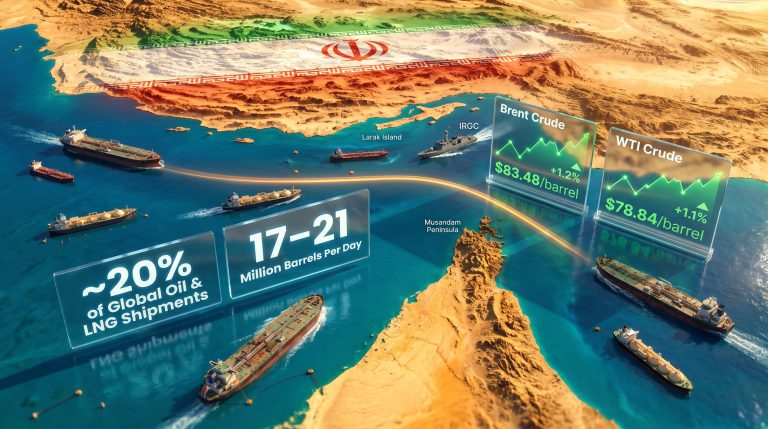
Before the conflict that erupted at the end of February 2026, roughly one-fifth of the world's entire oil and liquefied natural gas supply passed through the strait each day. There is no single pipeline network, no combination of alternative sea routes, and no strategic reserve system on Earth large enough to replace that volume at short notice.
The closest alternative, rerouting tankers around the Cape of Good Hope at the southern tip of Africa, adds approximately 10 to 14 days of voyage time each way. That extension does more than inflate freight costs. It removes vessel capacity from the global fleet by tying ships up in transit longer, compresses refinery scheduling windows, and embeds a persistent premium into LNG spot prices across Asian and European import markets.
The cascading consequences of closure extend well beyond freight rates:
- War risk surcharges applied to Hormuz-adjacent voyages have escalated sharply since hostilities began
- International P&I clubs and hull underwriters have inserted exclusion clauses that create direct legal exposure for operators navigating the region
- Spot crude pricing has decoupled from underlying inventory fundamentals, responding instead to diplomatic signals and legislative developments in Tehran
- Refinery feedstock scheduling across Asia has been disrupted, with downstream product availability tightening across several markets
The Three-Way Negotiating Impasse Driving Price Volatility
The current effort to establish workable Strait of Hormuz reopening plans has produced one of the more structurally complex diplomatic configurations in recent Gulf history. Three parties are simultaneously negotiating, and each holds a position that is fundamentally incompatible with at least one other party's redline. Furthermore, the trade war impact on oil has added additional layers of complexity to an already volatile market environment.
Iran's Proposed Framework
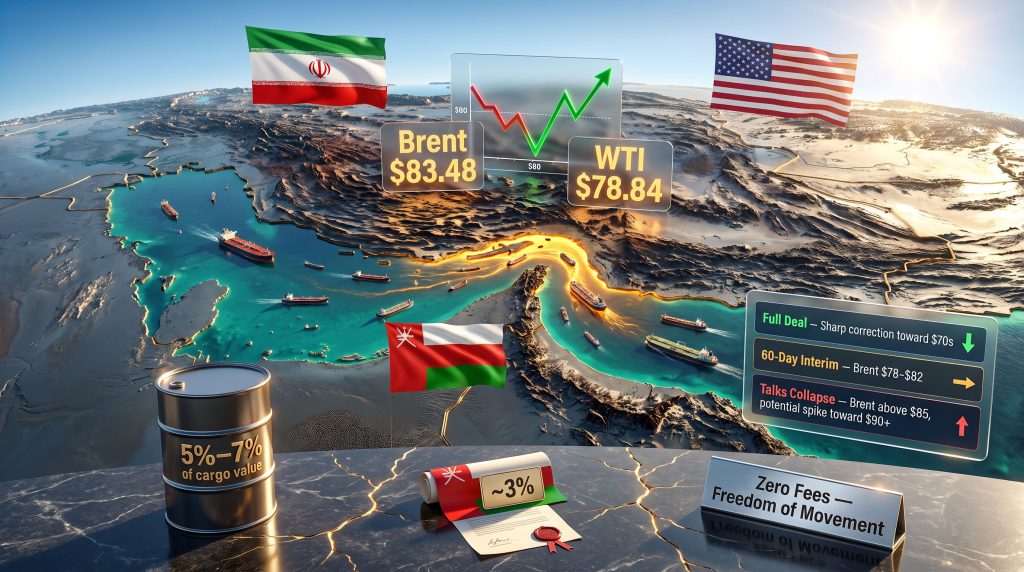
Iran's position centres on a traffic routing architecture in which inbound commercial vessels would transit through Iranian territorial waters, with Oman serving as a co-administrator and diplomatic intermediary. The fee structure Iran has proposed is significant: between 5% and 7% of cargo value per vessel, framed internally as recovery of environmental and security costs.
Importantly, Reuters reporting from July 28 confirmed that Iran presented Oman with a formal temporary reopening proposal, attaching a condition that the strait would remain closed if Oman declined to participate. This framing effectively positioned Oman not as a neutral mediator but as a party whose cooperation Iran considers essential to any arrangement.
The Fee Dispute: A Three-Way Impasse
| Party | Proposed Fee Structure | Core Justification |
|---|---|---|
| Iran | 5% to 7% of cargo value | Environmental and security cost recovery |
| Oman | Approximately 3% of cargo value | Shared administrative fee for co-management |
| United States | Zero fees, full freedom of movement | International maritime law, innocent passage principle |
Four industry sources have flagged the proposed fee model as structurally unworkable, and their reasoning goes beyond politics. International P&I clubs and hull underwriters have inserted exclusion clauses that would be triggered by fee payments directed toward sanctioned entities. Even if Iran and Oman reached diplomatic agreement on a fee schedule, international insurers would be legally barred from covering those payments, rendering the commercial shipping pathway non-functional regardless of what any bilateral agreement said.
The U.S. Zero-Fee Position
Washington, through Treasury Secretary Scott Bessent, has articulated a clear stance: any reopening must guarantee complete freedom of movement with no tolls imposed by any single state actor. This is not merely a political preference. It reflects the established international legal principle of innocent passage through international straits, a principle that has governed maritime law for decades and which the United States regards as non-negotiable.
The legal conflict here is fundamental. Iran's claim to levy transit fees on vessels using the strait is, under the United Nations Convention on the Law of the Sea framework, deeply contested. International straits that overlap with territorial waters are still subject to innocent passage rights, meaning coastal states cannot impose fees as a condition of transit. Iran's fee proposal therefore represents a challenge to the existing international maritime legal order, not merely a commercial negotiation.
The Legislative Wildcard: Iran's Parliamentary Review
While diplomatic negotiations proceed at the executive level, a parallel track has emerged inside Iran's parliament that introduces a qualitatively different category of risk.
An Iranian parliamentary committee is actively reviewing a preliminary bill that would formally prohibit U.S., Israeli, and vessels deemed hostile from using the strait entirely. The proposed penalties are severe: fines of up to 20% of cargo value for any violating vessel. This is not a fringe proposal. It is moving through the parliamentary review process, and its existence creates what analysts describe as a legislative overhang on any executive-level diplomatic progress.
Market participants should understand that even a draft bill that never becomes law can reprice global oil markets overnight. The Iranian parliamentary review demonstrated this dynamic precisely: Brent crude reversed a multi-day decline and gained more than $3 per barrel in a single Thursday session, not because any new restriction was enacted, but because the bill's existence signalled that the diplomatic pathway was more contested than optimists had assumed.
This legislative track also introduces an asymmetric risk profile. If the bill progresses, it could override whatever diplomatic arrangement Iran's executive branch negotiates, leaving tanker operators and cargo insurers with legal exposure they cannot hedge against through conventional war risk insurance. Tufts University analysts have noted that even a full reopening would not simply restore the pre-crisis status quo, given the structural changes that have accumulated.
How Oil Markets Are Pricing the Uncertainty
The price behaviour of crude benchmarks through the first week of August 2026 offers a remarkably transparent window into market psychology around Strait of Hormuz reopening plans and broader oil market dynamics.
The week's arc unfolded as follows:
- Early optimism phase: Prices declined as diplomatic progress appeared increasingly likely, with Brent falling below $80 per barrel for the first time since July 13.
- Parliamentary shock: Iran's vessel-ban bill emerged from parliamentary committee review, triggering a sharp reversal.
- Thursday's repricing: Oil futures gained more than $3 per barrel in a single session.
- Friday's continuation: Brent crude rose a further 99 cents (1.2%) to $83.48, while WTI climbed 85 cents (1.1%) to $78.84.
Tim Waterer, chief market analyst at KCM Trade, identified a dynamic that helps explain why prices have not fallen back to pre-crisis levels even during periods of apparent diplomatic progress. According to Waterer, the fact that markets have already witnessed at least one short-lived arrangement collapse earlier in 2026 has fundamentally eroded confidence that any new agreement would fully restore normal tanker movements. That persistent scepticism, he noted, is acting as a structural floor beneath oil prices.
This is a critical insight for investors and commodity traders: the market is not simply pricing the probability of a deal. It is pricing the probability that any deal will actually be commercially operable, given sanctions architecture, insurance exclusions, and legislative risk. Those are three separate probability estimates, and all three need to be favourable simultaneously for prices to normalise. Consequently, monitoring WTI and Brent futures has become essential for anyone seeking to navigate this environment.
Scenario Modelling: Three Market Pathways
| Scenario | Assessed Probability Signal | Brent Price Implication |
|---|---|---|
| Full deal, zero fees, U.S. preferred terms | Low: Iran unlikely to concede toll authority | Sharp downward correction toward $70s |
| 60-day interim deal with partial fee compromise | Moderate: closest to current negotiating position | Gradual easing, Brent stabilises $78 to $82 |
| Collapse of talks, parliamentary ban enacted | Elevated: given active legislative track | Sustained rally above $85, potential spike toward $90+ |
The Houthi Layer: Secondary Risk Premium
Complicating the picture further, Yemen's Houthi forces conducted missile and drone strikes against Saudi deployments in Marib and Hadramout provinces during the same Thursday trading session that saw oil gain more than $3 per barrel. Houthi activity in the Red Sea and broader Arabian Peninsula region adds a secondary risk premium that is analytically distinct from Hormuz reopening risk, but the two interact in commodity markets.
U.S. President Donald Trump stated publicly that he believed the conflict would be over soon. However, given the track record of failed interim arrangements in 2026, markets are applying significant discount rates to political optimism of this kind.
The next major ASX story will hit our subscribers first
Who Bears the Greatest Exposure: Asian Import Dependency
The nations with the highest structural exposure to a prolonged Hormuz closure are concentrated in Asia. India, China, Japan, and South Korea collectively represent the dominant share of Persian Gulf crude imports that historically transited the strait. Each of these economies has been drawing on strategic petroleum reserves to buffer domestic supply, but reserve drawdowns are a finite tool.
The interplay between oil prices and US-China trade tensions has further complicated the supply calculus for Asian importers. The quiet diplomatic pressure these nations are applying to both Washington and Tehran is likely more consequential than public statements suggest. For Asian refiners operating on thin margins with tightly scheduled crude delivery windows, every additional week of closure and Cape of Good Hope rerouting compounds both cost and operational complexity.
The Insurance Industry's Veto Power Over Any Deal
One dimension of the Strait of Hormuz reopening plans that receives insufficient attention is the role of international marine insurance markets. Even if Iran, Oman, and the United States reached a written agreement tomorrow, that agreement would not automatically make the strait commercially navigable.
Lloyd's of London market conditions and the positions of major P&I clubs determine whether cargo can be insured for Hormuz-adjacent voyages. Currently, war risk premium surcharges apply across the region. More critically, the exclusion clauses inserted into existing policies would be triggered by any fee payments directed toward Iranian-linked entities, meaning that even a diplomatically agreed fee arrangement could leave operators commercially stranded.
This insurance architecture effectively gives international underwriters a structural veto over any reopening deal. A commercially operable strait requires not just diplomatic agreement but insurance market confidence that route safety has been restored, war risk exposure has normalised, and no sanctioned financial flows are embedded in the transit fee structure.
The Precedent Risk That Extends Beyond Oil Prices
There is a dimension to these negotiations that transcends crude pricing. If Iran successfully establishes a toll regime over the Strait of Hormuz, even on a temporary basis framed as an interim arrangement, it creates a legal and commercial precedent with implications for every international strait on Earth.
The principle of innocent passage through international straits is one of the foundational elements of modern maritime law. A successfully enforced Iranian toll model would represent the first significant breach of that principle by a coastal state in the modern era, potentially encouraging other nations to assert similar toll authority over contested straits and channels in other regions.
For energy markets, that precedent risk is arguably more significant in the long run than the immediate price implications of any single reopening deal or breakdown.
FAQ: Strait of Hormuz Reopening Plans Explained
What is the current status of Strait of Hormuz reopening negotiations?
As of early August 2026, Iran and Oman are reported to be near a draft arrangement but remain divided over transit fees and vessel access rules. No final deal has been signed, and a 60-day interim framework is the most discussed near-term structure.
Why is Iran proposing fees for Strait of Hormuz transit?
Iran is seeking between 5% and 7% of cargo value per vessel, framed as covering environmental and security costs. Critics, including U.S. officials, argue this constitutes an unlawful toll on an international waterway and is incompatible with existing sanctions regimes.
What happens if the Strait of Hormuz reopening deal collapses?
A breakdown would likely sustain or accelerate oil price gains, with Brent potentially pushing above $85 to $90 per barrel. It would also prolong rerouting costs, LNG supply tightness in Asia, and elevated war risk insurance premiums globally.
What is the 60-day interim Hormuz framework?
It refers to a proposed short-term arrangement allowing commercial shipping to resume for approximately 60 days while parties negotiate a longer-term governance structure. It does not represent a permanent settlement.
How does the Iranian parliamentary ban bill affect reopening prospects?
The bill under review would formally prohibit U.S., Israeli, and hostile vessels from the strait and impose fines of up to 20% of cargo value. Its progression creates legislative risk that could override executive-level diplomatic progress at any point.
What role does Oman play in Strait of Hormuz negotiations?
Oman serves as the principal diplomatic intermediary between Iran and Western parties, leveraging its historically neutral posture in Gulf affairs. It has proposed a shared fee model of approximately 3% of cargo value, positioning itself between Iran's demand and Washington's zero-fee stance.
Disclaimer: This article contains forward-looking scenario analysis and market projections based on publicly available information as of early August 2026. Oil price forecasts and diplomatic outcome probabilities are inherently speculative and should not be construed as financial advice. Readers should conduct their own due diligence before making investment decisions.
Want to Stay Ahead of Commodity Market Shifts Driven by Geopolitical Disruption?
Discovery Alert's proprietary Discovery IQ model scans ASX announcements in real time, delivering instant alerts on significant mineral discoveries across more than 30 commodities — turning complex market signals into clear, actionable investment opportunities for both short-term traders and long-term investors. Explore how historic discoveries have generated substantial returns and begin your 14-day free trial today to secure a market-leading edge before the broader market moves.