August 7, 2026
The World's Most Consequential Waterway Is Slowly Coming Back to Life
Few mechanisms in global trade operate with as little margin for error as maritime chokepoints. When a single corridor handles a disproportionate share of the world's energy flows, even marginal disruptions ripple outward into fuel prices, freight markets, and the inflation indices of countries thousands of kilometres away. The Strait of Hormuz is the most extreme example of this dynamic in the modern era, and understanding what happens when it reopens requires understanding just how thoroughly it was closed.
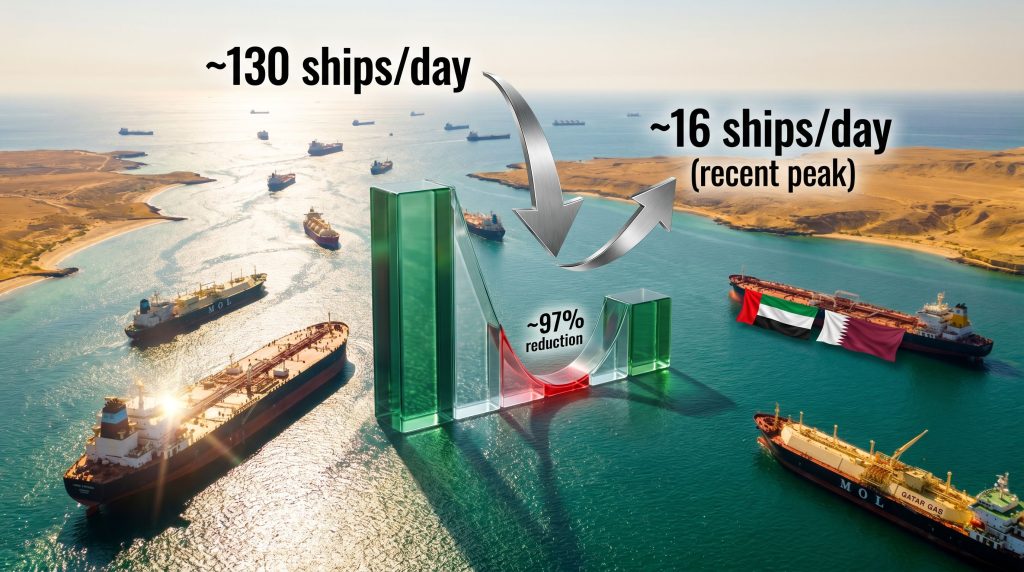
The strait connects the Persian Gulf to the Gulf of Oman and the broader Arabian Sea, forming a passage roughly 33 kilometres wide at its narrowest navigable point. Under normal operating conditions, approximately 130 vessels per day transit this corridor, collectively transporting an estimated 20% of the world's traded oil and a significant share of global liquefied natural gas volumes. No other single passage concentrates this level of energy exposure in such a geographically constrained space.
When conflict disrupted that passage, the consequences extended well beyond the tanker market. Global supply chains, the LNG supply outlook for contract delivery schedules, and crude oil pricing mechanisms all absorbed the shock simultaneously.
When big ASX news breaks, our subscribers know first
How Deep Was the Disruption? Understanding the Traffic Collapse
To appreciate the significance of Strait of Hormuz ship transits rising in recent weeks, it is necessary to grasp the severity of the preceding collapse. Maritime tracking data reveals a decline so extreme it borders on unprecedented in the context of a commercially active waterway.
The numbers tell a stark story:
| Metric | Pre-Conflict Baseline | Conflict Trough | Recent Recovery |
|---|---|---|---|
| Daily vessel transits | ~130 ships/day | ~4 ships/24 hrs | ~16 ships/day |
| Traffic decline vs. baseline | — | ~97% reduction | ~88% below normal |
| Non-Iranian stranded vessels departed | — | Minimal | At least 25% |
| AIS transponder compliance | High | Variable | Partially suppressed |
At the depth of the disruption, as few as four vessels were recorded transiting in a single 24-hour window. The recovery to approximately 16 transits per day at its recent peak represents meaningful progress from that floor, yet it still leaves the strait operating at roughly 12% of its pre-conflict throughput capacity.
A critical analytical nuance compounds the interpretation of these figures. Some vessels are completing transits with their Automatic Identification System (AIS) transponders deliberately deactivated, a tactic used by shipowners to reduce their vessel's visibility to hostile tracking systems. Because standard maritime intelligence platforms rely on AIS signal data to count vessel movements, any vessel transiting without a live transponder is effectively invisible to conventional tracking methods. This means the figures above likely represent a floor estimate of actual traffic, not a precise count.
The practical implication is significant: the recovery in Strait of Hormuz ship transits may already be more advanced than public data suggests, though by how much remains genuinely unknowable through open-source tracking alone.
What Is Driving the Recent Increase in Strait of Hormuz Ship Transits?
US Military Advisory Support: Redefining the Risk Equation
One of the most consequential factors enabling the recent uptick in transits has been the operational involvement of US military assets in providing navigational guidance to commercial operators. Multiple shipowners with direct knowledge of the situation have confirmed they communicated with American military forces, which provided them with routing advice and situational awareness to assist with the passage.
It is important to understand precisely what this involvement does and does not constitute. A spokesperson for US Central Command has confirmed that American military assets are not conducting formal escort operations for commercial vessels. The distinction between escorting and advising carries significant legal and diplomatic weight, as formal escort operations would represent a more direct military commitment and a more explicit signal to Iran about American intentions.
What is documented, however, is that the advisory framework is producing measurable results. In at least one reported incident, a group of vessels was approached by suspected Iranian fast boats during transit. Helicopters appeared in proximity and the fast boats withdrew, allowing the commercial vessels to proceed. Chevron's chief executive confirmed publicly that some vessels transiting Hormuz have faced active attack risk in recent days, a candid acknowledgment that the risk premium embedded in current freight rates is not manufactured but real.
The Larak Island Routing Pattern: What It Signals About Informal Arrangements
Maritime analysts have identified an emerging routing pattern in which some vessels are transiting via Larak Island rather than using the conventional deep-water transit lanes through Hormuz. This deviation is not a random navigation choice. Analysts interpret it as a potential indicator that certain operators have reached informal safe passage understandings directly with Iranian authorities, operating outside any formal diplomatic channel.
The strategic significance of this pattern extends beyond the individual transits it enables. It introduces a layer of bilateral, commercially-negotiated arrangement that is effectively invisible to conventional maritime intelligence systems, further compounding the underreporting problem. Furthermore, if some operators have secured private passage terms, the emergence of a two-tier transit system becomes a structural feature of the recovery rather than a temporary anomaly.
The Profile of Early Movers: Who Is Transiting and Why
The composition of vessels currently transiting Hormuz offers important intelligence about the nature of the recovery. Several key categories have been identified:
- Companies that had not transited Hormuz at any point since the conflict began are now re-entering, indicating a genuine shift in risk tolerance rather than continuation of pre-existing arrangements
- Traffic is bidirectional, with vessels documented both entering the Persian Gulf and departing, distinguishing genuine commercial re-engagement from one-off evacuation movements
- Regional state-linked operators including the UAE's national oil company have maintained or resumed passage, benefiting from proximity to diplomatic channels
- Qatar's LNG export operations have continued with relative consistency, with Doha quietly maintaining deliveries to key buyers throughout the disruption period
- Operators functioning under bilateral government-to-government arrangements represent a distinct category from those making purely commercial risk-acceptance decisions
This stratification matters analytically because it reveals that the current recovery is not a uniform reopening. It is, however, a layered, differentiated resumption in which political proximity and risk tolerance determine access ahead of any formal restoration of normalised transit conditions.
The US-Iran Diplomatic Track and Its Shipping Implications
What a Ceasefire Extension Would Actually Mean for Maritime Traffic
The broader diplomatic backdrop to the shipping recovery involves reported negotiations toward a framework that would extend a ceasefire by 60 days while opening formal discussions about Iran's nuclear programme. The reported structure of this potential agreement has elevated optimism across shipping markets, with owners privately acknowledging hope that a confirmed deal would enable a broader resumption of Persian Gulf entry. These geopolitical trade tensions are, consequently, central to any meaningful assessment of the recovery timeline.
However, the distinction between optimism and operational readiness is critical. Shipowners with direct knowledge of the situation have been clear that uncertainty persists until the full terms of any agreement are confirmed and publicly known. The asymmetry between exiting stranded vessels and committing new vessels to enter the Gulf is fundamental to understanding the recovery curve:
- Exiting stranded vessels involves a one-directional transit with a known endpoint. Risk is bounded.
- Entering the Persian Gulf commits a vessel to operating within a contested zone for the duration of its voyage. Risk is open-ended until departure.
TotalEnergies' chief executive was explicit that the company requires evidence of durable peace, not merely a ceasefire, before returning vessels to Persian Gulf operations. This position, from one of the world's largest energy companies, reflects the industry's standard for what constitutes an acceptable risk threshold. A ceasefire that could collapse within weeks does not clear that bar.
The nuclear programme dimension of the negotiations introduces a longer-duration uncertainty variable. Unlike a straightforward ceasefire agreement, discussions about Tehran's nuclear capabilities involve complex verification mechanisms, third-party stakeholder interests, and timelines that extend well beyond a 60-day window. Shipping executives are aware that even a successfully concluded initial agreement does not eliminate the structural geopolitical risk that made Hormuz dangerous in the first place.
What Happens to Tanker Earnings When Hormuz Fully Reopens?
The Mechanics of a Post-Reopening Earnings Surge
The tanker market implications of a Hormuz reopening are among the most closely watched dynamics in global commodity markets. Capital Tankers Corp.'s chief executive articulated a framework that has since become central to investor analysis of the sector: an anticipated initial phase of exceptionally elevated demand immediately following any full reopening, driven by the simultaneous clearing of a multi-month shipping backlog. In addition, the oil market impact of such a backlog clearance would be considerable, affecting both pricing benchmarks and freight rate structures simultaneously.
The mechanics driving this initial surge involve several compounding forces:
- Backlog clearance: Cargoes that were rerouted, delayed, or held in storage during the disruption period will need to move simultaneously as confidence returns
- Inventory restocking: Global oil stockpiles drawn down during the conflict will require extended replenishment, sustaining tanker demand beyond the initial clearance phase
- Ton-mile inflation: Vessels rerouted around the Cape of Good Hope during the disruption covered significantly longer distances than Hormuz transits require. As traffic normalises through Hormuz, the fleet's effective capacity per vessel will increase, but so will absolute demand for tonnage as volume recovers
- Fleet availability constraints: Vessels that spent extended periods operating in or adjacent to the strait may require unscheduled maintenance, temporarily reducing available supply precisely when demand is spiking
Tanker earnings are already described by industry executives as being at generational highs even before a full reopening is achieved. The analytical question for investors is not whether earnings will spike upon reopening, but how durable that spike will prove once the initial backlog is cleared and fleet supply responds.
The Sustained Rate Thesis: Beyond the Initial Frenzy
The longer-term case for sustained elevated tanker rates rests primarily on the inventory rebuilding cycle. When a major producing region is effectively cut off from global markets for an extended period, the downstream depletion of inventories creates a restocking demand that persists well after the supply disruption ends. Refineries that drew down strategic and operational stocks during the disruption must rebuild those buffers, generating extended tanker demand that does not dissipate after the initial frenzy phase.
This dynamic was observed following previous Gulf disruptions and represents the structural bull case for tanker operators in the period following any durable resolution of the Hormuz situation. For a broader view of how these forces intersect, the crude oil price analysis across 2025 provides useful historical context for how supply shocks translate into pricing outcomes.
Beyond Energy: The Non-Oil Dimension of Hormuz Traffic
Consumer Goods, Raw Materials, and the Underreported Supply Chain Impact
Coverage of the Hormuz disruption has concentrated almost exclusively on oil and LNG, but the strait is a general-purpose commercial corridor that handles a broad range of cargo categories. A full resumption of Strait of Hormuz ship transits would restore flows of:
- Manufactured consumer goods destined for Gulf markets and transshipment hubs
- Agricultural commodities including grain and feed imports to food-dependent Gulf economies
- Industrial raw materials supporting construction and manufacturing activity across the region
- Petrochemical products and refined fuels beyond crude oil and LNG
Extended rerouting via the Cape of Good Hope has added weeks to delivery timelines for all of these cargo categories and elevated freight costs across multiple supply chains simultaneously. For import-dependent economies that rely heavily on Gulf-routed shipping, the compounding effect on consumer prices has been a secondary but meaningful consequence of the disruption.
The next major ASX story will hit our subscribers first
Three Scenarios for the Road Back to Normal
The trajectory of Strait of Hormuz ship transits rising toward pre-conflict levels will be determined by which of three broad scenarios materialises. Furthermore, understanding oil price movements across each scenario is essential to gauging how energy markets will respond as conditions evolve.
Scenario 1: Ceasefire Holds and a Formal Agreement Is Reached
A confirmed 60-day ceasefire extension with credible implementation mechanisms would trigger a phased re-entry of mainstream shipping operators over a 30 to 60-day window. Tanker and LNG categories would lead the recovery, with container and bulk carriers following as operational confidence builds. This scenario produces the sharpest initial earnings spike but also the fastest subsequent normalisation as fleet supply responds.
Scenario 2: Agreement Collapses or Terms Remain Ambiguous
Continued operation at suppressed traffic levels characterises this outcome, with only the most risk-tolerant operators willing to transit. Cape of Good Hope rerouting becomes a semi-permanent feature of the freight market rather than a temporary workaround. Tanker earnings remain elevated but without the volume recovery that benefits cargo owners, refiners, and energy-importing nations.
Scenario 3: Partial Reopening Under Negotiated Conditions
A tiered access framework, potentially resembling the informal arrangements already observable via the Larak Island routing pattern, allows specific vessel categories, flag states, or operator profiles to transit under defined conditions. Traffic recovers gradually, a persistent uncertainty premium remains embedded in freight rates, and Qatar's LNG exports maintain preferential access ahead of oil tanker traffic.
The asymmetry across these scenarios matters for investors: Scenario 1 produces a sharp but potentially brief earnings peak. Scenarios 2 and 3 sustain elevated rates for longer but deny the volume recovery that energy importers and cargo owners require. The optimal outcome for tanker equity holders may not be the same as the optimal outcome for global energy markets.
Frequently Asked Questions: Strait of Hormuz Ship Transits
Why are Strait of Hormuz ship transits rising now?
A combination of US military navigational advisory support, emerging diplomatic progress toward a potential ceasefire extension, and growing risk appetite among select shipowners has enabled a modest but meaningful increase in commercial vessel transits. Traffic remains far below pre-conflict levels but has recovered from near-zero lows recorded earlier in the conflict.
How many ships transit the Strait of Hormuz per day currently?
Recent maritime intelligence data indicates approximately 16 vessels transited in a single day at the recent peak, compared to a pre-conflict baseline of roughly 130 ships per day. Current traffic remains approximately 85 to 90% below normal operating levels.
Is the US military escorting ships through the Strait of Hormuz?
US Central Command has confirmed that American military assets are not conducting formal escort operations. However, the command is providing navigational advice and situational awareness to commercial vessels making the transit, and there are documented incidents where US military assets appear to have intervened to prevent hostile approach.
What is the Larak Island route and why does it matter?
Maritime analysts have identified a routing pattern in which vessels transit via Larak Island rather than conventional Hormuz lanes. This is interpreted as a possible indicator that some operators have reached informal safe passage understandings with Iranian authorities, though no official confirmation of such arrangements exists.
What happens to oil prices if Hormuz fully reopens?
A full reopening would likely generate competing price pressures. Suppressed Gulf crude volumes re-entering the market could exert short-term bearish pressure on oil prices, while the tanker market would simultaneously experience a sharp earnings spike driven by backlog clearance and inventory restocking demand. The two effects would operate on different timescales.
Why are some ships transiting with their AIS transponders switched off?
Deactivating satellite tracking transponders is a risk-mitigation tactic used by some operators to reduce their vessel's detectability to hostile actors. This practice means publicly available vessel-tracking data likely understates the true volume of current transits, making any stated recovery figure a minimum estimate rather than a precise count.
This article contains forward-looking analysis regarding freight markets, diplomatic negotiations, and energy flows. Readers should be aware that geopolitical developments are inherently unpredictable and that actual outcomes may differ materially from the scenarios described. Nothing in this article constitutes financial or investment advice.
Want to Know Which ASX Miners Could Benefit From Shifting Global Commodity Flows?
Discovery Alert's proprietary Discovery IQ model delivers real-time alerts on significant ASX mineral discoveries, instantly translating complex market data into actionable insights for investors at every level — explore Discovery Alert's discoveries page to see how historic finds have generated substantial returns, and begin your 14-day free trial today to position yourself ahead of the next major opportunity.