August 25, 2026
The Architecture of Global Energy Dependency: Why One Waterway Controls Everything
Few mechanisms in global trade are as quietly consequential as maritime chokepoints. These narrow corridors of water carry the lifeblood of industrial civilisation, and for decades, analysts have warned that over-concentration of critical commodity flows through single geographic pinch points represents one of the most underappreciated systemic risks in the global economy. That warning has now crystallised into reality.
The Strait of Hormuz shipping disruption of 2026 is not simply a regional maritime incident. It is a stress test of the entire architecture of global energy logistics, one that is exposing the fragility embedded in decades of supply chain complacency. Understanding the full scope of what is happening, and what comes next, requires examining not just the immediate numbers, but the structural forces that made this moment inevitable.
When big ASX news breaks, our subscribers know first
What Makes the Strait of Hormuz So Economically Irreplaceable?
The Geography of Global Dependency: A 33-Kilometre Chokepoint
The Strait of Hormuz is, at its narrowest navigable point, approximately 33 kilometres wide. Within that corridor, two-lane shipping channels, each roughly three kilometres across, carry more concentrated economic value per transit than any other maritime passage on the planet.
The commodities at stake are not peripheral trade goods. They include:
- Crude oil representing approximately 25% of global seaborne supply, or roughly 21 million barrels per day under normal operating conditions
- Liquefied natural gas (LNG) from Qatar, the world's largest LNG exporter, which is entirely dependent on Hormuz access
- Petrochemicals feeding manufacturing supply chains across Asia, Europe, and the Americas
- Fertilizers including ammonia, urea, and phosphates critical to global food production
The broader geography amplifies the problem. The Persian Gulf is effectively an enclosed body of water with a single functional exit. Dubai's Jebel Ali port, one of the world's largest container transhipment hubs, sits inside this basin. Any sustained interruption at Hormuz does not merely delay cargo in transit; it seals off the Gulf basin entirely from global maritime commerce.
The Chokepoint Hierarchy: How Hormuz Compares to Other Global Bottlenecks
To appreciate why the Strait of Hormuz shipping disruption is categorically more severe than other maritime crises, consider how it ranks against comparable chokepoints:
| Chokepoint | Daily Oil Transit | Alternative Route Available? | Rerouting Cost Impact |
|---|---|---|---|
| Strait of Hormuz | ~21 million barrels/day | Minimal | Extreme |
| Strait of Malacca | ~16 million barrels/day | Limited | Moderate to High |
| Suez Canal | ~9 million barrels/day | Yes (Cape of Good Hope) | High |
| Bab-el-Mandeb | ~6 million barrels/day | Yes (via Suez bypass) | Moderate |
Unlike the Suez Canal, which can be bypassed via the Cape of Good Hope at considerable cost, or the Bab-el-Mandeb, which connects to alternative routing through the Suez system, the Strait of Hormuz has no meaningful substitute for Persian Gulf oil exporters. This structural irreplaceability is what elevates any disruption here to a different category of crisis entirely.
How Severe Is the Current Strait of Hormuz Shipping Disruption?
Quantifying the Traffic Collapse: From 140 Vessels to Single Digits
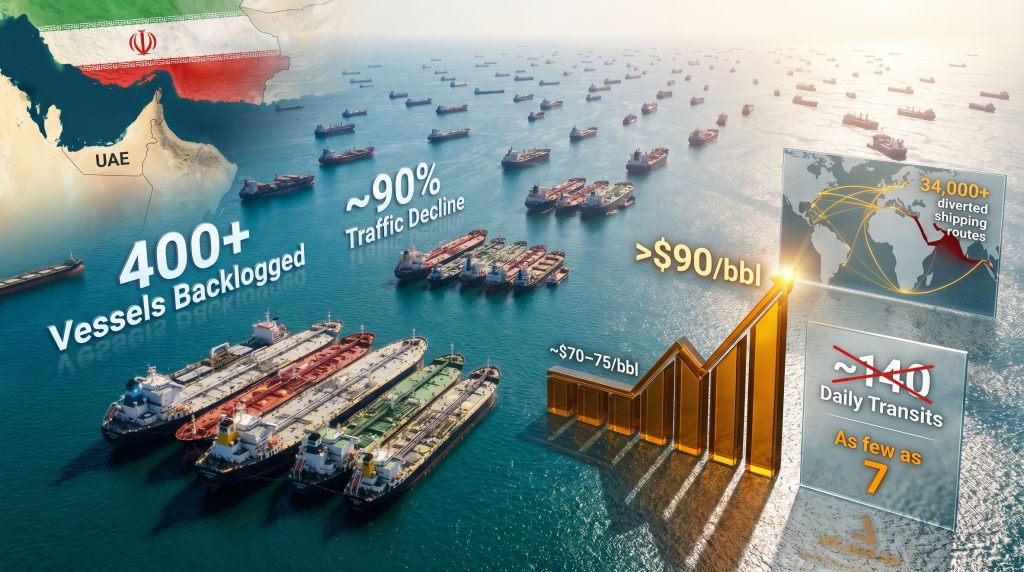
Under normal operating conditions, approximately 140 vessels per day transit the Strait of Hormuz, carrying crude oil, LNG, refined products, containers, and bulk commodities. During peak disruption periods in 2026, that figure has fallen to as few as 7 transits in a single 24-hour window, representing a reduction of approximately 90% in commercial maritime traffic.
Documented daily transit counts at the height of the disruption have included:
- Six total vessel transits recorded across a full 24-hour period
- Three cargo vessels and one tanker completing passage on a single day
- Two cargo ships and four tankers transiting on the following day
Particularly significant was the reported turning back of a UAE-bound container vessel at the strait's entrance, which analysts interpreted as a signal of active enforcement escalation rather than passive deterrence.
The Backlog Crisis: 400 Plus Vessels Stranded
The cascading consequence of this near-total traffic stoppage has been a vessel backlog of extraordinary scale:
- More than 400 ships are currently anchored in the Persian Gulf or staging in the Gulf of Oman
- Thousands of vessels are effectively landlocked within the Gulf basin, unable to exit
- Port congestion is cascading across regional hubs as queues extend indefinitely
- Over 34,000 shipping routes were diverted within the first four weeks of disruption
The Gulf of Oman staging zone, which typically functions as an orderly approach corridor for inbound and outbound vessels, has transformed into a holding pen of unprecedented size. Port operators at Jebel Ali, the Port of Fujairah, and other regional hubs are managing congestion levels with no historical precedent.
Iran's IRGC Transit Permission Framework
Central to understanding the mechanics of this disruption is the enforcement system reportedly operated by Iranian Revolutionary Guard naval forces. The framework operates as follows:
- Commercial vessels seeking passage must obtain explicit permission to transit
- A reported fee of approximately $2 million per vessel is imposed as a condition of passage
- US-flagged vessels and ships with Israeli affiliations are excluded from this arrangement entirely, regardless of fee payment
- Vessels originating from Iraqi and Iranian ports receive preferential transit access under the framework
This system creates a tiered, politically mediated access structure that is fundamentally incompatible with the principles of free navigation enshrined in UNCLOS Article 38, which guarantees transit passage rights through international straits. The resulting legal and jurisdictional ambiguity has complicated the ability of international bodies to mount a coordinated response.
What Commodities Are Most Exposed to Hormuz Shipping Disruption?
Energy Markets: Crude Oil and LNG Under Pressure
The most immediate and visible consequence of the Strait of Hormuz shipping disruption has been the repricing of global energy benchmarks. Brent crude prices have exceeded $90 per barrel as markets price in sustained supply uncertainty. Furthermore, crude oil price trends in the lead-up to 2026 had already signalled structural tightness across energy markets.
For context, this pricing trajectory shares characteristics with two prior shock events:
- The COVID-19 supply chain collapse of 2020 to 2021, which disrupted demand and production simultaneously
- The post-Ukraine war energy repricing of 2022, when Russian export disruptions triggered a structural reassessment of European energy security
Qatar's position as the world's largest LNG exporter makes the gas market particularly exposed. Unlike crude oil, which can theoretically be stored or redirected, LNG supply chains are built around dedicated regasification terminals and long-term offtake agreements. Disruption to Qatari LNG flows creates supply gaps that cannot be filled quickly by alternative producers. Indeed, global LNG supply dynamics were already under strain before this crisis accelerated the pressure.
Fertilizer and Food Security: The Hidden Vulnerability
Less visible in financial market coverage, but potentially more consequential for human welfare, is the fertilizer dimension of this crisis. Gulf producers are among the world's largest exporters of:
- Ammonia, a primary input for nitrogen-based fertilizers
- Urea, the most widely traded solid fertilizer globally
- Phosphates, essential for crop yield maintenance
Disruption to these flows transmits directly into agricultural input costs, with downstream effects on food price inflation. Nations already managing elevated debt burdens face a compounding dynamic where energy cost shocks, currency depreciation pressure, and rising food import costs arrive simultaneously. Sub-Saharan Africa, South Asia, and parts of Southeast Asia face disproportionate exposure given their import dependency profiles. Concerns around fertilizer import reliance have consequently intensified as the crisis extends.
The broader observation made by trade analysts, including commentary published by Creamer Media's Mining Weekly in May 2026, is that the strait's importance extends well beyond oil. The closure's impact on fertilizer flows represents a secondary crisis playing out on a slower timeline but with equally serious structural implications for global food security.
Container Trade and Consumer Goods
Dubai's Jebel Ali port, which handles a significant share of transhipment cargo for the broader Middle East, South Asia, and East Africa, is effectively isolated from normal operations. Supply chains carrying electronics, automotive components, and retail merchandise face rerouting delays measured in weeks, not days.
Recovery timeline estimates under optimistic scenarios suggest 2 to 3 weeks for traffic normalisation if conditions stabilise, though energy prices are expected to remain elevated considerably longer due to structural supply shortfalls that persist even after maritime access resumes.
How Are Major Shipping Lines Responding to the Crisis?
Carrier Suspensions and Force Majeure Declarations
The world's largest container carriers have responded with a combination of service suspensions and contractual force majeure declarations. Major lines including Maersk, MSC, CMA CGM, COSCO, and Evergreen are among those that have either suspended Gulf services or invoked force majeure clauses affecting their cargo commitments.
Force majeure implications are far-reaching for cargo owners:
- Delayed liability transfers back to shippers under standard contract terms
- Insurance claim complications arise as coverage gaps become apparent
- Contract renegotiations are required for time-sensitive shipments
- Downstream buyers face supply shortfalls with limited recourse
Rerouting Economics: The Cost of Going Around
For vessels that can reroute, the economics are severe:
| Rerouting Option | Additional Distance | Estimated Cost Premium | Transit Time Added |
|---|---|---|---|
| Via Red Sea (limited access) | Moderate | High, with insurance surcharge | 5 to 8 days |
| Via Cape of Good Hope | 6,000 to 8,000 nautical miles | Very High | 12 to 18 days |
| Suez Canal transit | Partial alternative | High | Variable |
Beyond the direct rerouting costs, carriers are absorbing:
- Bunker fuel surcharges escalating as longer voyages consume additional fuel
- War risk insurance premiums spiking for any vessel operating in Gulf-adjacent coverage zones
- Freight rate index increases across tanker, dry bulk, and container segments simultaneously
Port Congestion Cascades: Secondary Market Disruptions
The rerouting crisis does not resolve itself simply by redirecting vessels. Secondary congestion is emerging across multiple regions:
- Red Sea ports absorbing redirected vessel traffic are developing their own queue backlogs
- Asian import terminals are managing delayed cargo arrivals across multiple trade lanes simultaneously
- European energy terminals are drawing down strategic LNG reserves to compensate for supply gaps, a process that creates its own medium-term vulnerability as reserve buffers shrink
What Are the Macro-Economic Consequences of a Prolonged Hormuz Closure?
Energy Price Transmission: From Wellhead to Consumer
Energy price shocks originating at a maritime chokepoint do not arrive at consumer level instantaneously. They transmit through a sequential chain of pricing mechanisms, with each stage amplifying the original disruption signal before it reaches household budgets.
The transmission sequence operates across four distinct stages:
- Stage 1: Brent crude benchmark repricing, currently exceeding $90 per barrel
- Stage 2: Refined product cost escalation across diesel, jet fuel, and heating oil
- Stage 3: Freight and logistics cost inflation embedded in the price of manufactured goods
- Stage 4: Broad consumer price index pressure, most acute in economies heavily dependent on energy imports
Each stage introduces a time lag of weeks to months, meaning the full inflationary transmission of the current disruption will not be visible in consumer price data for some time after the crisis itself resolves.
Developing Economy Vulnerability Assessment
The asymmetric nature of this crisis deserves particular attention. While energy-exporting nations outside the Gulf may benefit from elevated crude prices, import-dependent developing economies face a simultaneous triple shock:
- Rising energy import costs consuming larger shares of foreign exchange reserves
- Currency depreciation pressure as trade deficits widen
- Food price inflation driven by fertilizer supply disruptions
The United Nations Conference on Trade and Development (UNCTAD) has formally highlighted chokepoint vulnerabilities as a systemic risk to global trade corridors, noting that the concentration of critical commodity flows through single geographic passages represents a structural fragility in the multilateral trading system.
War-Damaged Energy Infrastructure: Why Opening the Strait Alone Is Insufficient
A critical insight that extends well beyond the immediate maritime crisis is the observation, consistent with analysis from Creamer Media's Mining Weekly, that reopening the strait is necessary but not sufficient for trade normalisation. Regional conflict has caused physical damage to energy production and export infrastructure that will take considerably longer to repair than the diplomatic resolution of transit access.
Specific constraints include:
- Pipeline capacity limitations preventing rapid restoration of pre-disruption export volumes
- Refinery and terminal damage extending the recovery timeline for refined product exports
- Upstream production facility disruptions reducing the volume available for export even when transit becomes possible
This infrastructure dimension means that commodity price elevation is likely to persist for weeks to months beyond any maritime normalisation, a dynamic that markets may be underpricing relative to the diplomatic signal of a strait reopening.
The next major ASX story will hit our subscribers first
Scenario Modelling: What Happens Next?
Scenario A: Rapid De-escalation Within Two to Four Weeks
Under the most optimistic pathway:
- Transit volumes recover toward 80 to 100 vessels per day within three weeks of de-escalation
- Brent crude retreats toward the $75 to $80 per barrel range as supply anxiety eases
- Freight rates normalise over six to eight weeks as vessel backlogs clear
- Residual energy infrastructure damage sustains a mild commodity price premium for two to three months
Scenario B: Prolonged Partial Disruption Over Three to Six Months
Under a middle-path scenario:
- Iranian Revolutionary Guard forces maintain selective transit controls, permitting 20 to 40 vessels daily
- Brent crude stabilises in the $85 to $95 per barrel range with elevated volatility
- Global LNG markets face structural tightness as European strategic reserves are progressively drawn down
- Fertilizer shortages begin transmitting into agricultural commodity prices by the third quarter of 2026
Scenario C: Extended Closure Exceeding Six Months
Under the most severe scenario:
- Sustained closure triggers emergency International Energy Agency strategic petroleum reserve releases
- Global recession risk escalates, particularly for energy-import-dependent economies
- Investment in alternative energy infrastructure accelerates as buyers seek to reduce Gulf supply dependency
- Energy trade flows realign toward non-Gulf producers including the United States, Canada, Norway, and West African exporters
What Does This Mean for Global Energy Security Architecture?
The Structural Argument for Supply Chain Diversification
The 2026 Strait of Hormuz shipping disruption has reinforced a structural argument that energy security analysts have advanced for years: excessive dependency on single-chokepoint routing creates systemic fragility that cannot be insured away at the microeconomic level. However, the oil market disruption pressure building through escalating trade tensions had already primed markets for instability before this crisis emerged.
Partial bypass infrastructure does exist. The UAE's Habshan to Fujairah pipeline carries approximately 1.5 million barrels per day of capacity, routing crude from Abu Dhabi's interior fields directly to the Gulf of Oman coast, entirely bypassing the strait. Saudi Arabia's East to West Pipeline, known as the Petroline, provides a complementary diversion route across the Arabian Peninsula to Red Sea export terminals.
However, combined bypass capacity falls dramatically short of the 21 million barrels per day that normally transits Hormuz. These pipelines represent meaningful but partial solutions, not replacements for the strait's throughput under normal conditions.
Long-Term Investment Implications for Energy Markets
For investors monitoring this disruption, several structural positioning themes emerge:
- Upstream producers outside the Gulf region including US shale operators, Canadian oil sands producers, and Norwegian North Sea exporters are positioned as strategic beneficiaries of sustained Hormuz disruption
- LNG infrastructure investment is accelerating in Australia, the US Gulf Coast, and will likely resume in Qatar itself once the post-crisis reconstruction phase begins
- Fertilizer production diversification away from Gulf-dependent supply chains represents a medium-term agricultural commodity investment theme
- War risk insurance and maritime security sectors face a structural repricing event as underwriters reassess Gulf-adjacent coverage models
Disclaimer: The investment themes discussed above represent analytical observations based on publicly available information and should not be construed as financial advice. Commodity prices, geopolitical conditions, and market dynamics are inherently unpredictable. Readers should conduct independent research and seek qualified financial guidance before making investment decisions.
UNCTAD's Position and the De-escalation Imperative
UNCTAD's formal position is unambiguous: de-escalation represents the only durable solution to chokepoint vulnerability. No combination of alternative routing, strategic reserve releases, or bypass infrastructure can sustainably replace the Strait of Hormuz at scale. The organisation has called for multilateral diplomatic frameworks to guarantee maritime transit rights under international law, and for the establishment of neutral maritime monitoring mechanisms in conflict-adjacent zones.
The legal framework already exists in principle. UNCLOS Article 38 establishes the right of transit passage through international straits. The challenge is enforcement in a context where the naval forces of one territorial state have chosen to exercise de facto control over access, and where the international community lacks a unified mechanism for compelling compliance. In addition, geopolitical trade risks across multiple theatres are compounding the difficulty of assembling a coordinated international response.
Frequently Asked Questions: Strait of Hormuz Shipping Disruption
What percentage of global oil passes through the Strait of Hormuz?
Approximately 25% of global seaborne crude oil trade transits the Strait of Hormuz daily, representing roughly 21 million barrels per day under normal operating conditions. No other single chokepoint carries a comparable share of global energy supply with so little alternative routing available.
How many ships are currently blocked due to the Hormuz disruption?
Vessel backlogs have exceeded 400 ships anchored in the Persian Gulf and Gulf of Oman staging areas, with more than 34,000 shipping routes diverted within the first month of the disruption. Thousands of additional vessels remain effectively landlocked within the Gulf basin.
What is the reported transit toll imposed by Iranian naval forces?
Iranian Revolutionary Guard naval forces have reportedly implemented a permission-based transit system requiring commercial vessels to pay approximately $2 million to pass through the strait. US-flagged vessels and ships with Israeli affiliations are excluded from this arrangement entirely, regardless of fee payment willingness.
How long could the Strait of Hormuz disruption last?
Under optimistic scenarios, partial normalisation could occur within two to four weeks of de-escalation. However, physical damage to regional energy infrastructure means full supply restoration may take considerably longer, sustaining elevated commodity prices even after maritime traffic formally resumes.
What alternative routes exist if the Strait of Hormuz remains closed?
The UAE's Habshan to Fujairah pipeline and Saudi Arabia's Petroline offer partial bypass capacity, but neither can replace full strait throughput. Most tankers face a binary choice: waiting for reopening, or undertaking significantly longer voyages via the Cape of Good Hope at substantially higher cost and transit time.
Key Takeaways: Strait of Hormuz Disruption at a Glance
| Metric | Pre-Disruption | Current Status |
|---|---|---|
| Daily vessel transits | ~140 | As few as 7 |
| Traffic reduction | Baseline | ~90% decline |
| Vessels backlogged | Negligible | 400 plus |
| Routes diverted (first 4 weeks) | Baseline | 34,000 plus |
| Brent crude price | ~$70 to $75/bbl | Greater than $90/bbl |
| Carrier service status | Normal operations | Suspended or Force Majeure |
The core lesson embedded in this crisis extends beyond the immediate commodity price movements. As noted in trade commentary published by Creamer Media's Mining Weekly in May 2026, the disruption has demonstrated once again how profoundly the global economy depends on this narrow stretch of waterway. Critically, even full reopening of the strait cannot, by itself, restore normal trade conditions as long as the underlying energy infrastructure damaged by regional conflict remains impaired.
That dual constraint — a diplomatic challenge compounded by a physical reconstruction challenge — is what makes the Strait of Hormuz shipping disruption of 2026 structurally different from the maritime incidents that preceded it.
Readers seeking additional context on global maritime chokepoints and energy trade vulnerability are directed to UNCTAD's published research on trade disruption risk, and to publicly available analysis from the International Energy Agency on strategic petroleum reserve policy and energy security frameworks.
Want to Stay Ahead of Commodity Market Shifts Driven by Global Supply Disruptions?
When crises like the Strait of Hormuz shipping disruption reprice energy, fertilisers, and critical minerals overnight, Discovery Alert's proprietary Discovery IQ model delivers real-time alerts on significant ASX mineral discoveries — instantly identifying actionable opportunities across 30-plus commodities before the broader market reacts. Explore how historic discoveries have generated substantial returns on Discovery Alert's discoveries page, and begin a 14-day free trial to position ahead of the next major market move.