August 5, 2026
Why the Strait of Hormuz Is the Fulcrum of Global Energy Security
Every so often, a single geographic feature reminds the world just how fragile the architecture of global trade really is. Maritime chokepoints have shaped empires, determined the outcomes of wars, and quietly underpinned the energy infrastructure of modern industrial economies for decades. Yet among the world's critical waterways, one passage consistently stands apart not because of its size, but because of what flows through it and what cannot easily flow anywhere else.
The Strait of Hormuz shipping disruption unfolding across 2026 has forced energy analysts, logistics operators, government planners, and commodity traders to confront a question many had assumed was largely theoretical: what happens when the world's most consequential maritime chokepoint effectively closes?
The answer, it turns out, is simultaneously more complex and more damaging than most scenario models anticipated.
When big ASX news breaks, our subscribers know first
The Geography That Makes Hormuz Irreplaceable
Positioned between Iran to the north and Oman to the south, the strait narrows to approximately 33 kilometres at its most constrained navigable point. Despite this modest width, it functions as the singular artery through which roughly 20 to 25 percent of all seaborne oil trade passes on any given day, alongside substantial volumes of liquefied natural gas and liquefied petroleum gas destined primarily for Asian markets.
What distinguishes Hormuz from other vulnerable waterways is the absence of any credible alternative. Unlike the Suez Canal, where vessels can divert around the Cape of Good Hope at considerable cost but with operational feasibility, Gulf-origin crude has no substitute loading point. The oil and gas originates inside the Gulf itself. A tanker cannot simply reroute away from a blockage when the commodity it is carrying can only be sourced from within the blocked zone.
The comparison across major chokepoints illustrates just how exposed the global system truly is:
| Chokepoint | Share of Global Oil Trade | Primary Commodity | Alternative Route Available? |
|---|---|---|---|
| Strait of Hormuz | ~20-25% | Crude oil, LNG, LPG | Limited / No direct substitute |
| Suez Canal | ~12% | Mixed cargo, crude | Cape of Good Hope (costly) |
| Strait of Malacca | ~16% | Crude, containers | Lombok/Sunda Straits (limited) |
| Bab el-Mandeb | ~9% | Crude, containers | Cape of Good Hope |
The Hormuz column stands alone in the table for one critical reason: the alternative route problem is not a routing problem, it is a sourcing problem.
Historical Precedents and the Risk Framework They Created
The current crisis is not the first time Hormuz has been weaponised as geopolitical leverage. The 1984 to 1988 Tanker War established foundational precedents for war-risk insurance pricing and naval escort protocols that remain embedded in shipping industry practices today. The attacks on commercial vessels during that period prompted the creation of formal maritime convoy systems and reshaped how insurers modelled conflict exposure in Gulf waters.
The 2019 tanker seizure incidents offered a more recent calibration point. Iran demonstrated clear willingness to use vessel detention as a signalling mechanism during periods of intensified sanctions pressure, and financial markets responded with predictable but ultimately short-lived oil price movements. Risk premiums faded within approximately eight to ten weeks as no sustained physical closure materialised.
The 2024 Red Sea crisis involving Houthi attacks on commercial shipping provided the most immediately comparable precedent. Freight rates remained elevated for roughly six months, but the disruption never threatened the sourcing of cargo in the way Hormuz does. Vessels could load elsewhere and reroute. That essential safety valve does not exist in the current situation.
Historical analysis consistently shows that the duration of physical access restriction, rather than the severity of individual incidents, is the primary determinant of lasting market impact. Short, sharp disruptions produce fear premiums. Extended closures produce structural supply deficits.
What Is Actually Happening in the Strait of Hormuz Right Now
The Israel-Iran military conflict, which entered approximately its ninth week by early May 2026, triggered a cascade of maritime consequences beginning in March of that year. Iran formally restricted commercial shipping access through the strait, representing one of the most severe unilateral maritime access limitations in the waterway's modern history. Iran's new shipping rules have drawn widespread condemnation from international maritime bodies and legal scholars alike.
The Collapse in Vessel Transits
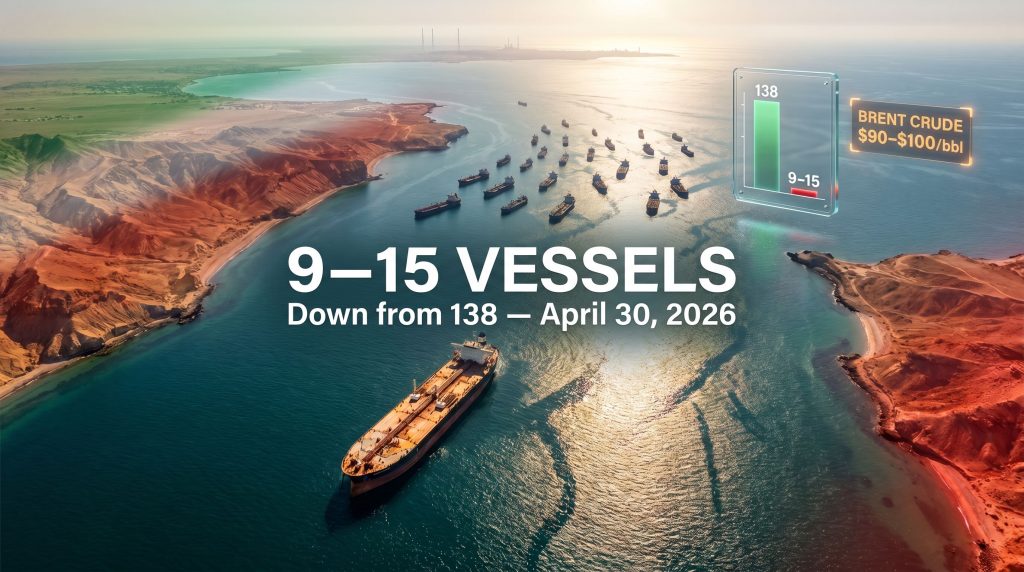
The speed of the deterioration has been striking. Daily commercial vessel transits through the strait fell from approximately 138 vessels on April 30, 2026, to as few as 9 to 15 vessels by May 2 and 3, 2026. That represents a reduction of up to 94 percent in active commercial throughput within days.
This near-total collapse in traffic volume within such a compressed timeframe has no modern precedent. Even during the most intense phases of the 1980s Tanker War, commercial vessel movements never fell to single-digit daily figures across the full breadth of the strait.
Additional developments compounding the security picture include:
- At least 34 documented attacks on commercial vessels since the maritime phase of the conflict commenced
- Small tankers in the 3,000 to 5,000 deadweight tonne range have emerged as the primary target category, with several incidents involving vessel seizure rather than simply damage
- A French container ship struck in the strait represents just one of several high-profile incidents that have intensified pressure on international shippers and insurers
- Suspicious AIS transponder deactivation, commonly referred to as dark vessel activity, has been flagged in UAE anchorage zones, complicating tracking and risk assessment for operators and underwriters alike
- Kuwait and UAE oil production operations have experienced partial shutdowns as a direct consequence of the deteriorating security environment
The Persian Gulf Strait Authority and Its Legal Dimensions
Iran's formal establishment of the Persian Gulf Strait Authority represents a qualitative escalation beyond previous tactics. Rather than treating transit restrictions as reactive, temporary emergency measures, Tehran has created a structured regulatory body asserting sovereign control over commercial passage permissions.
This directly challenges the framework established under the United Nations Convention on the Law of the Sea, which classifies the Strait of Hormuz as a waterway qualifying for transit passage rights. Under UNCLOS, all vessels retain the right of continuous and expeditious passage regardless of the political relationship between the flag state and the coastal nation.
Iran's authority structure does not merely threaten individual transits. It institutionalises the legal claim, creating a durable confrontation between national assertion and international maritime law that will persist regardless of near-term ceasefire outcomes.
The International Maritime Organization's Director-General formally addressed the UN Security Council, conveying that no safe transit conditions currently exist in the strait. This represents a rare and institutionally significant declaration from an organisation that typically favours measured diplomatic language.
Washington launched what was described as Project Freedom, a short-lived US-led naval enforcement initiative aimed at restoring commercial transit through escort and deterrence operations. The initiative's limited duration reflects the significant operational constraints involved, including the risk of direct confrontation with Iranian naval assets and the legal ambiguity created by the Strait Authority's declared jurisdiction.
How the Disruption Is Reshaping Global Energy Markets
Crude Oil Price Dynamics
Brent crude prices have breached the $90 to $100 per barrel range, driven by a combination of genuinely reduced Gulf export volumes and elevated risk premiums embedded in forward contracts. Understanding the crude oil volatility trends associated with such geopolitical events is essential for distinguishing actual supply removal from the fear premium layered on top.
Approximately 80 percent of Gulf-origin crude exports flow eastward toward Asian economies, including China, India, Japan, and South Korea. This directional concentration means the disruption has effectively split the global oil market into two divergent experiences. Atlantic Basin producers across the United States, West Africa, and the North Sea are experiencing an unexpected demand pull as Asian refiners scramble for alternative supply. Gulf-dependent refiners, by contrast, face acute competition for the same redirected barrels.
OPEC+ spare capacity calculations are being reassessed in real time, since member states holding production capacity inside the Gulf face the same access constraints as commercial shippers. Spare capacity that cannot reach a loading terminal is, in practical terms, not spare capacity at all.
The LNG and LPG Dimension Most Commentators Are Missing
While crude oil dominates headlines, the disruption's effect on gas markets may ultimately carry comparable long-term significance. Qatar, the world's largest LNG exporter, routes its output through the strait. Monitoring the LNG supply outlook closely is therefore critical, as any sustained restriction on Qatari flows creates compounding pressure across global gas markets disproportionate to Qatar's share of overall energy trade.
LPG markets face similar pressure. European propane markets, which had begun moderating from earlier conflict-driven spikes, are confronting renewed upward momentum as tanker availability tightens and rerouting cost premiums escalate. A podcast from Argus Media published on May 6, 2026, titled From Shock to Softness: Europe's Propane Market Eases, documented the brief moderation phase that now appears increasingly fragile given the ongoing transit collapse.
Fertiliser supply chains represent a further downstream consequence that typically receives insufficient analytical attention. Gulf-origin ammonia and urea feedstocks underpin a significant share of global nitrogen fertiliser production. Upstream cost pressures in these markets typically translate into agricultural input price inflation within a 60 to 90 day lag, meaning food system consequences from the current disruption may not manifest in consumer prices until late 2026.
Estimated Daily Economic Loss Breakdown
| Sector | Estimated Daily Impact | Primary Driver |
|---|---|---|
| Global oil and energy markets | Dominant share of ~$600M total | Reduced throughput plus price premium |
| International shipping and freight | Significant contributor | Rerouting costs, idle fleet, insurance surge |
| Regional Gulf economies | Moderate contributor | Production curtailments, trade contraction |
| Global food and fertilizer chains | Emerging, lagged impact | Ammonia and urea supply disruption |
The approximately $600 million per day aggregate loss estimate, which combines oil market, shipping, and regional economic impacts, is directionally consistent with UNCTAD assessments that have characterised the disruption's scale as comparable to the COVID-era and Ukraine war-era trade shocks of previous years.
Supply Chain and Logistics Consequences Beyond the Oil Price
Why the Rerouting Playbook Does Not Apply Here
Industry participants who navigated the 2024 Red Sea disruption quickly discovered that their experience did not transfer cleanly to the Hormuz situation. During the Houthi campaign against commercial shipping, Cape of Good Hope rerouting was commercially painful and operationally disruptive, but vessels could load their cargo at source and simply take the longer path to destination. The underlying supply was intact.
Gulf-positioned tankers face a categorically different constraint. Very Large Crude Carriers and Ultra Large Crude Carriers loading at Gulf terminals have no equivalent alternative loading point. The cargo originates inside the affected zone. Some operators have adopted a wait and anchor strategy, holding vessels at UAE or Omani anchorages in anticipation of improved conditions, which is creating port congestion and fleet utilisation inefficiencies that compound over time.
Insurance Markets, Freight Rates, and Cascading Effects
War-risk insurance premiums for Hormuz transit have reached levels not seen since the 2019 tanker seizure episodes, with a notable subset of underwriters withdrawing coverage entirely for certain vessel classes rather than pricing the risk at any premium level. This represents a fundamentally different market signal from elevated pricing: it suggests some underwriters view the risk as genuinely unquantifiable under current conditions.
Key cascading effects across adjacent markets include:
- Shipping lines have suspended scheduled services through the region, triggering container imbalances as equipment becomes stranded or repositioned
- Air freight demand has increased as time-sensitive cargo operators seek alternatives, adding cost pressure across electronics, pharmaceutical, and perishable goods supply chains
- Resurgent piracy activity off the Somali coast, partly attributed to regional fuel scarcity linked to diverted tanker cargo, introduces an additional compounding maritime security risk operating in parallel
Differential Exposure Across Asian Importing Economies
The downstream effects on import-dependent Asian economies are not uniform. Each nation's exposure is shaped by its reserve buffer, refinery configuration, and alternative supplier relationships:
- China: As the world's largest crude oil importer, China faces the steepest near-term exposure. Strategic petroleum reserve drawdowns are already under active evaluation. Chinese refiners have a history of aggressively pivoting to sanctioned crude at discount prices during supply disruptions, which may moderate some of the cost impact but creates separate diplomatic tensions.
- India: Indian refiners, already adapted to processing Middle Eastern sour crude grades, face both supply competition and elevated freight costs simultaneously. The disruption may accelerate a diversification trajectory toward US and West African grades that was already underway.
- Japan and South Korea: Both nations maintain strategic petroleum reserves capable of providing a 30 to 90 day buffer, but face genuine vulnerability if the disruption extends materially beyond that window.
- Emerging markets across South and Southeast Asia: Nations without meaningful strategic reserve infrastructure face the sharpest inflationary transmission channels through both fuel and food price pathways, with limited policy tools to absorb the shock.
The next major ASX story will hit our subscribers first
The Geopolitical Architecture Driving the Crisis
Iran's decision to formally restrict strait access reflects a strategic calculation that extends well beyond the immediate military conflict. The Persian Gulf Strait Authority functions not merely as a security enforcement mechanism but as a diplomatic instrument, signalling Tehran's intent to institutionalise its access control claims rather than treat restrictions as temporary emergency measures tied to specific military objectives.
This represents a genuinely novel development in Iranian strait strategy. Previous episodes of coercive maritime action were characterised by reactive, time-limited measures designed to signal displeasure or extract concessions during particular escalation cycles. The creation of a formal regulatory body introduces institutional permanence that complicates any ceasefire framework that does not explicitly address maritime access terms.
Gulf Cooperation Council member states, including Saudi Arabia, UAE, and Kuwait, find themselves caught in an extraordinarily difficult position. They face simultaneous pressure from military security concerns and severe economic disruption from production curtailments and shipping paralysis. Their capacity to serve as constructive intermediaries in ceasefire negotiations is constrained by their own material vulnerability.
Furthermore, the oil market disruption triggered by these geopolitical tensions extends well beyond the immediate region, reshaping pricing dynamics, supply agreements, and trade flows on a global scale. Multiple ceasefire frameworks are reportedly under active discussion. However, the gap between Iran's sovereignty claims over strait navigation and the international community's insistence on freedom of navigation under UNCLOS remains the central unresolved legal and political barrier. Any agreement that does not explicitly address the Persian Gulf Strait Authority's status risks producing a nominal ceasefire while leaving the institutional architecture of transit restriction fully intact.
Institutional Responses and Their Structural Limits
The IMO's formal declaration that safe transit cannot be guaranteed marks a significant institutional threshold. The UN Security Council has passed resolutions calling for freedom of navigation, but enforcement mechanisms remain constrained by the structural dynamics of permanent member veto politics and the divergent strategic interests of major powers in the conflict's resolution.
UNCTAD has formally characterised the disruption as a global trade shock of comparable magnitude to the COVID-19 pandemic's supply chain impact and the Ukraine war's commodity market effects. This framing matters because it signals to policymakers that the economic damage has already crossed a threshold requiring macro-level policy responses rather than targeted sectoral interventions.
The International Energy Agency and member governments retain the option of coordinated strategic petroleum reserve releases. This tool was deployed effectively during the 2022 energy crisis. However, SPR releases provide a demand buffer measured in weeks to months rather than resolving the underlying supply access constraint. Their effectiveness diminishes rapidly if the disruption extends beyond the 90-day threshold at which most importing nations' reserve buffers approach exhaustion.
Three Scenarios for Resolution and Market Stabilisation
Scenario 1: Rapid De-escalation (Low Probability, Near-Term)
A ceasefire agreement incorporating explicit maritime access guarantees is reached within two to four weeks. Vessel transits resume gradually over 30 to 60 days as insurance markets recalibrate. Brent crude retreats toward the $75 to $80 per barrel range as the risk premium unwinds. Supply chain normalisation follows within 60 to 90 days. This scenario requires resolution of the Persian Gulf Strait Authority's legal status, which is the single largest obstacle to rapid normalisation.
Scenario 2: Prolonged Managed Disruption (Moderate to High Probability)
Conflict continues at reduced intensity, with partial transit restoration under negotiated or de facto arrangements. Daily transits recover to 40 to 70 percent of pre-conflict levels within 60 to 90 days. Oil prices stabilise in the $85 to $95 per barrel range with elevated but commercially manageable insurance premiums. Asian importers accelerate long-term diversification strategies away from Gulf dependency. This is the scenario most consistent with historical precedents involving partial but incomplete normalisation.
Scenario 3: Extended Full Closure (Lower Probability, Severe Impact)
The Persian Gulf Strait Authority maintains effective control and no multilateral enforcement mechanism succeeds in restoring transit. Global oil markets enter a structural supply deficit, with Brent potentially exceeding $120 per barrel. Strategic reserve depletion forces demand destruction in price-sensitive emerging markets. Permanent trade route restructuring accelerates, with significant long-term implications for Gulf state fiscal sustainability and the region's ability to service sovereign debt obligations.
Frequently Asked Questions: Strait of Hormuz Shipping Disruption
What percentage of global oil passes through the Strait of Hormuz?
Approximately 20 to 25 percent of all seaborne oil trade transits the Strait of Hormuz, making it the single most consequential maritime chokepoint for global energy supply. This figure includes crude oil, LNG, and LPG volumes primarily destined for Asian markets.
Why can't tankers simply reroute around the Strait of Hormuz?
Unlike other maritime disruptions where alternative routing is commercially painful but operationally viable, Gulf-origin crude has no alternative loading point. The oil itself is produced inside the Gulf, meaning vessels cannot bypass the strait without abandoning the cargo source entirely. Rerouting is physically possible for vessels already at sea but does not solve the problem for vessels attempting to load at Gulf terminals.
How much have vessel transits declined during the current disruption?
Daily commercial vessel transits fell from approximately 138 on April 30, 2026, to as few as 9 to 15 vessels by May 2 and 3, 2026, representing a decline of up to 94 percent within days.
What is the Persian Gulf Strait Authority and why does it matter?
Iran's Persian Gulf Strait Authority is a formally established regulatory body asserting Iranian sovereign control over commercial transit through the strait. Its significance lies in the institutionalisation of access restrictions, moving from reactive enforcement to a structured legal claim that directly conflicts with international maritime law under UNCLOS and is likely to persist beyond any near-term ceasefire.
Which countries are most affected by the Hormuz shipping disruption?
Asian economies face the greatest acute exposure, particularly China, India, Japan, and South Korea, which collectively receive approximately 80 percent of Gulf crude exports. Emerging markets in South and Southeast Asia without strategic reserve buffers face the most severe inflationary transmission effects. Monitoring current crude oil prices remains critical for policymakers in these regions as they assess the full extent of their import cost exposure.
What is the estimated daily economic cost of the disruption?
Combined losses across oil markets, international shipping, and Gulf regional economies are estimated at approximately $600 million per day, with international organisations characterising the broader trade impact as comparable in scale to COVID-era and Ukraine war-era supply shocks.
Key Takeaways: Assessing the Hormuz Crisis Through a Strategic Lens
The 2026 Strait of Hormuz shipping disruption has exposed structural vulnerabilities in the global energy system that decades of scenario planning consistently underweighted. Several conclusions emerge from the analysis:
- The 94 percent collapse in daily vessel transits within days demonstrates the speed at which geopolitical escalation can translate into physical supply chain rupture, far outpacing institutional response capacity
- The $90 to $100 per barrel Brent environment reflects both genuine supply removal and an elevated risk premium, and the ratio between these two components will determine how quickly prices respond to de-escalation signals
- The establishment of the Persian Gulf Strait Authority introduces a legal and institutional dimension that will outlast any near-term ceasefire, reshaping long-term shipping risk frameworks for the region regardless of military outcome
- Asian economies bear the greatest structural exposure while Atlantic Basin producers face an unexpected demand windfall, creating divergent economic incentives that complicate coordinated international responses
- Effective resolution requires not merely a ceasefire but an explicit, legally binding maritime access agreement, a considerably higher and more difficult bar than any previous Gulf conflict de-escalation episode has required
- The fertiliser and food system consequences of sustained Gulf disruption remain materially underappreciated in current market pricing, with agricultural input cost inflation likely to manifest with a 60 to 90 day lag
This article is intended for informational and analytical purposes only and does not constitute financial, investment, or trading advice. Forward-looking scenarios, price projections, and probability assessments involve inherent uncertainty and should not be relied upon for investment decision-making. Readers are encouraged to consult qualified financial and commodity market advisors before acting on any information contained herein.
Want to Identify ASX Mineral Discoveries Before the Broader Market Does?
While geopolitical disruptions like the Strait of Hormuz crisis reshape global commodity supply chains, Discovery Alert's proprietary Discovery IQ model delivers real-time alerts on significant ASX mineral discoveries — instantly translating complex data across more than 30 commodities into clear, actionable insights for both traders and long-term investors. Explore Discovery Alert's dedicated discoveries page to understand how historic mineral discoveries have generated substantial returns, and begin your 14-day free trial today to position yourself ahead of the market.