
July 13, 2026
The Chokepoint That Rules Global Energy: Understanding the Strait of Hormuz Shipping Traffic Slowdown
Every few years, the global energy system is reminded of a structural vulnerability it cannot engineer its way out of. The Strait of Hormuz, a narrow passage barely 33 kilometres wide at its most constricted point, sits between Iran and Oman and carries the weight of the world's energy security on its geography alone. This Strait of Hormuz shipping traffic slowdown, when military escalation disrupts transit through this corridor, produces consequences that are not regional. They are planetary.
What unfolded in the second week of July 2026 was not merely a geopolitical flare-up. It was a live stress test of the most consequential maritime chokepoint in modern history, one that exposed how thin the margin of resilience truly is in global energy supply chains. Furthermore, it triggered an oil price shock felt across commodity markets worldwide.
When big ASX news breaks, our subscribers know first
Why the Strait of Hormuz Is Structurally Irreplaceable
The case for Hormuz's importance is not rhetorical. It is mathematical. Approximately 20 to 25 percent of all seaborne oil and liquefied natural gas traded globally transits this single waterway every year. No other maritime corridor carries anything close to this concentration of energy volume. The Persian Gulf, which the strait connects to the Arabian Sea and Indian Ocean, holds the world's largest cluster of proven hydrocarbon reserves.
Under normal operating conditions, approximately 120 vessel transits occur each day through the strait, encompassing crude oil tankers, LNG carriers, refined product vessels, and commercial cargo ships. The throughput is relentless, and the dependency of energy-importing nations across Asia, Europe, and South Asia on this corridor is structural rather than incidental.
The absence of viable alternatives is what makes the strait so powerful as both a commercial artery and a geopolitical instrument:
- The Abu Dhabi Crude Oil Pipeline to Fujairah offers overland bypass capacity, but it handles only a fraction of total Gulf export volumes and has no equivalent for LNG
- Rerouting around the Cape of Good Hope adds up to 14 additional sailing days, dramatically increasing fuel consumption, freight costs, and war-risk insurance exposure
- For LNG specifically, there are no alternative export corridors operating at meaningful scale. Gulf LNG either moves through Hormuz or it does not move
This combination of volume concentration and infrastructure inflexibility means that even a partial, temporary disruption to Strait of Hormuz shipping traffic generates outsized price signals in global commodity markets. Consequently, the global crude supply trends become immediately vulnerable whenever this corridor falters.
From 120 Ships Per Day to Six: Mapping the Traffic Collapse
How Severe Was the Reduction?
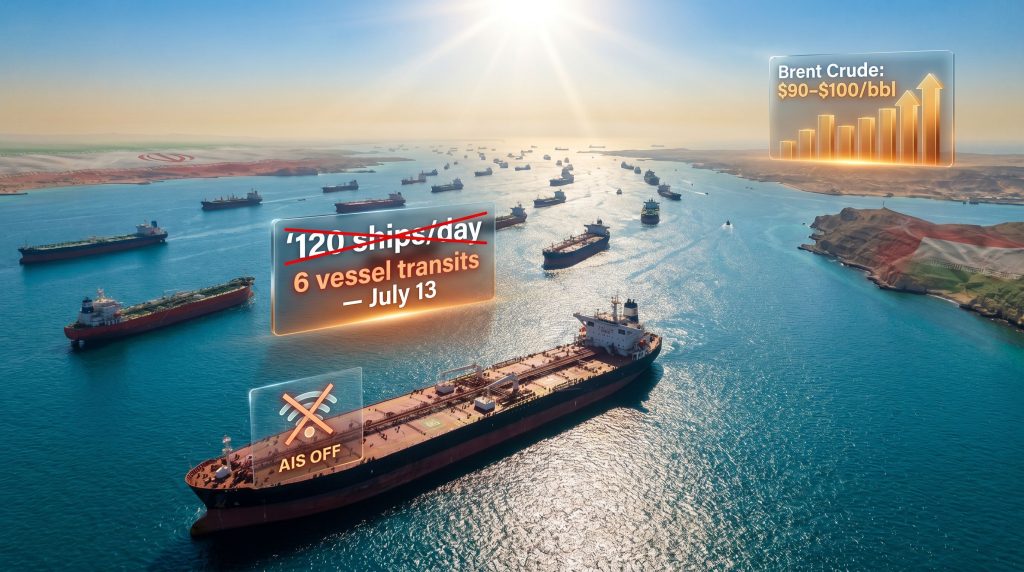
Ship-tracking data published by Kpler confirmed what market participants had feared. On July 13, 2026, only six vessel transits were recorded through the strait, the lowest daily figure in five weeks. To contextualise this figure: at a normal baseline of 120 transits per day, six vessels represent a reduction of approximately 95 percent from ordinary operating volumes.
The specific vessels that did move through the strait during this period illustrate the selective nature of the disruption:
| Vessel | Cargo | Cargo Volume | Destination |
|---|---|---|---|
| Humanity (VLCC) | Iranian crude oil | 2 million barrels | Departing Gulf |
| Capetan Andreas | Kuwaiti oil products | ~500,000 barrels | Departing Gulf |
| Three unnamed tankers | Empty (entering to load) | N/A | Entering Gulf |
| ADNOC-controlled tanker | Crude | Undisclosed | Dahej, India |
The pattern is telling. Vessels with state-actor connections, Iranian crude, or military adjacency continued to move. Commercially operated vessels outside these frameworks largely did not.
What Did Transponder Deactivation Mean in Practice?
A particularly significant operational detail emerged from the tracking data. The majority of tankers that did cross the strait deactivated their Automatic Identification System (AIS) transponders whilst in transit. AIS transponders are the foundational technology of maritime situational awareness, broadcasting a vessel's identity, position, speed, and destination to other ships, port authorities, and satellite tracking systems. Switching them off creates:
- Blind spots in real-time maritime tracking used by insurers and commodity traders
- Inability to verify cargo ownership or intended destination during transit
- Elevated risk of misidentification by military assets operating in an active conflict zone
- Significant complications for insurance underwriting, as coverage typically requires verifiable positional data
Perhaps most strikingly, no LNG tankers were visible in ship-tracking data entering the strait over the disruption weekend. For a fuel that must be kept at cryogenic temperatures and delivered on contracted schedules, this absence has cascading consequences for East Asian buyers dependent on Gulf LNG supply. According to Hormuz Strait Monitor, real-time vessel tracking confirmed the extraordinary scale of this withdrawal from normal transit activity.
The Escalation Sequence That Triggered the Strait of Hormuz Shipping Traffic Slowdown
The current disruption did not emerge from a single flashpoint. It developed through a compounding series of escalatory steps that each narrowed the operational window available to commercial shipping operators:
- Iran's Islamic Revolutionary Guard Corps announced a blockade of the strait, citing violations of approved transit routes by commercial vessels
- A vessel travelling on an unapproved route was struck, prompting Iran to formally declare the strait closed to commercial traffic
- US Central Command conducted multiple waves of precision strikes against Iranian targets across dozens of locations on a single Sunday
- Iran's naval forces stopped two vessels by remotely disabling their onboard systems, without publicly identifying the ships
- Iran's Revolutionary Guard struck US military installations in Jordan, Bahrain, and Kuwait, broadening the theatre of conflict beyond the strait itself
- Fresh attacks struck Iran's Qeshm Island, located within the Strait of Hormuz, further elevating navigational risk for any vessel in transit
Each step in this sequence added to the risk calculus facing commercial shipping operators. The cumulative effect was a near-complete withdrawal of risk-tolerant commercial traffic from the waterway.
An Iranian adviser publicly characterised control of the Strait of Hormuz as a more powerful strategic instrument than nuclear capability, framing maritime chokepoint leverage as Tehran's primary geopolitical tool. This doctrine treats economic coercion via energy infrastructure as superior to weapons-based deterrence in practical terms.
This posture reflects an asymmetric warfare logic that has evolved significantly over the past decade. Rather than relying on kinetic strikes that invite proportionate military responses, Iran's naval doctrine increasingly emphasises the ability to disable vessels remotely by shutting down their onboard systems. This approach achieves the objective of halting commercial traffic whilst minimising the legal and military exposure associated with direct weapons use. For a broader geopolitical oil price analysis, these dynamics sit at the centre of current market uncertainty.
The 2,300-Vessel Backlog: A Secondary Crisis With Its Own Momentum
Whilst the daily transit figures captured most of the media attention, a secondary crisis had been building quietly in the anchorage zones of the Persian Gulf and Gulf of Oman. As of mid-July 2026, approximately 2,300 vessels were waiting in these waters, unable or unwilling to attempt a strait transit.
| Category | Stranded Vessels |
|---|---|
| Total vessels (Gulf + Gulf of Oman) | ~2,300 |
| Cargo ships | 1,566 |
| Tankers (all types) | 705 |
| Fully loaded oil tankers awaiting transit | 255 |
| Oil tankers in Gulf of Oman specifically | 87 |
| Seafarers stranded aboard | ~11,000 |
The arithmetic of backlog clearance is sobering. Even at the partial recovery rate of 40 to 71 daily transits observed during the weekend following the peak disruption, clearing 2,300 vessels would require weeks to months of uninterrupted, conflict-free operations. Given the active military engagement in the region, that scenario remained highly uncertain.
What About the Human Cost?
The human dimension of this backlog has received comparatively little attention relative to the oil price movements it generated. Approximately 11,000 seafarers remained aboard vessels anchored in holding patterns across the Gulf and Gulf of Oman. A United Nations maritime agency announced a formal evacuation plan in response. These individuals face not only professional disruption but genuine safety exposure in an active conflict zone, raising questions under international maritime law about operator liability and state responsibility for crew welfare.
Competing Official Narratives: Who Controls the Definition of "Open"?
One of the analytically distinctive features of the current crisis is the simultaneous existence of two mutually contradictory official positions on the strait's operational status:
| Actor | Official Position | Operational Reality |
|---|---|---|
| US Government | Strait is open to commercial traffic | Only 6 vessels transited on peak disruption day |
| Iran (IRGC) | Strait declared closed after route violation | Naval forces actively stopping and disabling vessels |
| Commercial operators | Treating strait as effectively restricted | Widespread transponder deactivation and rerouting |
The US-Iran agreement to establish a communication line for safe passage, reached during diplomatic talks in Switzerland, represents a partial de-escalation mechanism. However, the practical meaning of "open" in an active conflict zone differs substantially from its peacetime definition:
- Vessels may technically transit, but do so at unquantified and uninsured risk
- No formal guarantee of protection exists for commercially operated vessels without state affiliation
- Insurance underwriters have applied war-risk surcharges that make many transits economically unviable regardless of physical safety
- The IRGC retains the demonstrated operational capability to stop vessels by disabling their systems at any point
For a Very Large Crude Carrier carrying 2 million barrels of crude oil, war-risk insurance premiums at elevated conflict-zone rates translate to millions of dollars in additional voyage cost. Many smaller operators and independent charterers cannot absorb this figure, effectively pricing them out of Gulf trade even when the strait is nominally accessible.
The next major ASX story will hit our subscribers first
Economic Transmission: How Maritime Disruption Reaches Global Prices
The relationship between Strait of Hormuz shipping traffic volume and global commodity prices is not indirect. It is direct, rapid, and measurable. Brent crude prices surged toward $90 to $100 per barrel in response to the disruption, reflecting not just the immediate supply reduction but the forward uncertainty about duration and escalation trajectory.
Gulf-to-Asia spot freight rates tripled as rerouting via the Cape of Good Hope became the default choice for operators unwilling to risk a Hormuz transit. This freight rate increase is itself inflationary across multiple supply chains:
- Energy sector: LNG supply disruption threatens contracted delivery schedules for Japan, South Korea, and China, which collectively represent the world's largest LNG import market and have limited spot market alternatives at short notice
- Refinery feedstocks: South and Southeast Asian refineries dependent on Gulf crude face feedstock shortages as tanker deliveries stall in the backlog
- Food and consumer goods: Higher freight and war-risk insurance costs feed through to import prices for food commodities and manufactured goods in energy-importing nations
- Just-in-time supply chains: The additional 14 sailing days required for Cape of Good Hope rerouting compresses inventory buffers that were already lean following post-pandemic supply chain restructuring
In addition, OPEC market influence becomes considerably more complex to exercise when physical transit infrastructure is compromised by conflict rather than production decisions. Furthermore, the compounding effects of oil prices and trade war tensions create additional headwinds for Asian economies already navigating elevated import costs.
If the backlog of 2,300 vessels remains uncleared beyond 30 days, the effective withdrawal of Gulf crude from accessible markets could generate a supply shock comparable in magnitude to significant OPEC production cut events, potentially exceeding several million barrels per day.
This represents a speculative projection based on current backlog data and partial transit rates. Actual outcomes will depend on the pace of de-escalation and the rate at which stranded vessels can be cleared.
Three Recovery Scenarios and What Each Means for Markets
The forward trajectory of the Strait of Hormuz shipping traffic slowdown depends on variables that are genuinely uncertain, including the pace of diplomatic progress, the IRGC's tactical decisions, and the willingness of commercial operators to resume transits as conditions evolve.
Scenario 1: Rapid De-escalation (Optimistic)
- Full ceasefire agreement within two to four weeks
- IRGC naval activity halts; AIS transponder deactivation ceases
- Backlog clears over six to eight weeks as daily transits return toward the 120-vessel baseline
- Oil prices retreat from peak levels but remain modestly elevated due to backlog-related supply lag
Scenario 2: Managed Tension (Base Case)
- Intermittent conflict continues with periodic transit disruptions
- Daily transits stabilise at 50 to 70 percent of pre-conflict levels, approximately 60 to 85 ships per day
- Backlog partially clears but a residual pool of 500 to 800 vessels persists for months
- Freight rates and oil prices remain structurally elevated for three to six months
Scenario 3: Prolonged Blockade (Stress Case)
- Escalation continues or expands to additional Gulf infrastructure targets
- Daily transits remain at 10 to 20 percent of normal levels for 60 or more days
- Global oil supply shock triggers emergency releases from International Energy Agency strategic petroleum reserves
- Permanent infrastructure investment in alternative export capacity accelerates significantly
According to research published by UNCTAD on Hormuz disruptions, the implications for global trade and development in even a moderate disruption scenario are substantial, affecting developing economies with limited import substitution capacity most acutely.
The Structural Lesson: Energy Geography Has Not Been Solved
The Strait of Hormuz shipping traffic slowdown of July 2026 is more than a geopolitical incident. It is a reminder that the global energy transition has not yet resolved the fundamental geographic vulnerability at the heart of fossil fuel supply chains. Despite decades of discussion about diversification, alternative pipelines, and reduced Gulf dependency, the world's largest energy consumers remain structurally exposed to disruptions in a 33-kilometre-wide corridor controlled by a country with demonstrated willingness to use it as leverage.
Several longer-term structural responses are likely to accelerate as a result of this disruption:
- Expanded investment in UAE overland pipeline capacity and alternative Gulf export infrastructure
- Faster LNG supply diversification toward US, Australian, and East African sources to reduce Gulf concentration risk
- Increased strategic petroleum reserve holdings among major Asian importing nations as insurance against future chokepoint events
- Renewed urgency around renewable energy deployment in Asian markets as the strategic cost of Gulf fossil fuel dependency becomes more visible in financial terms
The 2026 disruption has also surfaced a doctrine worth taking seriously in future energy security planning. When a state actor describes control of an energy chokepoint as more strategically valuable than nuclear weapons, it is providing an honest assessment of how asymmetric leverage works in the 21st century. The Strait of Hormuz is not merely a shipping lane. It is infrastructure with the capacity to reshape global economic conditions from a single geographic point. That is a vulnerability the energy system has not yet found a way to eliminate.
This article is intended for informational purposes only and does not constitute financial or investment advice. Scenario projections and price estimates involve inherent uncertainty and should not be relied upon as forecasts. Readers seeking ongoing coverage of Middle East energy developments may find Arab News' Energy and Middle East sections a useful resource at arabnews.com.
Want to Stay Ahead of the Commodity Opportunities Emerging From Global Energy Disruptions?
When geopolitical shocks like the Strait of Hormuz crisis send commodity markets into turbulence, the investors best positioned to act are those with real-time intelligence on emerging opportunities — Discovery Alert's proprietary Discovery IQ model scans ASX announcements daily, translating complex commodity signals across more than 30 resources into clear, actionable insights. Explore how historic mineral discoveries have generated significant returns on Discovery Alert's discoveries page, and begin your 14-day free trial to ensure you're positioned ahead of the market when the next major opportunity surfaces.