June 19, 2026
The Anatomy of a Chokepoint: Why a 33-Kilometre Waterway Controls the Global Economy
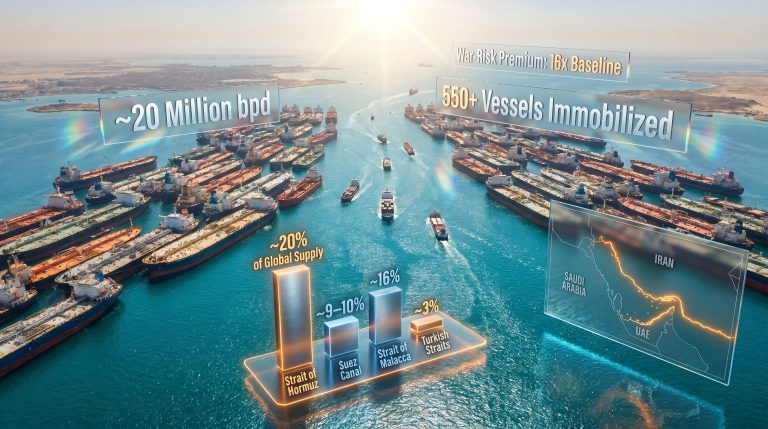
Every few decades, the global energy system is reminded of a structural vulnerability it cannot engineer its way out of quickly. The Strait of Hormuz is that vulnerability in its most concentrated form. Barely 33 kilometres wide at its navigable narrowing, this corridor between the Persian Gulf and the Gulf of Oman carries roughly 20% of all oil traded globally, alongside enormous volumes of liquefied natural gas, petrochemicals, and fertilizers originating from some of the world's most productive hydrocarbon basins.
Understanding why this waterway holds such disproportionate leverage requires thinking about geography, not just geopolitics. Saudi Arabia, Iraq, Kuwait, the UAE, Qatar, and Iran all depend on Hormuz as their primary or sole viable export gateway. There is no realistic short-term substitute for the transit volume the strait enables. When it closes, as it did following US and Israeli air strikes on Iran on February 28, the consequences cascade almost instantly: Asian fuel shortages, emergency government policy responses, and crude oil geopolitics that reverberate through every import-dependent economy on earth.
The diplomatic agreement signed between Washington and Tehran created the legal scaffolding for recovery. Whether that scaffolding can support the weight of physical, operational, and financial normalization is an entirely different question. Strait of Hormuz tanker traffic after the US-Iran deal is recovering, but the pace and permanence of that recovery are far from settled.
When big ASX news breaks, our subscribers know first
What the Memorandum of Understanding Actually Commits To
The framework agreement between the US and Iranian presidents established several specific conditions worth examining carefully, because the gap between what the text says and what it operationally delivers is significant.
Key provisions of the MOU include:
- A 60-day toll-free commercial transit window for vessels passing through the strait, pending further diplomatic negotiations
- A requirement for Iran to complete demining operations within 30 days of the agreement's signing
- Immediate resumption of commercial vessel movement, with the caveat that technical and military obstacles must first be resolved
- A simultaneous US sanctions waiver on Iranian oil exports, creating an economic incentive for Tehran to maintain compliance
The agreement's demining clause is where analysts have focused most of their scrutiny. No commencement date has been publicly confirmed, no designated responsible party has been named, and no international verification mechanism was included in the publicly available text. For shipping operators calculating risk, these omissions are not minor administrative details. They represent the difference between a theoretical reopening and a lane their vessels can actually traverse without unquantifiable physical danger.
The southern passage through the strait runs through Omani territorial waters, a geographic fact that limits Iran's practical ability to impose tolls on that specific corridor and may accelerate demining prioritization there. Maritime intelligence analysts have noted that once the Omani-administered southern route is cleared, the toll question becomes significantly less commercially relevant regardless of what Tehran proposes.
Strait of Hormuz Tanker Traffic After the US-Iran Deal: What the Data Actually Shows
The divergence between market optimism and verified vessel movement data tells the most analytically useful story of the reopening's early phase. Furthermore, live vessel tracker data from Reuters illustrates just how stark the contrast between diplomatic momentum and physical shipping activity can be.
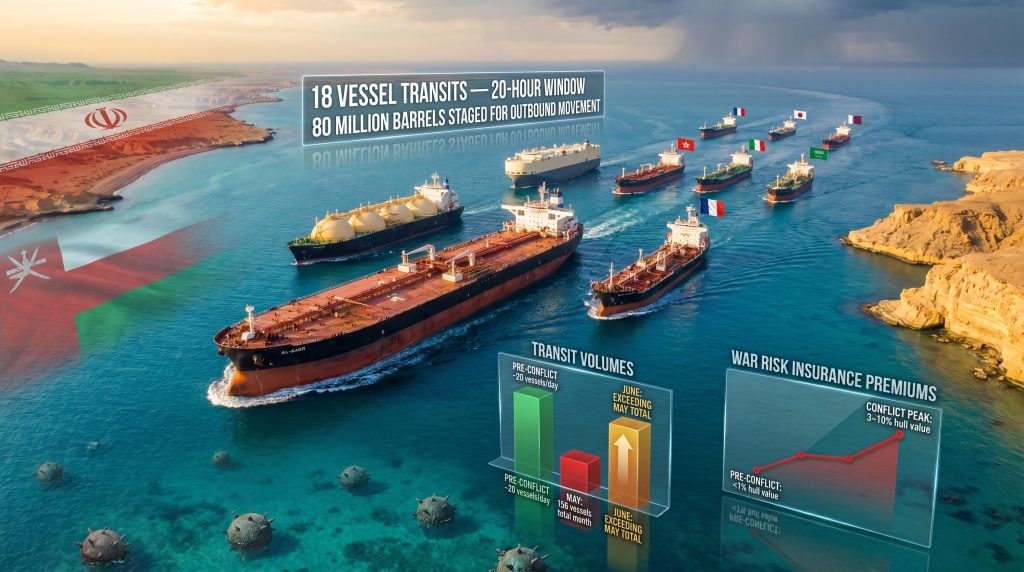
Maritime intelligence tracking recorded 18 vessel transits between 6 p.m. on June 17 and 2 p.m. UTC on June 18, according to Windward, a maritime intelligence company cited by RFE/RL. Those transits included a diverse mix of vessel types and national operators:
| Vessel Type | Flag or Control | Direction | Market Signal |
|---|---|---|---|
| LNG tanker | French-flagged | Outbound | First LNG movement post-deal |
| Oil tankers | Hong Kong-flagged | Outbound | Commercial crude restart signal |
| Vehicles carrier | Italian-flagged | Outbound | Non-energy cargo confidence |
| Oil tanker | Japanese-controlled | Outbound | Asian buyer re-engagement |
| Multiple tankers | Saudi-flagged | Outbound | Gulf producer export resumption |
| Supertankers (4+) | Various | Outbound | Heavy crude volume movement |
| LNG vessel | Qatar-linked | Outbound | Qatari LNG export restart |
| Fuel tanker | China-linked | Outbound | Chinese import demand signal |
Ten of the 18 vessels that moved in that initial window had been stranded inside the Persian Gulf for approximately 109 days, trapped since the conflict began in late February. Their movement represents the beginning of a release valve for what had become a massive inventory overhang.
Context for that release valve is striking. An estimated 80 million barrels of crude oil had accumulated in tankers staged near the strait awaiting safe transit conditions, with earlier reporting noting at least 60 million barrels specifically queued for delivery to Asian markets. The June transit total had already surpassed the 156 vessels tracked across the entirety of May by the time these early movements were recorded, though daily averages during the first two weeks of June had been running at only around seven vessels per day, a fraction of the roughly 20 vessels per day that transited under pre-conflict conditions. In addition, this oil tanker traffic resumption has been closely monitored by energy market participants worldwide.
Simultaneously, Iranian-controlled vessels were observed repositioning westward through the Malacca Strait from Southeast Asia, apparently moving to load cargo at Iranian ports following the lifting of the US naval blockade on Iranian waters.
Strait of Hormuz tanker traffic after the US-Iran deal is best understood not as a reopening, but as a cautious probe. The vessels that moved first represent operators with high risk tolerance and strong commercial incentive, not a representative sample of the broader shipping industry.
The Four Variables That Determine Whether Recovery Is Real
Analysts tracking the strait's operational status have converged on four distinct variables that each need to resolve before traffic can approach pre-conflict throughput levels. Progress on one does not automatically accelerate progress on the others.
1. Demining: The Physical Prerequisite
Sea mines represent the most fundamental barrier to normalisation because no insurance product or diplomatic assurance can substitute for a physically clear waterway. The MOU requires Iran to conduct demining operations within 30 days, but the absence of implementation specifics creates a gap that operators cannot bridge through risk appetite alone.
The Omani territorial waters dimension adds a layer of strategic complexity. Because the navigable southern corridor passes through Omani jurisdiction, Iran's leverage over that specific route is constrained regardless of what it can threaten in Iranian-administered waters. This geographic reality could either accelerate Omani-led demining coordination or create jurisdictional ambiguity that delays it.
2. War Risk Insurance: The Financial Gatekeeper
Before the conflict, war risk insurance premiums for vessels transiting listed high-risk zones represented less than 1% of hull value. During the conflict, those premiums escalated to a range of 3% to 5% of hull value, with spikes reaching as high as 10% for specific vessel categories and high-risk windows.
Several characteristics of insurance normalisation make it structurally slower than physical security improvements:
- Premiums are recalculated on a daily basis, meaning cost volatility persists even as the security environment improves
- Underwriters require sustained, verified safe transit data before revising assessments downward, typically measured in weeks to months of incident-free movement
- A single hostile incident, even a minor drone harassment event, can reset the entire premium recalculation process
- Insurance normalisation consistently lags physical security improvements because risk models are backward-looking by design
3. Crew Safety and Operator Confidence: The Human Factor
Ben Cahill, a nonresident senior fellow at the Atlantic Council's Global Energy Center, has observed that financial cost was ultimately secondary to the physical safety question for vessel operators during the conflict period. Shipping companies were not primarily deterred by insurance premiums. They were deterred by the prospect of their crews being killed, captured, or trapped in a war zone.
The critical behavioural question is whether Iranian naval and paramilitary forces will continue to harass commercial vessels, deploy drones, or interfere with transit operations once the deal's 60-day window creates pressure to comply. Historical precedent from the Tanker War of the 1980s suggests that harassment behaviour can persist well beyond formal ceasefire arrangements, particularly when enforcement mechanisms are ambiguous.
Once genuine crew safety confidence develops, analysts expect traffic recovery to accelerate rapidly, because the underlying commercial demand from Asian importers for Gulf hydrocarbons is structurally strong and has been suppressed, not destroyed, by the conflict.
4. Toll Architecture: The Post-60-Day Uncertainty
Iran has signalled interest in imposing maritime service fees in cooperation with Oman for vessels transiting the strait. The 60-day toll-free window in the MOU provides temporary resolution, but the post-60-day framework remains entirely undefined. Maritime intelligence analysts have expressed scepticism that a permanent toll regime would prove commercially viable or diplomatically sustainable, particularly given the southern route's passage through Omani jurisdiction. The commercial logic of a toll regime also runs counter to Iran's own interest in maximising oil export revenue, since fees that deter transit reduce the volume of Iranian oil reaching global markets.
How Gulf Producers and Asian Importers Are Recalibrating
The Bypass Infrastructure Acceleration
Both Saudi Arabia and the UAE significantly expanded bypass pipeline utilisation during the conflict, routing crude to Red Sea and Gulf of Oman terminals respectively to circumvent the strait entirely. However, the oil market disruption caused by the closure has accelerated long-term infrastructure planning well beyond what was considered necessary before the conflict began:
- Saudi Arabia increased throughput on its East-West Pipeline, directing crude to the Yanbu terminal on the Red Sea
- The UAE relied on its pipeline connecting Gulf production to the Fujairah terminal on the Gulf of Oman
- Both routes were targeted by Iranian forces during the conflict, though neither proved as vulnerable as the strait itself
- Qatar was actively preparing an LNG export comeback ahead of the reopening, having been among the most severely constrained producers during the closure
Goldman Sachs has issued analysis suggesting that Hormuz's share of global oil transit may never fully return to pre-conflict levels, citing accelerating bypass infrastructure investment and buyer-side supply chain diversification as structural forces that will persist regardless of the diplomatic outcome. This represents a significant long-term reassessment of the strait's role in global energy architecture.
The Asian Importer Response
India's position is particularly instructive for understanding how import-dependent nations are recalibrating. Despite receiving its first post-deal LNG cargo through the strait, India has signalled it is not rushing to restore pre-war procurement volumes from Middle Eastern suppliers. The country's energy import bill surged by approximately 82% during the high-price period driven by the conflict, according to OilPrice.com reporting, a fiscal shock large enough to accelerate strategic diversification planning at the highest government levels.
India has simultaneously ordered a major expansion of its strategic petroleum reserves, a direct policy response to the supply disruption vulnerability the conflict exposed. This reserve expansion decision reflects a structural shift in how Indian energy planners assess concentration risk, not a temporary procurement adjustment.
What Crude Markets Are Pricing and What They Are Missing
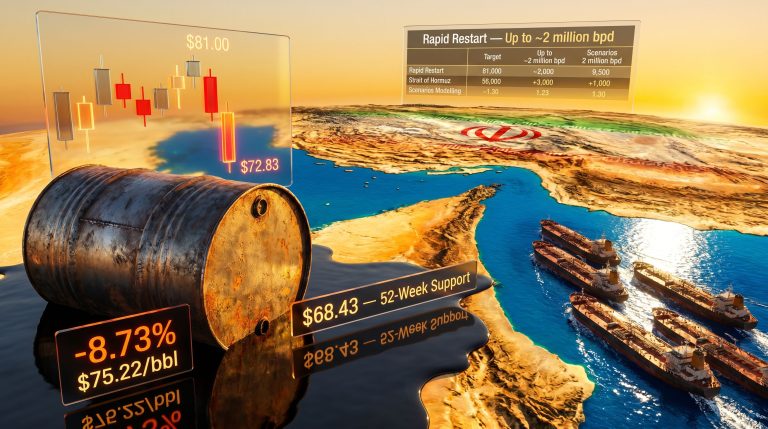
Oil prices initially fell sharply following the ceasefire agreement as traders priced in the anticipated return of Gulf supply. The subsequent rebound, triggered when US-Iran peace talks showed signs of strain, illustrates a pattern that is likely to persist through the 30 to 60-day implementation window: crude markets are trading Hormuz news flow rather than verified throughput data. Consequently, the oil price shock experienced earlier in 2025 continues to shape how analysts and executives interpret every new data point from the region.
Several market dynamics are worth understanding precisely:
- US crude oil inventories declined by approximately 52 million barrels over a nine-week period during the conflict, according to OilPrice.com, a drawdown that requires sustained supply normalisation to reverse
- The ECB has noted that the Iran peace deal will not erase the energy price shock already absorbed by European economies, even if the strait fully reopens
- Falling Murban and Dubai crude benchmark prices have begun opening arbitrage opportunities for buyers in the US and Europe, a pricing signal that some market normalisation is occurring even before physical flows fully normalise
- High tanker charter rates remain an independent constraint on Persian Gulf oil shipments to Asia, compounding the supply chain disruption beyond the strait's physical status
The IEA has projected a substantial oil surplus by 2027 as Middle Eastern supply gradually returns to global markets, but this projection carries an assumption of sustained reopening that current traffic data does not yet confirm. Furthermore, the LNG supply outlook for the remainder of 2025 remains contingent on how quickly Qatari and other Gulf exporters can restore consistent transit volumes.
Three Recovery Scenarios
| Scenario | Timeline | Key Conditions Required | Oil Market Implication |
|---|---|---|---|
| Rapid Full Recovery | 30 to 60 days | Demining certified, insurance normalises, no incidents | Significant downward pressure on crude prices |
| Gradual Partial Recovery | 3 to 6 months | Selective transit resumes, premiums remain elevated | Moderate price relief with persistent uncertainty |
| Structural Stagnation | 6 to 18+ months | Demining delays, new incidents, unresolved toll disputes | Sustained elevated prices, accelerated bypass investment |
The next major ASX story will hit our subscribers first
The Structural Shift Argument: Is Hormuz's Role Permanently Diminished?
The conflict has exposed something that energy security analysts have long understood intellectually but that markets had never priced fully: Iran possesses the ability to switch off a disproportionate share of global trade flows through a single geographic action. The strategic leverage this represents has shifted how energy-importing nations approach supply chain concentration risk in ways that will outlast the current diplomatic settlement.
Ben Cahill of the Atlantic Council has argued that one of the lasting lessons of the episode is the danger of excessive dependence on a single chokepoint, and that buyers in importing countries will reassess supply risk and transit risk through the Middle East in significant ways for years to come. This perspective aligns with Goldman Sachs's structural analysis and with the observable behaviour of India, the world's third-largest oil importer, which is diversifying away from Middle Eastern concentration even as the strait reopens.
The counterargument is equally grounded in economic reality. Bypass infrastructure, while expanded, cannot fully substitute for Hormuz capacity at current investment levels. Gulf producers lose export revenue for every day the strait remains constrained. Iran forfeits the economic normalisation it negotiated the deal to achieve. The economic gravity favouring full reopening is enormous. However, the question is whether the diplomatic and operational mechanisms are strong enough to overcome the physical and insurance-related barriers within the deal's 60-day framework window.
Indeed, the emerging multi-polar world economy means that the geopolitical calculus around Hormuz is no longer governed solely by US-Iran bilateral dynamics, but by a far more complex web of competing interests from Asian importers, European energy buyers, and Gulf producers alike.
Strait of Hormuz tanker traffic after the US-Iran deal is at an inflection point where the distance between a functioning agreement and a functioning shipping lane will be measured not in diplomatic language, but in verified vessel transits, cleared sea lanes, and declining insurance premiums over the weeks ahead.
This article is intended for informational purposes only and does not constitute financial, investment, or trading advice. Forecasts, scenarios, and analyst projections referenced herein involve inherent uncertainty and should not be relied upon as predictions of future outcomes. Readers are encouraged to consult independent financial and energy market advisors before making investment decisions.
Want to Stay Ahead of the Next Major Resource Discovery Triggered by Global Supply Shocks?
Energy market disruptions like the Strait of Hormuz closure consistently ripple through commodity prices and mineral exploration sectors, creating time-sensitive investment opportunities that reward those who act first. Discovery Alert's proprietary Discovery IQ model delivers real-time ASX mineral discovery alerts, transforming complex market data into actionable insights — start your 14-day free trial today, or explore historic discovery returns to understand just how significant these opportunities can be.