July 14, 2026
The Strait of Hormuz Has Become the World's Most Contested Toll Road
Global energy markets have long understood that geography is destiny. The world's most critical oil and gas flows do not travel through vast open oceans where disruption is unlikely, but through narrow, politically volatile chokepoints where a single policy shift, a naval standoff, or an unexpected announcement can instantly reprice billions of dollars in commodity exposure. No waterway illustrates this vulnerability more acutely than the Strait of Hormuz, and no recent development has tested that vulnerability more directly than the Trump 20 per cent charge on Strait of Hormuz cargo, declared effective immediately following a July 13, 2026 announcement.
This is not simply a story about shipping costs. It is a collision between unilateral executive power, established international maritime law, and the structural energy dependencies of major importing economies. Understanding what is actually proposed, what the law says, who has the authority to enforce anything, and what happens to global energy prices in each scenario requires moving well beyond the headlines.
When big ASX news breaks, our subscribers know first
What the Proposed 20 Per Cent Charge Actually Involves
The policy as announced frames the United States as the operational and legal guardian of the Strait of Hormuz, with the 20 per cent charge positioned as a security reimbursement fee for providing safe commercial passage. The charge is described as applying to all cargo categories transiting the strait, not merely crude oil. LNG carriers, chemical tankers, and general freight vessels would all theoretically fall within its scope.
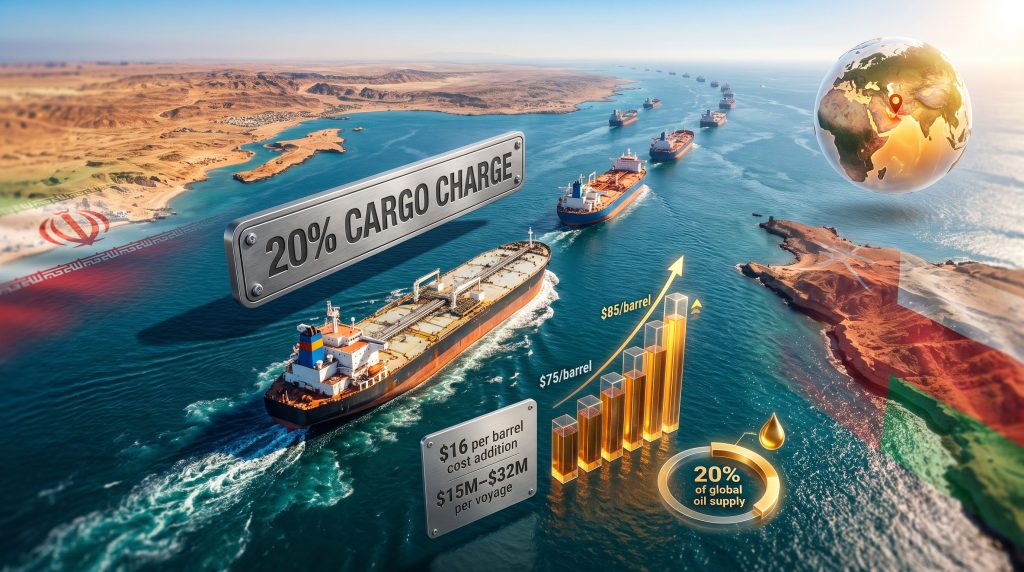
The financial arithmetic is striking. A fully loaded Very Large Crude Carrier (VLCC) typically carries approximately 2 million barrels of crude oil. At a price of roughly $80 per barrel, the cargo value alone reaches $160 million. Applying a 20 per cent ad valorem charge to that single voyage would generate a fee of between $15 million and $32 million, depending on prevailing oil prices and the precise calculation basis used by analysts.
To put that in context, the typical freight cost for a VLCC voyage from the Persian Gulf to Asia has historically ranged from $2 million to $5 million under normal market conditions. The proposed toll would dwarf the actual transport cost of the cargo, representing an entirely new category of maritime levy with no precedent in modern global trade. Furthermore, Brent and WTI futures moved sharply in response to the announcement, reflecting the immediate market sensitivity to this kind of structural disruption.
Key structural note: No enforcement mechanism was disclosed alongside the July 13 announcement. It remains unclear whether the fee would be assessed against the vessel operator, the cargo owner, the charterer, or the importing nation's government. This ambiguity is not a minor administrative detail. It fundamentally determines whether the charge is commercially implementable or legally enforceable.
International Maritime Law and the IMO's Unambiguous Position
What UNCLOS Establishes About Transit Passage
The United Nations Convention on the Law of the Sea (UNCLOS) provides the governing legal framework for international maritime navigation. Article 37 of UNCLOS is explicit: all ships and aircraft hold an unconditional right of transit passage through straits used for international navigation. No coastal state, bordering nation, or third-party power holds authority to suspend, restrict, or monetise that passage.
The Strait of Hormuz qualifies under the stronger transit passage doctrine rather than the more limited innocent passage right. This distinction matters. Innocent passage can be suspended under certain circumstances by coastal states; transit passage through internationally used straits cannot. The Strait of Hormuz, running between Iranian and Omani territorial waters, is unambiguously governed by the transit passage framework.
Crucially, UNCLOS prohibits mandatory tolls on straits used for international navigation. This is not a grey area subject to creative legal interpretation. The prohibition is explicit.
The IMO's Institutional Response
The International Maritime Organisation moved quickly to clarify its position following the Trump announcement. The IMO's stance is that there is no legal foundation under which mandatory fees can be introduced for passage through an international strait, regardless of which nation attempts to impose them. This position was reiterated at the IMO Council's 137th Session, which issued a resolution reaffirming that navigational rights under international law must not be blocked, restricted, or suspended, and that passage through the Strait of Hormuz must remain free of tolls and charges in accordance with international law, including the IMO Convention.
The IMO indicated it would withhold further detailed comment pending the release of additional information on the proposed enforcement mechanism, but its substantive legal position requires no qualification. The charge, if implemented, would represent a direct violation of established international maritime law. For broader context on how geopolitical trade tensions are reshaping international norms, this episode fits a wider pattern of states testing the limits of multilateral frameworks.
The US Policy Contradiction That Cannot Be Ignored
Perhaps the most analytically significant dimension of this episode is the internal contradiction within US foreign policy itself. The timeline is instructive. As noted in reporting on Trump's Hormuz announcement, the proposal caught many observers off guard given prior US commitments.
| Policy Actor | Position | Date |
|---|---|---|
| President Donald Trump | 20% cargo charge effective immediately | July 13, 2026 |
| Secretary of State Marco Rubio | International law prohibits tolls on international waterways | Prior statement |
| Trump (earlier position) | No tolls during 60-day ceasefire period | June 20, 2026 |
| Iran Foreign Minister Abbas Araghchi | Iran is the rightful guardian; 20% is excessive but Iran will be fair | July 14, 2026 |
Secretary of State Marco Rubio had previously acknowledged the legal constraint that prohibits transit tolls under international law. Trump himself committed, as recently as June 20, 2026, to imposing no toll charges during the 60-day ceasefire period and none thereafter unless a deal failed. The July 13 announcement directly contradicts both positions. For global shipping markets, this degree of policy inconsistency within a single administration is itself a risk factor. When the executive branch reverses its own commitments within weeks, the credibility of any enforcement mechanism, or any subsequent withdrawal, is structurally compromised.
Iran's Counter-Claim and the Jurisdictional Paradox
Iran's response revealed a geopolitical dynamic that deserves careful analysis. Rather than rejecting the concept of a toll outright, Iran's Foreign Minister Abbas Araghchi asserted that Iran, as the waterway's legitimate coastal-state guardian under UNCLOS, holds the authority that the US claims to be exercising. His public commentary implied that while 20 per cent is excessive, Iran might consider applying its own fair charge. This is a significant signal. Tehran's objection is to American jurisdiction over the strait, not necessarily to the concept of extracting revenue from transit.
Prior to the current escalation, reporting had indicated that Iran may have been levying informal per-vessel fees of approximately $2 million on ships transiting the strait, an amount substantially below the proposed US toll but consistent with the general principle that Iran views the waterway as a resource to be managed, not merely a neutral corridor.
Iran's geographic position reinforces its claim. The Strait of Hormuz sits between Iranian and Omani territorial waters. Under UNCLOS, Iran holds legitimate coastal-state rights, even if those rights do not extend to blocking or monetising transit passage. The trade war impact on oil markets adds yet another layer of complexity to how these overlapping jurisdictional disputes are being interpreted by energy traders.
Why the Strait of Hormuz Cannot Simply Be Bypassed
The Geometry of Energy Trade
Approximately 20 per cent of global oil supply and a significant proportion of global LNG exports transit the Strait of Hormuz each year. The waterway connects the Persian Gulf to the Arabian Sea and represents the only viable maritime exit for the world's most concentrated cluster of hydrocarbon producers.
The major Gulf exporters dependent on Hormuz transit include:
- Saudi Arabia, the world's largest oil exporter by volume
- Iraq, whose export terminals are entirely Gulf-facing
- The UAE, whose Habshan-Fujairah pipeline partially bypasses Hormuz but cannot absorb full export volume
- Kuwait, with no overland or alternative maritime export route
- Qatar, which holds no viable non-Hormuz LNG export pathway whatsoever
The navigable width of the strait is approximately 33 kilometres at its narrowest functional point, with two-lane traffic separation schemes of roughly 3 kilometres in each direction. This physical constriction makes the waterway inherently vulnerable to both deliberate disruption and the cost externalities of elevated risk premiums.
Alternative Routes: The Hard Reality
| Alternative Route | Feasibility | Key Limitations |
|---|---|---|
| Saudi Arabia East-West Pipeline | Limited partial substitute | Insufficient capacity to replace total Hormuz volume |
| Suez Canal rerouting | Indirect and costly | Requires different loading terminals; longer voyage times |
| Cape of Good Hope bypass | Extremely expensive | Adds two to three weeks to voyage time; cost-prohibitive |
| No viable alternative | Qatar LNG, Kuwait crude | No pipeline or overland substitute exists |
The practical conclusion is that no combination of alternative routes can fully substitute for Hormuz capacity. Any toll regime, whether US-imposed or Iranian-administered, would embed itself into the structural cost base of global energy trade.
India's Energy Security Exposure: A Multi-Dimensional Risk
The Import Dependency Structure
India's exposure to Hormuz disruption is among the highest of any major economy, and it operates across multiple simultaneous channels.
| Energy Import Category | Dependency Level | Hormuz Exposure |
|---|---|---|
| Total crude oil imports | More than 85% of domestic requirements | High, majority sourced from Gulf producers |
| LNG imports from West Asia | Approximately 80% of total LNG purchases | Around 60% transits Strait of Hormuz |
| Gulf crude as share of total oil imports | Dominant supplier bloc | Direct Hormuz transit dependency |
A toll-driven increase in shipping costs does not arrive in isolation. It compounds existing oil price volatility, meaning both input price variables move in the same direction simultaneously. For India's oil marketing companies (OMCs), which had already implemented retail fuel price increases in tranches through May 2026, a sustained move above $85 to $90 per barrel presents both margin compression and politically sensitive retail pricing decisions.
The Inflation and Currency Feedback Loop
India's June 2026 retail inflation reached 4.38 per cent, breaching the Reserve Bank of India's medium-term 4 per cent target for the first time in 17 months. Economists at ICICI Bank noted that oil prices had begun rising again, introducing fresh uncertainty into both the inflation trajectory and the broader growth outlook.
The transmission mechanism from a Hormuz toll to Indian consumer prices runs through several stages:
- Higher freight costs increase the landed cost of crude oil for Indian refiners
- Refinery input cost increases flow through to petrol, diesel, LPG, and aviation turbine fuel pricing
- Elevated fuel costs increase input costs across fertiliser manufacturing, petrochemicals, and industrial sectors
- Broader cost-push inflation compounds existing food and services price pressures
- A widening current account deficit from higher oil import bills weakens the rupee
- A weaker rupee increases the effective cost of all dollar-denominated commodity imports, amplifying the original price increase
The Indian rupee breached 96 per US dollar on July 14, 2026, reflecting the geopolitical risk premium being priced into emerging market currency positions. This compounding feedback between oil prices and currency depreciation is one of the less-discussed but analytically critical dimensions of India's Hormuz exposure.
Brent Crude Price Dynamics
Brent crude had retreated to approximately $75 per barrel in the period preceding the renewed Hormuz tensions, consistent with earlier surplus forecasts from major energy agencies. The July 13 announcement reversed that trajectory. Brent crude futures surged to a one-month high of near $85 per barrel in immediate response.
Andy Lipow, president of Lipow Oil Associates, stated in commentary to CNBC's Squawk Box Asia that if the proposed charge is applied to crude oil shipments, it could add approximately $16 per barrel to the cost of oil transiting the strait. He further noted that the US administration had not provided any operational detail on how the charge would function in practice. Analysts at Citi separately warned that any attempt to enforce the toll could materially increase the near-term probability of broader military conflict, a scenario with oil price implications extending well beyond the $16 per barrel toll estimate. For a fuller picture, the oil and geopolitics analysis from earlier in 2025 provides useful historical framing for how these dynamics have evolved.
The next major ASX story will hit our subscribers first
The Cost Pass-Through Chain and What It Means for Global Trade
The economic transmission of a Hormuz toll through global supply chains follows a predictable sequence, though the speed and magnitude at each stage depend heavily on enforcement credibility and duration.
- Shipping operators assess whether to absorb the toll within existing margins or pass it to cargo owners via freight rate adjustments
- Cargo owners, including refiners, trading houses, and national oil companies, factor the additional cost into procurement pricing and contract negotiations
- Refiners adjust product crack spreads to recover margin, increasing wholesale fuel prices
- Distributors and retailers reflect refined product cost increases in consumer pricing
- Energy-intensive industries face structural input cost inflation across chemicals, fertilisers, plastics, and manufacturing
- Consumers absorb the final cost through higher fuel prices, utility bills, and goods inflation
War risk insurance premiums would amplify this chain significantly. Premiums on Hormuz-transiting vessels spike immediately when enforcement risk rises, meaning the effective cost increase to shipping operators would exceed the stated 20 per cent toll. The Baltic Dirty Tanker Index, which tracks freight rates for crude oil tankers, would reflect the combined toll, insurance, and rerouting cost premium across the market.
Frequently Asked Questions on the Trump Hormuz Toll Proposal
Is the US Legally Permitted to Impose a 20 Per Cent Charge on Strait of Hormuz Cargo?
Under UNCLOS Article 37 and the IMO's established institutional position, no nation holds legal authority to impose mandatory transit fees on internationally used straits. The IMO has explicitly stated there is no legal basis for such a toll. Notably, senior figures within the US government had previously acknowledged this legal constraint, making the July 13 announcement a direct contradiction of both established international law and prior US policy statements.
How Much Would the Charge Add to an Oil Shipment's Cost?
Analyst estimates suggest the 20 per cent charge could add approximately $16 per barrel to crude oil transiting the strait. For a fully loaded VLCC carrying 2 million barrels, this translates to a single-voyage cost increase of between $15 million and $32 million, depending on prevailing oil prices and the calculation methodology applied.
What Is Iran's Position?
Iran rejected US jurisdictional authority over the strait while simultaneously implying it may consider its own fair toll, suggesting Tehran's objection is to American control rather than the concept of fee collection itself. Iran asserts its status as the waterway's legitimate guardian under international law given its coastal-state position under UNCLOS.
What This Episode Signals Beyond the Immediate Toll
The Trump 20 per cent charge on Strait of Hormuz cargo, regardless of its ultimate legal viability or practical implementation, marks a meaningful shift in how major powers are willing to treat critical maritime infrastructure. If the precedent of unilateral toll imposition at an internationally recognised transit strait is established, even in contested form, it creates a template that other nations could reference in relation to their own strategic chokepoints, including the Turkish Straits, the Strait of Malacca, and the Bab-el-Mandeb.
The escalation-ceasefire-re-escalation pattern that has characterised US-Iran relations throughout 2026 also introduces a structural uncertainty premium into energy market pricing that is difficult to model. Markets can price a specific risk; they struggle to price policy unpredictability itself. For energy importers, OMCs, and sovereign fiscal planners across Asia, the practical takeaway is that scenario planning must now incorporate sustained Hormuz freight cost increases, oil price volatility above $85 per barrel, and currency pressure as concurrent rather than sequential risks.
Disclaimer: This article contains forward-looking analysis, market projections, and scenario assessments based on publicly available information as of the date of writing. Nothing in this article constitutes financial, investment, or policy advice. Oil price forecasts and cost estimates are sourced from third-party analyst commentary and are subject to significant uncertainty. Readers should conduct independent research before making any investment or commercial decisions.
Want to Stay Ahead of ASX Resource Stocks Caught Up in Global Energy Volatility?
Geopolitical disruptions like the Hormuz toll uncertainty can trigger rapid repricing across ASX-listed energy and resources stocks — and Discovery Alert's proprietary Discovery IQ model scans ASX announcements in real time, delivering instant alerts on significant mineral discoveries so subscribers can identify actionable opportunities before the broader market reacts. Begin your 14-day free trial at Discovery Alert today and position yourself ahead of the next major market-moving event.