June 8, 2026
When Shipping Lanes Become Battlegrounds: The Hormuz Fee Debate Explained
Global energy markets have always operated under the assumption that the world's most critical maritime corridors remain open, neutral, and free to navigate. That assumption is now being fundamentally tested. The emergence of Strait of Hormuz transit fees as a potential permanent fixture of global energy trade represents one of the most significant structural challenges to the post-war international maritime order in decades. Understanding what these fees are, who pays them, and what they mean for the price of energy worldwide requires unpacking layers of geopolitics, maritime law, and commercial shipping economics that rarely surface in mainstream energy coverage.
When big ASX news breaks, our subscribers know first
The World's Most Consequential Waterway
Measuring just 21 nautical miles at its narrowest point, the Strait of Hormuz connects the Persian Gulf to the Gulf of Oman and, ultimately, the broader Arabian Sea. Its physical dimensions are modest. Its strategic significance is anything but.
Before the West Asia conflict disrupted normal operations in early 2026, the strait handled roughly one-fifth of the entire world's oil supply, processing an estimated 17 to 20 million barrels per day. For context, that single passage carried more crude oil daily than the combined production of the United States and Canada at peak output levels. Furthermore, the corridor's role in global LNG supply added another dimension of criticality, handling approximately 25% of global LNG trade, a volume dominated by Qatari exports bound for Asian and European markets.
The shipping lane itself is technically bifurcated under an International Maritime Organization traffic separation scheme, with inbound and outbound lanes each spanning roughly 2 nautical miles. Channel depths range between 100 and 300 feet, accommodating the largest crude-carrying vessels in commercial service. Despite its enormous throughput, the navigable corridor leaves virtually no room for error and even less room for political dispute.
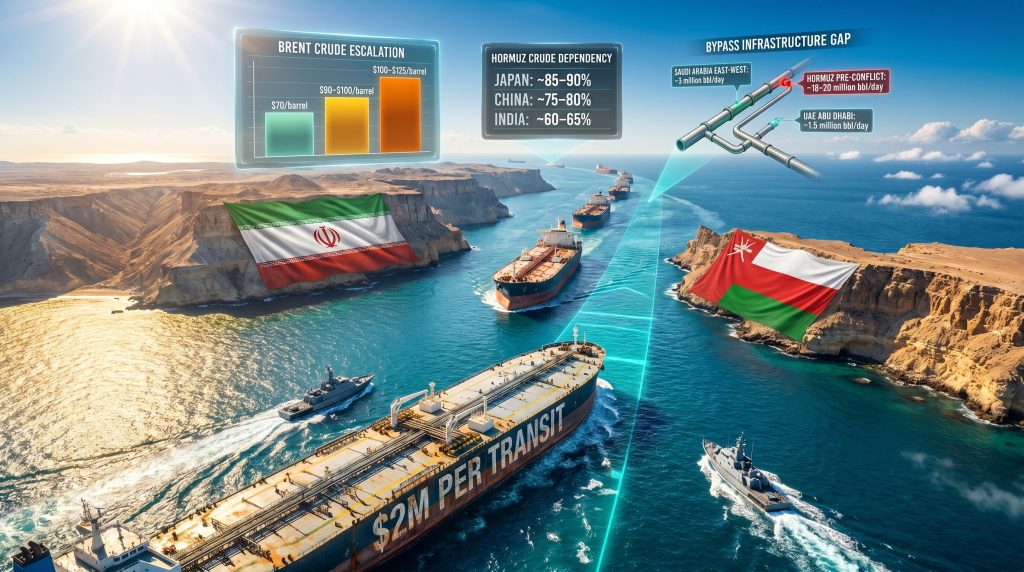
Crucially, no viable large-scale alternative exists for Gulf energy exporters. Saudi Arabia's East-West Pipeline and the UAE's Abu Dhabi Crude Oil Pipeline collectively bypass the strait but handle a combined maximum of roughly 6.5 million barrels per day, less than one-third of historical strait throughput. When the strait is compromised, the global energy system has no equivalent backup.
How the West Asia Conflict Rewrote the Rules of Transit
From Open Corridor to Constrained Passage
The conflict that began on February 28, 2026, following US-Israeli joint strikes on Iran, fundamentally altered the operational character of the strait. What had been a busy but commercially routine waterway transformed almost immediately into a contested, monitored corridor where vessel movements became subject to approvals and conditions not previously required.
The Islamic Revolutionary Guard Corps assumed a more active role in controlling vessel movement through the northern passage, introducing procedural layers that effectively slowed throughput and created significant uncertainty for tanker operators and their charterers. While some vessels have departed the Gulf region since hostilities began, the flow of oil and LNG through the corridor has remained severely disrupted more than 100 days into the crisis.
The Oil Price Shock in Numbers
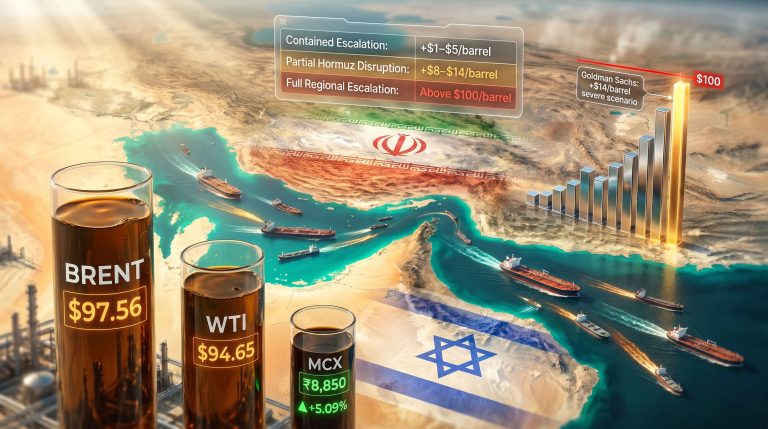
The market response was immediate and severe. The following table illustrates how crude benchmark pricing evolved across the conflict timeline:
| Market Phase | Brent Crude Price Range | Conditions on the Ground |
|---|---|---|
| Pre-conflict (early 2026) | ~$70/barrel | Open passage, normal throughput |
| Peak escalation | $100–$125/barrel | Active strikes, severe disruption |
| Partial de-escalation | $90–$100/barrel | Constrained reopening signals |
The price trajectory reflects two distinct drivers. The first is the physical supply disruption itself, which removed a meaningful portion of global crude availability from the market. The second is the speculative and psychological premium embedded in futures pricing, as traders attempted to price in escalation scenarios including full strait closure, Iranian mining operations, and attacks on Gulf export terminals.
This psychological premium is often underappreciated in mainstream analysis. The broader oil price shock of 2026 follows patterns seen in the 1980s Tanker War, where markets priced fear more aggressively than actual supply loss, with oil prices spiking 60% during the Iran-Iraq conflict even as total global supply disruption remained partial.
Understanding Strait of Hormuz Transit Fees: Structure and Mechanics
What Iran Is Actually Proposing
Iran's position, as articulated by its ambassador to Russia Kazem Jalali in an interview published by Russian newspaper Izvestia on June 8, 2026, is that the Strait of Hormuz will reopen but under conditions jointly determined by Iranian and Omani authorities. Central to these conditions is the introduction of fees for services associated with strait passage.
Iran's stated framework characterises these charges not as transit tolls but as payment for services rendered, a distinction with significant legal implications discussed further below. According to recent reports, the fee variables reportedly include:
- Vessel type and size classification
- Cargo category (crude oil, refined products, LNG, chemical tankers)
- Diplomatic status of the vessel's flag state
- Prevailing geopolitical conditions at the time of transit
Individual vessels have reportedly been charged up to $2 million per transit under the emerging clearance system. Operational implementation appears to involve clearance codes, documentation verification, and IRGC escort corridor assignments, suggesting a structured bureaucratic process rather than an ad hoc shakedown.
Comparing Global Toll Waterways
To contextualise what a formal Hormuz fee regime would mean commercially, it is useful to compare it against established international canal fee structures:
| Waterway | Operator | Fee Basis | Typical VLCC Fee | Legal Framework |
|---|---|---|---|---|
| Suez Canal | Egyptian Government | Vessel tonnage + cargo | $1M–$3M per transit | Bilateral treaties + UNCLOS |
| Panama Canal | Panama Canal Authority | Panama Canal Universal Measurement | $400K–$800K per transit | 1977 Carter-Torrijos Treaty |
| Strait of Hormuz (proposed) | Iran/Oman (proposed) | Vessel type + cargo + conditions | Up to $2M per transit | Contested under UNCLOS |
The critical difference is that both the Suez and Panama canals are artificial waterways built and maintained by sovereign states that possess clear legal authority to charge user fees. The Strait of Hormuz is a natural international strait, a distinction that sits at the heart of the legal controversy.
Is Iran Legally Entitled to Levy Strait of Hormuz Transit Fees?
The UNCLOS Framework and Transit Passage Rights
The United Nations Convention on the Law of the Sea, which entered into force in 1994, establishes a specific legal doctrine of transit passage for international straits under Articles 37 through 44. Under this framework, vessels of all states enjoy the right of continuous and expeditious transit through international straits used for international navigation. Coastal states bordering such straits are explicitly prohibited from imposing requirements that have the practical effect of denying, hampering, or impairing this right.
Critically, UNCLOS prohibits coastal states from levying financial charges on foreign vessels exercising transit passage rights through international straits, distinguishing this corridor type from territorial waters where broader coastal state jurisdiction applies.
"The Strait of Hormuz qualifies unambiguously as an international strait under UNCLOS, connecting two parts of the high seas and used by international shipping as a primary navigation route. This classification triggers the transit passage provisions and, by extension, the prohibition on tolls."
Iran has not ratified UNCLOS, which complicates enforcement but does not eliminate the legal argument. Iran maintains that its sovereign jurisdiction over the northern shore of the strait, combined with the principle of sovereign service provision, creates the legal basis for charging fees. Most international maritime law scholars reject this framing on the grounds that service-charge nomenclature does not alter the functional character of a compulsory payment levied on vessels exercising a recognised international right.
The Service Charge Argument and Its Weaknesses
Iran's framing of Strait of Hormuz transit fees as payment for services provided is legally strategic. By positioning the charges as voluntary compensation for navigational assistance, escort services, or maritime safety infrastructure, Iran attempts to sidestep the UNCLOS prohibition on transit tolls.
However, this argument has three fundamental weaknesses:
- Compulsion negates voluntariness: If vessels cannot transit without engaging these services and paying the associated fees, the transaction cannot be characterised as voluntary in any meaningful sense.
- No precedent supports the model: No other coastal state has successfully established a fee regime on an international strait under a service-charge framing that has received broad international legal acceptance.
- Iran's non-ratification of UNCLOS cuts both ways: While it insulates Iran from direct treaty obligations, it also deprives Iran of the treaty's protections and makes it harder to argue for treaty-compliant interpretations of its own actions in international forums.
The Oman Dimension: A Neutral Party Under Pressure
Iran's Proposed Joint Authority Structure
The involvement of Oman in Iran's proposed transit fee framework is strategically significant and diplomatically complex. Iranian ambassador Jalali's public statements indicate that new passage conditions would be determined jointly by Iranian and Omani authorities, positioning Oman as a co-administrator of the fee regime rather than merely a geographical bystander.
Oman's inclusion is not accidental. The Sultanate controls the southern shore of the strait and the Musandam Peninsula, which juts into the strait and provides the primary land-based observation and control infrastructure on the Arabian Sea side. Without Oman's cooperation, any fee enforcement mechanism would be incomplete and operationally vulnerable.
Oman has historically served as a diplomatic back-channel between Western powers and Iran, leveraging its unique position as a Gulf Cooperation Council member with cordial ties to Tehran. This neutrality is economically valuable to Muscat and would be jeopardised by active participation in a fee regime that the United States has characterised as a sanctions-risk scenario.
Washington's Counter-Pressure Campaign
US Treasury Secretary Scott Bessent publicly stated that Oman's ambassador had informed him there were no plans to introduce such charges as of late May 2026. This statement served a dual purpose: it signalled that US pressure on Muscat was producing results while simultaneously warning other parties that Washington was actively monitoring the situation.
The US framing of potential Omani participation as a sanctions risk is particularly potent given Oman's significant trade and financial ties to Western partners. The implicit threat is that any Omani entity involved in administering or facilitating Strait of Hormuz transit fees could face exposure under existing Iran-related sanctions frameworks, a consequence with potentially severe commercial consequences for the Omani economy.
"Washington's intervention signals that Strait of Hormuz transit fees are not merely a shipping cost issue. They represent a broader contest over who controls the legal and economic architecture governing global energy transit."
The next major ASX story will hit our subscribers first
The Economics of Transit Fees: From Vessel Charge to Consumer Pump
Breaking Down the Per-Barrel Cost Impact
A Very Large Crude Carrier typically carries approximately 2 million barrels of crude oil per voyage. At the maximum reported fee level of $2 million per transit, the arithmetic is straightforward: $1.00 per barrel in direct toll cost.
On a standalone basis, $1.00 per barrel is commercially manageable for most market participants. However, it does not exist in isolation. The relevant cost stack for a Hormuz-transiting tanker in mid-2026 looks considerably more burdensome:
- Base freight rate (elevated due to supply constraints): +$2.00–$3.00/barrel equivalent
- War-risk insurance premium (Lloyd's and marine market pricing): +$1.50–$2.50/barrel equivalent
- Transit fee (at maximum reported level): +$1.00/barrel
- Crew hazard pay and operational risk adjustments: +$0.25–$0.50/barrel
The total additional cost burden relative to pre-conflict voyage economics could therefore reach $4.75 to $7.00 per barrel on the highest-cost voyages, a meaningful addition to the structural oil price floor that refiners and ultimately consumers must absorb.
Scenario Modelling: What a Permanent Fee Regime Means at Scale
Scenario A: Low-Fee, High-Volume ($500,000 per vessel)
Assuming 15 to 20 tankers transiting daily at a $500,000 fee per vessel, Iran's potential annual toll revenue would range between approximately $2.7 billion and $3.6 billion. The per-barrel cost impact at this level, roughly $0.25/barrel, would likely be absorbed by markets without significant structural price adjustment. This scenario represents the commercially sustainable floor that Iran might target to maintain transit volumes.
Scenario B: High-Fee, Selective System ($2 million per vessel)
At maximum reported fee levels applied selectively, the per-barrel cost contribution rises to approximately $1.00/barrel, compounding with existing freight and insurance premiums. This scenario is more likely to trigger cargo diversion behaviour, accelerate investment in bypass pipeline infrastructure, and prompt affected nations to seek diplomatic resolution more urgently.
Shipping Insurance: The Compounding Factor
War-risk insurance pricing in the Hormuz corridor has undergone a structural repricing since the conflict began. The Lloyd's marine market and P&I clubs covering tanker operators have dramatically increased premiums for Gulf voyages, creating a cost burden that compounds with any formal fee structure.
The categories facing the highest insurance exposure include:
- VLCCs and ULCCs carrying crude oil from Saudi, Iraqi, and UAE terminals
- LNG carriers operating from Qatari export terminals at Ras Laffan
- Chemical tankers carrying refined petrochemical products from Gulf processing hubs
This insurance repricing persists even during periods of partial de-escalation, as underwriters price sustained risk rather than momentary calm, embedding a structural cost premium into Gulf energy exports that will take years to unwind even after any formal conflict resolution.
Which Economies Face the Greatest Exposure
Asian Importers Bear Disproportionate Risk
The geographic and logistical realities of Asian energy import patterns create a deeply uneven distribution of Strait of Hormuz transit fee exposure. The following table illustrates the scale of dependency among major importing nations:
| Country | Estimated Hormuz Dependency | Strategic Vulnerability Rating |
|---|---|---|
| Japan | ~85–90% of crude imports | Very High |
| China | ~75–80% of Gulf imports | Very High |
| South Korea | ~70% of crude imports | High |
| India | ~60–65% of crude imports | High |
| European importers | Variable, generally lower | Moderate |
Japan's exposure is particularly acute. With virtually no domestic oil production and limited alternative supply routes, any sustained disruption or fee imposition on Hormuz transit translates almost directly into higher domestic energy costs, inflationary pressure, and potential industrial output constraints.
India faces a dual vulnerability that deserves specific attention. Beyond its heavy reliance on Gulf crude, India's geographic proximity to the conflict theatre creates logistical complications for alternative routing, and its diplomatic relationships with both Iran and Western partners create challenging policy trade-offs when forced to take sides in a fee dispute.
China's calculus is more complex. While its economic exposure to Hormuz disruption is severe given the volume of Gulf crude that feeds its refinery system, Beijing simultaneously possesses diplomatic leverage with Tehran that no other major consuming nation can match. China's response to any formal fee regime will be watched closely as a bellwether for whether the system achieves international legitimacy or remains an Iranian-imposed unilateral measure.
Who Actually Pays the Fee: Exporters, Buyers, or Carriers?
The contractual allocation of transit fee costs within crude oil supply chains is not straightforward. Under standard voyage charter terms, the shipowner bears the cost of navigation, which would initially make transit fees a shipowner liability. However, these costs are rapidly passed through to charterers under freight rate adjustments, and from charterers to buyers under cost, insurance, and freight pricing mechanisms.
The practical outcome is that Gulf exporters, including Saudi Arabia, UAE, Iraq, and Kuwait, face an implicit competitive disadvantage relative to non-Hormuz supply sources as their delivered costs to Asian markets rise. This creates long-term pressure on Gulf Cooperation Council export competitiveness and may accelerate buyer diversification toward non-Gulf supply sources, including US shale exports and West African crude. In addition, the wider oil market disruption stemming from these dynamics is reshaping how major importers approach their long-term energy procurement strategies.
Alternative Routes: The Infrastructure Gap
Existing Bypass Capacity and Its Limits
Two principal pipeline systems currently offer partial bypass capability around the Strait of Hormuz:
- Saudi Arabia's East-West Pipeline (Petroline): Capacity of approximately 5 million barrels per day, connecting Eastern Province production to Red Sea export terminals at Yanbu. This infrastructure dates to the 1980s and has been periodically upgraded but remains physically constrained in throughput.
- UAE's Abu Dhabi Crude Oil Pipeline: Capacity of approximately 1.5 million barrels per day, connecting Habshan to the Fujairah terminal on the Gulf of Oman coast, entirely bypassing the strait. This was specifically designed as a strategic bypass asset.
Combined, these two systems can handle approximately 6.5 million barrels per day, against the 17 to 20 million barrels per day that transited the strait pre-conflict. The structural gap is enormous and cannot be closed through incremental upgrades to existing infrastructure within any commercially relevant timeframe.
LNG: The Harder Problem
For liquefied natural gas, the bypass challenge is even more severe than for crude oil. LNG requires specialised cryogenic export terminals and dedicated receiving facilities, neither of which can be replicated through pipeline infrastructure. Qatar's position as the world's largest LNG exporter and its near-total dependence on Hormuz passage for its export volumes creates a vulnerability with no near-term technical solution.
The economic viability threshold for major new bypass pipeline investment is typically assessed at sustained crude oil prices above $80 to $90 per barrel. At mid-2026 price levels in the $90 to $100 range, the financial case for accelerated investment has strengthened materially, and several projects under consideration by Gulf Cooperation Council states have reportedly attracted renewed interest from sovereign wealth funds and international infrastructure investors.
Frequently Asked Questions: Strait of Hormuz Transit Fees
What Is a Strait of Hormuz Transit Fee?
A proposed or partially implemented charge levied on commercial vessels, particularly oil tankers and LNG carriers, for passage through the Strait of Hormuz. Iran has indicated these charges would vary based on vessel type, cargo classification, and prevailing geopolitical conditions, framed as payment for services associated with the passage.
How Much Does a Strait of Hormuz Transit Fee Cost?
Individual vessels have reportedly been charged up to $2 million per transit under the emerging clearance system, though no publicly available transparent fee schedule has been published. The per-barrel cost impact at this maximum level is approximately $1.00/barrel for a fully laden VLCC.
Is It Legal for Iran to Charge Strait of Hormuz Transit Fees?
Under the transit passage provisions of UNCLOS, coastal states are generally prohibited from imposing financial charges on vessels exercising transit passage rights through international straits. Iran's legal framing of the charges as service fees rather than transit tolls remains widely contested among international maritime law specialists, and Iran's non-ratification of UNCLOS complicates but does not resolve the legal picture.
What Role Does Oman Play in the Proposed Fee System?
Iran has indicated that new passage conditions would be jointly determined by Iranian and Omani authorities. However, Oman reportedly signalled to US officials in late May 2026 that no formal fee plans were in place, reflecting intense American pressure on Muscat to avoid participation in any joint toll mechanism.
Which Countries Are Most Affected?
Japan, China, South Korea, and India face the highest exposure due to their heavy reliance on Gulf crude and LNG imports routed through the strait. Japan's dependency is estimated at 85 to 90% of its crude imports, making it among the most strategically vulnerable of the world's major oil-consuming economies.
The Deeper Stakes: Rewriting Maritime Governance
From a Free Passage Norm to a Monetised Corridor
The debate over Strait of Hormuz transit fees is ultimately about something larger than shipping costs. It represents a direct challenge to the international maritime governance framework that has underpinned global trade since the post-World War II era. The transit passage doctrine embedded in UNCLOS was designed precisely to prevent situations where coastal states could extract economic rents from the geographical accident of bordering a critical international strait.
Moreover, the broader geopolitical landscape of resource competition means that if Iran successfully establishes a functioning toll regime, even a partial one, it creates a precedent with potentially far-reaching consequences. Other strategically positioned coastal states controlling natural maritime chokepoints, including the Bab el-Mandeb, the Strait of Malacca, and the Turkish Straits, could face internal political pressure to pursue similar monetisation strategies, particularly during periods of geopolitical tension.
Scenarios for Resolution
Three broad resolution pathways present themselves, each with distinct implications for the permanent character of Strait of Hormuz transit fees:
- Full conflict resolution with fee elimination: A comprehensive peace framework that explicitly addresses maritime passage rights and returns the strait to pre-conflict operational norms. This outcome would require significant concessions from Iran that appear unlikely without major corresponding guarantees on sanctions relief and security assurances.
- Negotiated fee codification: A formal agreement, potentially mediated through Oman or other neutral parties, that establishes a transparent, internationally recognised fee schedule at levels acceptable to major consuming nations. This outcome would normalise the fee regime legally but represent a significant departure from the UNCLOS transit passage framework.
- Sustained ambiguity: The current situation persists, with de facto fees collected through the IRGC clearance system without formal legal codification, creating ongoing commercial uncertainty and elevated insurance premiums that function as a permanent structural cost for Hormuz-dependent energy trade.
The role of US sanctions architecture in constraining Iran's ability to collect and deploy toll revenues in the international financial system adds another layer of complexity to all three scenarios. Even if Iran successfully imposes fees operationally, converting those revenues into usable foreign exchange may prove difficult under existing sanctions structures, potentially limiting the financial incentive for maintaining a complex and diplomatically costly toll regime. Analysts tracking the situation note that the global reaction from shipping nations and energy importers will prove decisive in determining whether the fee regime becomes entrenched or collapses under diplomatic and commercial pressure.
"The Strait of Hormuz transit fee debate will ultimately be resolved not in legal forums or shipping offices, but in the broader arena of great-power competition and energy security diplomacy. The outcome will define the rules governing the world's most critical energy corridor for decades to come."
This article contains analysis of evolving geopolitical and market conditions. Readers should note that the situation remains fluid and assessments of price impacts, fee structures, and diplomatic outcomes involve inherent uncertainty. Nothing in this article constitutes financial or investment advice.
Want to Stay Ahead of How Geopolitical Disruptions Like the Hormuz Crisis Are Reshaping Commodity Markets?
Discovery Alert's proprietary Discovery IQ model delivers real-time alerts on significant ASX mineral discoveries, instantly cutting through complex market conditions to surface actionable opportunities — including those driven by global energy volatility and supply chain realignment. Start your 14-day free trial today and explore how historic mineral discoveries have generated substantial returns for investors who positioned themselves early.