August 10, 2026
The Geopolitics of Chokepoint Control: Why the Strait of Hormuz Has Become the Central Battleground of US-China Competition
Every major conflict over energy security eventually traces back to geography. The world's most consequential hydrocarbon reserves are not evenly distributed, and neither are the narrow maritime passages through which those resources must travel to reach the economies that depend on them. For decades, strategists have understood that controlling these passages is not merely a military objective but a tool of civilisational leverage. The US blockade of the Strait of Hormuz represents the most direct expression of this logic in modern history, and understanding it requires looking beyond the immediate military confrontation toward the deeper structural competition it was almost certainly designed to serve.
When big ASX news breaks, our subscribers know first
Why the Strait of Hormuz Holds the World's Energy System Hostage
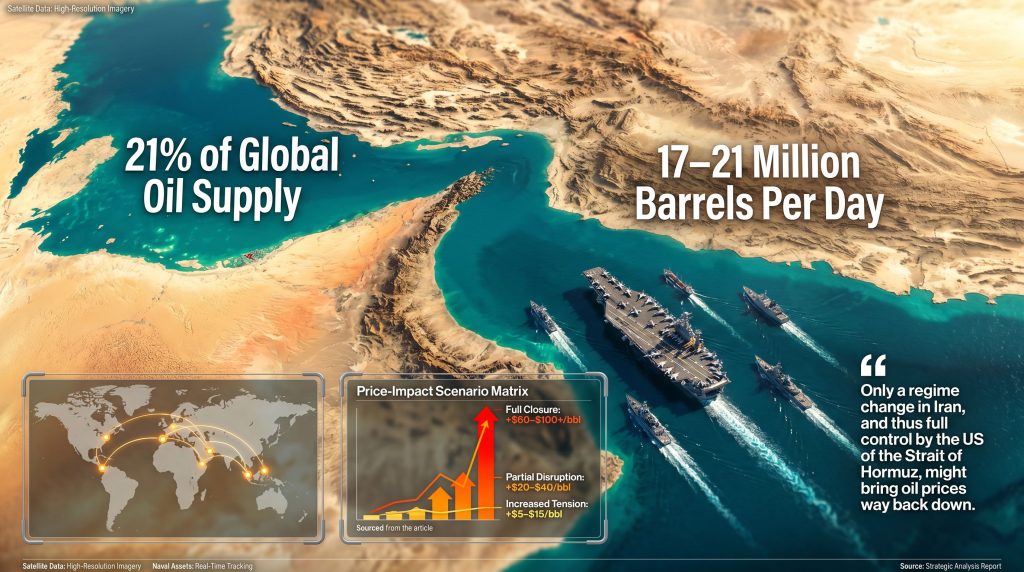
Geography does not negotiate. The Strait of Hormuz, flanked by Iran to the north and Oman and the UAE to the south, forms a natural bottleneck through which an estimated 17 to 21 million barrels of petroleum liquids pass every single day, representing roughly 21% of global oil supply according to reporting from OilPrice.com analyst Simon Watkins. No pipeline network, no alternative sea route, and no emergency reserve system can replace that volume at short notice.
Beyond crude oil, the Strait also serves as the primary export corridor for Qatar's liquefied natural gas output, making it structurally critical to the global LNG market as well. The nations most exposed to any interruption are not obscure frontier economies but the industrial giants of the Asia-Pacific: China, Japan, South Korea, and India collectively route a disproportionate share of their energy imports through this 21-mile waterway.
The price implications of disruption scale sharply with severity:
| Disruption Scenario | Estimated Price Impact | Market Response Window |
|---|---|---|
| Partial flow reduction (30-50%) | +$25 to $40 per barrel spike | Days to weeks |
| Near-total closure (over 90%) | +$60 to $100+ per barrel | Immediate |
| Semi-permanent US naval presence | Sustained $10-$20 risk premium | Months to years |
| Full US control post-regime change | Potential price normalization | 12-24+ months post-resolution |
A complete closure would effectively remove more oil from global markets in a single day than Saudi Arabia and Iraq collectively produce, creating a supply shock that no short-term rerouting strategy could absorb. With Goldman Sachs reporting that global oil inventories have already fallen to an 8-year low, the buffer capacity that historically softened supply shocks has been substantially eroded before this crisis even reached its current intensity. Furthermore, crude oil price trends in 2025 had already signalled tightening market conditions well before the conflict escalated.
From Kinetic Conflict to Chokepoint Economics: How the US Blockade Took Shape
The US military campaign, designated internally as Operation Epic Fury, initially pursued conventional objectives against Iran's nuclear and ballistic missile infrastructure. What has emerged since then represents a strategic evolution, as Washington transitioned toward a blockade-and-sanctions framework that effectively repositions US naval power to control the economic arteries of the Persian Gulf rather than simply degrade Iranian military capability.
US Central Command has directed dozens of vessels to reverse course or return to port, with explicit warnings that Iranian-linked ships attempting passage face interdiction. The USS Abraham Lincoln carrier strike group, supported by multiple destroyer-class vessels positioned south of the Strait, forms the operational architecture of this blockade. The 2026 Strait of Hormuz crisis provides a detailed account of how this standoff developed in real time.
Project Freedom and the Convoy Confrontation
President Trump's launch of Project Freedom added a further dimension. The initiative deployed US Navy destroyers as escorts for commercial vessels transiting the waterway. During the inaugural convoy, Iranian forces responded with a coordinated combination of missile fire, drone swarms, and small boat attacks, with US forces reportedly neutralising multiple Iranian vessels during the engagement.
The resulting dynamic is historically unusual. Both the United States and Iran are simultaneously operating competing interdiction frameworks over the same body of water, each asserting authority over maritime traffic within overlapping claimed zones. Western partners including the UK have declined to enforce the US blockade directly, instead contributing to mine-clearing and maritime security operations in adjacent areas.
The commercial distortions this standoff generates are already visible. Iraq has begun offering substantial discounts on crude shipments routed via Hormuz to maintain export volume, a market signal that the crisis is warping normal pricing mechanisms well beyond the Strait itself. Shipping bosses have expressed nervousness about Trump's plan to guide vessels through the Strait, reflecting industry-wide anxiety about the operational risks involved.
Deliberate Architecture or Strategic Opportunism? Reading the 2025 National Security Strategy
A question with significant long-term implications is whether the current US posture at Hormuz represents a reactive response to Iranian escalation or the deliberate execution of a pre-designed strategic framework. The evidence, when examined through the lens of the Trump administration's 2025 National Security Strategy, suggests the latter interpretation deserves serious consideration.
The NSS articulates a tripartite global order in which US dominance remains the organising principle. Washington reserves the right to exercise influence beyond its primary strategic orbit in the Americas through what the document describes as rolling geopolitical adjustments. The framework identifies one of the three spheres as a contested arena of strategic competition centring on the Indo-Pacific and Middle East corridor.
China as the Primary Structural Challenge
Critically, the NSS frames China, not Russia or Iran, as the primary long-term structural challenge to US primacy. Russia's 2022 invasion of Ukraine intensified this concern, as Washington interpreted the precedent as a philosophical template potentially relevant to China's stated ambitions regarding Taiwan. Public statements from President Xi Jinping suggesting military readiness by 2027 added urgency to this assessment. Indeed, geopolitical tensions reshaping global trade have made this structural rivalry increasingly visible across multiple sectors simultaneously.
The strategic logic connecting Hormuz to the US-China competition is not incidental. It flows directly from a structural reality: China must import the overwhelming majority of its energy, and the Middle East holds the world's largest hydrocarbon reserves outside the United States itself.
China's Energy Architecture in the Middle East: Deeper Than Most Realise
China's exposure to Middle Eastern energy is not simply a matter of commodity trading. Over the past decade, Beijing has systematically constructed a commercial architecture across the region designed to convert energy dependency into strategic leverage. The primary instrument has been the Belt and Road Initiative, which deploys comprehensive cooperation agreements pairing Chinese infrastructure investment, often financed through loans secured against strategic assets, in exchange for preferential access to oil and gas fields.
Iraq represents the clearest expression of this strategy. Two foundational agreements anchor Beijing's position:
- The Oil for Reconstruction and Investment agreement signed in September 2019, which established the template of exchanging oil access for Chinese-financed infrastructure
- The Iraq-China Framework Agreement of 2021, which extended cooperation across energy, infrastructure, and economic sectors more broadly
According to Simon Watkins' analysis for OilPrice.com, drawing on his earlier reporting in Petroleum Economist and subsequent book on the global oil market, China currently controls approximately 34% of Iraq's proven oil reserves and directs roughly two-thirds of Iraq's current production through Chinese-operated or Chinese-financed facilities. This represents an extraordinary concentration of commercial control over a single OPEC member's output, achieved entirely through economic rather than military means. Consequently, OPEC's influence on global oil markets has become increasingly entangled with Beijing's strategic positioning across the region.
The Iran-China Cooperation Agreement
Iran's dimension extends further still. The Iran-China 25-Year Comprehensive Cooperation Agreement, whose scope encompasses oil, gas, banking, telecommunications, and military sectors, gives Beijing influence not just over Iranian resources but indirectly over the physical infrastructure of the Strait of Hormuz itself. From Washington's perspective, this arrangement effectively places Chinese strategic interests at the operational controls of global energy supply, a structural arrangement the US cannot accept.
Iran's reach extends further through the Shia Crescent, a network of military, political, religious, and economic proxies spanning Lebanon, Syria, Yemen, and elements of Bahrain. China's partnership with Tehran amplifies Beijing's indirect leverage across this entire network without requiring any direct Chinese military presence in the region.
The Global Chokepoint Map: Hormuz as One Node in a Larger System
What distinguishes the current US strategic posture from previous Middle Eastern interventions is the simultaneous consolidation of influence across multiple critical maritime passages worldwide. Taken individually, each bilateral agreement or military deployment might appear as a tactical response to regional circumstances. Viewed together, however, they form a coherent architecture.
Thierry Wizman, Global FX and Rates Strategist at Macquarie Group in New York, identifies the US-Indonesia Major Defense Cooperation Partnership signed on 13 April as a particularly significant component of this broader pattern. The agreement grants Washington enhanced monitoring rights and contingency operation capabilities over the Strait of Malacca and the South China Sea, the primary maritime corridor through which Chinese energy imports from the Middle East must pass on their way to Chinese ports.
| Chokepoint | US Strategic Action | Strategic Relevance to China |
|---|---|---|
| Strait of Hormuz | Naval blockade and Project Freedom convoy operations | Primary source region for Chinese oil and gas imports |
| Strait of Malacca | US-Indonesia MDCP signed 13 April | Mandatory transit for Chinese energy imports from Middle East |
| Strait of Gibraltar | US-Morocco 2026-2036 Defense Cooperation Roadmap | Atlantic-Mediterranean gateway for European energy flows |
| GIUK Gap | Reinforced US naval presence and alliance commitments | North Atlantic strategic corridor |
| Panama Canal | Renewed US political and strategic pressure | Pacific-Atlantic transit linkage |
Wizman further notes that the US-Morocco Defense Cooperation Roadmap formalises long-term US access to Moroccan military facilities for logistics, training, and operational coordination, securing a reliable operational foothold at the Strait of Gibraltar. When combined with reinforced positioning at the Greenland-Iceland-UK Gap and continued pressure over the Panama Canal, the cumulative picture is of a systematic effort to establish US influence at every major maritime passage through which Chinese trade and energy flows must transit.
If this architecture is indeed the intended outcome, Wizman argues that oil price normalisation becomes a secondary concern rather than the primary objective. The goal is structural control over the chokepoints, and elevated energy prices may be an acceptable cost of achieving it.
The next major ASX story will hit our subscribers first
Oil Price Scenarios: Four Pathways from the Current Crisis
Energy market participants are navigating four structurally distinct outcome scenarios, each with profoundly different implications for commodity pricing and global economic stability.
Scenario One: Semi-Permanent US Naval Presence
The most probable near-term outcome involves the US maintaining a sustained military footprint near the Strait without achieving full geopolitical resolution. Under this scenario, WTI and Brent remain structurally elevated by a $10 to $20 per barrel risk premium relative to pre-conflict levels. With WTI currently trading near $100 per barrel and Brent at approximately $108 per barrel, this baseline is already reflected in current pricing. Wizman has stated that oil prices staying above pre-war levels would not be surprising if the US naval presence near the Strait becomes semi-permanent, given the sustained level of tension such a posture implies.
Scenario Two: Negotiated Settlement Without Regime Change
A diplomatic resolution preserving the Iranian government but imposing new constraints on nuclear and missile programs would partially compress the risk premium without fully eliminating it. China's commercial positions in Iraq and Iran would largely survive such an agreement, meaning the strategic calculus driving US concern would be only partially addressed.
Scenario Three: Regime Change and Full US Control
Wizman identifies this as the only scenario under which oil prices could fall substantially below current levels, as it would structurally remove the Iran-China energy nexus and reposition Hormuz governance under US-aligned authority. It carries the highest operational and diplomatic cost.
Scenario Four: Chinese Countermeasure Escalation
Dr. Mamdouh G. Salameh, an International Oil Economist and Global Energy Expert who commented on the OilPrice.com analysis, argues that the plan is ultimately unworkable because China will not be deterred from importing Iraqi and Iranian crude and is prepared to use force if necessary to break the blockade. Beyond direct confrontation, Beijing holds significant asymmetric instruments including China's rare earth export restrictions, which would directly impact US defense systems and advanced manufacturing, alongside the rejection of any long-term US trade framework.
This scenario carries the highest systemic risk. Economic analysts have noted that sustained oil prices above $125 per barrel could tip the global economy into recession, and California gasoline prices surpassing $6 per gallon already indicate consumer-level demand destruction emerging at current price levels.
How Major Economies Are Adapting to the Hormuz Disruption
The immediate economic consequences of the US blockade of the Strait of Hormuz are not distributed evenly. Asia-Pacific nations face the most acute exposure, while European responses have diverged significantly from Washington's approach.
Asia-Pacific Exposure:
- China has directed refiners to disregard US sanctions on key Iranian oil buyers while deepening its commercial partnerships in Iraq and Iran
- India has condemned Iranian attacks on regional infrastructure while raising LPG and jet fuel prices domestically in response to supply tightening
- Japan's top utility JERA has secured LNG supply only through July, while Russian oil cargoes are arriving to partially compensate for Middle East supply constraints
- South Korea suffered a direct incident when an explosion struck a cargo ship in the Strait, accelerating domestic discussions about supply diversification
- Pakistan faces the most severe acute crisis, turning to Russia and Venezuela for alternative supply while opening Iran land corridors and serving as a regional ceasefire mediator
In Europe, TotalEnergies has extended a fuel price cap in France as the Middle East crisis persists, reflecting direct consumer-level pressure. The UK and European partners have declined to enforce the US blockade, contributing instead to mine-clearing operations. Australia and Japan have formalised a new bilateral energy supply chain pact, deepening ties as both nations seek to reduce structural Hormuz dependency over the medium term.
The UAE's withdrawal from OAPEC signals a fracturing of Gulf energy cooperation frameworks under crisis conditions, a structural development with implications for the long-term governance of regional oil policy that extends well beyond the immediate conflict. In addition, the US-China trade war continues to compound these pressures, layering economic friction atop the existing geopolitical tensions.
The Counterarguments: Where the US Strategy Faces Its Hardest Tests
No strategic framework operates without vulnerabilities, and the US chokepoint consolidation approach faces several structurally significant challenges.
Critics argue that Washington demonstrably failed to anticipate Iran's willingness to blockade the Strait despite years of explicit Iranian signalling, suggesting at minimum that the transition to the current posture involved significant miscalculation. Sustaining a semi-permanent naval presence in the Persian Gulf generates substantial operational overextension and financial cost, imposes energy supply disruptions on key US allies who had no input into the decision, and creates continuous exposure to Iranian escalation through its Shia Crescent proxy network.
China's Asymmetric Leverage
China's countermeasures extend well beyond the energy domain. Beijing controls the processing of an estimated 60 to 80% of the world's rare earth elements, materials essential for US defense systems, semiconductor manufacturing, and clean energy technology supply chains. This represents a category of leverage that naval power cannot neutralise, and Beijing has already signalled a willingness to deploy it as a retaliatory instrument.
Furthermore, the commercial depth of China's positions in Iraq means any resolution that preserves Iraqi sovereignty will almost certainly preserve Chinese commercial interests in Iraqi production. The strategic objective of separating Beijing from Middle Eastern energy resources may therefore be structurally unachievable through chokepoint control alone, regardless of how the Iran conflict ultimately resolves.
Disclaimer: This article is for informational and educational purposes only and does not constitute financial, investment, or trading advice. The scenarios, price projections, and strategic assessments presented reflect analyst commentary and publicly available reporting as of the time of writing and should not be relied upon as predictions of future market outcomes. Energy markets involve significant volatility and geopolitical risk. Readers should conduct their own research and consult qualified financial advisers before making investment decisions.
Want to Stay Ahead of the Next Major Resource Discovery Driven by Shifting Geopolitics?
As energy security tensions reshape global commodity markets and investor attention turns toward resource independence, Discovery Alert's proprietary Discovery IQ model delivers real-time ASX mineral discovery alerts — translating complex market signals into actionable opportunities the moment they emerge. Explore how historic discoveries have generated extraordinary returns on Discovery Alert's dedicated discoveries page, and begin your 14-day free trial today to position yourself ahead of the market.