August 10, 2026
The Strait of Hormuz as a Strategic Weapon: Understanding the Geopolitics Behind the US-Iran-Oman Deal
Energy chokepoints have historically defined the outer limits of geopolitical power. From the Suez Crisis of 1956 to Iraq's invasion of Kuwait in 1990, control over the physical arteries of global oil supply has repeatedly proven to be among the most potent forms of leverage one nation can exercise over another. What is unfolding at the Strait of Hormuz in mid-2026 represents one of the most complex variants of this dynamic in modern history: a three-party diplomatic architecture in which the world's most critical maritime chokepoint has been transformed from a passive shipping corridor into an active instrument of coercive bargaining.
Understanding the US-Iran-Oman deal to reopen the Strait of Hormuz requires more than tracking the latest diplomatic exchange. It demands a structural analysis of who holds leverage, what each actor actually wants, and why the sequence of concessions matters as much as the concessions themselves.
When big ASX news breaks, our subscribers know first
Why the Strait of Hormuz Holds Global Energy Markets Captive
The geography of the strait is deceptively simple. Sitting between Iran to the north and Oman to the south, it connects the Persian Gulf to the Gulf of Oman and ultimately to the broader Indian Ocean. At its narrowest navigable point, the passable channel measures approximately 3.2 kilometres wide, a figure that understates the extraordinary volume of commerce it supports.
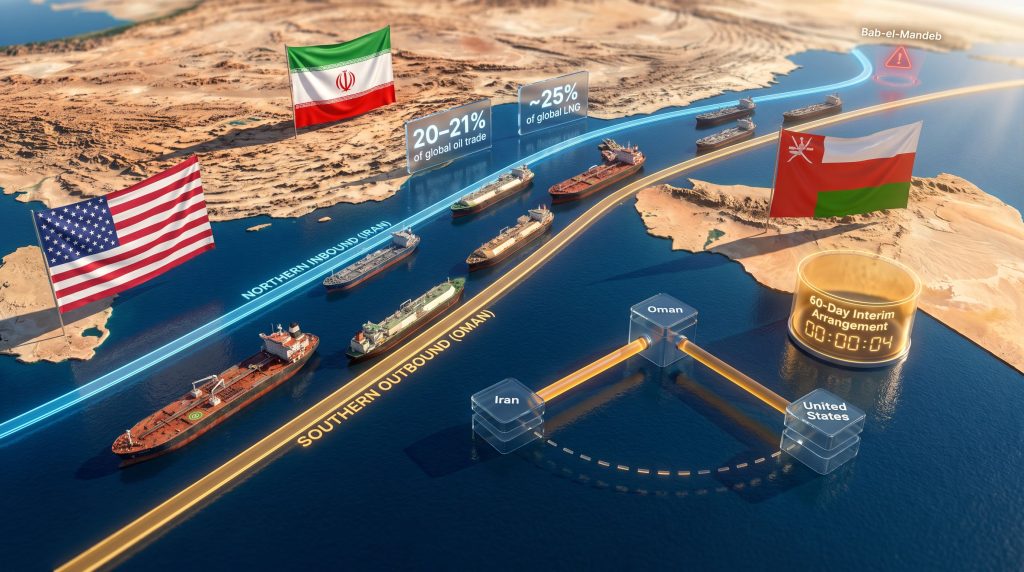
Approximately 20 to 21 percent of all globally traded oil and around 25 percent of the world's liquefied natural gas transits this waterway annually, according to the US Energy Information Administration. For context, that represents more hydrocarbon flow than passes through the Suez Canal, the Bab-el-Mandeb strait, and the Bosphorus combined. Nations such as Japan, South Korea, India, and China depend on Hormuz for a substantial share of their energy imports, making disruption to the strait a matter of national economic security for multiple major economies simultaneously.
When Iran closed the strait in late February 2026 following US and Israeli military strikes on Tehran, the cascading consequences were immediate and severe. Furthermore, the resulting crude oil price volatility sent shockwaves through energy markets worldwide:
- Crude oil spot prices surged as supply risk premiums were priced into forward contracts
- Marine insurance costs for Gulf transit vessels rose sharply, with war-risk premiums increasing the operating cost of every voyage through the region
- Asian LNG importers faced supply route uncertainty, forcing some to seek more expensive alternative sources, compounding LNG supply implications across the region
- Shipping operators began rerouting vessels around the Cape of Good Hope, adding thousands of nautical miles and significant fuel costs per voyage
What made the February 2026 closure structurally different from earlier Hormuz tension episodes was Iran's explicit framing of the blockade not as a temporary warning but as a durable strategic position tied to a list of non-negotiable demands.
The Timeline That Explains the Current Negotiating Landscape
To understand why the US-Iran-Oman deal is structured the way it is, the sequence of events matters enormously:
- Late February 2026: US and Israeli air strikes target Iranian territory, aimed at dismantling Iran's nuclear weapons programme and degrading its regional military capabilities. Iran retaliates by closing the Strait of Hormuz.
- June 2026: Washington and Tehran agree to a ceasefire arrangement, providing a brief diplomatic opening.
- July 2026: The United States reimposed a naval blockade on Iranian shipping in the Gulf. Tehran characterised this as a direct violation of the June ceasefire, formally breaking down that arrangement.
- August 2026: Iran and Oman reach the reported final stages of a bilateral shipping lane agreement. The US signals conditional willingness to lift its port blockade once a deal is announced and Iran begins fulfilling its obligations.
This sequence reveals a critical structural feature of the current negotiation: the US and Iran are not engaged in direct talks. Tehran has made clear it will not open direct communication with Washington while it considers the US to be in breach of the June ceasefire. All diplomatic exchange flows through intermediaries, with Oman playing the central coordinating role.
The Architecture of the Proposed 60-Day Interim Arrangement
The deal under discussion is framed explicitly as a temporary 60-day trial arrangement, not a permanent resolution to the crisis. Its operational structure divides the strait into two directional lanes:
| Feature | Detail |
|---|---|
| Duration | 60-day interim arrangement |
| Inbound Lane | Northern route through Iranian-administered waters |
| Outbound Lane | Southern route through Omani-administered waters |
| Transit Fees During Trial | None proposed |
| Post-Trial Fee Mechanism | Under discussion; potential charges for security and environmental services |
| Mine Clearance | Central lane demining proposed as part of a longer-term subsequent phase |
| US Port Blockade | To be lifted after deal announcement and Iranian compliance begins |
The geographic coordinates for these new lanes have reportedly been agreed between Iran and Oman. The absence of transit fees during the initial period is notable: it suggests both parties are prioritising the resumption of traffic volume over immediate revenue generation, likely because the economic costs of continued closure outweigh any near-term fee income.
The proposed lane structure has a jurisdictional significance that extends well beyond shipping logistics. By establishing Iran's administrative role over the inbound northern lane, the arrangement implicitly recognises Tehran's sovereign authority over a portion of the world's most commercially critical waterway. This is a precedent with long-term geopolitical implications that go far beyond the 60-day trial period.
Scenario Modelling: Three Possible Outcomes After 60 Days
Scenario A: Successful transition to a permanent framework
Both parties honour commitments. Negotiations advance toward a durable arrangement. Central lane demining proceeds under international maritime oversight. Crude oil risk premiums unwind and insurance costs normalise across Gulf routes.
Scenario B: Partial compliance and extended renegotiation
One or both parties fail to meet key benchmarks during the trial. The 60-day window expires without a permanent structure. Shipping uncertainty persists and spot oil prices remain elevated. Oman escalates its mediation efforts to prevent full breakdown.
Scenario C: Deal collapse and renewed blockade
A triggering incident, whether a further military exchange, a shipping confrontation, or a sanctions escalation, derails the arrangement entirely. Iran reasserts full control over the strait. Global energy markets face an acute supply shock, potentially exceeding the initial price response of February 2026.
What Each Actor Wants: A Strategic Leverage Breakdown
Iran's Multi-Condition Negotiating Position
Iran is not treating the Strait of Hormuz as a single-issue bargaining chip. The conditions publicly stated by senior Iranian officials, including Foreign Minister Abbas Araqchi and the secretary of Iran's top national security body Mohammad Baqer Zolqadr, constitute a comprehensive list of demands:
- Financial compensation from the United States for damage caused by military strikes
- A complete end to US military threats and aggressive posturing toward Iran
- Cessation of US hostilities toward Iran's regional partners in Lebanon, Palestine, Yemen, and Iraq
- Removal of the US naval blockade currently operating in the Gulf
- Full lifting of economic sanctions on Iran
- Release of frozen Iranian financial assets held abroad
This list is instructive not only for what it contains but for what it signals strategically. Iran is using the strait as a bundled leverage instrument, converting a single physical asset into a platform for extracting multiple categories of concession across economic, military, and diplomatic domains simultaneously.
The compensation demand is particularly revealing. No US administration has publicly acknowledged any willingness to pay financial reparations to Iran. It likely functions as a maximum opening position rather than a hard precondition, but its inclusion in Iran's public stance complicates the diplomatic optics of any deal for both governments.
The United States' Calibrated Restraint
Washington's approach to the negotiation has been characterised by deliberate low-key positioning. US President Donald Trump described the US posture as one of watching rather than pressing, noting Iran's severe domestic economic pressures as a factor in the overall calculus. This framing reflects a strategic calculation that time is working against Tehran given Iran's high inflation environment and constrained financial resources, reducing the urgency for the US to make rapid concessions.
The US commitment structure is explicitly conditional and sequenced: the naval blockade on Iranian ports will be lifted only after a deal is formally announced and Iran has demonstrably begun implementing its side of the arrangement. This conditionality is designed to prevent Iran from claiming diplomatic credit without delivering operational compliance.
Oman's Strategic Dividend
Oman's role in this negotiation is not passive facilitation. As the administrator of the southern outbound lane and the primary diplomatic intermediary between Tehran and Washington, Muscat has positioned itself as operationally indispensable to any resolution. This elevates Oman's geopolitical standing in the Gulf and provides it with practical maritime governance relevance that extends beyond the current crisis.
Oman also has direct economic interests in a reopened strait: its own coastline runs along the southern edge of the Hormuz passage, and restored shipping flows would benefit Omani ports, insurance services, and ancillary maritime industries. According to Al Jazeera, Oman's mediation role reflects its longstanding tradition of serving as a neutral diplomatic bridge between adversarial parties in the region.
The Dual-Chokepoint Pressure Strategy: Houthis and the Bab-el-Mandeb
One of the less widely appreciated dimensions of the current crisis is that the Strait of Hormuz disruption does not exist in isolation. Iran's Yemeni allies, the Houthi movement, have simultaneously intensified attacks on shipping at the Bab-el-Mandeb strait, the chokepoint connecting the Red Sea to the Gulf of Aden. Consequently, these compounding oil market disruptions have amplified pressure on global supply chains far beyond what either chokepoint could achieve alone.
In August 2026, the Houthis:
- Declared a naval blockade against Saudi Arabia in the Red Sea, framing it as a response to what they characterised as a Saudi siege in Yemen, an allegation Riyadh denied
- Claimed an attack on Saudi Aramco's Jazan refinery, which resulted in a fire that was subsequently contained with no reported casualties
- Continued targeting commercial vessels transiting the Red Sea corridor
This dual-chokepoint pressure strategy, simultaneously constraining both the Hormuz passage and the Bab-el-Mandeb route, creates a compounding energy security problem for global markets. Alternative routing through either corridor becomes less viable when both are simultaneously contested.
The broader regional security environment was further complicated when Saudi Arabia formalised a trilateral defence pact with Turkey and Pakistan in August 2026. Turkish Foreign Minister Hakan Fidan characterised the alliance as a general security commitment rather than an anti-Iran posture, but its formation signals a widening realignment of Middle Eastern security architecture that could shape the diplomatic context around any Hormuz settlement.
The United Arab Emirates added another layer of instability by reporting that Iran had struck a vessel affiliated with its state oil company, an incident that underscores how vulnerable any interim shipping arrangement would be to a single escalatory incident during the proposed 60-day trial period.
The next major ASX story will hit our subscribers first
The Sequencing Problem: The Central Structural Risk
Perhaps the most technically complex aspect of the US-Iran-Oman deal to reopen the Strait of Hormuz is not the lane geography or the fee structure but the sequencing logic that governs when each party acts.
- Iran wants verifiable US concessions before it fully reopens the strait
- The US wants demonstrable Iranian compliance before lifting the blockade on Iranian ports
- Neither party trusts the other sufficiently to move first without guarantees
This creates a classic commitment problem in diplomatic negotiations: each side's willingness to act is conditional on prior action by the other, but neither can credibly commit to acting second without risking being exploited if they act first. Oman's value in this architecture lies precisely in its ability to function as a trusted verification mechanism, providing both parties with credible evidence that the other side is fulfilling its obligations in real time.
The ambiguity around post-trial transit fees adds a further layer of commercial uncertainty. Shipping operators and energy traders need clarity on cost structures before committing vessels to resumed Gulf transit. If fee arrangements remain undefined after the 60-day trial ends, the commercial incentive to resume full traffic volume may be weaker than the geopolitical resolution would imply. The broader geopolitical risk landscape across the region means that market participants are unlikely to price out risk premiums entirely, even in the event of a formal agreement.
What Reopening Would Mean for Global Energy Markets
A credible and verified announcement of strait reopening would likely trigger several near-simultaneous market responses:
- An immediate downward correction in crude oil benchmark prices as geopolitical risk premiums unwind
- A reduction in war-risk insurance premiums for Gulf transit routes, lowering per-voyage operating costs
- A resumption of more direct LNG routing for Asian importers, reducing spot market pressure on alternative supply sources
- Downward pressure on oil producers outside the Gulf who had benefited from elevated pricing during the closure period
However, even a successfully reopened strait is unlikely to produce an immediate return to pre-February 2026 pricing. Ongoing Houthi activity at the Bab-el-Mandeb, residual uncertainty about the durability of any interim arrangement, and the broader unresolved US-Iran conflict will sustain a meaningful risk premium in energy markets for the foreseeable future. Furthermore, the OPEC market influence over production decisions will play a significant role in determining how quickly any price correction takes hold once access is restored.
The longer-term structural consequence of the Hormuz crisis may be its accelerating effect on energy supply chain diversification strategies. Nations heavily dependent on Gulf imports are likely to assign higher risk weights to strait-dependent supply chains in their long-term energy planning, accelerating investment in alternative routing, strategic petroleum reserve capacity, and non-Gulf supply relationships.
Key Indicators to Watch
For analysts and market participants tracking the progress of the US-Iran-Oman deal to reopen the Strait of Hormuz, the following developments represent the most meaningful leading indicators. As reported by the Associated Press, negotiators on all sides are under considerable pressure to deliver a workable framework before the current diplomatic window narrows:
- A formal joint announcement from Iran and Oman confirming agreed shipping lane coordinates and operational start dates
- A US statement specifying the precise conditions under which it will lift the naval blockade on Iranian ports
- Any movement on frozen Iranian asset releases, which would signal broader US willingness to engage with Iran's economic demands
- Houthi activity levels at the Bab-el-Mandeb as a proxy for Iran's regional de-escalation intent
- The outcome of the UAE shipping incident investigation and Iran's response to it
What distinguishes this negotiation from previous Hormuz tension episodes is the sheer density of unresolved interdependencies. The deal is less a single agreement than a sequenced architecture of conditional commitments, in which each party's next move is explicitly conditioned on the verified prior action of another. Its success depends not on mutual goodwill, but on the structural credibility of each party's commitments and the robustness of Oman's capacity to verify and bridge them in real time.
Disclaimer: This article contains forward-looking analysis based on publicly available information as of August 2026. Geopolitical developments are inherently unpredictable. Nothing in this article constitutes financial, investment, or trading advice. Market projections and scenario analyses represent analytical assessments, not forecasts, and actual outcomes may differ materially from those described.
Want to Stay Ahead of the Resource Opportunities Emerging From Global Energy Disruptions?
Discovery Alert's proprietary Discovery IQ model delivers real-time alerts on significant ASX mineral discoveries, instantly translating complex market shifts — including those driven by geopolitical disruptions like the Hormuz crisis — into actionable investment opportunities. Explore how historic mineral discoveries have generated substantial returns by visiting Discovery Alert's dedicated discoveries page, and begin your 14-day free trial today to position yourself ahead of the market.