August 10, 2026
The Structural Vulnerability Hiding Inside Asia's Cheapest Crude Supply
For most of the past decade, global oil analysts debated whether Asian refiners would ever meaningfully diversify away from Middle Eastern crude. The question was largely academic. Then Russia's invasion of Ukraine in February 2022 rewrote the calculus entirely, flooding Asian markets with heavily discounted Urals crude and solving, almost overnight, the region's longstanding premium cost problem. India, in particular, absorbed Russian barrels at a pace that transformed the entire architecture of its energy supply chain.
Now, with the US Senate passing the Lindsey O. Graham Sanctioning Russia Act of 2026, that architecture faces its most serious external legal challenge to date. Understanding what the legislation actually does, where it can be tested, and what it cannot easily accomplish is essential for anyone tracking US Senate Russia sanctions and Indian crude supplies.
When big ASX news breaks, our subscribers know first
What the Graham Act Actually Authorises
The legislation passed the US Senate by an 86 to 11 bipartisan margin, a vote spread that signals unusually strong cross-party consensus. The bill targets Russia's energy revenue streams by empowering the president to impose secondary tariffs of up to 100% on goods imported from the five largest purchasers of Russian oil and gas. Russia's top five energy customers by volume include both India and China, making both nations directly exposed to the bill's secondary tariff mechanism.
The legislation's scope extends beyond crude oil trade. It targets:
- Russian government officials and entities linked to energy revenues
- Financial institutions facilitating Russian energy transactions
- Specific energy infrastructure projects tied to sanctioned entities
- The so-called shadow fleet, the network of tankers used to circumvent existing price caps
The secondary tariff mechanism works by creating a Presidential authority, not an automatic trigger. Once the bill becomes law, the executive branch retains discretion over whether, when, and against whom to apply the 100% tariff. This distinction matters enormously for forecasting real-world outcomes. Furthermore, the tariff-driven economic impact on Asian energy markets could extend well beyond the immediate legislative intent.
Critically, the bill has not yet cleared the US House of Representatives and must navigate additional legislative and administrative steps before it could take legal effect. Any analysis of enforcement outcomes is therefore contingent on a multi-stage process that remains incomplete.
India's Exposure: From Marginal Buyer to Dominant Customer
The scale of India's shift toward Russian crude since 2022 is difficult to overstate. What began as opportunistic spot purchasing during a period of extreme discount availability has evolved into a structural supply dependency that now defines Indian refinery economics. According to analysis from Kpler, this dependency has reached levels that make near-term substitution extraordinarily challenging.
| Year | Russian Crude to India | Share of Indian Imports |
|---|---|---|
| 2021 | ~100,000 bpd | ~2.5% |
| 2022 | ~740,000 bpd | Significant increase |
| 2023 | ~1.8 million bpd | ~39% |
| 2024 (average) | ~1.8 million bpd | Elevated |
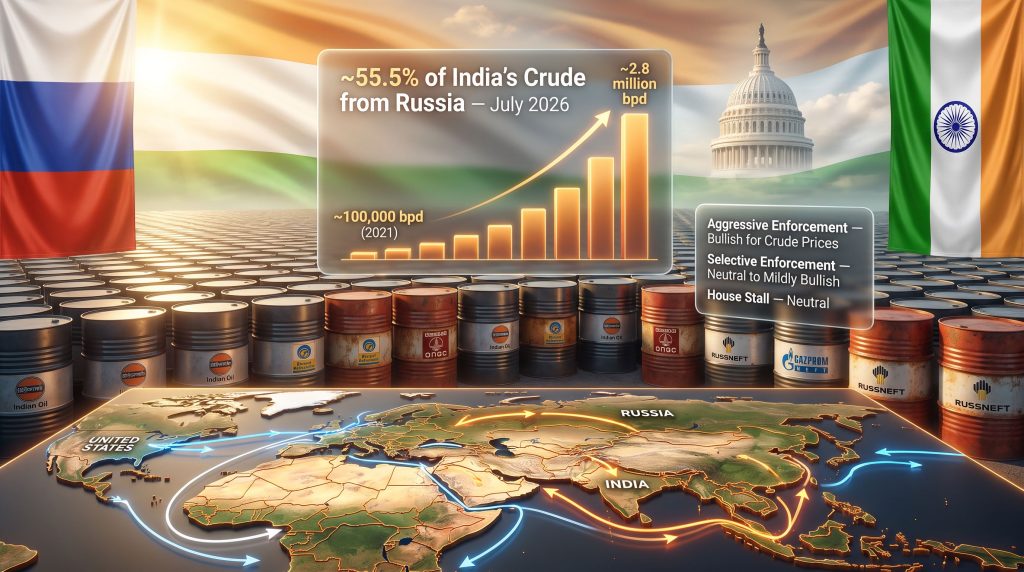
| July 2026 | ~2.8 million bpd (record) | ~55.5% of ~5 million bpd |
Sources: US Energy Information Administration (2021–2022 data); Kpler (2023–2026 data)
The progression reveals something important beyond raw volume growth. Russian crude has transitioned from an arbitrage opportunity into a genuine supply hedge. When traditional Middle Eastern routes face geopolitical disruption, Indian refiners have relied on the reliability and pricing of Urals-grade crude as a buffer against spot market volatility. This embedded function makes diversification far more complex than simply sourcing equivalent barrels elsewhere.
The deep discounts that initially attracted Indian buyers were not incidental. Western sanctions removed European demand almost entirely, compressing Russia's available buyer base to Asian markets. With constrained buyer competition, Moscow was structurally incentivised to offer prices well below Brent benchmarks. Indian state refiners, operating under margin pressure from domestic fuel pricing policies, found the economics practically irresistible. The broader oil geopolitics and supply dynamics underpinning this shift continue to reverberate across global energy markets.
The Substitution Challenge: Why Replacement Is Not a Simple Equation
Replacing 2.8 million barrels per day in the short term is not a logistics problem. It is a structural impossibility given current global spare capacity and refinery configuration realities.
| Supplier Region | Replacement Feasibility | Key Constraints |
|---|---|---|
| United States | Moderate | Freight cost premium, refinery adaptation required |
| Middle East (Saudi Arabia, UAE, Iraq) | High in theory | Geopolitical risk, higher price point |
| West Africa | Moderate | Volume ceilings, longer voyage times |
| Latin America | Low to moderate | Infrastructure gaps, distance penalties |
A less widely understood constraint is refinery configuration. Many of India's large refining complexes, including those operated by Indian Oil Corporation and Reliance Industries, have been progressively optimised to process Urals-grade crude, which has a specific sulphur content and API gravity profile. Switching to lighter or chemically different crudes requires either hardware modifications, blending strategies, or both. Neither is rapid or without cost.
US crude exports to India did reach a two-year high in early 2025, indicating that diversification is already in motion at the margins. However, even at elevated export levels, American barrels represent a fraction of what Russian supply currently delivers. The crude price volatility trends resulting from any forced supply shift would further complicate procurement decisions for Indian refiners already operating under margin pressure.
How Tight Markets Amplify the Risk
The timing of this legislative development introduces a compounding variable that is frequently underappreciated in sanctions analysis. Global crude markets are currently operating under relatively tight conditions, with Middle Eastern supply uncertainty adding further pressure to available balances.
When sanctions analysts model the impact of restricting Russian crude flows, a common error is assuming that displaced barrels are simply redirected to alternative buyers. In a balanced or undersupplied market, that assumption breaks down. Restricted flows that cannot be fully absorbed elsewhere result in genuine supply deficits, which translate directly into higher benchmark prices.
A forced and rapid curtailment of Russian crude flows to Indian and Chinese refiners would not merely create procurement headaches for Asian buyers. It would tighten global oil balances in ways that affect every importing nation simultaneously. Upward pressure on Brent crude prices would flow through to fuel costs, freight rates, and inflation dynamics across the global economy.
This is why the enforcement question is not purely a bilateral US-India trade issue. It carries systemic global energy market implications that US policymakers would need to weigh carefully before activating the tariff mechanism. Indeed, the US-China trade war oil prices dynamic adds yet another layer of complexity to an already volatile geopolitical environment.
Three Scenarios for Indian Crude Flows
The eventual outcome for Indian refiners depends on variables that remain unresolved. Three distinct pathways are worth examining.
| Scenario | Key Driver | Impact on Indian Refiners | Global Price Effect |
|---|---|---|---|
| Aggressive enforcement, no waivers | Strong US political will | High cost pressure, forced diversification | Bullish for crude prices |
| Selective enforcement with diplomatic carve-outs | US-India relations, energy security concerns | Moderate adjustment, partial supply continuity | Neutral to mildly bullish |
| House stall or legislative gridlock | Congressional dynamics | Minimal near-term disruption | Neutral |
Scenario one represents the maximum disruption outcome. If the House passes the bill and the executive branch enforces it without waivers, Indian refiners face both a procurement crisis and a secondary tariff on exports to the United States. The economic pressure would be substantial, but the global price consequences might paradoxically create political incentives for the US to soften enforcement.
Scenario two is arguably the most historically consistent outcome. During periods of Middle Eastern supply stress, the US has previously extended temporary sanctions flexibility that allowed Russian crude to continue flowing to Indian buyers. That precedent is not a guarantee, but it reflects the pragmatic tension between sanctions as a geopolitical tool and energy market stability as a national economic interest.
Scenario three remains plausible given the divergence between Senate and House dynamics, and the complex administrative requirements that follow any legislative passage. Furthermore, the trade war impact on oil markets suggests that geopolitical escalation rarely follows a linear or predictable trajectory.
The next major ASX story will hit our subscribers first
Macroeconomic Exposure Beyond the Refinery Gate
For India, the stakes extend well beyond procurement costs at individual refineries. The macroeconomic transmission channels are significant:
- Current account pressure: India imports roughly 85% of its crude oil requirements. A higher average crude price resulting from reduced Russian discount availability would widen the current account deficit meaningfully.
- Rupee vulnerability: A larger import bill denominated in US dollars creates downward pressure on the Indian rupee, with secondary effects on inflation and monetary policy.
- Foreign exchange reserves: Sustained crude price elevation draws down India's forex reserves more rapidly, reducing the Reserve Bank of India's policy buffer.
- Energy security doctrine: India has positioned energy diversification as a national strategic priority, but the pace of that diversification has lagged behind the growth in Russian dependency.
The diplomatic dimension is equally complex. India has cultivated a strategic partnership with the United States while simultaneously deepening its energy relationship with Russia. The Graham Act creates a potential inflection point in that balancing act, requiring Indian policymakers to navigate competing pressures from Washington and their own refining industry simultaneously.
What Policymakers and Analysts Should Monitor
Several specific milestones will determine whether this legislation moves from Senate passage to operational enforcement:
- House committee scheduling: Whether the bill receives a committee hearing and floor vote in the current Congressional session is the immediate gating factor
- Waiver eligibility criteria: The bill's framework for exemptions will determine whether India can qualify by demonstrating a credible commitment to reducing Russian energy purchases over a defined timeline
- Indian state refiner procurement signals: Any shifts in tender activity or long-term supply agreement negotiations by Indian Oil Corporation, Bharat Petroleum, or Hindustan Petroleum would signal that supply chain adjustments are underway at an operational level
- US-India diplomatic communications: Bilateral trade and energy discussions will likely intensify if House passage becomes probable
Disclaimer: This article contains forward-looking analysis based on publicly available legislative and market data as of August 2026. Scenarios and projections regarding enforcement outcomes, price effects, and supply chain adjustments involve uncertainty and should not be construed as investment advice. Readers should conduct independent research before making decisions based on geopolitical or energy market forecasts.
Frequently Asked Questions
What is the Lindsey O. Graham Sanctioning Russia Act of 2026?
It is a bipartisan US Senate bill passed by an 86-11 margin that would authorise the president to impose secondary tariffs of up to 100% on goods from the five largest purchasers of Russian oil and gas, alongside broader sanctions targeting Russian officials, banks, and energy infrastructure.
How would secondary tariffs on Indian exports work in practice?
Under the bill's mechanism, goods exported from India to the United States could face tariffs of up to 100% if India is classified among the five largest buyers of Russian energy and the president chooses to activate the authority. Waivers and exemptions remain available at presidential discretion.
Does India currently rank among the top buyers of Russian crude?
Yes. With approximately 2.8 million barrels per day of Russian crude imports recorded in July 2026, representing roughly 55.5% of total Indian crude intake, India is one of the world's largest buyers of Russian energy by volume. The implications for US Senate Russia sanctions and Indian crude supplies are consequently significant for global energy markets.
Could India realistically shift away from Russian crude quickly?
Short-term substitution at current Russian supply volumes would be structurally very difficult. Refinery configuration constraints, freight cost differentials, and the absence of readily available alternative supply at equivalent scale make rapid diversification unlikely without significant economic cost. The Atlantic Council's assessment of the broader sanctions bill similarly highlights the depth of these structural dependencies.
What happens to global oil prices if Russian flows to India are restricted?
Analysts note that restricted flows in a tight market do not simply redirect to alternative buyers. The resulting supply tightening could put sustained upward pressure on Brent crude benchmark prices, affecting importing nations globally. The intersection of US Senate Russia sanctions and Indian crude supplies is therefore a systemic concern, not merely a bilateral one.
For ongoing coverage of Indian oil and gas procurement policy and the evolving geopolitics of global crude markets, readers can access detailed reporting through ET EnergyWorld at energy.economictimes.indiatimes.com.
Want to Stay Ahead of the Next Major Resource Discovery Reshaping Global Markets?
While geopolitical shifts and sanctions reshape global energy supply chains, Discovery Alert's proprietary Discovery IQ model scans ASX announcements in real time, instantly identifying significant mineral discoveries and delivering actionable opportunities directly to subscribers — explore historic discoveries that have generated extraordinary returns and begin your 14-day free trial at Discovery Alert to secure a market-leading edge.