August 23, 2026
The Strait of Hormuz: Why the World's Most Dangerous Waterway Just Got More Dangerous
Few geographic features carry as much economic weight as a stretch of water roughly 33 kilometres wide at its narrowest point. The Strait of Hormuz, separating the Persian Gulf from the Arabian Sea, functions as the circulatory valve of global energy supply. When that valve is threatened, the consequences radiate across commodity markets, shipping insurance desks, and central bank policy rooms simultaneously. The events of early July 2026, in which U.S. strikes Iran for second straight day amid Strait of Hormuz tensions, represent one of the most significant stress tests that global energy supply chains have faced in years.
Understanding what happened, why it happened, and what it means for energy markets requires more than a news summary. It demands a structural analysis of the chokepoint itself, the military logic behind escalating U.S. operations, the fragility of the diplomatic framework that preceded the breakdown, and the range of scenarios that now sit in front of energy traders, logistics operators, and policymakers.
When big ASX news breaks, our subscribers know first
The Strait of Hormuz: A Geography Lesson With Trillion-Dollar Consequences
Why No Alternative Route Can Replicate What the Strait Provides
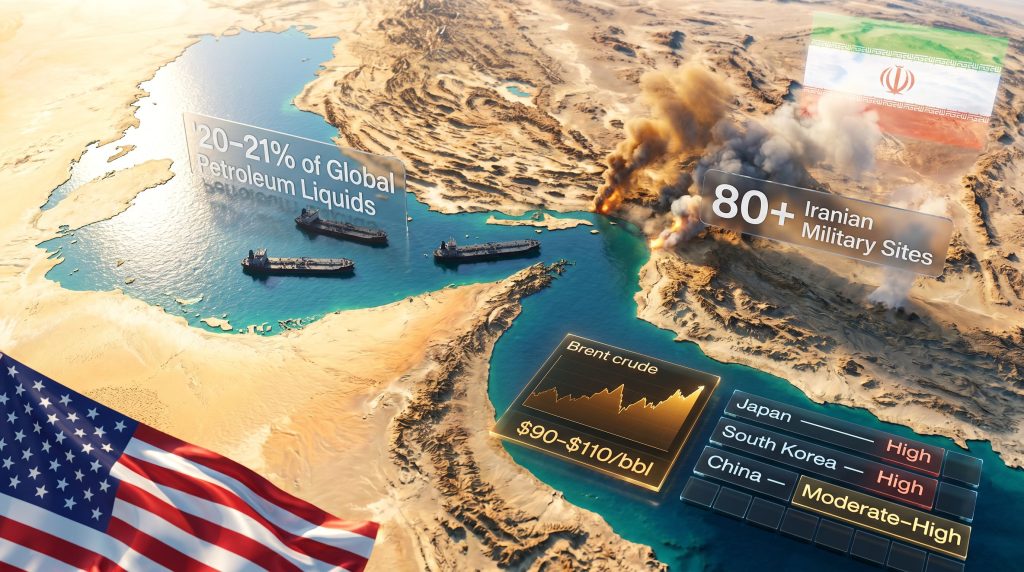
Approximately 20 to 21% of all petroleum liquids traded globally transit the Strait of Hormuz on any given day, according to estimates from the U.S. Energy Information Administration. For liquefied natural gas, the figure is comparable, with a significant proportion of Gulf-sourced LNG flowing through the strait toward buyers in Japan, South Korea, China, and India. The LNG supply outlook for these regions has consequently grown far more uncertain.
The strait's geographic configuration creates its strategic chokepoint status. Ships entering and exiting operate through designated traffic separation schemes, with inbound and outbound lanes each approximately 3 kilometres wide, separated by a median zone. This concentration of tanker traffic within a narrow, predictable corridor makes maritime coercion relatively straightforward for a coastal power with anti-ship missile systems and fast attack craft.
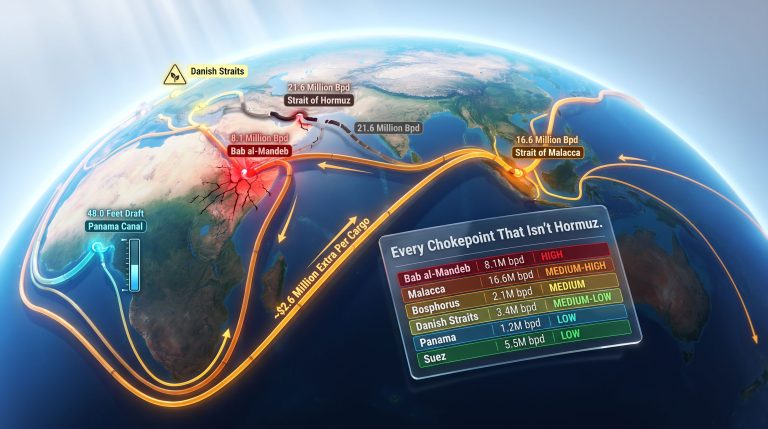
Alternative routing options exist in limited form. The UAE's Habshan to Fujairah pipeline, commissioned over a decade ago, can move approximately 1.5 million barrels per day of Abu Dhabi crude directly to the Arabian Sea, bypassing the strait entirely. Saudi Arabia's East-West pipeline offers a similar bypass for Saudi crude destined for Red Sea export terminals.
However, the combined bypass capacity of these infrastructure assets falls dramatically short of the roughly 20 to 21 million barrels per day that typically transits the strait, making a full substitution operationally impossible on short notice.
Iran's Maritime Pressure Playbook: More Sophisticated Than It Appears
Iran's approach to maritime coercion is not improvised. Over several decades, the Islamic Revolutionary Guard Corps Navy has developed a layered set of capabilities specifically calibrated to threaten commercial shipping without necessarily triggering a full conventional military response. These tools include:
- Anti-ship missile systems positioned along the Iranian coastline, capable of targeting vessels across the strait's full width
- Mine-laying capacity, which historically represents one of the most economically disruptive tools available to Iran given its ability to freeze insurance markets and rerouting decisions
- Small boat swarm tactics, using large numbers of fast attack craft to overwhelm the defensive posture of individual merchant vessels or their naval escorts
- Seizure operations conducted under legal pretexts, typically involving vessels with commercial ties to nations Iran is in dispute with
What makes this toolkit particularly effective is that it does not require Iran to win a direct military confrontation. It only requires creating sufficient uncertainty to push war risk insurance premiums to prohibitive levels, which effectively closes the strait economically before any physical blockade is established.
A Timeline of Collapse: From Ceasefire to Consecutive Strikes
The deterioration from a negotiated pause in hostilities to back-to-back U.S. military operations unfolded across a compressed window of weeks. The sequence below captures the key inflection points, illustrating how rapidly the 2026 Strait of Hormuz crisis escalated into a full military confrontation.
| Date / Period | Event |
|---|---|
| June 2026 | U.S.-Iran memorandum of understanding temporarily reduces hostilities |
| Early July 2026 | Iran conducts attacks on three commercial vessels transiting the strait |
| Tuesday, July 8 (Day 1) | U.S. strikes more than 80 Iranian military sites in response |
| Wednesday, July 9 (Day 2) | CENTCOM launches additional operations targeting coastal military infrastructure |
| Post-strike | IRGC declares it has targeted U.S. military installations in Kuwait and Bahrain |
| Ongoing | Diplomatic channels suspended during Iran's weeklong mourning period |
What the Second Day of Strikes Tells Us About U.S. Strategic Intent
The decision to launch a second consecutive round of operations is analytically significant. A single punitive strike, as has occurred in prior U.S.-Iran standoffs, is typically framed as a deterrence signal: a warning delivered to change behaviour without permanently degrading capability.
A consecutive second day of strikes against additional infrastructure, including coastal facilities used to coordinate threats against merchant shipping and more than 60 IRGC small patrol and attack vessels, signals a different doctrine entirely. Furthermore, this development has triggered considerable oil market disruption across global trading desks.
CENTCOM's operational framing centred on degrading Iran's capacity to threaten freedom of navigation. Under international maritime law, freedom of navigation doctrine establishes the right of all states to transit international straits used for international navigation. By anchoring the justification in this legal framework, U.S. Central Command positioned the operations as a sustained capability-reduction campaign rather than a symbolic response.
Why the June Memorandum of Understanding Proved Fragile
The temporary ceasefire reached in June 2026 appeared to offer a diplomatic off-ramp from what had been an extended period of elevated maritime tensions. However, the agreement carried structural vulnerabilities that ultimately contributed to its breakdown.
The revocation of a temporary waiver permitting limited Iranian oil sales appears to have been a critical accelerant. From Tehran's perspective, the removal of this economic concession undermined the reciprocal logic on which the memorandum rested. For the U.S. side, the reimposition of maximum pressure economics reflected a recalibration of negotiating leverage. Neither interpretation left much room for the agreement to survive contact with political reality.
Compounding the diplomatic fragility was the death of Supreme Leader Ali Khamenei, which created an institutional transition precisely when continuity of decision-making was most needed. Leadership transitions in authoritarian political systems frequently produce negotiating vacuums, as factions compete for influence and no single authority can make binding commitments.
Energy Market Consequences: Reading the Risk Premium Correctly
How Oil Markets Price Hormuz Uncertainty
Energy traders and risk analysts use historical precedent to calibrate how much of a premium belongs in crude benchmarks during periods of strait-specific tension. The relationship is nonlinear: markets typically embed a moderate risk premium during the early stages of an escalation cycle, with price spikes becoming more pronounced only when physical supply disruption becomes demonstrable rather than theoretical.
Consequently, monitoring crude oil price trends has become essential for anyone with exposure to energy markets right now. The key variables that determine how sustained elevated pricing remains include:
- Whether military operations expand to include Iranian energy production infrastructure
- The duration of commercial shipping diversion away from strait transit routes
- The response of International Energy Agency member states in releasing strategic reserves
- Whether insurance market paralysis precedes any physical closure
The U.S. Strategic Petroleum Reserve and coordinated IEA reserve release mechanisms represent the primary buffer tools available to importing nations. However, their effectiveness diminishes rapidly if a disruption extends beyond weeks into months.
LNG Exposure by Region: Who Bears the Greatest Risk
The vulnerability of different importing regions to a Hormuz disruption is not uniform. The table below illustrates the differentiated exposure landscape.
| Region | Hormuz Dependency Level | Alternative Supply Options |
|---|---|---|
| Japan | High | Limited near-term alternatives |
| South Korea | High | Some U.S. LNG flexibility |
| China | Moderate to High | Pipeline alternatives partially available |
| India | Moderate | Domestic production and diversification underway |
| Europe | Lower | U.S. and Australian LNG alternatives |
Japan and South Korea face the most acute near-term vulnerability, given their heavy reliance on Gulf LNG and limited ability to rapidly substitute with alternative supply corridors. China carries significant economic exposure but maintains partial access to pipeline gas from Central Asia and Russia. India's dual dependency, both on Hormuz-transiting LNG imports and on discounted Iranian crude supplies, creates a particularly complex policy calculus in New Delhi.
The Shipping Market Dimension: War Risk Insurance as a Leading Indicator
One of the most underappreciated early warning signals in Hormuz disruption scenarios is the behaviour of war risk insurance premiums. When underwriters begin pricing in elevated probability of vessel loss or damage in designated war risk zones, the economic effect of a potential closure begins materialising before any physical restriction occurs.
Shipowners facing prohibitive insurance costs face a binary choice: reroute around the Cape of Good Hope, adding approximately 10 to 14 days to voyage times and substantially higher fuel and charter costs, or suspend operations in the affected zone entirely. Iran's attacks on three merchant vessels in early July were not merely a military provocation. They were a direct intervention in the insurance market calculus that governs whether commercial shipping continues to flow through the strait at all.
Three Scenarios and What They Mean for Global Energy
Scenario A: Contained Degradation, Elevated But Stable Prices
In the most contained scenario, U.S. military operations remain focused on reducing Iran's coastal attack capability without expanding to energy production sites. Iran retaliates through asymmetric means, including proxy pressure in Iraq and Yemen, without attempting a full strait closure. Crude benchmarks stabilise in an elevated range, potentially between $90 and $110 per barrel, with shipping disruption manageable through rerouting and selective reserve releases.
Scenario B: Partial Closure Through Mining or Exclusion Zones
A more serious escalation involves Iran deploying mines in transit lanes or declaring exclusion zones around portions of the strait. This scenario could disrupt 15 to 20% of global seaborne oil volumes and trigger emergency IEA reserve releases. LNG spot prices in Asia would spike sharply given the limited short-term substitutability of Gulf supply, and insurance market paralysis would push a substantial portion of commercial tanker traffic onto Cape of Good Hope routing.
Scenario C: Full Regional Conflict and Supply Shock
The tail-risk scenario involves an expansion of conflict to include Iranian nuclear or energy infrastructure, potentially drawing broader regional actors into direct confrontation. Historical modelling and analyst projections suggest a full, sustained strait closure could generate an immediate crude price increase of 30 to 50% above pre-crisis levels, with cascading effects on global inflation, transportation cost structures, and central bank policy trajectories.
The Broader Strategic Picture: Supply Chain Resilience in a Post-Ceasefire World
How This Conflict Reshapes the Case for Hormuz Bypass Infrastructure
Every escalation cycle in the strait strengthens the economic argument for bypass infrastructure investment. The UAE's Habshan to Fujairah pipeline, Saudi Arabia's East-West corridor, and proposed expansions to Red Sea terminal capacity all gain strategic rationale when the cost of Hormuz dependency becomes viscerally apparent to importing nations and their energy ministries.
U.S. LNG export capacity, which has grown substantially over the past decade, also functions as a structural hedge in this environment. For buyers in Japan and South Korea, the ability to flex toward U.S. Atlantic basin LNG supplies during periods of Gulf disruption represents genuine supply chain optionality, even if the economics and infrastructure logistics make it imperfect in the short term.
Iran's Sanctions Exposure and OPEC+ Dynamics
The revocation of the temporary oil sales waiver removes a source of revenue that Iranian production had partially relied upon during the period of reduced hostilities. Secondary sanctions risk for buyers of Iranian crude, particularly in China and India, adds another layer of complexity to the supply picture.
In addition, OPEC's market influence will play a significant role in determining how quickly spare capacity is deployed as major producers in the Gulf navigate both political and economic pressures. The calculus around spare capacity deployment becomes politically as well as economically loaded, particularly given the geopolitical trade tensions already weighing on global commerce.
The next major ASX story will hit our subscribers first
Key Indicators to Monitor as the Situation Develops
For energy market participants, policymakers, and logistics operators, the following signals will be most informative in assessing how this situation evolves:
- Whether the CENTCOM target set expands to include Iranian petroleum infrastructure
- How Iran's IRGC postures during the leadership succession and mourning period
- The pace at which diplomatic re-engagement resumes once the mourning period concludes
- Whether IEA member states coordinate a reserve release as a preemptive market stabilisation measure
- Movements in war risk insurance premiums as a leading indicator of commercial shipping confidence
- Congressional and allied nation statements regarding the scope and duration of U.S. military operations
As reported by CNBC, the second round of U.S. strikes specifically targeted Iranian vessels and coastal infrastructure used to harass commercial shipping, underscoring that the U.S. strikes Iran for second straight day amid Strait of Hormuz tensions marked a deliberate shift in operational doctrine rather than a reactive escalation.
This article contains analysis of geopolitical scenarios and their potential market consequences. Energy price projections and scenario outcomes involve significant uncertainty. Nothing in this article constitutes investment, financial, or trading advice. Readers should conduct their own independent research and consult qualified professionals before making any decisions based on geopolitical risk analysis.
Want to Capitalise on the Next Major Commodity Discovery Before the Broader Market Reacts?
While geopolitical shocks like the Strait of Hormuz crisis reshape energy markets overnight, Discovery Alert's proprietary Discovery IQ model scans ASX announcements in real time, instantly identifying significant mineral discoveries and turning complex data into actionable investment insights — explore historic discoveries and their extraordinary returns, then begin your 14-day free trial at Discovery Alert to position yourself ahead of the market.