July 30, 2026
The World's Most Dangerous Waterway Is Now an Active Warzone
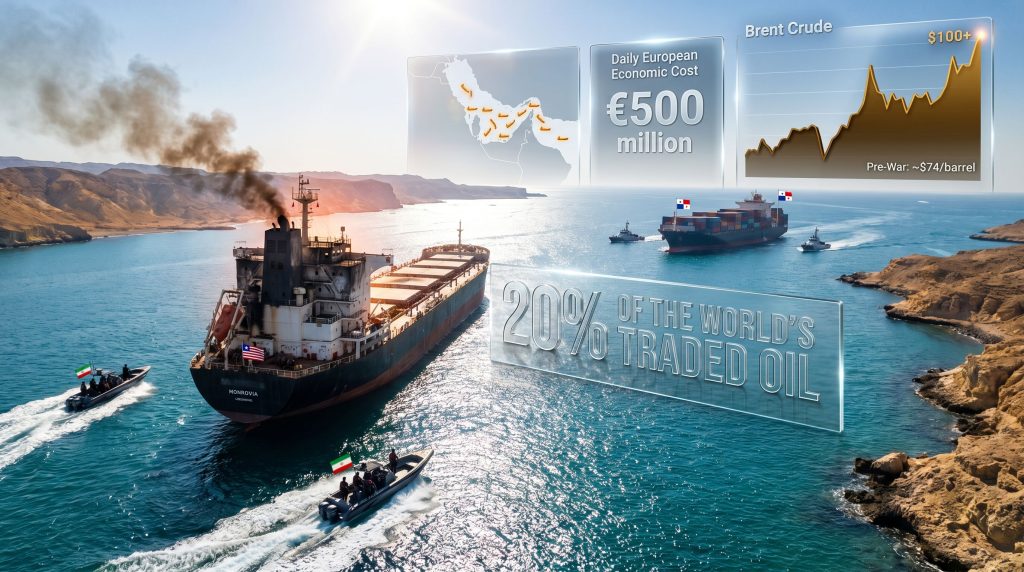
Energy security analysts have warned for decades that a single chokepoint holds disproportionate power over the global economy. No pipeline network, no alternative shipping corridor, and no strategic reserve system has ever been able to fully offset what the Strait of Hormuz provides in peacetime: the uninterrupted flow of roughly 20 percent of the world's traded oil through a passage barely 33 kilometres wide at its narrowest point. That vulnerability, long theorised in war-game scenarios, is no longer hypothetical.
In late April 2026, Iran fires on ships in the Strait of Hormuz have become a defining feature of an active conflict that began on February 28, 2026, when a surprise US-Israeli strike on Iran triggered a multi-front war across the Middle East. What started as an aerial and missile exchange has migrated decisively to the maritime domain, where Iran holds a structural geographic advantage that no amount of airpower can easily neutralise.
When big ASX news breaks, our subscribers know first
How the Strait Became a Theatre of War
The Strait of Hormuz sits between Iran's southern coastline to the north and Oman's Musandam Peninsula to the south. This geography is not merely a geographic footnote. It is the source of Iran's most potent asymmetric leverage. From its northern coastline, Iran can deploy fast-attack craft, coastal radar systems, and maritime interdiction teams against commercial shipping with minimal capital investment relative to the economic damage it can inflict on adversaries thousands of kilometres away.
As aerial strikes gave way to ceasefire negotiations, Iran shifted its primary coercive instrument from missiles to maritime interdiction. The logic is straightforward: the current ceasefire framework halts bombing campaigns and missile exchanges, but it contains no binding provisions governing naval operations. That definitional gap has become the central fault line of the conflict, further compounding the geopolitical trade tensions already destabilising global supply chains.
On April 22 and 23, 2026, Iranian Revolutionary Guard Corps (IRGC) naval forces fired upon and seized two commercial cargo vessels transiting the strait, while attacking a third. The incidents were not isolated provocations. They represented the tactical expression of a broader strategic posture.
The Vessels, the Tactics, and the Damage
The sequence of events across those two days followed a pattern that maritime security experts recognise from prior IRGC operations, but with a significant escalation in aggression.
| Vessel | Flag State | Incident | Bridge Damage | Crew Casualties |
|---|---|---|---|---|
| Epaminondas | Liberia | Fired upon; seized and escorted to Iran | Yes | None reported |
| MSC Francesca | Panama | Fired upon; seized and escorted to Iran | Not specified | None reported |
| Euphoria | Not specified | Attacked after becoming stranded near Iranian coast | Not specified | Not specified |
Technomar, the management company responsible for the Liberian-registered Epaminondas, confirmed the vessel was approached and fired upon by a manned gunboat off the coast of Oman, with the ship's bridge sustaining damage in the engagement. A second cargo vessel came under fire hours later, and both ships were subsequently escorted into Iranian waters by IRGC personnel described in regional media reports as masked commandos operating from speedboats.
Panama's government issued a formal condemnation of the seizure of the MSC Francesca, characterising it as an illegal act constituting a serious attack on international maritime security. Washington's response was notably different: White House Press Secretary Karoline Leavitt stated publicly that because the seized vessels were neither American nor Israeli flagged, their seizure did not constitute a violation of ceasefire terms. (Arab News, April 23, 2026)
That definitional distinction has become one of the most consequential and contested elements of the entire standoff.
The Economic Shockwave Radiating From the Strait
The strategic importance of the Strait of Hormuz is not abstract. It transmits directly into consumer prices, corporate costs, and macroeconomic stability across three continents. Furthermore, the oil market disruption stemming from these incidents has reverberated well beyond the immediate conflict zone.
Oil Markets Under Sustained Pressure
Brent crude, the international benchmark, crossed $100 per barrel in the weeks following the conflict's outbreak, marking a 35 percent increase above pre-war levels that hovered around $74 per barrel. That single data point encapsulates the scale of the supply disruption flowing from the maritime confrontation. (Arab News, April 23, 2026)
| Metric | Pre-War Level | April 2026 Level | Change |
|---|---|---|---|
| Brent Crude Oil Price | ~$74/barrel | $100+/barrel | +35% |
| Daily European Economic Cost | Negligible | €500M (~$600M USD) | Ongoing |
| US Vessels Redirected by Blockade | 0 | 31 vessels turned back | Active blockade |
| Sanctioned/Iranian Tanker Movements (post-April 13) | Baseline | 34 recorded | 19 outbound, 15 inbound |
| Confirmed Iranian Crude Outbound | Baseline | ~10.7 million barrels | 6 laden movements |
EU Energy Commissioner Dan Jørgensen quantified the damage to Europe specifically, estimating that the disruption is costing the continent approximately €500 million per day, roughly equivalent to $600 million USD. He drew direct comparisons to the most severe energy crises of the past 50 years, a reference that invokes both the 1973 OPEC oil embargo and the 2021-2022 European gas crisis triggered by Russia's war in Ukraine. (Arab News, April 23, 2026)
The broader picture of oil prices and geopolitics illustrates how deeply intertwined energy markets and international conflict have become, particularly when chokepoints like the Strait of Hormuz are involved.
Iran Is Still Moving Oil Despite the Blockade
One of the less widely appreciated dynamics of the current standoff involves the continued movement of Iranian crude despite the US naval blockade imposed on April 13, 2026. Freight and energy analytics firm Vortexa tracked 34 movements of sanctioned and Iranian-linked tankers in and out of the Arabian Gulf in the single week following the blockade's imposition.
Of those 34 movements, 19 were outbound and 15 were inbound. Critically, six of the outbound movements were confirmed as carrying Iranian crude, representing approximately 10.7 million barrels of oil. Whether all of those barrels reached international markets remained unconfirmed as of the time of reporting. (Arab News, April 23, 2026, citing Vortexa)
This data point reveals an underappreciated tension in sanctions enforcement: the US blockade is creating significant friction on commercial shipping, but it has not fully severed Iran's ability to export crude through alternative logistics involving sanctioned tanker networks.
This dynamic mirrors patterns observed during previous sanctions regimes against Iran. Between 2019 and 2023, Iran maintained substantial oil exports to China and other markets despite US maximum pressure campaigns, largely through ship-to-ship transfers, flag-of-convenience vessels, and falsified cargo documentation. The current crisis appears to be activating similar workaround mechanisms, though at reduced volumes.
Why Equity Markets Are Defying the Energy Shock
One of the more striking features of the current crisis is the apparent disconnect between surging energy prices and relatively stable equity markets. Stock markets, at least as of late April 2026, appear to be absorbing the shock without capitulating. However, the market volatility reset already underway in global financial systems suggests that resilience may be more fragile than headline indices imply.
Historical precedent suggests this resilience has limits. During the 1973 Arab oil embargo, markets initially absorbed the price shock before declining sharply over the following months as inflation and supply chain disruptions compounded. During the 1990 Gulf War, Brent crude nearly doubled in price between August and October before retreating as the conflict's scope became clearer. In both cases, the critical variable was duration: short disruptions were absorbed; prolonged ones were not.
The relevant question for 2026 is at what oil price threshold, and over what sustained time period, market resilience breaks down. The aviation sector has emerged as a particular vulnerability, with analysis suggesting that a prolonged Hormuz closure could create jet fuel supply constraints severe enough to ground European airlines within weeks. (Arab News, April 22, 2026)
Why Diplomacy Has Stalled
The first round of US-Iran negotiations took place in Islamabad, with Iranian parliament speaker Mohammad Bagher Ghalibaf leading Tehran's delegation and meeting US Vice President JD Vance. Those talks produced no resolution, and the pathway to a second round has since closed, at least temporarily.
Iran's position is that any further negotiations are contingent on the lifting of the US naval blockade of Iranian ports. The Iranian mission in Egypt communicated directly to the Associated Press that no delegation would travel to Pakistan for a second round of talks while the blockade remained in force. Iranian Foreign Ministry spokesperson Esmail Baghaei accused Washington of demonstrating disregard and a lack of good faith in the negotiating process. (Arab News, April 23, 2026)
The structural contradiction at the heart of the ceasefire is this: the aerial dimension of the conflict has been paused, but the maritime dimension was never included in the ceasefire's terms. Both sides therefore have a legal basis for claiming the other is the aggressor, while simultaneously insisting they themselves are acting within the ceasefire framework.
Ghalibaf articulated Iran's position directly: a ceasefire that permits a naval blockade of Iranian ports is not a genuine ceasefire. The US position, as articulated by Leavitt, is that the blockade and the seizure of non-US, non-Israeli vessels are separate matters that do not fall within the ceasefire's scope. (Arab News, April 23, 2026)
This definitional dispute is not merely semantic. It is preventing the resumption of talks and creating conditions for further maritime escalation.
Three Scenarios for Resolution
Given the current impasse, strategic analysts would typically model the conflict's trajectory across a range of possible outcomes:
Scenario A: Negotiated Maritime Framework (Lower Probability, Near-Term)
- Both parties agree to a phased mutual withdrawal from maritime interdiction operations
- The strait reopens to commercial traffic under international monitoring
- Brent crude retreats toward $80 per barrel; European daily losses stabilise
Scenario B: Protracted Stalemate (Moderate Probability)
- The aerial ceasefire holds but maritime confrontations continue and periodically intensify
- Global shipping companies accelerate rerouting around the Cape of Good Hope, adding 10 to 14 days to transit times and significantly elevating freight costs
- Oil remains above $95 per barrel; food and consumer goods inflation compounds globally
Scenario C: Full Maritime Escalation (Lower Probability, Highest Impact)
- A US or allied naval vessel is struck by IRGC forces, triggering direct military engagement at sea
- The strait closes entirely to commercial traffic for an extended period
- Brent crude surpasses $130 per barrel; global recession risk rises sharply
The Broader Conflict: Lebanon, Human Costs, and Ripple Effects
The maritime confrontation in the strait is occurring against a backdrop of ongoing conflict across multiple theatres. In southern Lebanon on April 23, 2026, three separate Israeli strikes killed at least six people and wounded others, according to Lebanese authorities. Israel denied carrying out one of the strikes and did not comment immediately on the others. (Arab News, April 23, 2026)
Among the confirmed fatalities was Lebanese journalist Amal Khalil, a correspondent for the daily Al-Akhbar, whose body was recovered from rubble in the village of Al-Tiri. Lebanese health authorities reported that a rescue team searching for Khalil was initially unable to reach her as Israeli forces fired toward an ambulance in the area. Israel denied targeting journalists or preventing rescue operations.
French President Emmanuel Macron confirmed that a French UNIFIL peacekeeper wounded during a weekend attack attributed to Hezbollah had died of his wounds, adding to the toll among international peacekeeping forces operating in southern Lebanon.
Confirmed Conflict Casualties Since February 28, 2026
| Group | Confirmed Deaths |
|---|---|
| Iran | At least 3,375 |
| Lebanon | More than 2,290 |
| Israel (civilians) | At least 23 |
| Gulf Arab states | More than a dozen |
| Israeli soldiers (Lebanon) | 15 |
| US service members | 13 |
Source: Arab News, April 23, 2026, citing authorities
The conflict's effects extend well beyond the immediate combat zone. Communities in rural Sudan have reported critical shortages of medicines linked directly to supply chain disruptions caused by the war. Ukrainian President Volodymyr Zelenskyy warned that a prolonged Iran conflict increases the risk that Ukraine will be unable to secure missile defence systems it requires. Separately, the US reportedly blocked a $500 million cash shipment to Iraq over attacks on American interests by pro-Iran factions. (Arab News, April 23, 2026)
International Maritime Law: Is Iran Committing Piracy?
The legal characterisation of Iran's actions in the strait carries significant implications beyond the immediate military standoff. Under the United Nations Convention on the Law of the Sea (UNCLOS), the Strait of Hormuz is subject to the right of transit passage for all vessels, including warships, as an international strait used for navigation between one area of the high seas and another.
Iran's position, at least implicitly, is that vessels transiting the strait without its authorisation during an active conflict are subject to its wartime maritime jurisdiction. US officials have characterised IRGC tactics — including firing on vessels from armed speedboats, boarding operations by masked commandos, and the laying of mines — as acts of piracy under international maritime law. For further context on how OPEC's market influence intersects with these maritime developments, the broader energy geopolitics picture is instructive.
Panama's formal condemnation of the MSC Francesca seizure as an illegal act reinforces the view that a significant portion of the international community regards Iran's interdiction operations as falling outside the bounds of lawful naval action.
The precedent question extends beyond the current conflict. If Iran's requirement that vessels seek permission before transiting the strait is allowed to stand without meaningful international legal challenge, it would constitute a fundamental challenge to the principle of innocent passage and transit passage rights under UNCLOS. The implications for global shipping insurance, vessel routing economics, and maritime legal frameworks would outlast the immediate military confrontation by years, if not decades.
Historical context is instructive here. The Iran-Iraq Tanker War of the 1980s, during which both sides attacked commercial shipping in the Persian Gulf, permanently reshaped the maritime insurance market. War risk premiums in the Persian Gulf did not return to pre-conflict levels for years after the hostilities ended, and the Lloyd's of London market introduced structural changes to war risk coverage that persist to this day. PBS NewsHour's coverage of Iran firing on ships in the strait provides additional detail on how these incidents have complicated ceasefire efforts.
The next major ASX story will hit our subscribers first
FAQ: Iran Fires on Ships in the Strait of Hormuz
How Many Ships Has Iran Fired On or Seized?
Iran fired upon and seized two commercial cargo vessels, the Epaminondas and the MSC Francesca, on April 22 and 23, 2026, and separately attacked a third vessel identified as the Euphoria. More than 30 attacks on shipping across the broader Middle East region have been recorded since the war began on February 28, 2026. (Arab News, April 23, 2026)
Why Is the Strait of Hormuz So Critical to Global Oil Supply?
Approximately 20 percent of the world's traded oil transits the Strait of Hormuz under peacetime conditions. Its disruption compresses global supply directly, contributing to Brent crude rising more than 35 percent above pre-war levels to exceed $100 per barrel. (U.S. Energy Information Administration; Arab News, April 23, 2026)
Does the Ceasefire Cover the Maritime Attacks?
No. The current ceasefire applies only to aerial strikes and missile exchanges. The maritime blockade maintained by both the US and Iran continues, and each side disputes whether the other's naval actions constitute violations of ceasefire terms. Time Magazine's reporting on the Strait of Hormuz attacks offers a useful breakdown of how this ambiguity is shaping diplomatic efforts.
What Is the Economic Cost of the Disruption to Europe?
EU Energy Commissioner Dan Jørgensen estimated the disruption is costing Europe approximately €500 million per day, with long-term consequences for consumers and businesses comparable to the major energy crises of the past half-century. (Arab News, April 23, 2026)
Is Iran Still Exporting Oil Despite the US Blockade?
Vortexa's tracking data identified six outbound tanker movements confirmed as carrying Iranian crude in the week after the US imposed its blockade on April 13, 2026, representing approximately 10.7 million barrels. Whether those cargoes reached international markets remained unconfirmed at the time of reporting. (Arab News, April 23, 2026, citing Vortexa)
The Strategic Outlook: How Long Can This Standoff Last?
Iran's capacity to sustain maritime interdiction operations rests on an asymmetry that favours the defender in a geographic chokepoint. The IRGC can inflict enormous economic damage on global energy markets using fast-attack craft and coastal assets that represent a fraction of the cost of the naval forces required to counter them. This asymmetry is a fundamental feature of the strait's geography, not a temporary tactical advantage.
However, Iran's domestic economic position is severely compromised. A war-devastated economy, reduced oil export revenues, mounting civilian hardship, and a public grappling openly with uncertainty about the conflict's trajectory all create internal pressure on Tehran's leadership. One Tehran resident, 59-year-old Mashallah Mohammad Sadegh, captured the public mood clearly: people want to know where the situation stands, whether the path forward is ceasefire, peace, or continued war, because under current conditions it is impossible to plan. (Arab News, April 23, 2026)
For Washington, the strategic dilemma is equally constraining. Maintaining maximum pressure through the naval blockade preserves economic leverage over Iran, but every day that the blockade continues increases the probability of a maritime incident severe enough to trigger direct naval engagement. US Central Command has deployed AH-64 Apache helicopter patrols over the strait as a deterrence signal, but deterrence and escalation management become increasingly difficult to balance as both sides conduct active interdiction operations in a confined waterway.
Any durable resolution would require, at minimum:
- A mutual and verifiable withdrawal from maritime interdiction as a precondition for substantive diplomatic engagement
- Third-party monitoring of strait access, potentially under a United Nations or Gulf Cooperation Council framework
- A broader diplomatic package addressing Iran's nuclear programme, sanctions relief, and regional security architecture
The Strait of Hormuz crisis is not purely a bilateral dispute between Washington and Tehran. It is a systemic stress test of the global energy order, international maritime law, and the capacity of multilateral diplomacy to function under active conflict conditions.
The world is watching a chokepoint that was always described as too important to close. The evidence of late April 2026 — with Iran fires on ships in the Strait of Hormuz now an established pattern rather than a one-off provocation — suggests that assumption was dangerously optimistic.
Disclaimer: This article contains forward-looking analysis, scenario modelling, and projections based on information available as of April 23, 2026. Geopolitical situations of this nature are inherently dynamic and subject to rapid change. Nothing in this article constitutes financial, investment, or legal advice. Readers should consult qualified professionals before making decisions informed by the economic or market analysis presented here.
Want to Stay Ahead of the Market Disruptions Driving Commodity Prices?
When geopolitical shockwaves like the Strait of Hormuz crisis send energy and commodity markets into turmoil, identifying the right ASX mineral discoveries at the right moment becomes critical — and Discovery Alert's proprietary Discovery IQ model delivers real-time alerts the moment significant discoveries hit the ASX, turning complex market data into actionable opportunities. Explore how historic mineral discoveries have generated substantial returns by visiting Discovery Alert's dedicated discoveries page, and begin your 14-day free trial today to position yourself ahead of the next major market move.