August 8, 2026
The global energy system faces unprecedented challenges as maritime chokepoints become central to international conflicts. The Strait of Hormuz blockade represents one of the most significant threats to energy security, with this critical waterway handling approximately one-third of all seaborne-traded oil. Furthermore, understanding how these disruptions create cascading effects across financial markets, supply chains, and diplomatic relationships becomes essential for assessing long-term economic stability.
Understanding the Geopolitical Chokepoint Crisis
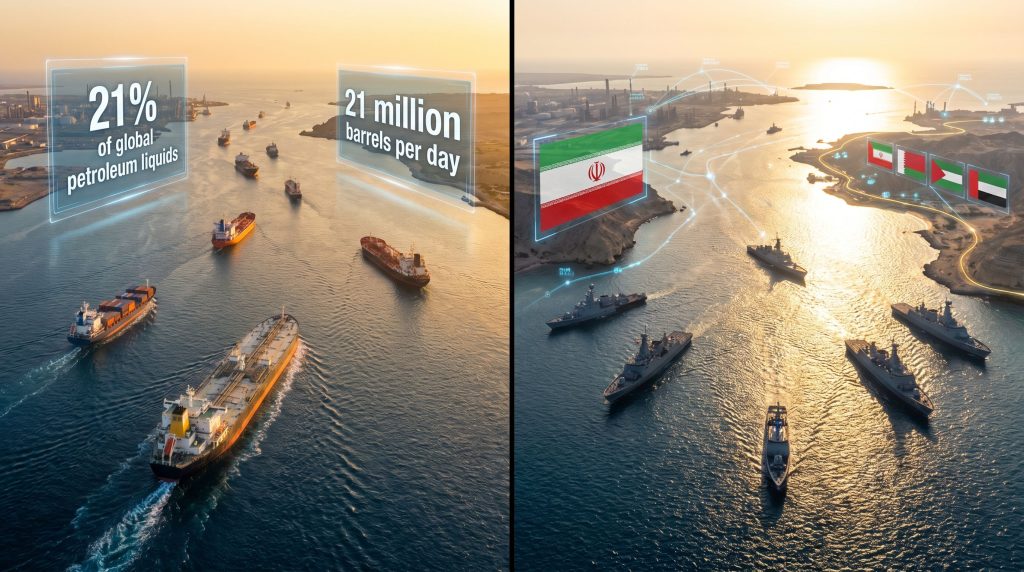
The Strait of Hormuz represents the world's most critical energy transit bottleneck, with approximately 21-22 million barrels per day flowing through its narrow shipping channels according to the U.S. Energy Information Administration. This waterway handles roughly one-third of all seaborne-traded oil, making it a focal point for understanding systemic energy supply vulnerabilities during periods of maritime conflict.
Current Transit Data and Market Impact:
• Transit volume reduction: Commercial traffic through the Strait has decreased to minimal levels during blockade periods
• Price volatility: WTI and Brent crude experiencing significant swings between $89-100 range during crisis periods
• Geographic constraints: Only 21 nautical miles wide at its narrowest point between Musandam Peninsula and Iranian coast
• Shipping lane limitations: Separated 2-nautical-mile corridors in each direction per International Maritime Organization guidelines
The strategic importance extends beyond volume metrics due to the Strait's unique geographic configuration. Under the United Nations Convention on the Law of the Sea (UNCLOS) Articles 37-38, the waterway qualifies as an international strait with established transit passage rights. However, these rights face challenges during geopolitical tensions, creating legal and practical complications for commercial shipping.
Historical precedents demonstrate the market sensitivity to Strait of Hormuz disruptions:
• 2011 Iranian threat: Crude oil prices spiked from approximately $100 to $103 per barrel within days when Iranian officials threatened closure
• 1980s Tanker War: Despite 546 vessel attacks during the Iran-Iraq conflict, the Strait remained partially operational throughout the period
• Current situation: Reports indicate "First Crude Cargo Clears Hormuz Since U.S. Blockade Began" as of April 2026
The zero-redundancy nature of this chokepoint means no alternative water route exists for pipeline capacity diversion. In addition, seasonal considerations further complicate transit during crisis periods, with monsoon patterns from June through September adding navigational challenges to an already constrained shipping environment.
When big ASX news breaks, our subscribers know first
How Do Naval Blockades Reshape Global Oil Flow Patterns?
Naval blockades create immediate dislocation between physical crude markets facing supply constraints and financial futures markets incorporating expectations of conflict resolution. This dual-market dynamic manifests in specific pricing patterns that reveal the true extent of supply chain stress beyond traditional hedging mechanisms.
The current oil price rally demonstrates how geopolitical tensions amplify market volatility. However, these disruptions also create opportunities for alternative suppliers to capture market share through strategic positioning.
Transit Volume Impact and Alternative Routing:
Market data from April 2026 shows substantial supply chain adaptation, with South Korea securing 273 million barrels of crude that bypasses Hormuz transit routes entirely. This represents proactive procurement strategies designed to avoid chokepoint dependencies during extended crisis periods.
Alternative routing cost calculations reveal the economic burden of blockade scenarios:
• Red Sea routing: Additional 3,000-6,000 nautical miles to tanker voyages
• Transit time increase: 10-15 additional days for alternative routes
• Fuel consumption: Additional 150-200 tons of bunker fuel at $600-700 per ton
• Total cost impact: Approximately $1.55-3.07 per barrel in additional transportation costs
These calculations demonstrate how alternative routing creates genuine economic pressures beyond speculative premium pricing. Consequently, the additional time value and insurance costs compound the fuel expense burden, making alternative routes significantly more expensive than normal Strait transit.
U.S. Export Surge as Substitution Evidence:
During disruption periods, U.S. crude exports climbed to approximately 5.2 million barrels per day, highlighting the substitution effect where non-Gulf producers capture incremental demand from Europe and Asia seeking to bypass blocked routes. This represents U.S. Gulf Coast producers operating near capacity to serve as swing supply during global supply disruptions.
Furthermore, the US oil production decline adds complexity to global supply rebalancing efforts during crisis periods.
Insurance Premium Mechanics and War Risk Assessment
War risk insurance rates typically operate under the following structure during crisis periods:
• Pre-crisis baseline: 0.015-0.025% of cargo value per voyage
• Crisis premium: 0.075-0.125% of cargo value (representing 3-5x multiplier)
• Cargo impact: For $150 million cargo loads, insurance costs increase from $22,500-37,500 to $112,500-187,500
The physical market tightness becomes evident when spot crude prices surge well above futures contracts, indicating buyers' willingness to pay immediate supply premiums rather than accept future delivery commitments. This spread between physical and futures represents pure disruption premium, reflecting genuine near-term scarcity rather than speculative positioning.
Which Energy Infrastructure Becomes Critical During Maritime Conflicts?
Pipeline bypass capacity assumes paramount importance during maritime blockades, with specific infrastructure assets becoming strategic alternatives for maintaining global energy flows. The following table details verified alternative export routes and their operational status:
| Pipeline Route | Capacity (mbpd) | Current Status | Strategic Value |
|---|---|---|---|
| East-West Pipeline (Saudi) | 5.0 | Operational | Critical Red Sea bypass |
| Abu Dhabi Crude Oil Pipeline | 1.8 | Active | Gulf of Oman terminals |
| Baku-Tbilisi-Ceyhan (BTC) | 1.0 | 70% utilisation | Caspian Sea access |
| Kirkuk-Ceyhan (Iraq) | 1.6 design | 0.8-1.1 actual | Constrained by supply |
Saudi Arabia's East-West Pipeline represents the most significant bypass infrastructure, transporting crude from Eastern Province fields to Yanbu terminal on the Red Sea. With approximately 5 million barrels per day capacity, this pipeline provides meaningful but insufficient substitution for complete Strait closure, representing roughly 25% of Saudi total export capacity.
Regional Production Rebalancing Constraints
While Saudi Arabia maintains approximately 2.0-2.5 million barrels per day of spare capacity and the UAE holds 1.0-1.5 million barrels per day above current production, deploying this capacity during simultaneous infrastructure damage creates operational challenges. Current reports indicate Middle East energy infrastructure damage approaching $60 billion, complicating rapid capacity activation.
Moreover, these energy security challenges extend beyond immediate production concerns to encompass long-term infrastructure resilience planning.
Non-Gulf Producer Supply Response:
Norway's strategic position has become evident through oil export earnings surging 68% during the current crisis period. With stable production around 1.7 million barrels per day, Norway benefits from geographic proximity to European markets and established infrastructure capacity.
Brazil's pre-salt production at approximately 2.9 million barrels per day provides geographic advantages for Atlantic basin markets, though the country operates near capacity with limited spare production availability.
Canadian oil sands production maintains approximately 4.5 million barrels per day output, but Canadian oil companies indicate they will "hold back investment despite windfall profits," suggesting capacity constraints despite favourable pricing conditions.
Combined non-Gulf spare capacity totals approximately 1.0-1.5 million barrels per day, demonstrating limited ability to offset complete Strait closure through alternative production alone.
Strategic Petroleum Reserve Coordination
International Energy Agency assessments suggest oil and gas recovery could require two years after war damage, indicating coordination discussions focus on extended emergency protocols rather than short-term releases. While specific deployment volumes remain undisclosed, the 60-90 day emergency stock deployment framework requires coordination among IEA member nations maintaining 90-day import coverage requirements.
What Are the Economic Cascade Effects of Energy Chokepoint Disruptions?
Economic modelling suggests each $10 oil price increase correlates with 0.2-0.4% GDP reduction in major economies, though this relationship varies significantly based on energy intensity, import dependency, and monetary policy responses. The current energy price environment creates measurable economic pressures across multiple sectors and geographic regions.
These economic impacts intersect with broader concerns about trade war impacts and US economy & inflation pressures.
Macroeconomic Impact Channels
Energy costs represent 7-12% of consumer price indices globally, creating direct inflation transmission mechanisms when supply disruptions drive sustained price increases. Central banks face complex policy choices between accommodating energy price shocks and maintaining price stability targets during extended disruption periods.
International Energy Agency demand analysis warns that prolonged high prices could reduce global oil consumption, creating automatic market balancing mechanisms that partially offset supply shortfalls. This demand destruction effect represents a critical constraint on production substitution effectiveness during extended crises.
Sectoral Vulnerability Assessment
Aviation industry exposure reaches 25-30% of operating costs tied directly to fuel prices, making airlines particularly vulnerable to sustained energy price increases. Recent data shows immediate impact on operational planning and route optimisation strategies.
Shipping sector costs demonstrate 40-50% dependence on bunker fuel pricing, with tanker charter rates climbing above $100,000 per day for Very Large Crude Carriers during crisis periods compared to normal rates below $50,000 per day.
Petrochemical industry feedstock costs maintain 60-70% linkage to crude oil derivatives, forcing production cuts as input costs climb. Chinese petrochemical sector data shows output reductions as production economics deteriorate during supply disruptions.
Power generation exposure varies by region, with natural gas-dependent areas facing 15-25% fuel cost exposure as energy markets experience cross-commodity correlations above 0.85 during crisis periods.
Regional Economic Adaptation Patterns
Asia-Pacific nations demonstrate particular vulnerability due to energy import dependency, with countries like Japan deploying $10 billion in assistance to help Southeast Asian nations cope with oil price shocks. This regional cooperation framework indicates recognition of systemic economic risks from sustained energy disruptions.
India's economic response includes central bank guidance directing oil refiners to stop buying dollars on spot markets, suggesting foreign exchange pressures from elevated energy import costs. These currency management measures indicate broader balance of payments impacts beyond direct energy costs.
How Do Financial Markets Price Extended Geopolitical Risk?
Financial market mechanisms reveal sophisticated risk pricing structures during extended geopolitical disruptions. Commodity markets demonstrate specific patterns that illuminate trader expectations about conflict duration, resolution probability, and long-term supply relationships.
Contango Curve Dynamics and Volatility Expansion
Forward crude oil curves steepen into contango structures reflecting 18-24 month supply normalisation expectations, with traders pricing extended disruption scenarios into longer-dated contracts. Options markets simultaneously expand volatility surfaces to 40-60% annual volatility compared to historical ranges of 25-30%.
Physical-Financial Market Divergence
The separation between physical crude markets and financial futures contracts creates measurable arbitrage opportunities. Physical market premiums above futures indicate genuine supply scarcity rather than speculative positioning, with buyers willing to pay immediate premiums rather than accept future delivery commitments.
Cross-Commodity Correlation Intensification
Natural gas, refined products, and crude oil demonstrate correlation coefficients above 0.85 during crisis periods, compared to normal correlations around 0.60-0.70. This correlation expansion indicates systemic energy market stress beyond individual commodity fundamentals.
Equity Market Sector Rotation Analysis
Energy sector performance patterns during supply disruptions show consistent characteristics:
• Upstream producers: 15-25% outperformance during crisis periods due to higher commodity prices
• Integrated oil companies: 10-15% premium driven by refining margin expansion
• Renewable energy stocks: 5-10% defensive premium as energy security concerns intensify
• Transportation sectors: 10-20% underperformance reflecting fuel cost pressures
World's top oil companies are positioned to generate an additional $234 billion in profits during the current crisis period, demonstrating the wealth transfer effects of supply disruption premiums from consumers to producers.
Currency and Bond Market Responses
Energy-importing nations experience currency pressures as elevated import costs strain current accounts, while energy-exporting countries benefit from improved terms of trade. Government bond markets reflect these dynamics through yield differentials that price fiscal impact expectations across different economic exposure profiles.
What Strategic Adaptations Emerge from Prolonged Energy Disruptions?
Extended energy disruptions accelerate structural changes in global energy infrastructure, supply chain design, and technology adoption timelines. These adaptations reflect both immediate crisis response requirements and longer-term strategic repositioning by governments and corporations.
Supply Chain Resilience Investment Priorities
Consumer nations actively reduce single-source dependencies below 30% thresholds through diversified procurement strategies. Long-term bilateral energy security agreements expand as countries seek stable supply relationships outside traditional spot market mechanisms.
Critical energy facilities receive enhanced physical and cyber security investments, recognising infrastructure vulnerability as national security priorities. These hardening measures extend beyond traditional production assets to include pipeline networks, storage facilities, and transportation hubs.
Technology Acceleration and Energy Transition Timeline Compression
Electric vehicle adoption curves demonstrate measurable acceleration during energy crisis periods, with purchase decisions influenced by fuel price volatility and supply security concerns. Renewable energy deployment similarly accelerates 20-30% above baseline projections as governments and corporations prioritise energy independence.
Energy storage investments increase 40-50% annually during crisis periods as grid operators seek to maximise renewable energy utilisation while maintaining system reliability. Alternative fuel development receives enhanced government funding support, though specific amounts vary by jurisdiction and technology focus.
Iran war developments have generated Chinese electric vehicle and battery export surges during Q1 2026, demonstrating how geopolitical disruptions accelerate clean energy technology adoption across global markets.
Infrastructure Diversification Strategies
European buyers actively pursue Canadian LNG to diversify supply sources away from traditional suppliers, while Asian consumers explore similar geographic diversification approaches. These long-term procurement strategies reflect permanent shifts in trade patterns beyond immediate crisis response.
Pipeline infrastructure expansion faces engineering and permitting constraints that limit rapid deployment, with realistic expansion timelines ranging from 6-24 months depending on project scope and regulatory requirements. East-West Pipeline capacity increases and similar projects require substantial capital investment and technical expertise.
The next major ASX story will hit our subscribers first
Which Diplomatic Resolution Pathways Offer Market Stability?
Diplomatic resolution frameworks focus on specific mechanisms for restoring commercial navigation while addressing underlying geopolitical tensions. Market stability requires addressing both immediate transit passage restoration and longer-term conflict prevention structures.
Multilateral Engagement and International Law Framework
United Nations Security Council mediation involving permanent members provides formal diplomatic channels, though effectiveness depends on consensus among major powers with differing strategic interests. Regional stakeholder inclusion through Gulf Cooperation Council nations, Turkey, and India as transit state mediators offers additional diplomatic pathways.
UNCLOS Article 38 transit passage rights restoration requires international legal enforcement mechanisms that operate effectively during conflict periods. Economic incentive structures linking sanctions relief to specific waterway reopening commitments provide concrete diplomatic leverage points.
The Iran sanctions framework demonstrates how economic pressure can influence maritime policy decisions, though long-term effectiveness requires broader multilateral cooperation.
Current Diplomatic Developments
Reports suggest "Iran Showing Signs of Capitulating Over Strait Of Hormuz" while "Trump Says Iran War Is 'Very Close to Over,' Hints at Deal This Week" indicate active diplomatic progress. However, "US-Iran Talks to Span Past Summer As Oil Flows Remain Disrupted" suggests extended negotiation timelines despite optimistic rhetoric.
Analysis of the potential economic implications shows how Iran views the Strait as a strategic leverage tool beyond immediate military objectives.
Market Confidence Restoration Indicators
Specific benchmarks signal supply normalisation progress:
• Insurance rate normalisation: Commercial shipping insurance rates returning to pre-crisis levels below 0.025% of cargo value
• Charter rate decline: VLCC tanker rates falling below $100,000 per day from current elevated levels
• Futures curve adjustment: Crude oil futures shifting from backwardation to normal contango structure
• Regional price convergence: Price differentials narrowing to historical 5-10% ranges between regional benchmarks
Lebanon ceasefire developments and potential Iran peace talks have already demonstrated market sensitivity to diplomatic progress, with oil prices declining on positive negotiation news. This responsiveness indicates trader expectations that diplomatic solutions remain viable despite current tensions.
Long-term Stability Mechanisms
Sustainable resolution requires addressing root causes beyond immediate transit access. International monitoring frameworks, regional security cooperation agreements, and economic integration projects could provide structural stability that reduces future disruption risks.
Energy infrastructure protection protocols and multilateral navigation security arrangements offer technical frameworks for maintaining commercial access during political tensions, though implementation requires sustained international cooperation commitment.
The Strait of Hormuz blockade scenario illuminates the interconnected nature of global energy security, financial markets, and geopolitical stability. Strategic scenario modelling reveals how maritime chokepoints create systemic vulnerabilities that extend far beyond traditional supply and demand analysis. Market responses demonstrate the rapid transmission of geopolitical risks through interconnected global systems, while adaptation strategies indicate both immediate crisis management requirements and longer-term structural changes in energy infrastructure and trade patterns.
Resolution timelines remain highly dependent on diplomatic progress, regional stability considerations, and the willingness of all parties to prioritise economic stability over geopolitical positioning. The current situation serves as a critical test case for international crisis management capabilities and energy system resilience in an increasingly complex geopolitical environment.
This analysis is based on publicly available information and market data as of April 2026. Energy markets remain highly volatile during periods of geopolitical tension, and actual outcomes may differ significantly from scenario modelling projections. Readers should consult current market data and professional analysis for investment and policy decisions.
Looking to Capitalise on Energy Market Volatility?
Discovery Alert's proprietary Discovery IQ model provides instant notifications on significant ASX mineral discoveries, particularly relevant during periods when traditional energy markets face disruption and investors seek alternative commodity exposure. Explore how historic discoveries have generated substantial returns during previous market crises, then begin your 14-day free trial to position yourself ahead of the market in these volatile times.