
June 17, 2026
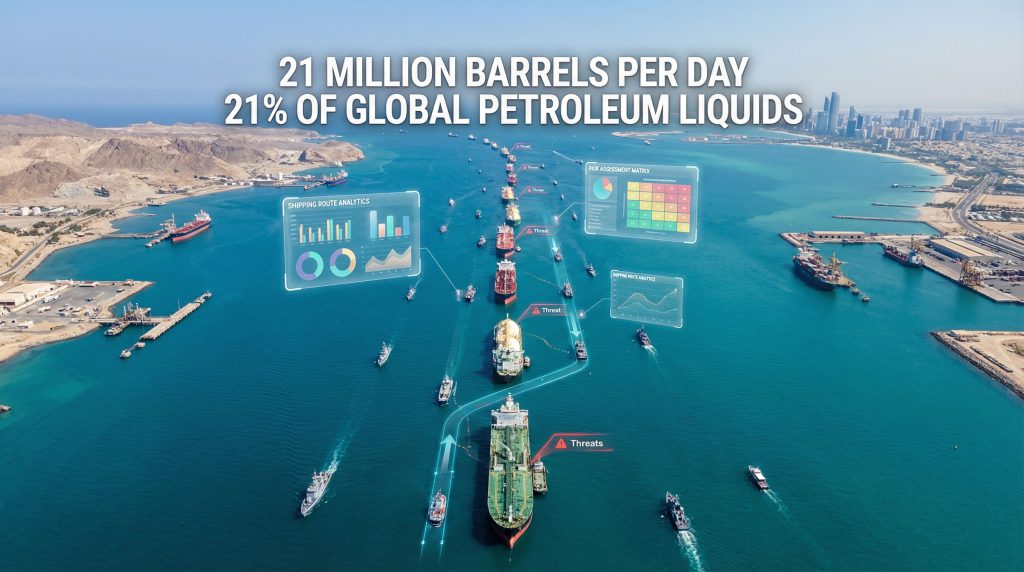
The global energy trade faces unprecedented challenges as geopolitical tensions and declining US oil production reshape maritime security dynamics. Maritime chokepoints represent the most vulnerable nodes in global supply chain architecture, where single geographic constraints can trigger cascading economic disruptions across continents. These narrow waterways concentrate enormous volumes of international trade through spaces that can be measured in miles rather than hundreds of kilometers, creating systemic vulnerabilities that extend far beyond their immediate geographic boundaries.
Understanding the strategic dynamics surrounding safe passage through the Strait of Hormuz requires analysing multiple layers of risk, from technical navigation challenges to geopolitical enforcement mechanisms that can reshape global energy markets within hours.
What Makes the Strait of Hormuz Critical for Global Energy Security?
Geographic Chokepoint Analysis
The Strait of Hormuz functions as the primary arterial connection between Persian Gulf energy production and global markets, with its strategic positioning creating an unavoidable dependency for energy-importing nations worldwide. This waterway measures approximately 21 miles (34 kilometers) at its narrowest point between Oman's Musandam Peninsula and the Iranian coastline, forming a natural bottleneck that concentrates maritime traffic into highly manageable surveillance zones.
Daily petroleum flows through the Strait reach 21 million barrels per day, representing approximately 21% of global petroleum liquids trade as of 2024. This volume translates to roughly $1.68-1.89 billion in petroleum value transiting daily, based on current market pricing between $80-90 per barrel. Additionally, the waterway handles approximately 25% of global liquefied natural gas (LNG) trade, making it equally critical for natural gas supply chains.
The concentration becomes even more pronounced when examining regional dependencies. The Asia-Pacific region receives approximately 80% of petroleum and LNG transiting the Strait, with major importers including:
- China: Relies on the Strait for approximately 40% of crude oil imports
- India: Significant dependency for energy security requirements
- Japan: Critical LNG supply route dependency
- South Korea: Essential for industrial energy needs
Europe receives approximately 8-10% of Strait transits, while the United States maintains minimal direct crude imports through the waterway but experiences substantial impacts through global price transmission mechanisms.
Economic Impact Multiplier Effects
The economic implications of Strait disruptions extend through multiple transmission channels that amplify initial supply shocks. Historical analysis demonstrates that supply disruptions at the Strait generate immediate global oil price increases of 3-5% per week during significant closure periods, with effects cascading through energy-dependent sectors including manufacturing, transportation, heating, and chemical production.
Furthermore, alternative routing economics reveal the magnitude of dependency on Strait transit. The Cape of Good Hope route adds approximately 6,000 additional nautical miles to Persian Gulf-to-Europe/Asia journeys, extending voyage times by 10-14 days and increasing costs by approximately $500,000-$1.2 million per tanker voyage depending on vessel size and current fuel prices.
The Suez Canal presents capacity limitations for potential rerouting, accommodating approximately 12,000 vessel transits annually (roughly 33 vessels daily) with current utilisation rates hovering near 85-90%. This leaves minimal flexibility for absorbing additional traffic diverted from Strait closures.
Pipeline alternatives face substantial capital requirements and development timelines. Major intercontinental pipeline projects typically require $8-15 billion in capital investment with multi-year construction periods, limiting their effectiveness as immediate alternatives to maritime transit.
When big ASX news breaks, our subscribers know first
How Do Current Geopolitical Tensions Affect Transit Safety?
Multi-Layered Threat Assessment Framework
Recent policy developments have fundamentally altered the operational environment for safe passage through the Strait of Hormuz. The ongoing trade war global impact has intensified regional tensions, while oil price trade war effects create additional volatility. On March 25-26, 2026, the Iranian Defence Council announced new conditions for transit, permitting passage only for what Iranian authorities term "non-hostile vessels" that meet specific criteria:
Conditional Access Requirements:
- Prior coordination with Iranian authorities
- Vessels must neither participate in nor support acts of aggression against Iran
- Full compliance with declared safety and security regulations
- Political acceptability based on flag state relationships
Iranian Foreign Minister Abbas Araghchi specifically identified China, Russia, India, Iraq, and Pakistan as nations whose vessels qualify for passage under this framework. This selective approach represents a significant departure from established international maritime law principles governing transit rights.
The severity of restrictions prompted UN Secretary-General António Guterres to issue a statement on March 26, 2026, declaring that prolonged closure of the Strait was choking the movement of oil, gas, and fertiliser at a critical moment in the global planting season. According to 22 nations ready for 'appropriate efforts' to ensure safe passage, multiple countries are coordinating response efforts to address the crisis.
International Maritime Law vs. Operational Reality
The legal framework governing Strait transit operates through the United Nations Convention on the Law of the Sea (UNCLOS) Articles 37-44, which establish "transit passage" rights for international straits. Under this framework:
- States possess transit passage rights through international straits used for international navigation
- Transit passage must be exercised without discrimination based on vessel origin or cargo
- Coastal states may establish safety regulations but cannot deny or hamper transit passage
- Article 44(2) specifically prohibits measures that "hamper the right of transit passage"
However, operational reality in March 2026 presents significant gaps between legal frameworks and enforcement capabilities. Iran's imposition of preconditions based on political alignment and mandatory coordination requirements effectively introduces discrimination mechanisms inconsistent with UNCLOS principles.
The enforcement capability depends on Iranian naval and coast guard resources relative to vessel traffic volumes. Historical precedent from the 1984 Tanker War demonstrates how geopolitical conflicts can override legal frameworks, when Iran and Iraq targeted merchant vessels despite international maritime law, forcing the deployment of international naval escorts.
Dispute Resolution Framework Limitations:
- UNCLOS Part XV establishes dispute resolution mechanisms but lacks rapid adjudication for real-time transit disputes
- Enforcement remains limited when disputes involve national security claims
- No immediate remedy exists for vessels facing selective enforcement
What Are the Primary Navigation Hazards in the Strait?
Electronic Warfare and GPS Disruption
Navigation system vulnerabilities represent increasingly sophisticated threats to safe passage through the Strait of Hormuz. Documented GPS/GNSS spoofing incidents have increased substantially, with the International Maritime Organisation and International Navigation Association documenting approximately 400-600 reported incidents of signal degradation affecting commercial vessels in Persian Gulf waters during 2024-2025.
GNSS Spoofing Mechanisms and Impacts:
GNSS spoofing involves transmitting false GPS signals more powerful than authentic satellite signals, causing receivers to lock onto incorrect coordinates. This creates multiple operational hazards:
- Position errors ranging from hundreds of metres to several kilometres
- Course deviation leading vessels into restricted waters or collision risks
- Timing disruption affecting automated navigation systems
- False arrival/departure logging complicating port scheduling
Approximately 15-25% of vessel transits through the Strait showed temporary AIS position anomalies during 2024-2025, though the majority resulted from technical issues rather than deliberate manipulation.
Backup Navigation System Requirements:
Modern vessels increasingly depend on GPS/GNSS for route optimisation and just-in-time scheduling, creating vulnerability when backup systems are inadequate:
- Inertial Navigation Systems (INS): $400,000-$800,000 per vessel installation with ±0.5-1% position error per hour without GNSS correction
- Celestial Navigation: Requires skilled personnel, provides 1-2 hour positioning intervals, rarely practised on modern vessels
- Radio Beacon Systems: Limited coverage and accuracy compared to GNSS
Physical Security Threats and Incident Patterns
Drone and missile attack capabilities have evolved significantly, with documented threats affecting vessel safety across multiple regional waterways. From October 2023 through March 2026, over 80 commercial vessels were targeted with more than 200 drone or missile attacks in adjacent Red Sea/Gulf of Aden waters, demonstrating the operational reach of non-state actors.
Drone Technology Assessment:
Iranian-origin drone systems (Shahed-136/Geran-2 variants) deployed by regional actors carry 40-50 kg warheads with approximately 2-3 metre circular error probability. Vessel vulnerability varies significantly by type:
- Tankers: Large cross-sections, slower acceleration, concentrated firefighting challenges
- Container Vessels: Structural redundancy through compartmentalisation but valuable cargo targeting priority
- LNG Carriers: Extreme cargo sensitivity requiring specialised protection protocols
Historical Targeting Analysis:
The 2019-2020 period saw multiple foreign-flagged tanker seizures in the Strait, including the British-flagged Stena Impero, demonstrating practical enforcement capabilities independent of international legal frameworks. These incidents established precedents for:
- Selective vessel targeting based on flag state relationships
- Extended detention periods for diplomatic leverage
- Minimal international legal recourse for affected operators
Which Vessel Categories Face the Highest Risk Exposure?
Tanker Fleet Vulnerability Analysis
Oil and gas tankers present the highest-value targets with specific vulnerability profiles that affect risk assessment and insurance calculations. Crude oil tankers face elevated risks due to:
Operational Characteristics:
- Cargo values ranging from $50-150 million per vessel depending on size and crude prices
- Limited manoeuvrability during loading/unloading operations
- Extended transit times through high-risk zones
- Concentrated firefighting challenges if damaged
LNG carriers face unique considerations with cargo sensitivity requiring specialised handling. Even minor hull breaches can trigger catastrophic boil-off scenarios, making them heavily defended by maritime insurers through enhanced security requirements and route restrictions.
Flag state considerations significantly impact risk exposure, with vessels registered under certain flags receiving enhanced diplomatic protection whilst others face potential targeting based on geopolitical alignment. The March 2026 Iranian announcement explicitly links passage rights to flag state relationships, formalising what was previously informal risk assessment.
Commercial Shipping Risk Stratification
Container Vessels present medium-risk profiles with specific characteristics:
- Cargo value concentration varying from $50-500 million depending on freight composition
- Structural redundancy providing protection against partial damage
- Schedule sensitivity making delays particularly costly
- Diverse flag state registrations complicating diplomatic protection
Bulk Carriers typically face lower targeting probability due to:
- Lower per-cargo value compared to refined petroleum products
- Greater route flexibility for alternative sourcing
- Reduced strategic significance compared to energy transport
Insurance Market Response Metrics:
| Vessel Type | War Risk Premium Increase (2024-2026) | Coverage Limitations |
|---|---|---|
| Crude Tankers | 150-300% | Maximum 30-day coverage periods |
| LNG Carriers | 200-400% | Prior approval required |
| Container Ships | 100-200% | Cargo-specific exclusions |
| Bulk Carriers | 75-150% | Standard terms with increased deductibles |
How Should Maritime Operators Conduct Pre-Transit Risk Assessment?
Intelligence Gathering and Threat Monitoring
Effective risk assessment requires systematic intelligence collection from multiple sources with varying reliability ratings. Maritime operators must integrate information from:
Official Sources:
- International Maritime Organisation (IMO) security circulars and incident reports
- Naval intelligence briefings from coalition forces operating in the region
- Port state control authorities providing local security assessments
- Flag state maritime authorities with regional diplomatic intelligence
Commercial Intelligence Services:
- Real-time threat monitoring with 24/7 operational centres
- Vessel tracking analysis identifying unusual movement patterns
- Communication monitoring for early warning indicators
- Historical incident analysis providing pattern recognition
Regional Maritime Security Coordination Centres:
- Combined Maritime Forces intelligence sharing protocols
- Regional Information Sharing Centre (RISC) threat assessments
- Bilateral navy cooperation agreements providing escort information
Vessel Preparation and Security Enhancement
ISPS Code Level 3 Implementation:
The International Ship and Port Facility Security (ISPS) Code Level 3 protocols become mandatory during high-threat transits, requiring:
- Enhanced watch-keeping procedures with additional personnel
- Restricted access to vessel control systems and navigation equipment
- Communication protocol modifications for emergency scenarios
- Coordination procedures with naval forces and port authorities
Communication System Redundancy:
Multiple backup communication systems ensure continued contact during electronic warfare scenarios:
- Satellite communication systems independent of terrestrial infrastructure
- High-frequency radio backup with encrypted channels
- Emergency beacon systems for search and rescue coordination
- AIS backup systems resistant to jamming or spoofing
Crew Training Requirements:
Specialised crew training for high-risk transit scenarios includes:
- Emergency response procedures for weapon attack scenarios
- Communication protocols with military escort forces
- Navigation backup system operation and celestial navigation basics
- Damage control procedures specific to combat-related incidents
What Are the Most Effective Safe Passage Strategies?
Convoy Operations and Escort Coordination
Naval escort coordination provides the most effective protection mechanism for high-value or high-risk vessels transiting the Strait. Combined Maritime Forces operating in the region maintain multiple task forces with specific operational capabilities:
Task Force 151 focuses on counter-piracy operations but provides escort services during elevated threat periods. Escort request procedures require:
- 72-hour advance notice minimum for escort coordination
- Vessel security assessment and compliance verification
- Route coordination with naval command structures
- Communication equipment compatibility testing
International Maritime Security Construct coordinates multinational naval presence with participating nations including the United States, United Kingdom, Australia, Saudi Arabia, Bahrain, UAE, and others. Request procedures involve:
- Flag state government coordination through diplomatic channels
- Commercial vessel grouping for efficient escort utilisation
- Timing windows based on naval asset availability
- Compliance requirements during escort operations
Convoy Formation Benefits:
- Shared security costs across multiple operators
- Enhanced deterrence through group visibility
- Coordinated response capabilities during incidents
- Reduced individual vessel exposure through collective protection
Alternative Routing and Contingency Planning
Cape of Good Hope Alternative Route Analysis:
| Factor | Strait of Hormuz | Cape Route | Impact Differential |
|---|---|---|---|
| Distance (Persian Gulf to Europe) | ~6,500 nm | ~12,500 nm | +6,000 nm |
| Transit Time | 8-10 days | 18-24 days | +10-14 days |
| Fuel Costs | $400-600K | $900K-1.2M | +$500-600K |
| Insurance Premiums | High war risk | Standard marine | Variable by period |
| Total Additional Cost | Baseline | +$500K-1.2M | Significant impact |
Regional Port Alternatives:
Emergency shelter options provide critical contingency capabilities:
- Fujairah (UAE): Major bunkering hub with repair facilities
- Salalah (Oman): Strategic position outside Persian Gulf
- Sohar (Oman): Industrial port with container and bulk handling
- Jebel Ali (UAE): Comprehensive port services but within Persian Gulf
The next major ASX story will hit our subscribers first
How Do Insurance Markets Respond to Strait of Hormuz Risks?
War Risk Premium Calculations
Insurance markets have fundamentally restructured coverage terms and pricing mechanisms in response to escalating Strait risks. The broader context of tariff-induced market volatility has further complicated risk assessments. Current market conditions reflect unprecedented volatility in war risk pricing:
Premium Escalation Patterns (2024-2026):
- Crude tankers: 150-300% premium increases with maximum 30-day coverage periods
- LNG carriers: 200-400% increases requiring prior approval for each voyage
- Container vessels: 100-200% increases with cargo-specific exclusions
- General cargo: 75-150% increases with enhanced deductibles
Coverage Limitation Trends:
Traditional annual policies have been replaced by voyage-specific coverage with restrictive terms:
- Maximum coverage periods reduced to 7-30 days depending on vessel type
- Prior approval requirements for route deviations or schedule changes
- Conditional coverage requiring naval escort coordination when available
- Cargo-specific exclusions for high-value or strategic commodities
Claims Processing Procedures:
War risk claims related to Strait incidents follow specialised procedures:
- Incident verification through naval intelligence sources
- Independent survey requirements within 48-72 hours when possible
- Coordinated investigation with flag state authorities
- Expedited settlement procedures for constructive total loss scenarios
Coverage Gap Analysis and Risk Transfer Mechanisms
Self-Insurance vs. Commercial Coverage:
Major shipping operators increasingly evaluate self-insurance alternatives due to commercial market limitations:
Captive Insurance Company Utilisation:
- Fleet operators establishing dedicated insurance subsidiaries
- Risk pooling across company-owned vessels
- Direct reinsurance market access for catastrophic loss protection
- Enhanced control over claims processing and settlement
Government-Backed Insurance Schemes:
Several nations have established or expanded government-backed insurance programmes:
- Flag state protection: Enhanced coverage for nationally-flagged vessels
- Strategic cargo coverage: Government support for essential commodity shipments
- Export credit insurance: Coverage for trade finance related to Strait transits
According to Iran charges up to $2 million for safe passage in Strait of Hormuz, nations hold urgent talks, recent developments have seen Iran implement fee structures for transit coordination, adding another layer of complexity to insurance calculations.
Disclaimer: Insurance market conditions remain highly volatile, and coverage terms change frequently based on evolving threat assessments. Operators should consult with specialised marine insurance brokers for current market conditions and coverage availability.
What Role Do International Naval Forces Play in Transit Security?
Combined Maritime Forces Structure and Capabilities
International naval coordination represents the primary security mechanism ensuring safe passage through the Strait of Hormuz. The Combined Maritime Forces (CMF) structure operates multiple specialised task forces with complementary operational capabilities:
Task Force 151 Integration:
- Primary focus on counter-piracy operations with escort capability extension
- Coordination with commercial vessel routing through Maritime Trade Operations centres
- Intelligence sharing protocols with flag state navies and commercial operators
- Response capability for incident escalation scenarios
International Maritime Security Construct Coordination:
- Multinational framework including United States, United Kingdom, Australia, Saudi Arabia, Bahrain, UAE participation
- Rotating patrol schedules maintaining continuous presence in critical transit zones
- Threat assessment sharing with commercial shipping through Maritime Domain Awareness initiatives
- Coordinated response protocols for freedom of navigation challenges
Bilateral Naval Cooperation Frameworks:
- Flag state navy arrangements providing enhanced protection for national-flagged vessels
- Regional maritime security partnerships between Gulf Cooperation Council states
- Information sharing agreements between NATO maritime commands and regional partners
- AUKUS submarine capability: Long-term enhancement of maritime domain awareness and response capability
Escort Request Procedures and Coordination Protocols
Naval escort availability operates through structured request and coordination mechanisms designed to optimise limited military resources:
Military Escort Availability Windows:
- Standard escort schedules: Bi-weekly convoy operations during normal threat periods
- Emergency escort provision: 48-72 hour response capability for elevated threat scenarios
- High-value cargo priority: Expedited escort for strategic petroleum reserve shipments or LNG carriers
- Seasonal scheduling adjustments: Enhanced coverage during regional conflict escalation periods
Communication Procedures with Naval Command:
- Initial coordination: Commercial vessels submit escort requests through Maritime Trade Operations centres
- Vessel compatibility assessment: Naval communications equipment testing and security clearance verification
- Route coordination: Course and speed adjustments to maintain formation integrity
- Emergency procedures: Distress communication protocols and response coordination
Civilian Vessel Compliance Requirements:
- Speed maintenance: Capability to maintain 12-15 knot convoy speeds
- Communication equipment: VHF/UHF radio compatibility with military frequencies
- Position reporting: Automated Identification System (AIS) operation and backup navigation systems
- Security protocols: ISPS Code Level 3 implementation and crew briefing requirements
How Can Shipping Companies Minimise Operational Disruption?
Supply Chain Resilience Planning
Operational disruption mitigation requires comprehensive supply chain analysis and contingency development that extends beyond immediate transit risk management. The challenges are compounded by broader energy export challenges affecting global markets:
Strategic Inventory Positioning:
- Buffer stock calculations: 30-90 day inventory positioning at alternative regional hubs
- Geographic distribution: Inventory placement outside Persian Gulf dependency zones
- Commodity-specific strategies: Different approaches for crude oil, refined products, petrochemicals, and LNG
- Cost-benefit optimisation: Balancing carrying costs against disruption risk exposure
Alternative Supplier Activation Protocols:
Supply diversification strategies reduce dependency on Persian Gulf sourcing:
| Energy Source | Primary Alternatives | Activation Timeline | Cost Differential |
|---|---|---|---|
| Crude Oil | North Sea, Permian Basin, Canadian Oil Sands | 30-60 days | +$3-8/barrel |
| Natural Gas | U.S. LNG, Qatar, Australia | 60-90 days | +$2-5/MMBtu |
| Refined Products | European, Asian refineries | 14-30 days | +5-15% |
| Petrochemicals | Americas, European sources | 45-90 days | +10-25% |
Customer Communication Frameworks:
- Proactive notification systems: Automated alerts for route disruption scenarios
- Expectation management: Clear communication regarding delivery timeline impacts
- Alternative solution coordination: Coordinated sourcing from alternative supply regions
- Force majeure documentation: Legal framework preparation for contract protection
Financial Hedging and Cost Management
Fuel Cost Volatility Protection:
Derivatives markets provide sophisticated tools for managing cost volatility associated with alternative routing:
- Fuel oil futures: Hedging against increased consumption during extended Cape route voyages
- Crude oil price swaps: Protection against global price volatility during supply disruptions
- Freight rate derivatives: Coverage for charter rate fluctuations during high-risk periods
- Currency hedging: Protection against exchange rate impacts on international charter arrangements
Charter Rate Fluctuation Management:
Spot charter markets experience extreme volatility during Strait disruptions, requiring active management:
- Time charter arrangements: Long-term vessel commitments providing cost certainty
- Freight rate options: Financial instruments providing protection against spike pricing
- Pool participation: Shared risk arrangements with other operators
- Fleet utilisation optimisation: Dynamic routing based on real-time market conditions
Emergency Funding Arrangements:
Extended voyage scenarios require substantial additional working capital:
- Revolving credit facilities: Pre-arranged funding for extended voyage scenarios
- Trade finance instruments: Letters of credit and documentary collections adapted for route changes
- Insurance advance payments: Accelerated claims processing for additional voyage costs
- Joint venture arrangements: Shared financing for convoy operations or alternative routing
What Are the Long-Term Implications for Global Energy Trade?
Infrastructure Investment Trends
Persistent Strait vulnerability has accelerated strategic infrastructure development aimed at reducing maritime chokepoint dependency:
Pipeline Development Projects:
Major intercontinental pipeline initiatives seek to bypass maritime vulnerabilities entirely:
- Trans-Arabian Pipeline Expansion: Saudi Arabia to Red Sea terminals providing Persian Gulf bypass capability
- Iran-Pakistan-India Pipeline: Alternative route development despite geopolitical challenges
- Qatar-Europe Pipeline Routes: LNG pipeline alternatives through Turkey and Mediterranean connections
- Central Asian Energy Corridors: Kazakhstan and Turkmenistan export routes through Caspian region
Capital requirements for major pipeline projects typically range from $8-15 billion with construction timelines extending 5-8 years, limiting immediate alternatives but providing long-term strategic options.
Strategic Petroleum Reserve Expansion:
National governments have significantly expanded emergency reserve capabilities:
- United States Strategic Petroleum Reserve: Expansion from 714 million to 1 billion barrel capacity target
- China Strategic Reserves: Estimated 500-600 million barrel capacity across commercial and government facilities
- India Strategic Reserves: 39 million barrel capacity with planned expansion to 132 million barrels
- Japan and South Korea: Combined 180-200 million barrel government and commercial reserve capacity
Geopolitical Realignment and Trade Route Evolution
Energy Partnership Diversification:
Long-term supply relationships are undergoing fundamental restructuring based on route security considerations:
- Arctic energy development: Increased investment in Russian Arctic LNG projects providing alternative supply routes
- African energy partnerships: Enhanced West African crude and East African LNG development
- Americas energy trade: Expanded shale oil and LNG exports reducing global Persian Gulf dependency
- Renewable energy acceleration: Strategic investments reducing overall fossil fuel import requirements
Regional Security Alliance Implications:
Maritime security partnerships are expanding beyond traditional frameworks:
- QUAD maritime cooperation: United States, Japan, Australia, India coordination for Indo-Pacific sea lane security
- Gulf Cooperation Council maritime initiatives: Enhanced regional naval cooperation and intelligence sharing
- NATO maritime command extension: Coordination with non-NATO partners for critical supply route protection
- AUKUS submarine capability: Long-term enhancement of maritime domain awareness and response capability
Technology Development for Autonomous Operations:
Advanced maritime technologies offer potential solutions for high-risk transit scenarios:
- Autonomous vessel development: Reduced crew exposure in high-threat environments
- Satellite-based navigation redundancy: GPS-independent positioning systems resistant to spoofing
- Blockchain cargo tracking: Tamper-resistant documentation for high-value shipments
- Advanced materials research: Hull protection and damage resistance improvements
How Should Stakeholders Prepare for Future Strait Disruptions?
Scenario Planning and Contingency Development
Comprehensive preparedness requires structured scenario analysis addressing multiple disruption types and durations:
Partial Closure Response Protocols:
Limited access scenarios where selective vessel passage continues:
- Flag state negotiation: Diplomatic channels for vessel passage approval
- Cargo reclassification: Documentation adjustments to qualify for "non-hostile" status
- Route timing optimisation: Coordination with permitted vessel convoys
- Alternative transshipment: Hub-and-spoke models using permitted flag vessels
Complete Blockade Response Protocols:
Total closure scenarios requiring comprehensive alternative arrangements:
- Cape route activation: Full logistics chain reconfiguration for extended voyage times
- Regional inventory drawdown: Strategic reserve utilisation and demand management
- Alternative supply activation: Non-Persian Gulf source arrangements
- Emergency allocation mechanisms: Government-coordinated distribution during shortage periods
Duration-Based Escalation Procedures:
| Disruption Duration | Response Phase | Key Actions | Resource Requirements |
|---|---|---|---|
| 1-7 days | Emergency Response | Route diversification, inventory management | Working capital increase |
| 8-30 days | Contingency Activation | Alternative sourcing, Cape route logistics | Credit facility utilisation |
| 31-90 days | Strategic Adjustment | Supply chain restructuring, customer allocation | Emergency funding, government coordination |
| >90 days | Structural Adaptation | Permanent sourcing changes, infrastructure investment | Major capital commitment |
Technology Solutions and Innovation Opportunities
Satellite-Based Navigation Backup Systems:
Advanced positioning technologies provide GPS-independent navigation capability:
- Multi-constellation GNSS: Integration of GPS, GLONASS, Galileo, and BeiDou systems for redundancy
- Inertial navigation enhancement: Fibre-optic gyroscope systems with extended accuracy periods
- Celestial navigation integration: Modern star tracker systems for backup positioning
- Quantum navigation development: Emerging technologies providing jam-resistant positioning
Autonomous Vessel Deployment:
Unmanned vessel technology offers potential solutions for high-risk transit scenarios:
- Remote operation capability: Shore-based control centres managing vessel transit through high-threat zones
- Reduced crew exposure: Minimal or zero personnel aboard vessels during dangerous transits
- Enhanced manoeuvrability: Computer-controlled evasive action faster than human response times
- Cost-effective operation: Reduced insurance requirements due to eliminated crew risk
Blockchain-Based Cargo Tracking:
Distributed ledger technology provides tamper-resistant documentation and tracking:
- Immutable cargo documentation: Blockchain-based bills of lading and cargo manifests
- Real-time location verification: GPS coordinates recorded in distributed ledger systems
- Automated compliance checking: Smart contracts verifying regulatory compliance throughout transit
- Enhanced security screening: Automated verification of cargo contents and vessel legitimacy
Disclaimer: The analysis presented in this article is based on publicly available information and expert assessments as of the publication date. Geopolitical situations and maritime security conditions change rapidly, and stakeholders should consult with current intelligence sources and professional maritime security advisors before making operational decisions. The scenarios and assessments presented are for planning purposes and do not constitute predictions of future events.
Safe passage through the Strait of Hormuz will continue to require adaptive strategies combining diplomatic engagement, operational flexibility, technological innovation, and comprehensive risk management. The evolution of this critical waterway's security environment demands continuous monitoring and planning from all stakeholders involved in global energy trade and maritime commerce.
Are You Looking to Navigate Energy Market Volatility Through Strategic Mineral Discovery Insights?
Maritime security risks in the Strait of Hormuz highlight the interconnected nature of global energy markets and the importance of diversified investment strategies. Discovery Alert's proprietary Discovery IQ model provides immediate alerts on significant ASX mineral discoveries, empowering investors to capitalise on alternative energy and mineral opportunities whilst geopolitical tensions reshape traditional supply chains. Begin your 14-day free trial today to position yourself ahead of rapidly evolving market dynamics affecting energy and resource sectors worldwide.