June 13, 2026
Strategic waterways have emerged as the defining battlegrounds of modern geopolitical tensions, where narrow maritime passages concentrate vast economic flows while simultaneously creating vulnerability points that state actors can leverage for political gain. The intersection of energy security, naval power projection, and commercial shipping dependencies creates complex risk matrices that extend far beyond traditional military calculations. As regional conflicts intensify and great power competition reshapes global trade patterns, these chokepoints transform from simple geographic features into dynamic instruments of economic warfare and diplomatic leverage. The current crisis surrounding Strait of Hormuz safe passage exemplifies how quickly maritime security concerns can escalate into global economic challenges.
What Makes the Strait of Hormuz a Critical Maritime Chokepoint?
Geographic Significance and Global Energy Dependencies
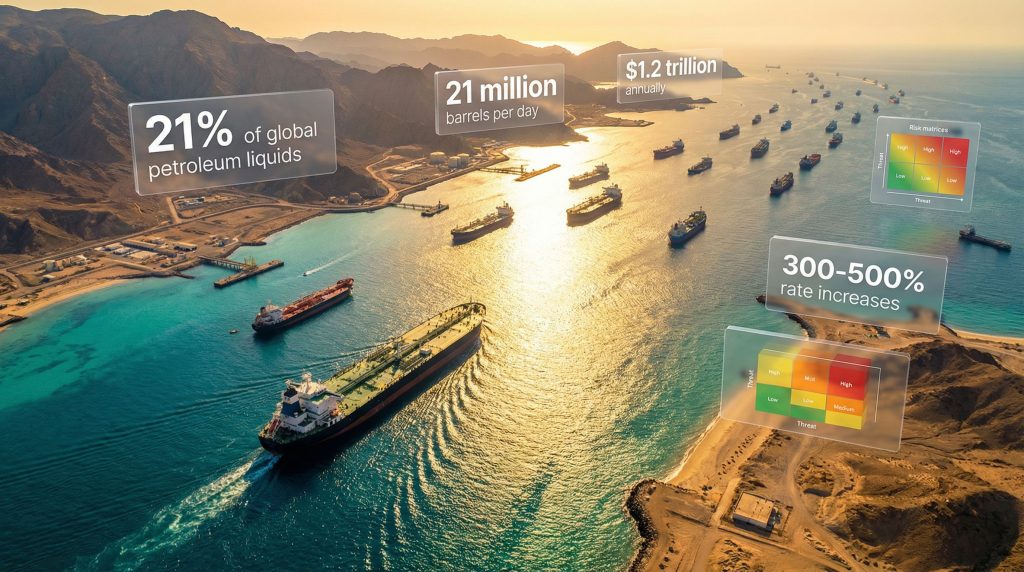
The Persian Gulf's singular connection to global maritime networks creates an extraordinary concentration of energy trade vulnerability. This 21-mile-wide waterway at its narrowest point channels approximately 21% of global petroleum liquids through shipping lanes that accommodate between 300 to 400 vessel transits monthly. The geometric constraints of the passage create inherent bottleneck characteristics, with two main shipping lanes separated by buffer zones that leave minimal maneuvering room for the massive very large crude carriers (VLCCs) exceeding 300,000 deadweight tons.
The strait's strategic importance extends beyond crude oil transportation, encompassing 20% of global liquefied natural gas (LNG) shipments that supply heating, electricity generation, and industrial processes across Asia, Europe, and beyond. This dual energy dependency means that disruptions affect both immediate fuel supplies and longer-term industrial capacity planning for energy-intensive manufacturing sectors.
Water depth averaging 160 feet accommodates heavily laden petroleum tankers, though vessels operating near maximum capacity require careful navigation to maintain safe clearance. During summer months, crude oil thermal expansion slightly affects weight distribution and draft calculations, adding technical complexity to navigation in an already constrained waterway.
Economic Impact Assessment Framework
Energy trade flowing through the strait represents approximately $1.2 trillion in annual value based on typical crude oil prices and transaction volumes. This monetary flow concentration creates immediate global economic consequences when disruptions occur, as alternative routing options impose significant cost penalties on energy importers.
| Transit Volume | Daily Capacity | Global Share | Economic Value |
|---|---|---|---|
| Crude Oil | 21 million barrels/day | 21% of global liquids | $850 billion annually |
| LNG Shipments | 25% of seaborne LNG | 20% of global LNG | $350 billion annually |
| Combined Energy Trade | All petroleum products | Primary Gulf export route | $1.2 trillion annually |
Alternative routing through the Cape of Good Hope adds approximately 6,000 nautical miles to typical Asia-bound energy shipments, translating to 10-15 day delays and additional transport costs of $2-3 per barrel. These cost increases compound through supply chains, affecting refined product prices, petrochemical feedstock costs, and industrial energy expenses across importing economies.
Regional energy export dependencies create asymmetric vulnerabilities for Persian Gulf producers. Saudi Arabia, United Arab Emirates, Kuwait, Iraq, and Iran collectively depend on Strait of Hormuz safe passage for their primary revenue sources, making the waterway a critical economic lifeline for multiple national budgets simultaneously.
When big ASX news breaks, our subscribers know first
How Do Geopolitical Tensions Affect Maritime Security in Strategic Waterways?
Current Regional Conflict Dynamics (2026)
The escalation timeline beginning in late February 2026 demonstrates how rapidly regional tensions translate into maritime operational disruptions. United States and Israeli military operations against Iranian targets triggered immediate retaliatory responses that directly targeted commercial shipping infrastructure, moving beyond threat levels to confirmed kinetic attacks on merchant vessels.
Timeline of Escalation Events:
- Late February 2026: Initial strikes against Iranian targets by US and Israeli forces
- Early March 2026: Iranian retaliatory operations commence in the strait
- Mid-March 2026: Confirmed casualties among commercial shipping crews
- Ongoing: Maritime security incidents continue affecting operations
The multi-party involvement distinguishes the current crisis from bilateral conflicts, creating diplomatic resolution complexity. Iran, Israel, the United States, and India represent primary stakeholders, while commercial shipping from dozens of additional nations faces operational impacts. Moreover, the US–China trade war impacts demonstrate how regional conflicts can amplify existing tensions between major powers. This structure requires multilateral coordination for effective crisis resolution, as individual bilateral agreements cannot address the full scope of maritime security concerns.
Indian coastal authorities' seizure of three oil tankers in February 2026 illustrates the intersection of sanctions enforcement and maritime security. The vessels Stellar Ruby, Asphalt Star, and Al Jafzia were detained off Mumbai's coast for suspected involvement in illicit oil trade activities, demonstrating how sanctions compliance creates additional operational risks for commercial shipping beyond direct military threats.
Historical Precedents for Waterway Disruptions
The Iran-Iraq War period from 1980-1988, particularly the Tanker War phase (1984-1988), provides instructive precedents for understanding current maritime security challenges. During this period, both combatants systematically attacked commercial shipping as part of economic warfare strategies, creating international incidents that prompted coordinated naval responses from external powers.
Key Historical Patterns:
- Economic Warfare Targeting: Commercial shipping became a primary target for imposing economic costs on adversaries
- Insurance Market Response: Premium increases of 300-500% for vessels transiting high-risk areas
- International Naval Intervention: External powers provided escort services for flagged vessels
- Alternative Routing Adoption: Major shipping companies temporarily rerouted operations around Africa
The historical precedent established a pattern where maritime chokepoint disruptions prompt international naval presence in affected regions. Kuwait's request for US naval escorts during the Tanker War demonstrates how commercial shipping security concerns can escalate into broader military commitments by external powers seeking to maintain maritime trade flows.
Recovery timeframes from historical maritime crises typically follow a two-phase pattern: initial crisis-driven disruptions lasting 3-6 months, followed by gradual operational normalisation as risk assessment practices adapt to new baseline threat levels. However, permanent supply chain modifications often persist beyond crisis resolution, as importers diversify suppliers to reduce future chokepoint dependencies.
What Are the Current Operational Risks for Commercial Shipping?
Threat Assessment Matrix
Contemporary maritime security challenges in the strait encompass multiple risk categories that require distinct mitigation approaches. The complexity of simultaneous threats creates compounding operational difficulties for commercial vessel operators attempting to maintain shipping schedules while ensuring crew safety.
| Risk Category | Threat Level | Impact Scope | Mitigation Complexity |
|---|---|---|---|
| Kinetic Attacks | Critical | Direct vessel damage, crew casualties | Military escort coordination required |
| GPS/Navigation Jamming | High | Navigation disruption, collision risk | Technical countermeasures, backup systems |
| Port Inspection Delays | Moderate | Schedule disruptions, cargo delays | Documentation compliance, legal preparation |
| Insurance Premium Escalation | High | 300-500% rate increases | Risk pooling, alternative coverage mechanisms |
Reports indicate that three Indian sailors were killed and one remains missing following Iranian retaliatory attacks targeting commercial shipping. These casualties represent the transition from maritime security threats to confirmed hostile actions against merchant vessels, fundamentally altering risk calculations for shipping companies operating in the region.
Vessel Classification and Vulnerability Analysis
Shadow Fleet Operations and Sanctions Compliance
The emergence of shadow fleet operations creates additional complexity for legitimate commercial shipping. These vessels employ various techniques including ship-to-ship transfers, frequent flag changes, and routing through sympathetic ports to move sanctioned cargo while evading detection. The simultaneous seizure of three such vessels in February 2026 suggests either increased enforcement activity or decreased operational security in sanctions evasion networks.
Flag State Considerations for Transit Permissions
Vessels operating under different maritime flags face varying levels of inspection risk and port state control challenges. Ships registered under sanctions-exposed states encounter heightened scrutiny, while vessels from neutral maritime registries may receive preferential treatment in diplomatic negotiations for Strait of Hormuz safe passage guarantees.
Iran's conditional transit policies create operational uncertainty for commercial shipping companies. Furthermore, Iran's foreign minister has indicated that vessel movement through the strait can occur only under special conditions due to regional insecurity, establishing a framework where safe passage becomes subject to political negotiations rather than established maritime law principles.
Technical Vulnerability Factors
- AIS Tracking Exposure: Automatic Identification System transmissions enable both maritime domain awareness and potential targeting
- Communication System Dependencies: Global Maritime Distress and Safety System equipment provides emergency capabilities but cannot guarantee rapid response
- Vessel Maneuverability Constraints: Large petroleum carriers have significant stopping distances and limited evasive capabilities
- Cargo Classification Risks: Energy shipments face higher targeting probability than general commercial cargo
How Are Global Supply Chains Adapting to Maritime Disruptions?
Alternative Routing Strategies
Supply chain managers are implementing diversified transportation strategies to reduce dependency on single chokepoint passages. The Cape of Good Hope route serves as the primary alternative for Asia-bound energy shipments, though this option imposes substantial additional costs and extended delivery timelines on energy importers.
Routing Comparison Analysis:
- Strait of Hormuz Route: 12-14 days typical transit time to Asian markets
- Cape of Good Hope Alternative: 18-29 days total transit time (additional 6,000 nautical miles)
- Cost Differential: $2-3 per barrel additional transport expenses
- Capacity Constraints: Limited alternative route capacity for full diversion
Pipeline alternatives provide land-based transportation options for specific regional destinations. The East-West Pipeline system and Kirkuk-Ceyhan infrastructure enable some Persian Gulf producers to bypass maritime chokepoints entirely, though pipeline capacities remain insufficient to replace seaborne transportation volumes for global markets.
Strategic petroleum reserve utilisation patterns indicate how importing nations manage supply disruption risks. Countries maintaining strategic reserves can temporarily substitute stored petroleum for current shipments, providing buffer capacity during crisis periods while alternative supply arrangements develop.
Economic Modelling of Disruption Scenarios
Short-term Impact Assessment (0-3 months):
Oil price volatility during initial disruption periods typically adds $15-25 per barrel premium to global crude prices as markets price in supply disruption risks. Our oil price rally analysis reveals how regional disruptions can trigger broader commodity market volatility. Regional refinery capacity utilisation changes as processors adjust input sourcing to available crude supplies, creating secondary price effects in refined product markets.
Spot market pricing diverges significantly from long-term contract pricing during crisis periods, as immediate supply availability commands premium rates while contracted volumes maintain established pricing structures. This divergence creates arbitrage opportunities for trading companies with flexible supply arrangements.
Medium-term Adaptation (3-12 months):
Supply chain reconfiguration costs encompass vessel chartering, alternative supplier development, and infrastructure investment acceleration. Companies invest in diversified supplier relationships and alternative transportation modes to reduce future chokepoint dependencies, though these investments require sustained capital commitments.
Insurance market adaptation follows predictable patterns: initial premium spikes followed by gradual stabilisation as risk assessment methodologies incorporate new baseline threat levels. However, permanently elevated premium structures reflect the sustained nature of geopolitical risks in strategic waterways.
What Role Do International Maritime Laws Play in Crisis Resolution?
Legal Framework for Freedom of Navigation
The United Nations Convention on the Law of the Sea (UNCLOS) establishes fundamental principles for maritime passage through international straits. Article 17 guarantees innocent passage rights for commercial vessels, while Articles 37-44 specifically address transit passage through straits used for international navigation. These legal frameworks provide the foundation for diplomatic pressure on states attempting to restrict commercial shipping.
Key Legal Principles:
- Innocent Passage Rights: Commercial vessels maintain legal passage rights through territorial waters
- Transit Passage Protections: International straits cannot be unilaterally closed to commercial navigation
- State Responsibilities: Coastal states must ensure safe navigation channels and appropriate maritime services
- Dispute Resolution Mechanisms: International arbitration processes for maritime law violations
Enforcement mechanisms for maritime law violations require international cooperation and coordinated response capabilities. Individual nations cannot unilaterally enforce UNCLOS provisions against major regional powers, necessitating multilateral diplomatic and potentially military responses to maintain legal navigation frameworks.
Multilateral Response Coordination
Combined Maritime Forces operating in the region provide institutional frameworks for coordinated naval responses to maritime security threats. These multinational naval partnerships enable burden-sharing for escort operations, maritime domain awareness, and crisis response capabilities that individual nations cannot sustain independently.
NATO Article 5 considerations create complex decision-making requirements when member nation vessels face attacks in international waters. The collective defence framework applies to attacks on member states, though determining response proportionality and geographic scope requires careful political coordination among alliance members.
Regional security partnership frameworks in the Persian Gulf enable coordinated responses among local allies, though these partnerships must balance competing national interests and varying relationships with external powers. The Gulf Cooperation Council provides one institutional mechanism for regional coordination, though member states maintain distinct foreign policy priorities.
How Do Energy Markets Price Geopolitical Risk Premiums?
Risk Assessment Methodologies
Energy markets employ sophisticated modelling approaches to quantify geopolitical risk premiums in commodity pricing. The Volatility Index (VIX) correlation with energy prices provides one measure of market sentiment regarding supply disruption probabilities, though crude oil markets maintain distinct risk characteristics from broader equity markets.
Market Risk Indicators:
- Futures Curve Analysis: Long-term contract pricing reflects sustained risk expectations
- Options Market Activity: Put/call ratios indicate trader sentiment regarding price volatility
- Insurance Rate Fluctuations: Maritime insurance premiums serve as leading indicators for operational risk
- Strategic Reserve Deployment: Government reserve releases signal official risk assessments
Insurance market indicators provide particularly valuable early warning information for maritime security developments. Premium rate changes typically precede broader market awareness of emerging risks, as insurance underwriters maintain detailed operational intelligence networks for maritime threat assessment.
Geopolitical risk modelling in commodity markets incorporates multiple scenario probabilities rather than single-point forecasts. Traders employ Monte Carlo simulation methods and scenario planning frameworks to estimate probability distributions for various disruption duration and severity combinations.
Regional Market Differentiation
The Asian premium for Middle Eastern crude reflects transportation cost differentials and supply security considerations specific to Pacific Rim markets. Asian importers typically pay $1-2 per barrel premium over European prices for comparable crude grades, reflecting longer transportation distances and fewer alternative supply sources.
Regional Pricing Variations:
- Asian Markets: Higher premiums due to transportation distances and supply concentration
- European Markets: Moderate premiums with pipeline alternative options
- North American Markets: Lower premiums due to domestic production capabilities
- Strategic Reserve Considerations: Government stockpile policies affect regional price sensitivity
European energy security diversification strategies have reduced dependence on Middle Eastern supplies through increased pipeline imports, renewable energy development, and strategic reserve expansion. These diversification investments create price insulation effects during Middle Eastern supply disruptions, though complete independence remains economically impractical.
North American shale production response capacity provides supply elasticity that moderates global price impacts during international supply disruptions. However, shale production requires 3-6 months to respond meaningfully to price signals, limiting short-term supply substitution capabilities during acute crisis periods.
The next major ASX story will hit our subscribers first
What Are the Long-term Strategic Implications for Global Energy Security?
Infrastructure Resilience Planning
Redundant capacity development in alternative transportation routes represents a fundamental shift in global energy infrastructure investment priorities. Countries and companies are investing in pipeline networks, storage facilities, and transportation capabilities that provide operational flexibility during chokepoint disruptions, though these investments require substantial capital commitments with uncertain return timelines.
Infrastructure Investment Priorities:
- Pipeline Network Expansion: Land-based alternatives to maritime transportation
- Storage Capacity Enhancement: Strategic and commercial inventory management
- Port Infrastructure Diversification: Alternative loading and discharge facilities
- Maritime Security Technology: Advanced navigation and communication systems
Technology solutions for maritime security enhancement encompass both defensive and domain awareness capabilities. Advanced satellite tracking, automated distress systems, and enhanced communication equipment provide improved safety margins for commercial vessels, though these technologies cannot eliminate fundamental vulnerabilities in narrow waterways.
Regional energy hub diversification strategies involve developing alternative supplier relationships and transportation networks that reduce dependence on any single geographic route or supplier. Consequently, these strategies require long-term contractual commitments and infrastructure investments that fundamentally alter global energy trade patterns.
Scenario Planning for Stakeholders
Optimistic Resolution Scenario (3-6 months):
Diplomatic breakthrough and de-escalation processes could restore normal commercial shipping operations within a relatively short timeframe. This scenario assumes multilateral negotiation success, Iranian cooperation with international maritime law principles, and gradual shipping lane reopening under international monitoring frameworks. Energy price premiums would experience 15-20% reduction as operational risks normalise.
Extended Disruption Scenario (6-18 months):
Prolonged conflict and sustained maritime insecurity could force permanent supply chain reconfiguration affecting global energy trade patterns. This scenario implies $50-75 billion in additional annual transport costs for energy importers, accelerated renewable energy investment timelines, and fundamental restructuring of international energy supplier relationships.
Structural Transformation Scenario (18+ months):
Extended disruptions could catalyse permanent changes in global energy infrastructure, trade relationships, and security arrangements. This scenario involves substantial new pipeline construction, alternative supply development, and multilateral security frameworks that persist beyond crisis resolution.
Investment patterns in non-chokepoint dependent supply chains reflect growing recognition that geographic concentration creates systemic vulnerabilities requiring diversification investments. However, examining tariff market impacts reveals additional trade complications that could affect energy security planning. Energy importing nations are developing supplier portfolios that reduce exposure to any single transportation route or regional conflict zone.
Building Maritime Security in an Interconnected World
Key Takeaways for Stakeholders
The diversification imperative for energy-dependent economies extends beyond simple supplier variety to encompass transportation route redundancy, storage capacity enhancement, and alternative energy source development. Countries maintaining singular dependencies on chokepoint-dependent energy supplies face increasingly untenable vulnerability profiles in an era of intensifying geopolitical competition.
Strategic Priorities for Energy Security:
- Supply Source Diversification: Multiple supplier relationships across different regions
- Transportation Route Redundancy: Pipeline, rail, and alternative maritime options
- Strategic Reserve Optimisation: Enhanced storage capacity and deployment flexibility
- Technology Integration: Advanced monitoring and communication systems for maritime operations
Multilateral cooperation frameworks serve dual functions as both crisis prevention tools and response coordination mechanisms. The complexity of modern maritime security challenges requires international partnerships that can provide sustained naval presence, diplomatic coordination, and economic burden-sharing during extended crisis periods.
Economic resilience through strategic reserve management provides critical buffer capacity during supply disruption periods, though reserve policies must balance storage costs against security benefits. Countries with substantial strategic petroleum reserves maintain greater policy flexibility during crisis periods, enabling measured responses rather than emergency market interventions.
Monitoring Indicators for Future Developments
Daily vessel transit counts and routing patterns provide real-time indicators of maritime security conditions in the strait. Significant deviations from normal traffic patterns, increased alternative routing adoption, or changes in vessel nationality distributions signal evolving risk perceptions among commercial shipping operators.
Critical Monitoring Metrics:
- Transit Volume Changes: Daily vessel counts and cargo tonnage variations
- Insurance Rate Fluctuations: Premium adjustments as market sentiment indicators
- Diplomatic Engagement Frequency: Meeting schedules and negotiation progress reports
- Infrastructure Project Timelines: Alternative route development and completion schedules
Insurance rate fluctuations serve as particularly sensitive indicators of changing risk assessments, as underwriters maintain detailed intelligence networks and rapid response capabilities to emerging threats. Premium adjustments often precede broader market recognition of changing security conditions.
Alternative infrastructure development project timelines provide medium-term indicators of strategic planning assumptions among major energy companies and importing governments. Acceleration of pipeline projects, storage facility construction, or alternative port development suggests expectations of sustained disruption risks requiring permanent mitigation investments.
Furthermore, understanding global trade impacts becomes increasingly relevant as countries navigate concurrent trade policy challenges. The intersection of maritime security concerns with broader trade disputes complicates strategic planning for energy importing nations.
Additionally, examining energy transition challenges reveals how regional energy security concerns may accelerate renewable energy adoption timelines. Countries facing chokepoint vulnerabilities may prioritise domestic energy production capabilities over traditional import dependencies.
The Strait of Hormuz safe passage crisis demonstrates how geographic chokepoints transform from routine commercial considerations into complex intersections of geopolitics, economics, and international law. As regional conflicts intensify and great power competition reshapes global trade patterns, the strategic significance of maritime chokepoints will likely increase, requiring sustained international cooperation and infrastructure investment to maintain global energy security in an interconnected world.
Looking to Navigate Maritime Risk in Energy Investments?
Discovery Alert's proprietary Discovery IQ model delivers real-time alerts on significant mineral discoveries across the ASX, helping investors identify opportunities that could benefit from shifting global energy dynamics and supply chain disruptions. Stay ahead of market movements with instant notifications on exploration companies that may capitalise on energy security concerns and resource diversification trends. Begin your 14-day free trial today to position yourself ahead of the market.