
August 4, 2026
The Strategic Vulnerability of Global Energy Networks
Global energy markets face unprecedented vulnerability through a single 21-mile maritime passage that controls the flow of petroleum across continents. The Strait of Hormuz oil traffic represents more than a shipping route; it embodies the fragility of energy security in an interconnected world where geographic monopolies can trigger economic disruption across multiple regions.
Understanding this vulnerability requires examining how natural chokepoints create systemic risk in global commodity flows, where alternatives remain either economically prohibitive or physically impossible to implement at scale. Furthermore, recent global trade tensions have amplified these concerns as nations seek to secure their energy supply chains.
When big ASX news breaks, our subscribers know first
Understanding the World's Most Strategic Energy Chokepoint
The Strait of Hormuz functions as an irreplaceable gateway for approximately 20% of globally traded petroleum liquids, according to the U.S. Energy Information Administration. This narrow waterway between Iran and Oman creates a geographic monopoly that no alternative maritime route can bypass for Persian Gulf crude exports.
The strait's strategic importance stems from its role as the exclusive maritime exit for major oil-producing nations, including Iran, Iraq, Kuwait, and significant portions of Saudi Arabian and UAE exports. Unlike other global shipping routes where alternatives exist, the Persian Gulf's geological formation creates an unavoidable dependency on this single passage.
Geographic Constraints and Maritime Dependencies
Normal operations through the strait facilitate massive daily energy flows:
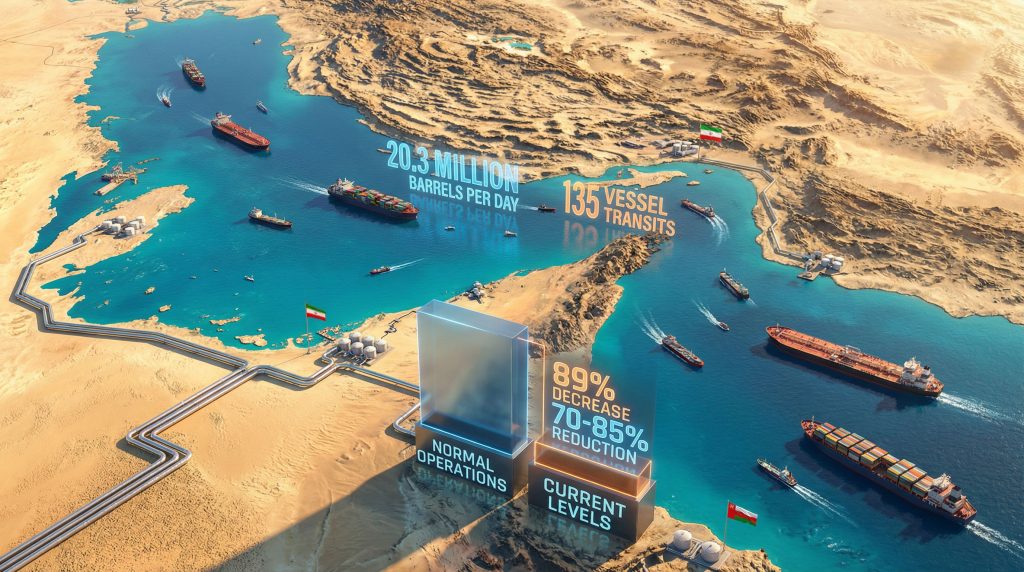
• 20.3 million barrels per day of petroleum liquids during peacetime
• 135 vessel transits in both directions under standard conditions
• Substantial LNG volumes from Qatar's export terminals
• Critical supply lines for Asian refineries dependent on Middle Eastern crude
The waterway's physical dimensions create additional constraints, with the narrowest shipping channels requiring precise navigation through territorial waters controlled by both Iran and Oman. International maritime law permits passage under the United Nations Convention on the Law of the Sea, but practical control mechanisms can severely limit traffic flow during geopolitical tensions.
What Makes the Strait of Hormuz Irreplaceable for Energy Markets?
The Persian Gulf's unique geography creates an energy security vulnerability that cannot be replicated elsewhere in global commodity markets. Major producing nations lack viable maritime alternatives, with limited pipeline infrastructure providing only partial bypass capacity.
However, energy export challenges extend beyond geographic constraints, as nations must also navigate complex geopolitical relationships and trade agreements.
Pipeline Infrastructure Limitations
While some alternative routes exist, their capacity constraints highlight the strait's irreplaceable role:
| Alternative Route | Daily Capacity | Limitations |
|---|---|---|
| Saudi Trans-Arabian Pipeline | 5 million barrels | Cannot replace full Gulf exports |
| UAE Abu Dhabi Pipeline | 1.5 million barrels | Limited to UAE production only |
| Potential Iraq Routes | Under development | Years away from meaningful capacity |
These alternatives represent emergency backup options rather than comprehensive solutions. The combined capacity of all existing pipeline bypasses equals roughly 25% of normal Strait of Hormuz oil traffic, demonstrating the waterway's strategic irreplaceability.
Qatar's LNG Export Vulnerability
Qatar's position as the world's largest LNG exporter amplifies the strait's importance beyond crude oil. The nation's 77 million tonnes per annum LNG export capacity relies entirely on Hormuz transit, creating vulnerabilities for global natural gas markets, particularly in Asian economies dependent on LNG imports.
How Do Geopolitical Disruptions Impact Global Oil Supply?
Recent disruptions beginning in March 2026 demonstrate the strait's vulnerability to geopolitical tensions. The dramatic reduction in vessel traffic illustrates how quickly energy security can deteriorate when control mechanisms restrict commercial shipping.
Current oil price movements analysis reveals how supply disruptions create immediate market volatility.
Current Traffic Analysis
Reports from major news outlets indicate significant disruption patterns in April 2026:
Pre-Disruption vs. Current Operations:
| Metric | Normal Levels | April 2026 | Reduction Percentage |
|---|---|---|---|
| Daily Vessel Transits | 135 ships | 12-15 ships | 89% decrease |
| Oil Flow Rate | 20+ million b/d | 3-6 million b/d | 70-85% reduction |
| Commercial Tanker Traffic | Regular schedule | Minimal passage | 95% decrease |
The April 12, 2026 transit of three vessels (Cospearl Lake, He Rong Hai, and Serifos) represented the largest single-day oil movement since disruptions began, yet carried only 6 million barrels combined capacity, highlighting how dramatically normal operations had deteriorated.
Operational Control Mechanisms
Current transit requirements demonstrate how geopolitical control translates into commercial restrictions:
• Permission protocols requiring advance approval for all vessel movements
• Route specifications mandating adherence to designated shipping lanes
• Cargo verification ensuring compliance with political requirements
• Extended approval timeframes creating scheduling uncertainties
Iranian authorities implemented specific route requirements, with vessels following northerly corridors through the strait rather than traditional shipping lanes. This control mechanism demonstrates how territorial water claims can effectively regulate international commerce.
What Are the Economic Consequences of Strait Disruption?
The economic ramifications of reduced Strait of Hormuz oil traffic extend far beyond immediate supply shortages, creating market distortions that affect global energy pricing, supply chain logistics, and regional economic stability.
In addition, OPEC production impact decisions become even more critical during periods of strait disruption.
Immediate Market Disruptions
Supply constraints create cascading effects across energy markets:
• Price volatility with crude oil approaching elevated levels during disruption periods
• Supply chain backlogs affecting thousands of vessels globally
• Insurance premium increases for war-risk coverage
• Regional price differentials as alternative supplies command premium pricing
The magnitude of disruption becomes apparent when considering that over 3,000 vessels experienced delays during the initial closure period, including approximately 800 oil tankers carrying critical energy supplies.
Alternative Route Economics
Commercial operators face significant cost increases when utilising bypass options:
Cost Impact Analysis:
| Transport Method | Additional Costs | Time Delays | Capacity Constraints |
|---|---|---|---|
| Cape of Good Hope Route | 40-50% shipping increase | 2-3 weeks additional | No capacity limits |
| Oman East Coast Ports | 25% cost premium | 1-2 weeks delay | Infrastructure limitations |
| Saudi Pipeline System | Moderate premiums | Minimal delays | 5 million b/d maximum |
| UAE Pipeline Network | Variable costs | 1-2 days | 1.5 million b/d capacity |
These economic impacts demonstrate why the strait remains the preferred route despite geopolitical risks. Alternative options either lack sufficient capacity or impose cost penalties that make them economically viable only during crisis situations.
Which Nations Face the Greatest Energy Security Risks?
The strait's disruption creates asymmetric impacts across the global economy, with certain nations facing disproportionate energy security vulnerabilities based on their import dependencies and alternative supply access.
Primary Export Dependencies
Saudi Arabia's energy exports illustrate the strait's critical importance to producing nations. The kingdom's crude oil shipments through Hormuz represent substantial portions of global supply, making any disruption economically significant for both Saudi revenues and international markets.
Major Export Vulnerabilities:
• Saudi crude exports heavily dependent on Hormuz transit
• Iraqi oil production lacking meaningful bypass options
• Iranian petroleum sales entirely dependent on strait access
• Kuwaiti exports with no viable maritime alternatives
Critical Import Dependencies
Asian economies face particular vulnerability due to their reliance on Persian Gulf crude:
• China: Major dependency on Middle Eastern crude imports via Hormuz
• Japan: Limited alternative supply sources for refinery operations
• South Korea: Heavy exposure to Gulf crude for petrochemical industries
• India: Substantial import requirements from Persian Gulf producers
European refineries maintain more diversified supply sources but still face significant exposure to Middle Eastern supply chains, particularly for specific crude grades required by refinery configurations.
The next major ASX story will hit our subscribers first
How Do Control Mechanisms Affect Commercial Shipping?
The implementation of transit controls demonstrates how geopolitical authority can effectively regulate international commerce through territorial water claims and administrative requirements.
Permission and Compliance Requirements
Vessels seeking strait passage must navigate complex approval processes that significantly impact commercial operations. Iranian authorities established specific requirements for vessel transit, including advance permission requests and adherence to designated shipping routes.
The three vessels that successfully transited on April 12, 2026, followed northerly routes demanded by Tehran, demonstrating how political requirements override traditional commercial navigation preferences. This pattern illustrates the practical implementation of territorial control over international shipping lanes.
Commercial Risk Assessment
Shipping companies evaluate multiple risk factors when considering strait transit:
• Operational uncertainty from unpredictable approval processes
• Insurance complications with war-risk coverage requirements
• Cargo security concerns regarding potential vessel detention
• Schedule disruptions affecting global shipping networks
Major commercial operators largely avoided the strait during peak disruption periods, contributing to the 89% reduction in vessel traffic observed in early 2026.
What Strategic Alternatives Exist for Energy Security?
Long-term energy security strategy requires developing alternatives that can partially offset the strait's strategic importance, though complete replacement remains economically and technically challenging.
Pipeline Infrastructure Development
Existing pipeline systems provide limited bypass capacity:
Saudi Trans-Arabian Pipeline (Petroline): This east-west crude system carries approximately 5 million barrels per day from Eastern Region production to Red Sea export terminals at Yanbu. While significant, this capacity represents only 25% of normal Hormuz traffic.
UAE Abu Dhabi Crude Oil Pipeline: The ADCOP system provides 1.5 million barrels per day capacity to bypass the strait, connecting Abu Dhabi production to Arabian Sea export facilities.
Proposed Regional Networks: Various infrastructure projects under consideration could enhance bypass capacity, though implementation timelines extend multiple years and require substantial capital investment.
Emergency Response Mechanisms
Governments maintain several tools for managing supply disruptions:
• Strategic Petroleum Reserves providing temporary supply buffers during crisis periods
• Alternative sourcing agreements with non-Gulf producers to offset supply gaps
• Demand management protocols reducing consumption during emergency situations
• International coordination mechanisms for sharing reserves and managing crisis response
How Might Future Scenarios Reshape Global Energy Flows?
The strait's vulnerability creates multiple potential futures for global energy markets, each with distinct implications for pricing, supply security, and geopolitical stability.
Prolonged Disruption Scenario
Extended closure would create severe market impacts:
• Supply shortage: 20% reduction in global oil availability
• Price escalation: Potential for crude oil exceeding $120-150 per barrel
• Economic contraction: Energy-intensive industries facing operational constraints
• Strategic reserve depletion: Government stockpiles drawn down to critical levels
Selective Access Framework
Partial reopening with political preferences could fragment global energy markets:
• Preferential treatment for allied nations receiving priority passage
• Premium pricing structures creating multiple market tiers
• Supply chain reconfiguration as companies adapt to restricted access
• Alternative route acceleration spurring infrastructure investment
Market Normalisation Pathway
Full operational restoration would create different challenges:
• Backlog processing potentially creating temporary oversupply conditions
• Price volatility during market readjustment periods
• Infrastructure investment in enhanced security and monitoring systems
• Geopolitical precedent establishing frameworks for future crisis management
What Long-Term Implications Exist for Energy Geopolitics?
The Strait of Hormuz represents more than an energy chokepoint; it exemplifies how geographic constraints create enduring geopolitical leverage in an interconnected global economy. Control over critical infrastructure provides strategic influence that extends beyond immediate commercial considerations.
Shipping traffic data confirms the ongoing vulnerability of global energy systems to geopolitical disruption.
The strait's strategic importance will likely increase as global energy demand grows, particularly from Asian economies dependent on Persian Gulf supplies. This dynamic creates incentives for infrastructure diversification whilst highlighting the limitations of alternative routes in fully replacing the waterway's capacity.
Key Strategic Considerations:
• Infrastructure vulnerability in globalised energy systems
• Geographic leverage as a tool of international relations
• Economic interdependence creating mutual vulnerabilities
• Technology limitations in developing comprehensive alternatives
Understanding these dynamics becomes essential for energy security planning, investment decision-making, and international policy coordination. The strait's role as both a critical commercial passage and potential geopolitical weapon demonstrates the complex relationship between geography, economics, and strategic power in contemporary international affairs.
Future energy security will depend on balancing efficiency gains from centralised infrastructure against resilience benefits from diversified supply chains, with the Strait of Hormuz oil traffic serving as a crucial case study in managing strategic vulnerabilities.
This analysis is based on publicly available information and market observations. Energy market conditions and geopolitical situations can change rapidly, and readers should consult current sources for the most recent developments.
Looking to Capitalise on Energy Sector Opportunities?
Discovery Alert's proprietary Discovery IQ model delivers real-time notifications on significant ASX mineral discoveries, including critical energy minerals and commodities that could benefit from global supply chain disruptions. Begin your 14-day free trial at Discovery Alert today and position yourself ahead of the market with instant insights into actionable investment opportunities.