August 14, 2026
Understanding the Strategic Importance of the Strait of Hormuz
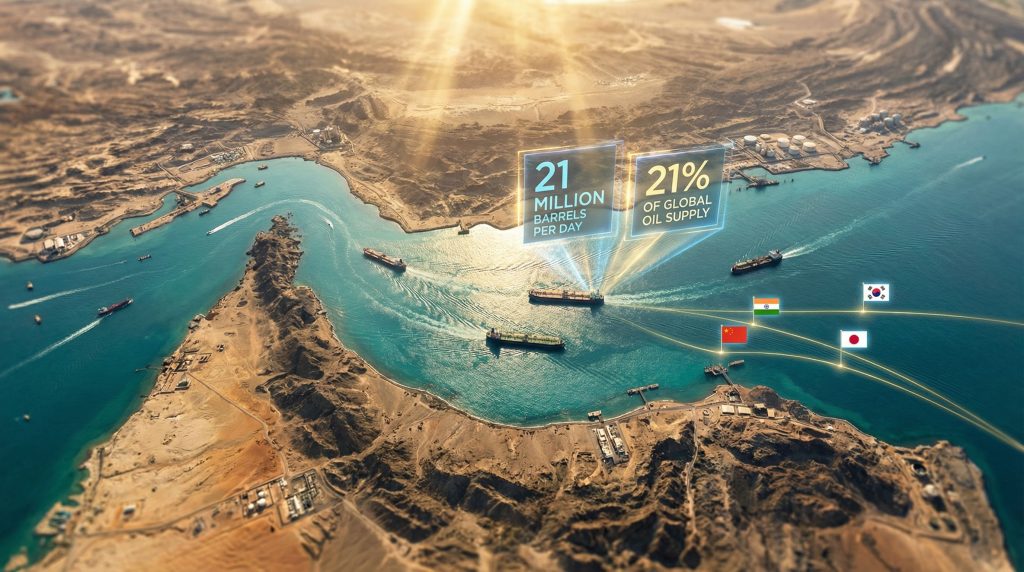
The global energy system operates through critical chokepoints where vast quantities of resources flow through narrow geographical constraints. Among these vulnerabilities, few match the strategic significance of the waters between Iran and Oman, where approximately 20 to 21 million barrels per day transit through a corridor barely 33 kilometres wide. This concentration represents roughly one-fifth of global oil supplies flowing through a single maritime passage, creating systemic risk that extends far beyond regional boundaries. The closure of the Strait of Hormuz represents one of the most significant threats to global energy security.
Physical market indicators reveal the acute nature of this dependency during disruption events. When supply constraints emerge, the disconnect between theoretical pricing mechanisms and actual commodity availability becomes stark. Recent market dynamics demonstrate this bifurcation clearly: whilst benchmark crude prices reflect moderate premiums, physical cargo premiums have exploded to unprecedented levels, with Omani crude trading at record premiums of $51 per barrel above Brent, compared to February averages of merely 75 cents. These conditions align with the Trump-driven oil rally that experts have been monitoring closely.
Geographic and Economic Fundamentals
The Strait represents more than a shipping lane; it functions as the primary arterial connection between Middle Eastern production centres and Asian consumption hubs. The geographic constraint creates natural bottleneck effects that become pronounced during conflict periods, as alternative routing options face severe capacity limitations and extended transit times.
Maritime traffic patterns through this corridor reflect the concentration of global energy dependency. The 33-kilometre width between the Iranian coast and Omani territory creates a natural chokepoint where vessel congestion, security concerns, and weather conditions can rapidly amplify supply disruptions across international markets.
Alternative pipeline infrastructure exists but operates at capacity levels insufficient to compensate for maritime closure scenarios. The Saudi East-West pipeline system, whilst significant, handles approximately 7 million barrels per day at maximum utilisation, representing only one-third of typical Strait transit volumes.
Key Infrastructure and Stakeholder Analysis
Loading terminals and storage facilities throughout the Persian Gulf region concentrate substantial infrastructure investment in proximity to this single transit route. Fujairah and other UAE terminals, Omani export facilities, and Kuwaiti infrastructure all depend on Strait accessibility for international market connectivity.
Shipping route dependencies create cascading vulnerabilities throughout global supply chains. Asian refineries maintain operational schedules based on 30-day transit times from Gulf loading ports, meaning each day of closure compounds supply gaps exponentially. European jet fuel imports, historically representing 379,000 barrels per day or three-quarters of Middle Eastern aviation fuel exports, face complete disruption when transit becomes impossible.
Strategic petroleum reserve locations globally provide some buffer capacity, but deployment timelines and replacement mechanisms operate on different timeframes than immediate supply disruptions. The International Energy Agency's announced 400 million barrel coordinated release represents the largest emergency response in history, yet experts note that inventory drawdowns cannot substitute for sustained production flows.
When big ASX news breaks, our subscribers know first
How Would Physical Oil Markets React to a Hormuz Disruption?
Physical commodity markets operate under different mechanisms than financial derivatives, creating pricing divergences that become extreme during supply disruptions. Current market conditions demonstrate this bifurcation clearly, as benchmark prices reflect moderate increases whilst actual cargo availability commands extraordinary premiums.
The closure of the Strait of Hormuz creates immediate scarcity in physical markets that paper trading cannot adequately capture. Dubai crude cash premiums surged to $56 per barrel on Monday from February averages of 90 cents, indicating genuine shortage conditions rather than speculative positioning. These premium levels push physical crude prices to approximately $150 per barrel for May loading, representing scarcity pricing that exceeds financial market expectations. Furthermore, these conditions reflect the complex oil price trade war dynamics that have emerged in recent months.
Immediate Price Impact Scenarios
Historical precedent analysis reveals limited comparable events in terms of supply disruption magnitude. The current situation involves approximately 10 million barrels per day of Middle Eastern production shutdowns, according to International Energy Agency data, representing physical supply loss that exceeds the feared disruption from Russia-Ukraine tensions by more than three times.
Market structure differences between current conditions and historical crises create unique pricing dynamics. Whilst Brent crude trades near $100 per barrel, representing approximately 65 per cent increases above year-start levels, this benchmark pricing briefly reached nearly $120 per barrel before retreating despite ongoing physical constraints.
The bifurcation between financial and physical markets reflects trader psychology that appears to discount the severity of supply disruption. Expert analysis suggests that investors maintain confidence in rapid political resolution, essentially betting on what market participants term a "Trump put" – the assumption that diplomatic intervention will quickly restore normal operations.
Regional crude benchmarks demonstrate more severe pricing stress than international markers. Omani crude, exported from terminals outside the Strait's direct influence, commands record premiums that reflect alternative supply scarcity and shipping route constraints affecting all Gulf production.
Supply Chain Stress Indicators
Refining sector responses provide clear indicators of physical market stress beyond crude pricing. China's Sinopec, the world's largest refiner by capacity, announced production throughput cuts exceeding 10 per cent from planned levels due to crude supply shortfalls. This operational response demonstrates that even the largest processing facilities cannot compensate for supply disruption through efficiency improvements or alternative sourcing.
Processing rate adjustments across Asia reflect systematic supply constraint rather than temporary disruption. Refiners throughout the region have implemented throughput reductions to conserve existing inventory, indicating that supply gaps are widening faster than alternative sourcing can compensate.
Transit timing compounds supply chain vulnerability, as Gulf shipments require approximately one month to reach Asian customers. Each day of continued closure expands the supply gap facing regional refineries, creating cumulative rather than linear impact on processing capabilities. In addition, these developments echo previous US oil production decline patterns that analysts have tracked.
Strategic inventory management reveals the limits of buffer capacity during sustained disruption. Whilst strategic petroleum reserves provide temporary relief, drawing down inventories cannot substitute for delivery of new barrels, establishing that emergency stocks address demand management rather than supply replacement.
Which Regions Face the Greatest Energy Security Risks?
Asia-Pacific Vulnerability Assessment
The Asia-Pacific region demonstrates the highest concentration of energy security risk due to import dependency patterns and limited alternative supply diversity. Asian economies rely on the Middle East for approximately 60 per cent of crude imports, creating severe vulnerability when the primary transit corridor faces closure.
China's refining sector provides the clearest indicator of regional vulnerability. Sinopec's production cuts exceeding 10 per cent represent unprecedented operational adjustments for the world's largest refinery operator, demonstrating that scale advantages cannot overcome fundamental supply constraints during corridor closure.
Supply chain timing amplifies Asian vulnerability compared to other regions. The 30-day transit period from Gulf loading terminals to Asian discharge ports means that each closure day creates expanding rather than static supply gaps. Regional refineries face compound rather than linear supply deterioration as existing inventory depletes whilst replacement shipments remain blocked.
Defensive policy responses across the region indicate government recognition of severe supply stress. China and Thailand have implemented refined fuel export bans as protective measures, though expert analysis suggests these unilateral responses may collectively worsen global market conditions rather than resolve regional supply constraints. However, this represents just one aspect of broader oil price crash analysis affecting global markets.
European Market Exposure Analysis
European energy security faces distinct vulnerabilities centred on refined product rather than crude supply disruption. Europe historically received roughly three-quarters of Middle Eastern jet fuel exports via the Strait, representing approximately 379,000 barrels per day of aviation fuel imports that face complete elimination during closure scenarios.
The refined product disruption creates more immediate pressure than crude supply constraints. Jet fuel barges in the Amsterdam-Rotterdam-Antwerp hub have reached record prices of $190 per barrel, surpassing previous peaks during the immediate aftermath of Russia's Ukraine invasion in February 2022. This pricing indicates more severe supply stress than the earlier European energy crisis.
Comparative disruption analysis reveals greater physical impact than previously feared scenarios. Expert assessment indicates that the physical disruption from current Middle Eastern conflict has exceeded the feared Russian supply loss by more than three times, according to investment bank analysis. Russia had supplied approximately 30 per cent of European crude imports and one-third of refined product imports before Ukrainian invasion sanctions.
Aviation sector vulnerability represents a critical infrastructure pressure point for European economies. No Middle Eastern jet fuel cargo has transited the Strait since conflict began, creating immediate supply pressure on aviation fuel infrastructure that cannot be quickly substituted through alternative supply sources.
European jet fuel pricing reflects scarcity conditions that exceed crude market stress. Asian jet fuel prices approaching $200 per barrel, combined with European refining hub records, demonstrate that downstream product markets face more severe constraint than upstream crude availability, suggesting that refining capacity rather than crude supply may become the binding constraint.
What Are the Economic Cascade Effects Beyond Energy?
Energy price transmission mechanisms create cascade effects throughout economic sectors that extend far beyond direct fuel costs. The magnitude of current refined product pricing suggests that downstream economic impacts will be substantial and broad-based across transportation, manufacturing, and consumer sectors. Consequently, these effects align with the broader OPEC meeting impact on global markets.
Transportation and Logistics Impact
Aviation sector cost pressures represent the most immediate cascade effect from current supply disruptions. Jet fuel prices approaching $200 per barrel in Asian markets create direct input cost inflation for airlines that typically cannot be absorbed through operational efficiency improvements alone.
Maritime transportation faces multiple pressure points beyond fuel costs. Vessel routing around closure scenarios adds 15-20 days to transit times for Cape of Good Hope alternatives, creating capacity constraints throughout global shipping networks. Insurance premiums and security costs escalate during conflict periods, compounding direct fuel cost increases.
Regional supply chain disruption amplifies transportation cost pressures. Refined fuel export bans by China and Thailand create artificial scarcity in regional transportation fuel markets, forcing logistics operators to source alternatives at premium pricing or reduce operational capacity.
Industrial Sector Disruption Modelling
Petrochemical feedstock availability faces constraint from the same supply disruptions affecting transportation fuels. Asian refinery processing cuts directly impact downstream chemical production, as throughput reductions exceeding 10 per cent at major facilities reduce both fuel and chemical feedstock output simultaneously.
Manufacturing sector energy input costs escalate through multiple channels beyond direct fuel pricing. Record refined product pricing affects manufacturing operations through transportation cost increases, heating fuel expenses, and petrochemical input price inflation across diverse industrial sectors.
Consumer price transmission operates through multiple mechanisms during energy crisis periods. Transportation cost increases affect retail goods pricing, whilst heating fuel and electricity generation input costs create direct household expense pressures across regional economies.
The defensive policy responses themselves create additional economic cascade effects. Export restrictions on refined fuels may protect domestic supply availability but contribute to international price increases that ultimately affect trade relationships and economic cooperation frameworks.
How Do Alternative Supply Routes Compare?
Alternative routing capacity faces fundamental limitations that prevent full compensation for closure of the Strait of Hormuz. Existing pipeline infrastructure, whilst significant, operates at maximum capacity levels insufficient to replace maritime transit volumes during extended closure scenarios.
Pipeline Capacity Analysis
Pipeline infrastructure throughout the Middle East provides partial alternatives but cannot achieve full replacement capacity. The Saudi East-West pipeline system represents the largest alternative route, handling up to 7 million barrels per day at maximum utilisation, yet this capacity represents only one-third of typical Strait transit volumes.
UAE pipeline infrastructure through Oman provides additional routing options but at much smaller capacity levels. These alternative routes face utilisation constraints and expansion timelines that limit their effectiveness during immediate crisis scenarios.
Pipeline expansion projects require 12-24 month construction timelines for significant capacity increases, making them unsuitable for addressing immediate supply disruptions. Current utilisation rates on existing alternatives already approach maximum levels, limiting available surge capacity during crisis periods.
Maritime Diversion Scenarios
Cape of Good Hope routing represents the primary maritime alternative for Gulf crude exports during Strait closure, but transit time increases of 15-20 days create capacity constraints throughout global shipping networks. Extended voyage times reduce effective vessel availability and increase charter rates across international tanker markets.
Suez Canal capacity limitations create additional chokepoint vulnerability for alternative routing scenarios. Increased traffic through alternative routes may create congestion and operational constraints at other critical maritime passages, potentially amplifying rather than resolving global supply chain disruption.
Vessel availability and charter rate implications compound the cost impacts of alternative routing. Extended voyage times reduce effective fleet capacity, whilst increased demand for available vessels escalates charter rates and insurance premiums throughout international tanker markets. Recent geopolitical analyses highlight which countries face the greatest economic exposure.
Recent evidence suggests limited alternative routing success during current conditions. Modest tanker movements across the Strait in recent days provided temporary market relief, but expert analysis emphasises that the volumes being moved are extremely modest and insufficient to address fundamental supply constraints.
What Strategic Responses Would Major Powers Deploy?
United States Energy Diplomacy Options
Strategic Petroleum Reserve deployment represents the primary immediate response mechanism available to major consuming nations. The International Energy Agency announced plans for a record 400 million barrel release from member states' strategic reserves, representing the largest coordinated emergency response in history.
However, expert analysis establishes fundamental limitations of reserve utilisation during sustained supply disruption. Drawing down inventories cannot substitute for delivery of new barrels, meaning that strategic reserves address demand management rather than supply replacement. Even immediate reopening of the Strait would not provide instant relief, as restoring Middle Eastern flows would require weeks, if not months.
Political leadership messaging contrasts sharply with physical market realities. Presidential statements that oil prices will decline very rapidly following crisis resolution appear increasingly disconnected from ground-level supply conditions. That optimism looks increasingly hard to square with realities on the ground, both on the battlefield where fighting is intensifying, and in physical oil markets where supply constraints are expanding.
Naval escort operations represent potential military responses, but feasibility and cost analysis during active conflict scenarios present substantial operational challenges. Diplomatic pressure mechanisms and sanctions leverage may provide negotiating tools, but their effectiveness during active military conflict remains limited.
China's Energy Security Countermeasures
China's responses demonstrate both the vulnerability of major importing nations and the limitations of unilateral protective measures. Sinopec's production throughput cuts exceeding 10 per cent indicate that even the world's largest refinery operator cannot bridge supply gaps through operational adjustments or alternative sourcing.
Refined fuel export bans implemented by China and Thailand represent defensive measures that may protect domestic supply availability but risk exacerbating global market tightness. These unilateral policy responses highlight the tension between national energy security and international market stability during crisis conditions.
Alternative supply development through Central Asian partnerships and Belt and Road Initiative infrastructure requires long-term investment timelines incompatible with immediate crisis response needs. Domestic shale and renewable capacity scaling similarly operates on development timelines unsuitable for addressing current supply constraints.
European Union Contingency Planning
European response mechanisms face particular constraints due to refined product rather than crude supply disruption. Complete elimination of Middle Eastern jet fuel transit creates immediate aviation sector pressure that cannot be quickly addressed through alternative supplier negotiations or emergency demand reduction protocols.
Energy solidarity mechanisms within the European framework provide theoretical cooperation structures, but practical implementation during severe supply constraint faces resource allocation challenges among member states with differing import dependencies and strategic reserve levels.
Renewable energy deployment acceleration represents long-term strategic response but provides limited relief during immediate supply disruption scenarios. Infrastructure resilience investment priorities may shift based on current crisis experience, but implementation timelines extend beyond immediate crisis resolution requirements.
The next major ASX story will hit our subscribers first
How Would Markets Price Long-Term Closure Scenarios?
$200 Oil Feasibility Analysis
Mathematical analysis of supply-demand balances under sustained closure scenarios supports the feasibility of extreme pricing outcomes. Current physical market premiums approach these levels already, with Omani crude reaching approximately $150 per barrel for May loading despite benchmark pricing near $100 levels.
The International Energy Agency had forecast global supply surplus of approximately 3.7 million barrels per day prior to current disruption, yet approximately 10 million barrels per day of Middle Eastern production shutdowns have eliminated this buffer and created deficit conditions. Sustained closure would amplify this deficit progressively.
Demand destruction thresholds in major economies remain untested at current price levels, but historical precedent suggests that $200 oil would trigger significant consumption adjustments across transportation, heating, and industrial sectors. Central bank monetary policy responses would likely focus on preventing secondary inflation effects whilst accommodating energy price increases.
Investment Flow Redirection Patterns
Energy security premiums in equity valuations reflect investor recognition of supply vulnerability. Alternative energy project funding may accelerate under high oil price scenarios, though implementation timelines limit immediate supply impact.
Infrastructure resilience investment priorities are likely to shift toward supply diversification and strategic reserve expansion following current crisis experience. Geopolitical risk premiums may become permanent features of commodity pricing rather than temporary crisis adjustments.
Alternative energy transition acceleration under crisis conditions may paradoxically slow during immediate shortage periods, as attention focuses on securing conventional supply rather than developing replacement technologies. Investment flow patterns may favour immediate supply solutions over longer-term transition investments during acute shortage conditions.
What Are the Technological and Infrastructure Solutions?
Emergency Response Capabilities
Floating storage and regasification unit deployment provides tactical flexibility during supply disruption, but capacity levels remain insufficient for full supply replacement. Mobile refining capacity and modular processing solutions offer theoretical alternatives but require significant lead times for deployment and integration.
Emergency pipeline construction faces regulatory approval processes and engineering challenges that extend timelines beyond immediate crisis response needs. Digital supply chain optimisation and route planning provide operational improvements but cannot overcome fundamental capacity constraints during corridor closure.
Long-Term Resilience Building
Strategic reserve expansion requirements vary by region based on import dependency levels and existing storage capacity. Asian economies face the greatest reserve adequacy challenges due to high import dependency and limited domestic production alternatives.
Diversified supply chain development investments require sustained commitment and international cooperation frameworks that extend beyond immediate crisis resolution. Energy efficiency improvement potential across sectors provides demand reduction capabilities but requires time for implementation and behavioural adjustment.
Renewable energy transition acceleration impacts during energy security crises create complex trade-offs between immediate supply security and longer-term transition objectives. Technology innovation funding may redirect toward rapid deployment solutions rather than advanced research during shortage conditions.
Lessons from Historical Energy Disruptions
Comparative Crisis Analysis
The 1973 Oil Embargo established precedent for coordinated policy responses and market adaptation mechanisms during supply disruption. Strategic petroleum reserve development and International Energy Agency coordination frameworks emerged from this historical experience.
The 1979 Iranian Revolution demonstrated supply shock management strategies and the importance of alternative supplier development. OPEC spare capacity utilisation protocols and regional energy partnership frameworks evolved from these earlier disruption experiences.
The 2022 Russia-Ukraine conflict provided recent precedent for sanctions implementation and market restructuring under geopolitical pressure. However, current Middle Eastern disruption involves physical supply constraint rather than policy-driven supply restriction, creating different market dynamics and response requirements.
Institutional Response Evolution
International Energy Agency coordination mechanisms face testing under current conditions that exceed previous historical precedent in terms of physical supply volume disruption. G7 energy security cooperation frameworks provide diplomatic coordination structures but require adaptation to current scale of supply constraint.
Regional energy partnership development trends may accelerate following current crisis experience, as nations recognise the vulnerability of single-corridor import dependency. Critical mineral supply chain diversification priorities may expand beyond traditional energy security concerns to encompass broader economic resilience planning.
Future Energy Security Architecture
Structural Market Changes
Chokepoint vulnerability reduction strategies will likely receive increased investment and policy attention following current crisis experience. Supply chain regionalisation and near-shoring trends may accelerate across energy-intensive industries as firms recognise the economic impact of supply disruption.
Energy transition acceleration under crisis conditions creates opportunities for renewable energy deployment whilst highlighting the continuing importance of supply security during transition periods. Critical mineral supply chain diversification becomes essential for renewable energy infrastructure development and energy storage deployment.
Policy and Investment Implications
Energy independence versus efficiency trade-offs require careful analysis of costs and benefits across different scenarios. Infrastructure resilience investment requirements will likely increase following current crisis demonstration of vulnerability levels.
International cooperation framework evolution may favour regional energy partnerships and diversified supply agreements over single-source dependency relationships. Technology innovation funding redirection patterns may emphasise rapid deployment capabilities over advanced research during shortage conditions.
Disclaimer: This analysis presents current market conditions and expert assessments as of March 2026, but future developments remain uncertain. Energy markets involve substantial volatility and geopolitical risk factors that may significantly impact outcomes. Investment decisions should consider multiple scenarios and consult professional financial advice.
Ready to Identify the Next Major Energy Discovery?
Discovery Alert's proprietary Discovery IQ model delivers real-time alerts on significant ASX mineral discoveries, instantly empowering subscribers to identify actionable opportunities ahead of the broader market. Understand why historic discoveries can generate substantial returns by visiting Discovery Alert's dedicated discoveries page and begin your 14-day free trial today to position yourself ahead of the market.