May 20, 2026
Strategic Architecture of Global Rare Earth Dependencies
The architecture of global mineral supply networks reveals few vulnerabilities as pronounced as those found in rare earth reserves distribution. Unlike conventional commodities where production disperses across multiple continents, the rare earths supply chain represents perhaps the most concentrated industrial bottleneck in modern manufacturing. This concentration extends beyond simple geographic clustering to encompass technological expertise, infrastructure investment, and decades of accumulated processing knowledge that competitors find increasingly difficult to replicate.
The implications ripple through sectors ranging from renewable energy infrastructure to national defense systems, creating dependencies that transcend traditional market dynamics. Understanding these supply chain vulnerabilities requires examining not just current production figures, but the underlying technological barriers, capital requirements, and geopolitical factors that maintain existing concentration patterns.
When big ASX news breaks, our subscribers know first
How Market Concentration Creates Systemic Supply Vulnerabilities
Processing Infrastructure Bottlenecks
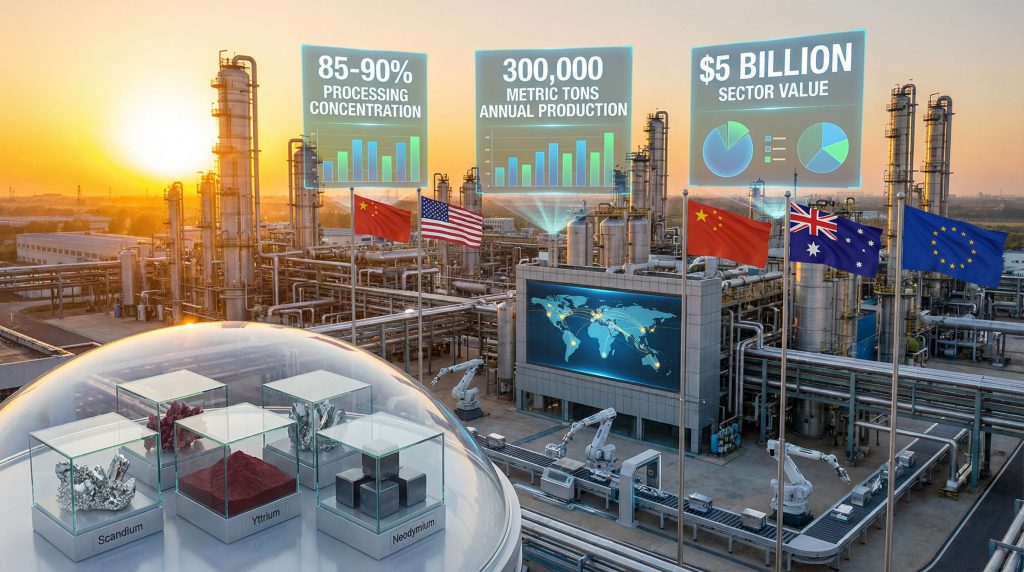
The rare earths industry operates through a highly specialized processing chain where separation and refining capabilities remain concentrated in single facilities. Current market structure shows 85-90% of global refining capacity controlled by one nation, despite that country holding less than half of known global reserves. This creates a fundamental disconnect between resource availability and processing capability that defines much of the strategic vulnerability.
Critical Infrastructure Dependencies:
- Separation technology requiring proprietary chemical processes
- High-precision purification achieving 99.9%+ purity standards
- Specialised waste management systems for radioactive byproducts
- Advanced metallurgical facilities for final product manufacturing
The technical complexity of rare earth separation presents barriers that extend far beyond capital investment. The process involves managing seventeen chemically similar elements through multi-stage separation requiring precise temperature control, specialised solvents, and waste handling protocols that few facilities globally have mastered.
Supply Chain Chokepoint Analysis
Recent developments demonstrate the fragility of existing arrangements. Furthermore, the Kangankunde project in Malawi, now attracting US government attention through senior State Department officials, represents one attempt to diversify supply sources. US Deputy Assistant Secretary Nicholas Checker's site visit confirms official recognition that alternative supply chains have become national security priorities.
Current Production Metrics:
- Global mine production: Approximately 300,000 metric tons annually
- Market valuation: $5 billion sector value
- Processing time cycles: 6-12 months from ore to refined product
- Investment barriers: $30+ billion estimated for alternative processing infrastructure
The Kangankunde facility, targeting first production in 2026, illustrates both the potential and challenges of supply diversification. While recognised as "one of the world's premier rare earth deposits," the project still requires extensive infrastructure development and technology transfer to achieve commercial viability.
Demand Growth Exceeding Supply Response Capabilities
Application-Specific Consumption Patterns
The rare earths supply chain challenge intensifies as specific applications drive exponential demand growth. Electric vehicle manufacturing alone requires 10-15 kilograms of rare earths per unit, while wind turbine installations consume 600 kilograms per 3 MW generator. Consumer electronics, though using smaller quantities at 0.15 grams per smartphone, contribute to demand through sheer volume.
High-Growth Sector Requirements:
- Automotive electrification: Permanent magnets for motors and generators
- Renewable energy: Wind turbine direct-drive systems
- Consumer electronics: Speakers, cameras, and vibration motors
- Defence applications: Advanced weapons systems and electronic warfare equipment
Supply Response Limitations
New production faces significant lead time constraints that prevent rapid capacity expansion. Mining development requires 5-7 years from discovery to production, while processing facility construction demands multi-billion dollar investments and regulatory approval cycles extending 2-4 years in developed markets.
Environmental permitting presents additional complications, particularly for processing facilities handling radioactive thorium and uranium naturally occurring in rare earth ores. These regulatory requirements, while necessary for environmental protection, create additional barriers for alternative supplier development.
Alternative Production Hub Development Strategies
Emerging Producer Capabilities
Beyond traditional suppliers, several nations are developing significant production capabilities. Myanmar operations currently produce 31,000 metric tons annually, representing meaningful global market share despite political instability. Australian expansion targets 13,000 metric tons with ambitions for downstream processing development.
Regional Development Initiatives:
- African projects: Nigeria and West African exploration programmes
- Southeast Asian growth: Thailand and Vietnam capacity building
- North American integration: United States-Canada coordination
- European diversification: Strategic autonomy initiatives
The Kangankunde project exemplifies African rare earth development potential. Executive Chairperson Robert Martin confirmed "significant progress across early works, non-process infrastructure and contracting activities," suggesting the project maintains its 2026 production timeline despite global supply chain disruptions.
Western Alliance Supply Security Measures
Coordinated efforts among allied nations focus on reducing dependency through shared infrastructure investment and technology cooperation. The Mountain Pass facility in the United States represents 15% of global production capacity, while recycling initiatives could potentially satisfy 30% of future demand through urban mining insights.
Additionally, governments recognise the importance of the critical minerals energy transition in achieving strategic autonomy. The International Energy Agency highlights how export controls on critical minerals make supply concentration risks a reality for many nations.
Strategic Alliance Components:
- Government stockpiling: 90-180 day supply buffers
- Public-private partnerships: Defence Department supply security funding
- Technology sharing: Advanced separation technique collaboration
- Investment coordination: Bilateral development finance support
Capital Investment Requirements and Timelines
Achieving meaningful supply diversification requires substantial capital deployment across multiple scenarios. Accelerated diversification through 2025-2030 would demand $50+ billion in global infrastructure development, assuming 60% success probability for meaningful market share capture.
Investment Scenario Modelling:
| Scenario | Investment Required | Timeline | Success Probability |
|---|---|---|---|
| Accelerated Development | $50+ billion | 7-10 years | 60% |
| Gradual Transition | $30-40 billion | 10-15 years | 75% |
| Status Quo Maintenance | Minimal | Ongoing | 25% |
More conservative gradual transition scenarios spanning 2025-2035 require $30-40 billion in phased development but achieve 75% success probability for partial supply chain independence. These timelines reflect realistic infrastructure development cycles and technology transfer requirements.
Technology Innovation Pathways for Supply Security
Recycling Infrastructure Development
Urban mining represents a potentially significant supply source, with 30% of rare earth demand theoretically recoverable from existing waste streams. Processing efficiency improvements through automation could reduce costs by 40% while creating closed-loop manufacturing systems.
The battery recycling process demonstrates how technological advances can transform waste streams into valuable supply sources. Furthermore, recent developments in rare earth breakthrough technologies are redefining market possibilities.
Recycling Technology Applications:
- Electronic waste processing: Smartphone and computer component recovery
- Automotive battery recycling: End-of-life electric vehicle processing
- Industrial magnet reclamation: Wind turbine and motor refurbishment
- Defence equipment recovery: Classified material processing protocols
Investment requirements for comprehensive recycling networks range from $5-10 billion globally, significantly less than new mining infrastructure while offering faster deployment timelines.
Alternative Material Research Programmes
Substitute development initiatives focus on reducing rare earth intensity across applications. Non-rare earth permanent magnet research shows promise, while synthetic production methods remain under laboratory development with 10-15 year commercial viability timelines.
Research and Development Priorities:
- Material efficiency optimisation: Reduced rare earth content per application
- Substitute material development: Alternative magnetic and optical materials
- Processing technology advancement: Lower-cost separation techniques
- Circular economy integration: Design for recyclability standards
Regulatory Framework Evolution and Policy Coordination
Strategic Reserve Management Systems
Government stockpiling programmes establish 90-180 day supply buffers with coordinated allied nation emergency sharing protocols. Private sector incentives include tax advantages for domestic processing and supply chain transparency requirements through digital passport systems.
Policy Instrument Applications:
- National stockpile management: Government reserve coordination
- Investment incentive structures: Tax policy for strategic projects
- Environmental streamlining: Accelerated permitting for critical facilities
- International cooperation: Multilateral supply security agreements
Trade Policy and Investment Protection
Critical minerals partnerships create shared supply security frameworks while technology transfer protocols manage controlled expertise sharing. Bilateral investment treaties provide protection mechanisms, and WTO-compliant dispute resolution procedures address trade remedy applications.
Environmental regulations increasingly accommodate strategic priorities through streamlined approval processes for critical projects while maintaining advanced containment requirements and closed-loop processing mandates. The China Briefing explains why Australia is getting serious about investments in the rare earths supply chain.
The next major ASX story will hit our subscribers first
Market Structure Transformation Scenarios Through 2030
Supply Chain Reconfiguration Probabilities
Optimistic diversification outcomes project 40% non-traditional supplier market share by 2030, with 3-4 regional refining hubs operational and 50% supply independence achieved for major economies. This scenario assumes sustained political commitment and successful technology transfer.
Market Evolution Scenarios:
Moderate Transition (Most Probable):
- 25% alternative supplier development
- 2 major regional facilities established
- 30% reduced dependency on dominant suppliers
- Modest premium for secure supply sources
Limited Change (Risk Scenario):
- 70%+ single-country dominance maintained
- 3-5 year project postponements
- Geopolitical premium embedded in pricing
- Minimal supply chain diversification
Investment Risk Assessment Framework
High-probability success factors include sustained political commitment across election cycles, separation expertise availability through technology transfer, streamlined environmental approval for strategic projects, and continued demand growth from electric vehicle and renewable energy sectors.
Critical failure risks encompass capital cost escalation beyond projected budgets, technical complexity barriers proving more challenging than anticipated, environmental opposition delaying implementation, and geopolitical retaliation disrupting alternative supply development.
The Kangankunde project demonstrates both opportunity and risk in the rare earths supply chain diversification efforts. US government engagement through senior State Department officials confirms strategic priority status, while the 2026 production target provides a concrete timeline for measuring progress against these scenarios.
This analysis employs strategic scenario modelling based on publicly available information and should not be considered investment advice. Rare earth supply chain developments involve significant geopolitical and technical uncertainties that may materially affect actual outcomes.
Looking to Capitalise on Strategic Mineral Supply Opportunities?
Discovery Alert's proprietary Discovery IQ model delivers real-time notifications on significant ASX mineral discoveries, particularly targeting critical minerals essential for global supply chain security. Subscribers gain immediate access to actionable investment intelligence, positioning themselves ahead of market movements as supply chain vulnerabilities create new opportunities across strategic mineral sectors. Begin your 30-day free trial today to secure your competitive advantage in this rapidly evolving market landscape.