July 14, 2026
Strategic Architecture of India's Offshore Investment Framework
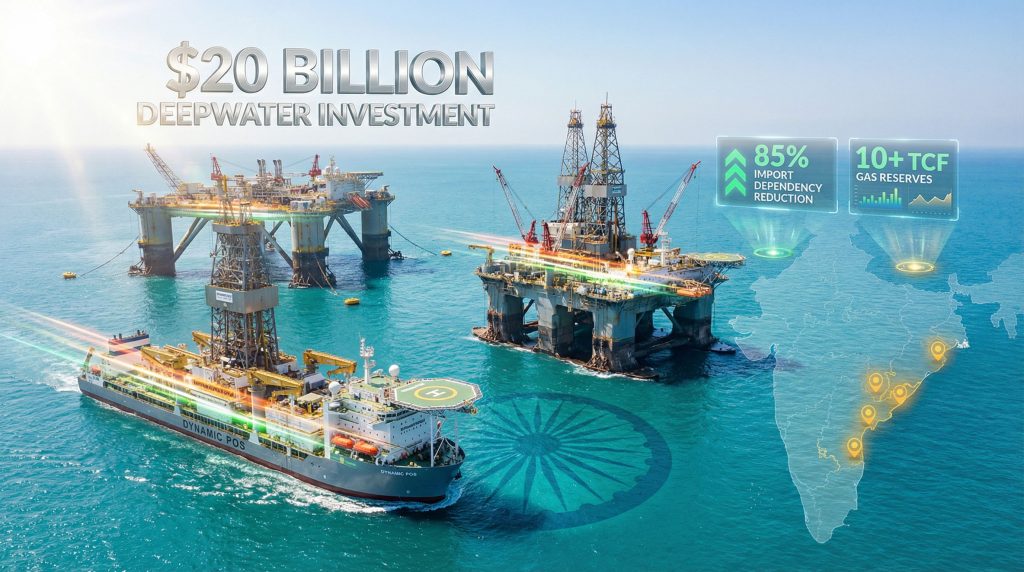
India's approach to deepwater exploration represents a fundamental departure from traditional exploration strategies, with the ONGC $20 billion deepwater rig tender signaling the most aggressive offshore drilling commitment in the nation's energy history. This unprecedented investment framework encompasses multiple operational phases designed to accelerate domestic hydrocarbon production while reducing the country's 85% crude oil import dependency.
The tender specifications reveal a sophisticated operational strategy requiring diverse deepwater drilling capabilities across varying water depths and geological conditions. Furthermore, understanding oil market dynamics becomes crucial when evaluating such massive investments in offshore exploration infrastructure.
The program seeks to deploy a combination of drillships, semi-submersible rigs, and anchor-moored systems across a five-year operational window. The aggressive 80-day mobilisation requirement demonstrates the urgency behind India's energy security objectives.
Key Investment Parameters:
- Total commitment: $18-20 billion over five years
- Rig portfolio: Mixed deepwater drilling platforms
- Operational scope: Multiple basin exploration program
- Mobilisation timeline: 80-day deployment window
- Bidding framework: International competitive procurement
This investment structure distributes operational risks across multiple drilling platforms whilst ensuring technological flexibility to address varying deepwater environments. The diversified approach reduces dependency on single rig types and enables continuous operations despite equipment-specific technical challenges or seasonal weather constraints.
Financial Risk Distribution and Contract Architecture
The tender's financial framework incorporates sophisticated risk mitigation strategies through long-term charter agreements with performance-based extension provisions. Industry analysis suggests the investment allocation follows established deepwater project cost structures:
| Investment Component | Estimated Value Range | Risk Profile |
|---|---|---|
| Rig Charter Commitments | $12-14 billion | Moderate (contracted rates) |
| Operational Support Services | $3-4 billion | Variable (performance-dependent) |
| Infrastructure Development | $2-3 billion | High (frontier development) |
| Contingency Provisions | $1-2 billion | Risk mitigation buffer |
The extended contract duration provides cost certainty whilst enabling contractors to justify substantial mobilisation investments for Indian operations. This approach contrasts with traditional spot market rig charters, reflecting ONGC's strategic commitment to sustained deepwater exploration rather than opportunistic drilling campaigns.
Performance-based extension mechanisms create incentive structures aligning contractor performance with ONGC's production objectives. Consequently, these provisions enable contract extensions based on operational delivery metrics, encouraging technological innovation and operational efficiency throughout the program duration.
When big ASX news breaks, our subscribers know first
Technological Innovation and Operational Capabilities
The deepwater drilling program incorporates advanced offshore technologies essential for operations in India's challenging monsoon-prone marine environment. The technical specifications reflect international best practices whilst addressing specific operational constraints unique to the Indian Ocean deepwater conditions.
Advanced Drillship Technologies
Ultra-deepwater drillships specified in the tender incorporate dynamic positioning systems enabling precise well placement in water depths exceeding 3,000 metres. These vessels feature sophisticated weather monitoring and prediction systems essential for monsoon season operations, when extreme sea conditions can halt conventional drilling activities.
Critical Drillship Capabilities:
- Dynamic positioning precision: Maintains exact well positioning despite environmental turbulence
- Enhanced weather resistance: Operational continuity during adverse conditions
- Real-time optimisation: Integrated drilling data analytics and automated decision-making
- Advanced well control: Redundant blowout prevention systems with emergency disconnect protocols
The integration of real-time drilling optimisation represents a significant technological advancement enabling continuous performance monitoring and immediate operational adjustments. This capability proves particularly valuable in frontier exploration environments where subsurface conditions remain uncertain and drilling parameters require constant optimisation.
Semi-Submersible Platform Advantages
Semi-submersible drilling platforms provide superior stability in rough sea conditions typical during India's southwest monsoon season (June-September). The tender specifications emphasise dual-derrick configurations enabling parallel drilling operations and enhanced productivity metrics.
Operational Efficiency Features:
- Dual-derrick productivity: Simultaneous well operations reducing project duration
- Weather downtime mitigation: Enhanced stability during adverse conditions
- Cost optimisation: Improved rig utilisation rates across multiple well locations
- Operational flexibility: Rapid repositioning capabilities for multi-well programs
Industry benchmarks indicate dual-derrick configurations can reduce overall project timelines by 25-30% compared to single-derrick operations. This proves particularly valuable in time-sensitive exploration programs where weather windows limit operational periods.
Strategic Technology Partnerships
ONGC's collaboration framework with international energy majors facilitates access to proven deepwater technologies whilst sharing substantial financial and technical risks. These partnerships enable technology transfer mechanisms avoiding independent research and development investments.
International Collaboration Framework:
- ExxonMobil partnership: Advanced deepwater drilling methodologies and reservoir optimisation
- Total Energies integration: Subsea infrastructure and floating production technologies
- BP collaboration: Digital oilfield systems and operational automation
- Petrobras expertise: Pre-salt drilling techniques and deepwater project management
These strategic alliances provide access to specialised expertise accumulated through decades of international deepwater operations, accelerating India's capability development in frontier exploration environments.
Geographic Targeting and Basin Development Strategy
The deepwater drilling program focuses on three strategically selected offshore basins representing different risk profiles and development stages. This diversified geographic approach balances proven production potential with frontier exploration opportunities.
Krishna-Godavari Basin Optimisation
The Krishna-Godavari (KG) Basin represents India's most prolific deepwater gas production region, with estimated reserves exceeding 10 trillion cubic feet across water depths ranging from 400 to 3,000 metres. The basin's proven commercial discoveries and existing infrastructure provide operational advantages reducing technical execution risks.
KG Basin Strategic Advantages:
- Proven reservoir performance: Multiple commercial discoveries demonstrate economic viability
- Infrastructure leverage: Existing flowlines and processing facilities enable rapid development
- Technical precedent: Established drilling templates reduce subsurface uncertainty
- Regulatory familiarity: Known environmental and permitting frameworks
The basin's mature development status enables ONGC to deploy proven drilling techniques whilst testing advanced technologies in familiar geological conditions. This approach provides operational confidence supporting more aggressive exploration in frontier regions.
Andaman Ultra-Deepwater Frontier
ONGC has commenced ultra-deepwater drilling operations in the Andamans, representing high-risk, high-reward frontier exploration in water depths potentially exceeding 3,000 metres. This region offers significant exploration upside balanced against substantial technical and commercial uncertainties.
Frontier Exploration Characteristics:
- Limited geological data: Requires advanced seismic interpretation and drilling engineering
- Ultra-deepwater complexity: Premium drilling technology and specialised expertise
- Regulatory framework: Evolving environmental compliance in sensitive marine ecosystems
- Strategic location: Regional energy security through diversified production geography
The Andaman program demonstrates ONGC's willingness to pursue frontier exploration despite elevated risk profiles, reflecting confidence in advanced drilling technologies and international partnership support.
Mumbai Offshore Integration
Mumbai's offshore basin offers mature field extension opportunities leveraging existing infrastructure and proven reservoir characteristics. The region's established production facilities enable rapid monetisation of new discoveries whilst providing operational support for deepwater drilling activities.
Infrastructure Integration Benefits:
- Existing facilities: Processing and transportation infrastructure reduces development capital
- Operational support: Established supply chains and crew rotation logistics
- Regulatory efficiency: Proven environmental compliance and permitting processes
- Enhanced recovery: Secondary recovery opportunities in producing fields
Market Dynamics and Industry Transformation
The ONGC $20 billion deepwater rig tender reflects broader structural changes in global offshore drilling markets, where national oil companies increasingly pursue aggressive domestic exploration strategies to enhance energy security and reduce import dependencies. Understanding oil price rally factors helps contextualise the timing of such substantial investments.
Global Rig Market Implications
The tender's scale and duration create significant market demand for premium deepwater drilling assets, potentially influencing global rig charter rates and contractor capacity allocation. The 80-day mobilisation requirement demonstrates ONGC's willingness to pay premium rates for immediate rig availability.
Market Impact Factors:
- Capacity constraints: Limited premium deepwater rig availability in global markets
- Charter rate pressure: Extended contracts command premium pricing
- Technology requirements: Advanced capability specifications limit contractor pool
- Geographic factors: Monsoon season operations require specialised equipment
Current deepwater rig charter markets reflect tight capacity conditions with premium drillships commanding daily rates exceeding $400,000 during peak demand periods. ONGC's long-term commitment provides contractors with revenue certainty justifying substantial mobilisation investments.
Competitive Landscape Evolution
International drilling contractors participating in the tender represent leading offshore service providers with extensive deepwater experience. Vantage Drilling's ultra-deepwater drillship capabilities exemplify the advanced technology requirements for such operations. The competitive bidding process ensures access to proven technologies whilst driving operational efficiency through market mechanisms.
Contractor Selection Criteria:
- Technical capability: Ultra-deepwater drilling experience and advanced equipment
- Operational track record: Proven performance in challenging marine environments
- Financial stability: Capacity to support multi-billion dollar contract commitments
- Local integration: Indian market knowledge and supply chain relationships
The international competitive framework encourages technology transfer and local capability development whilst ensuring operational excellence through proven service providers.
Environmental Compliance and Regulatory Framework
The deepwater drilling program operates within India's comprehensive environmental regulatory framework requiring extensive impact assessments and mitigation strategies across all operational phases. In addition, considerations around US oil production trends influence global environmental standards for offshore operations.
Environmental Protection Protocols
Modern deepwater drilling operations incorporate zero-discharge policies and advanced environmental monitoring systems addressing marine ecosystem protection concerns. The regulatory framework mandates continuous environmental compliance monitoring throughout drilling operations.
Environmental Safeguard Measures:
- Zero-discharge drilling: Closed-loop mud systems preventing marine contamination
- Ecosystem monitoring: Continuous marine life impact assessment and mitigation
- Emergency response: Advanced spill response and containment capabilities
- Regulatory compliance: Ministry of Environment clearances and ongoing monitoring
Advanced blowout prevention systems incorporate redundant safety mechanisms and automated emergency response protocols exceeding international offshore safety standards. These systems prove essential in ultra-deepwater environments where emergency response complexity increases significantly.
Regulatory Compliance Strategy
The program's regulatory framework encompasses multiple agencies and compliance requirements spanning environmental protection, maritime safety, and hydrocarbon exploration regulations.
Compliance Requirements:
- Environmental clearances: Ministry of Environment impact assessments and approvals
- Maritime safety: International maritime organisation standards and protocols
- Coastal zone compliance: Regulatory requirements for onshore support facilities
- Indigenous consultation: Community engagement and benefit-sharing frameworks
Proactive regulatory engagement ensures operational continuity whilst maintaining environmental stewardship standards essential for long-term offshore operations licence retention.
Implementation Timeline and Operational Milestones
The deepwater drilling program follows a structured implementation timeline designed to maximise operational efficiency whilst ensuring systematic capability development across target basins. However, market volatility hedging strategies become essential when managing such long-term investment commitments.
Mobilisation and Deployment Strategy
The 80-day mobilisation requirement reflects ONGC's strategic urgency to capitalise on current market conditions and accelerate domestic production growth. This aggressive timeline necessitates advance contractor preparation and supply chain optimisation.
| Implementation Phase | Timeline | Critical Milestones |
|---|---|---|
| Contractor Selection | Q2 2026 | Final bid evaluation and award |
| Rig Mobilisation | Q3 2026 | 80-day deployment window |
| Initial Operations | Q4 2026 | First well spudding and testing |
| Full Program Deployment | 2027-2031 | Peak drilling across all basins |
| Performance Extension | 2032+ | Contract extensions based on results |
The phased implementation enables systematic risk management whilst ensuring continuous operational momentum across multiple drilling programs.
Operational Excellence Metrics
Performance measurement frameworks incorporate operational efficiency, safety compliance, and environmental stewardship metrics determining contract extension eligibility.
Key Performance Indicators:
- Drilling efficiency: Well completion timelines and cost per metre drilled
- Safety performance: Lost time incident rates and environmental compliance
- Technical success: Discovery rates and commercial viability assessments
- Operational uptime: Weather downtime minimisation and equipment reliability
These metrics create accountability frameworks ensuring contractor performance aligns with ONGC's strategic objectives whilst incentivising continuous operational improvement.
The next major ASX story will hit our subscribers first
Financial Risk Assessment and Investment Protection
The deepwater drilling program incorporates comprehensive risk assessment frameworks addressing technical, operational, and market uncertainties inherent in frontier exploration activities. Furthermore, the natural gas outlook influences overall hydrocarbon investment strategies.
Technical Risk Mitigation
Deepwater drilling operations face substantial technical risks requiring sophisticated mitigation strategies and contingency planning across multiple operational scenarios.
Primary Risk Factors:
- Subsurface uncertainty: Unknown geological conditions and drilling hazards
- Weather dependencies: Monsoon season operational limitations and delays
- Equipment reliability: Complex deepwater systems and maintenance requirements
- Regulatory changes: Evolving environmental and safety compliance requirements
The diversified rig portfolio distributes technical risks across multiple platforms whilst providing operational flexibility addressing equipment-specific challenges or environmental constraints.
Market Risk Management
Long-term contract structures provide cost certainty whilst protecting against market volatility affecting rig charter rates and operational costs.
Financial Protection Mechanisms:
- Fixed charter rates: Protection against rig market inflation over contract duration
- Performance guarantees: Contractor accountability for operational delivery standards
- Currency hedging: Mitigation of exchange rate volatility on dollar-denominated contracts
- Insurance coverage: Comprehensive operational and environmental liability protection
These financial safeguards ensure program continuity despite market uncertainties whilst protecting ONGC's substantial investment commitment.
Strategic Implications for India's Energy Independence
The ONGC $20 billion deepwater rig tender represents a transformative investment in India's energy security infrastructure, potentially reducing the nation's 85% crude oil import dependency through enhanced domestic production capabilities.
Production Growth Projections
Successful implementation could significantly increase India's domestic hydrocarbon production, contributing to energy independence goals whilst generating substantial government revenues through increased domestic output.
Projected Strategic Outcomes:
- Import dependency reduction: Potential 15-20% decrease in crude oil imports within a decade
- Revenue generation: Increased government income from domestic hydrocarbon production
- Energy security enhancement: Reduced vulnerability to global supply chain disruptions
- Regional influence: Strengthened position in Asian energy markets and policy discussions
The program's success could establish India among leading offshore producers whilst creating replicable frameworks for other emerging market deepwater exploration initiatives.
Long-term Industry Transformation
Beyond immediate production benefits, the deepwater program catalyses broader industry transformation through technology transfer, workforce development, and supply chain enhancement.
Industry Development Benefits:
- Technology advancement: Access to cutting-edge deepwater drilling technologies
- Workforce development: Skilled labour creation for offshore operations
- Supply chain enhancement: Domestic capacity building for offshore support services
- Infrastructure development: Improved offshore logistics and support capabilities
This comprehensive approach ensures sustainable capability development extending beyond the immediate drilling program duration.
The deepwater drilling initiative positions India at the forefront of global offshore exploration whilst demonstrating the strategic value of aggressive domestic resource development in an increasingly uncertain global energy environment. Success in this program could establish new benchmarks for emerging market deepwater exploration efficiency and environmental stewardship.
Disclaimer: This analysis involves forecasts and speculation regarding future energy market developments, offshore drilling operations, and regulatory changes. Actual results may vary significantly from projections discussed. Investment decisions should consider comprehensive risk assessments and professional financial advice.
Want to Capitalise on Energy Sector Opportunities?
Discovery Alert's proprietary Discovery IQ model delivers real-time alerts on significant ASX mineral and energy discoveries, empowering subscribers to identify actionable opportunities ahead of the broader market. Begin your 14-day free trial today and secure your market-leading advantage in the dynamic resources sector.