June 20, 2026
Strategic Capital Architecture in Critical Minerals Financing
The global race to secure non-Chinese rare earth supply chains has fundamentally transformed how Western governments approach mining project financing. Traditional commercial lending models prove inadequate when evaluating projects that serve strategic national interests beyond pure financial returns. This paradigm shift creates unprecedented opportunities for sophisticated investors who understand the intersection of geopolitical risk, industrial policy, and resource economics.
Critical minerals financing now operates under entirely different risk-return calculations than conventional mining ventures. When multiple sovereign governments coordinate export credit facilities for a single project, they signal that supply chain security carries premium valuations that transcend typical project economics. Understanding these dynamics becomes essential for investors navigating the emerging critical minerals pivot.
Australia's Strategic Position in Global Supply Chain Diversification
Australia currently produces approximately 14,000 tonnes per annum (tpa) of rare earth oxide equivalent, representing roughly 10% of global production as of 2024. This output primarily originates from Lynas Rare Earths' Mount Weld operations in Western Australia, demonstrating proven commercial viability for integrated Western rare earth operations outside Chinese control.
The strategic imperative driving Australia's critical minerals focus stems from stark supply concentration risks. China maintains control over approximately 60-70% of global rare earth processing capacity and roughly 80% of critical rare earth element separation capacity, despite declining primary mine production. This processing dominance creates systemic vulnerabilities for Western manufacturers, particularly in renewable energy and defense applications.
Australia's federal government has designated critical minerals as a "national priority" through its 2023 Critical Minerals Strategy, emphasizing supply chain resilience and strategic partnerships with allied nations including Japan, South Korea, the United States, Germany, and European Union members. Furthermore, the Trump administration's executive order on critical minerals reinforces this strategic alignment. This policy framework provides the foundation for official financing support extending far beyond commercial lending parameters.
The International Energy Agency projects demand for rare earth elements will increase by 3-7x by 2040 under accelerated clean energy transition scenarios, with the highest growth concentrated in neodymium-praseodymium (NdPr) for permanent magnets in wind turbines and electric vehicle motors. This demand trajectory justifies treating advanced-stage Western rare earth projects as strategic infrastructure rather than purely commercial ventures.
Multi-Sovereign Financing Architecture Analysis
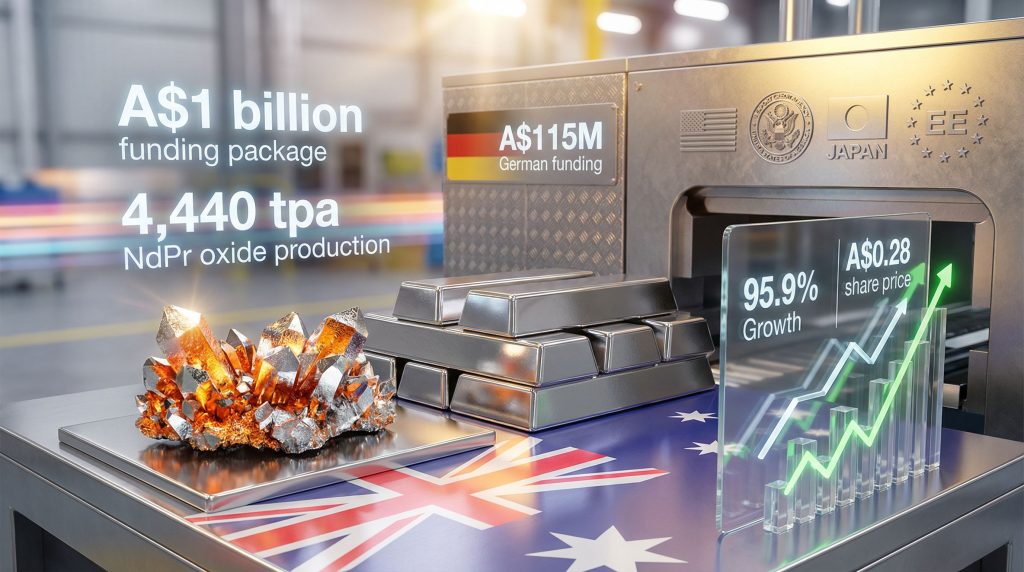
The Arafura Rare Earths capital raise represents an unprecedented coordination of international export credit agencies backing a single critical minerals project. The financing architecture combines commitments from four separate sovereign institutions: U.S. Export-Import Bank (up to A$300M), Export Development Canada (up to A$300M), Northern Australia Infrastructure Facility (~A$150-200M), and German export credit via Euler Hermes (A$115M).
This multi-sovereign structure serves multiple strategic functions beyond capital provision. Each participating government effectively validates the project's strategic importance within their respective national security frameworks. In addition, the diversified sovereign backing creates natural diplomatic incentives for project success, as failure would reflect poorly on coordinated Western critical minerals policy. The recent US EXIM strategic loan to Perpetua Resources demonstrates similar patterns in critical mineral financing.
| Funding Source | Commitment Amount | Strategic Rationale | Approval Status |
|---|---|---|---|
| U.S. EXIM Bank | Up to A$300M | Supply chain security for U.S. manufacturers | Confirmed |
| Export Development Canada | Up to A$300M | North American critical minerals partnership | Confirmed |
| Northern Australia Infrastructure Facility | ~A$150-200M | Domestic strategic asset development | Confirmed |
| German Export Credit (Euler Hermes) | A$115M | EU supply diversification compliance | Pending |
| Total Sovereign Backing | >A$865M | Multi-allied strategic coordination | 87% Complete |
The risk mitigation benefits of this diversified sovereign backing extend beyond traditional project finance metrics. Lenders typically reduce interest rates by 25-50 basis points when projects carry explicit government backing from multiple allied nations, reflecting reduced political and regulatory risk profiles.
When big ASX news breaks, our subscribers know first
Shareholder Approval Results and Risk Profile Transformation
The Arafura Rare Earths capital raise achieved exceptional shareholder approval margins across all four resolutions at the December 2025 Extraordinary General Meeting, signaling unprecedented investor confidence in the project's strategic positioning and execution probability.
EGM Results Analysis and Market Sentiment Indicators
| Resolution Type | Approval Rate | Strategic Significance |
|---|---|---|
| SPP Authorization (Resolution 3) | 95.9% | Retail investor confidence validation |
| Director SPP Participation (Resolution 4) | 94.0% | Management-shareholder alignment confirmation |
| Tranche 2 Institutional Placement (Resolution 2) | 87.9% | Institutional backing verification |
| Tranche 1 Ratification (Resolution 1) | 87.4% | Regulatory compliance baseline |
These approval margins significantly exceed typical mining sector benchmarks, where major capital raises generally achieve 75-85% approval rates across equity placement resolutions. The 95.9% approval rate for the Share Purchase Plan particularly indicates exceptional retail investor confidence, as retail shareholders typically vote more conservatively on dilutive equity issuances.
The strong institutional approval rates (87.4%-87.9%) for the Tranche resolutions demonstrate that sophisticated investors are calibrating risk-return expectations favorably against the project's debt financing terms and execution probabilities. However, understanding various ASX capital raising methods remains crucial for investors evaluating these structures. Hancock Prospecting's A$125 million commitment provides substantial voting block support while representing approximately 15-18% ownership stake based on industry disclosure patterns.
Investment Confidence Metrics and Risk Premium Implications
Shareholder approval completion eliminates "equity raise failure" as a residual risk factor in lender risk models. This materially improves debt financing terms because lenders no longer must model contingency scenarios around failed shareholder votes triggering covenant defaults or capital restructuring requirements.
The Share Purchase Plan oversubscription potential at A$0.28 per share pricing will provide additional market validation signals. This pricing implies approximately 5-10% discount to volume-weighted average price depending on measurement periods, suggesting management confidence in fair value positioning relative to near-term catalysts.
Director participation approval through Resolution 4's 94% margin legitimizes insider participation while reducing future governance disputes over related-party transactions in secondary share offerings. This governance clarity proves particularly valuable for projects requiring multiple construction-phase funding tranches.
German Funding Gap Analysis and Timeline Implications
The remaining A$115 million German government funding commitment represents the final external component required for Final Investment Decision (FID) progression. This commitment operates through German export credit channels via Euler Hermes and UFK (Unified Export Credit Consortium), Germany's principal mechanisms for tied-aid financing supporting German industrial offtakers.
German Export Credit Framework and Approval Timeline
The A$115 million commitment (approximately EUR 73-75 million at December 2025 exchange rates) connects directly to German industrial offtaker relationships, particularly Siemens Gamesa's wind turbine permanent magnet requirements. Wind turbine permanent magnets require 1.2-1.5 kg of rare earth elements per megawatt rated capacity, creating substantial demand from Germany's renewable energy industrial base.
Siemens Gamesa's offshore wind turbines in the 15+ MW capacity class require approximately 600-800 kg of neodymium-praseodymium (NdPr) permanent magnet material per unit. At Arafura's projected 4,440 tpa NdPr oxide capacity, this represents theoretical supply for 5,500-7,400 wind turbines annually, capturing significant portions of European offshore wind deployment pipelines.
Based on historical precedent for large renewable energy infrastructure financing through German export credit agencies, typical approval timelines include:
- Initial assessment phase: 4-8 weeks (technical due diligence, offtaker credit assessment)
- Policy approval phase: 6-10 weeks (interagency coordination, budget allocation verification)
- Formal commitment phase: 2-4 weeks (documentation finalization, board approval)
- Total expected timeline: 12-22 weeks from formal application to binding commitment
EU Critical Minerals Regulation Alignment
Germany's participation aligns directly with the European Union's Critical Minerals Act (Regulation EU 2023/1542), adopted in May 2023 and effective through 2024-2025. This regulation mandates EU member states to diversify supply sources and reduce import concentration risk, with rare earth elements specifically identified as critical materials requiring strategic intervention.
The German Federal Ministry for Economic Affairs and Climate Protection has emphasised "securing critical raw materials for the energy transition" as a strategic priority following 2023-2024 supply chain disruptions. Financing a non-Chinese rare earth source directly fulfils these policy objectives while positioning Germany as a supply chain security leader within the EU bloc.
Alternative funding scenarios if German approval fails would likely require commercial debt replacement at 150-250 basis points higher cost for the A$115M tranche, while potentially delaying Final Investment Decision by 6-12 months for alternative structuring processes.
Comparative Analysis of Global Rare Earth Project Financing
The Arafura Rare Earths capital raise structure establishes new benchmarks for sovereign-backed critical minerals financing, representing unprecedented coordination among Western allied governments in supporting strategic resource development outside Chinese control.
Sovereign-Backed Financing Model Comparisons
| Project | Primary ECA Participants | Total Sovereign Commitment | Project Status |
|---|---|---|---|
| Arafura (Nolans) | U.S. EXIM, EDC, NAIF, Euler Hermes | >A$1B total package | Advanced permitting, FID pending |
| MP Materials (Mountain Pass) | U.S. EXIM (USD $120M confirmed) | USD $160-200M estimated | Operational expansion phase |
| Lynas (Kuantan II) | Malaysia EXIM, Japanese JBIC | USD $100-150M estimated | Construction phase |
MP Materials successfully secured USD $120 million from U.S. Export-Import Bank for separation facility development at Mountain Pass, demonstrating U.S. government commitment to domestic rare earth processing capabilities. However, MP's financing remains single-sovereign focused, lacking the multi-allied coordination characterising Arafura's approach.
Lynas Rare Earths operates the world's largest rare earth separation facility outside China through its Kuantan, Malaysia operations, with ~11,000 tpa rare earth oxide equivalent capacity annually. Lynas demonstrates commercial viability of Western-controlled integrated rare earth supply chains, though processing occurs in Southeast Asia rather than fully Western jurisdictions.
Capital Efficiency and Project Economics Benchmarking
| Financial Metric | Nolans Project | Industry Benchmark Range |
|---|---|---|
| Capital per tonne annual capacity | ~A$225,000/tpa NdPr | A$200,000-300,000/tpa |
| Projected debt-to-equity ratio | ~60:40 | 50:50 to 70:30 typical |
| Secured offtake coverage | 66% contracted | 40-80% typical range |
| Projected mine life | 38 years | 20-40 years standard |
The A$225,000 per tonne annual capacity metric positions Nolans within industry benchmarks while reflecting higher-cost integrated processing capabilities. This capital intensity proves justified when evaluated against strategic premium valuations for secure Western supply chains.
ThyssenKrupp's German green steel initiative received comparable multi-institutional European financing through KfW development bank participation in 2023-2024, establishing precedent for German government co-financing of industrial decarbonisation projects with 15+ year tenors at below-market rates. This precedent suggests moderate-to-high probability for Arafura's German funding approval.
Strategic Investment Implications and Market Positioning
The Arafura Rare Earths capital raise completion transforms the investment thesis from speculative resource development to strategic infrastructure with explicit government backing from four allied nations. This fundamental shift creates unique investment dynamics that transcend traditional mining sector metrics.
Supply Chain Security Premium Valuation Framework
Critical minerals projects now command valuation premiums reflecting strategic value beyond traditional net present value calculations. When multiple Western governments coordinate financing support, they effectively signal that supply chain security carries premium valuations justifying higher capital costs and extended payback periods.
Geopolitical risk mitigation for Western manufacturers creates tangible value that traditional mining project economics fail to capture. Original Equipment Manufacturers (OEMs) in wind energy, electric vehicles, and defence applications increasingly prioritise supply chain security over marginal cost advantages, particularly following 2020-2024 supply chain disruptions.
The 66% secured offtake coverage through long-term contracts provides revenue stability while maintaining 34% exposure to spot market pricing for potential upside participation during supply shortages. This balanced approach optimises both downside protection and upside participation for equity investors.
Construction Timeline and Market Timing Analysis
The projected Q1 2026 Final Investment Decision target positions Nolans for production commencement by 2028-2029, coinciding with projected peak demand growth for permanent magnet rare earths in renewable energy applications. Consequently, global wind energy deployment of 400+ GW annually by 2030 could require 500,000+ tonnes rare earth oxide equivalent, creating substantial demand absorption capacity.
Construction cost inflation risks in the current environment require careful monitoring, though sovereign backing provides natural hedges against cost overruns through potential additional government support mechanisms. The multi-sovereign structure creates diplomatic incentives for project success that extend beyond commercial lending parameters.
Operational readiness factors including workforce availability and technical expertise will prove critical during construction acceleration phases. For instance, the Northern Territory location provides access to Australia's established mining services sector while maintaining proximity to Asian processing and logistics infrastructure.
Risk Assessment and Project Execution Dependencies
Despite exceptional shareholder approval margins and unprecedented sovereign backing, the Arafura Rare Earths capital raise faces residual risks that sophisticated investors must carefully evaluate before Final Investment Decision completion.
Technical and Financial Dependencies Analysis
German funding approval probability represents the primary near-term execution risk. While EU Critical Minerals Act compliance and German industrial policy alignment support approval likelihood, bureaucratic delays or policy changes could extend timeline by 6-12 months beyond current Q1 2026 FID targets.
Alternative financing scenarios if German commitment fails would require commercial debt substitution at estimated 150-250 basis points higher costs, representing A$2-4 million additional annual interest expense over typical 10-15 year debt tenors. However, this cost increase remains manageable within project economics but would reduce equity returns correspondingly.
Construction cost inflation poses systematic risks across the mining sector, with recent projects experiencing 15-25% cost escalations from original estimates. However, sovereign backing creates natural cost overrun mitigation through potential additional government support mechanisms not available to purely commercial projects.
Market Demand Risk Factors and Scenario Analysis
Electric vehicle adoption rate sensitivity creates demand variability for NdPr permanent magnets, though multiple demand sectors (wind energy, industrial motors, defence applications) provide diversification benefits. EV market penetration delays could reduce demand growth rates by 10-20% versus baseline projections.
Wind energy deployment pace directly impacts permanent magnet demand, with offshore wind showing particularly strong NdPr intensity requirements. European offshore wind targets of 300+ GW by 2050 support long-term demand fundamentals regardless of near-term deployment variations.
Supply response from competing projects requires ongoing monitoring, though few Western rare earth projects approach Nolans' development stage with comparable sovereign backing. Chinese supply additions could pressure pricing, though strategic premiums for Western supply chains provide natural pricing floors.
Operational Readiness and Execution Capabilities
Workforce availability challenges in Australia's Northern Territory require proactive planning, though established mining services infrastructure provides foundational capabilities. The region's experience with large-scale resource projects (Ichthys LNG, various iron ore operations) demonstrates available technical expertise.
Regulatory compliance maintenance across multiple jurisdictions (Australian federal, Northern Territory, plus international export compliance) creates ongoing administrative requirements. However, early-stage regulatory approvals completion reduces residual permitting risks significantly.
Technical separation facility performance represents the most critical operational risk factor. While rare earth separation technologies are well-established, individual plant optimisation and ramp-up periods typically require 12-18 months for full nameplate capacity achievement.
The next major ASX story will hit our subscribers first
Investment Strategy Considerations for Market Participants
The Arafura Rare Earths capital raise completion creates distinct investment opportunities across different investor categories, each requiring tailored strategy approaches based on risk tolerance, time horizon, and strategic objectives.
Institutional Investment Thesis and Portfolio Positioning
Hancock Prospecting's A$125 million commitment provides strategic validation from one of Australia's most successful mining investment entities. This participation signals confidence in both project fundamentals and government support sustainability across political cycles. Furthermore, Hancock's mining industry expertise and capital market relationships provide additional project development support beyond pure financial backing.
Sovereign wealth fund and pension fund allocation trends increasingly emphasise critical minerals exposure as essential infrastructure investments. The multi-sovereign backing structure aligns with institutional mandates for strategic asset exposure while providing government partnership benefits that pure commercial projects cannot offer.
ESG compliance advantages for Western rare earth production create additional institutional investment appeal. Environmental and social governance requirements increasingly favour Western-controlled supply chains over Chinese alternatives, particularly for European and North American institutional mandates.
Portfolio positioning considerations include:
- Strategic asset allocation (2-5% portfolio weighting for specialised critical minerals exposure)
- Geographic diversification (Australian jurisdiction with international offtaker relationships)
- Supply chain integration (upstream exposure complementing downstream renewable energy investments)
- Inflation hedging (commodity price exposure with strategic premium components)
Retail Investor Participation Strategy
The Share Purchase Plan (SPP) oversubscription potential at A$0.28 per share creates tactical entry opportunities for retail investors, though allocation methodology may limit individual participation in high-demand scenarios. Historical SPP oversubscriptions typically result in scale-back allocations of 20-50% of applied amounts.
Share price performance expectations post-funding completion typically show 10-20% volatility ranges around key milestones (German funding approval, FID announcement, construction commencement). Patient capital deployment across multiple entry points may optimise cost basis versus timing single purchases.
Dividend policy implications during construction phases typically involve minimal or zero distributions until cash flow generation commences. Retail investors should model 3-4 year investment horizons before potential dividend initiation, focusing on capital appreciation during development phases.
Retail strategy considerations include:
- Dollar-cost averaging through construction phase volatility
- Risk management through position sizing (maximum 3-5% of total portfolio)
- Timeline expectations (4-6 years from investment to potential steady-state returns)
- Exit strategy planning (hold through production ramp-up versus earlier tactical realisation)
Risk-Adjusted Return Optimisation
Volatility management requires understanding that critical minerals investments exhibit higher price swings than diversified equity indices, though sovereign backing provides downside protection versus purely commercial projects. Expected annual volatility ranges of 30-50% reflect both commodity price exposure and project development risks.
Correlation benefits with traditional portfolio holdings prove favourable, as critical minerals often move independently of broader equity markets while providing inflation protection and strategic asset exposure. Low correlation coefficients (0.2-0.4) with major equity indices support portfolio diversification objectives.
Options strategies for sophisticated investors might include covered call writing during high volatility periods or protective put purchases around key milestones. However, liquidity considerations and bid-ask spreads require careful evaluation before implementing derivative strategies.
Frequently Asked Questions: Arafura Capital Raise Analysis
What makes this financing structure unique in the mining sector?
The combination of four sovereign export credit agencies (U.S. EXIM, Export Development Canada, Northern Australia Infrastructure Facility, and German Euler Hermes) backing a single critical minerals project represents unprecedented international cooperation. This coordination reflects strategic prioritisation of supply chain security over traditional commercial lending metrics, effectively treating the project as allied nations' strategic infrastructure rather than purely commercial mining ventures.
How does the A$0.28 share price compare to fair value estimates?
The placement pricing reflects balanced capital raising efficiency versus existing shareholder dilution management. At approximately 5-10% discount to volume-weighted average price, this pricing suggests management confidence in fair value positioning relative to near-term catalysts including German funding approval and Final Investment Decision progression. The 95.9% shareholder approval rate validates market acceptance of this pricing level.
What happens if German funding doesn't materialise on schedule?
Alternative scenarios include European development banks or additional commercial debt facilities filling the A$115M gap, though potentially at 150-250 basis points higher cost representing A$2-4 million additional annual interest expense. Timeline delays of 6-12 months for alternative structuring remain possible, though multiple funding alternatives exist given the project's strategic importance and sovereign backing from other allied nations.
When will construction actually commence?
Full Notice to Proceed depends on German funding completion, currently targeted for Q1 2026 Final Investment Decision. Construction acceleration could begin within 3-6 months post-FID, with initial production targeted for 2028-2029 timeframe. The 38-year mine life provides substantial operating runway once production stabilises.
How does sovereign backing affect investment risk profile?
Multi-sovereign backing significantly reduces political and regulatory risks while providing natural cost overrun mitigation through potential additional government support mechanisms. However, commodity price exposure, operational execution risks, and market demand variability remain standard mining sector risks. The strategic premium for Western supply chains provides some downside pricing protection versus purely commercial projects.
What are the key performance milestones for monitoring investment progress?
Critical milestones include: German funding approval (Q1 2026 target), Final Investment Decision completion, construction contract awards, first production achievement (2028-2029 target), and nameplate capacity attainment. For instance, quarterly construction progress reports and 4,440 tpa NdPr oxide production ramp-up metrics will provide ongoing performance visibility for equity investors.
Investment Disclaimer: Critical minerals investments carry substantial risks including commodity price volatility, operational challenges, regulatory changes, and market demand fluctuations. Sovereign backing reduces certain risk categories but does not eliminate investment risks. Investors should conduct independent due diligence and consider professional financial advice before making investment decisions. Past performance of mining projects and government-backed investments does not guarantee future results.
Ready to Capitalise on the Next Strategic Mineral Discovery?
Discovery Alert's proprietary Discovery IQ model instantly identifies significant ASX mineral discoveries, transforming complex geological announcements into actionable investment opportunities for both short-term traders and long-term investors. Experience why sophisticated investors rely on Discovery Alert's real-time intelligence to position themselves ahead of the market – begin your 30-day free trial and discover the power of AI-driven mineral discovery alerts.